In the Wind. . . . rebuild, renovate, and restore
The three “R’s” of organ projects
In March of 2004 I attended a two-day symposium celebrating the restoration of the organ built in 1800 by David Tannenberg for the Home Moravian Church in Winston-Salem, North Carolina. The organ had been removed from the church in 1910 to be replaced by a larger modern organ, but as the preservation of archives is a priority of the Moravian Church, the Tannenberg was safely stored until the 1980s when Old Salem Curator Paula Locklair invited the renowned organ historian Barbara Owen to inspect it. Barbara observed that the organ was of enormous musical and historical significance and that it was eminently restorable. This initiated a remarkable process that culminated in that symposium, which included a rededication recital played by Peter Sykes.
On June 14, 1989, the Reverend Dr. Robert Sawyer, pastor of the Home Moravian Church wrote a letter to Old Salem giving permission for the restoration of the organ, and a long-term loan agreement was executed in February 1992, allowing the placement of the organ in the new Horton Center Gallery at Old Salem. The instrument was assembled in the gallery in its unrestored condition in 1998 by the staff of Taylor & Boody, organbuilders in Staunton, Virginia. It was dismantled and moved to the Taylor & Boody workshop for its unique thorough restoration in 1999. The project was carried out with strict attention to the organ’s original state. No changes were made, and expendable materials like felt and leather were replaced with materials as similar as possible to the originals.
Old Salem is a historic site that includes a reconstructed village that depicts eighteenth-century life and arts and crafts, the Museum of Early Southern Decorative Arts, the Old Salem Research Center, the Anne P. and Thomas A. Gray Library and Archives, and the James Gray Auditorium designed specifically for the restored organ with attention to recreating its original acoustic setting in the Home Church. Old Salem’s devotion of so much time and energy and so many resources to this project is testament to the Moravian mission of honoring their past by displaying it to the public.
The symposium included lectures like “The Art and Mystery of Tuning Without Machines in Eighteenth-Century Europe” by Kristian Wegscheider, organ builder from Dresden, Germany, and “Tannenberg’s Tool Chest: The Mystery of the Missing Mandrels” by Laurence Libin, then research curator of the Musical Instrument Collection at the Metropolitan Museum of Art in New York City. Laury Libin and I visited the Gray Archives where an ancient clavichord was on display in a vitrine. There were remnant scraps of the original felt bushings, many missing strings, a few broken keys, but the point of the display was to present the instrument in its original form as if it was a static artifact. We discussed the different attitudes toward preservation, contrasting the now lifeless clavichord with the vibrant and brilliant restored Tannenberg organ. If you restore Marie Antoinette’s boudoir, you might replace fabric or choose to leave it in original condition, but you set up velvet ropes so visitors cannot touch it. When you restore a pipe organ you may choose to replace some of the original material, especially leather and felt that is necessary for the function of the instrument’s mechanicals.
A working restoration
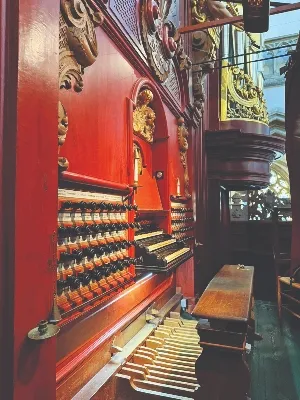
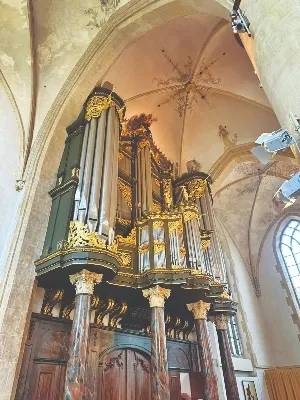
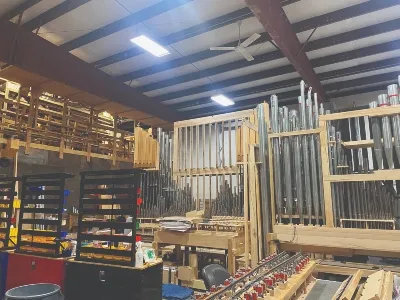
In July of 2025 I spent two days with Erik Winkel, the director of Flentrop Orgelbouw in Zaandam, the Netherlands. First, I visited the workshop where among several other projects, the firm was working on the restoration of the organ built by Arp Schnitger in 1721 for the Grote of Sint-Michaëlskerk in Zwolle, the Netherlands. With sixty-four stops and ninety-four ranks, it is the largest of the monumental eighteenth-century organs across northern Germany and the Netherlands. I saw rollerboards, square rails, and many other miscellaneous parts of the Zwolle organ, just like you would see in examples built in the nineteenth, twentieth, and twenty-first centuries.
A couple days later, Erik took me to Zwolle to visit the organ. The restoration of the Rugwerk (Rückpositiv) was complete and had been dedicated, but the main organ case was largely empty. The windchests were in place with toeboards and sliders removed, covered with plywood walkboards. It was a thrill to climb around inside the main case and see the details of construction. I will have to go back to hear it when the restoration
is complete.
Erik described how Flentrop preserves as much original material as possible with techniques like burnishing wood rather than sanding it to relieve friction between mechanical parts, so they do not lose a few flecks of sawdust. He described the earlier restoration of the Zwolle organ led by Dirk Flentrop between 1953 and 1955, at which time it was decided to replace a particular run of tracker action. Mr. Flentrop retained the parts he had replaced, storing them on top of the little building in the church tower, located above and behind the organ and housing the twelve wedge bellows. Erik proudly told how the current restoration is returning original material to the organ as they elected to reuse the original parts to replace Dirk Flentrop’s replacements. I am grateful to Erik for his generosity, picking me up at my hotel in Haarlem (there’s another fine organ there!) and driving me an hour and a half to Zwolle. He dropped me at the train station, letting me find my way back to the hotel so he could visit his parents who live in Zwolle.
I first learned about the Zwolle organ as a pre-teen listening to the recordings made by E. Power Biggs in the 1960s, especially his performance of Bach’s transcription of Vivaldi’s d-minor concerto from L’estro Armonico in the two-record set, The Golden Age of the Organ. I first learned that piece in 1970 when I was fourteen, murdering the downward parallel thirds in the closing fugue, but I improved it as I performed it regularly throughout my career. That wonderful record included several other Schnitger organs and featured the chorale preludes of Ernst Pepping (1901–1981), which I played throughout my career.
Restoration or renovation
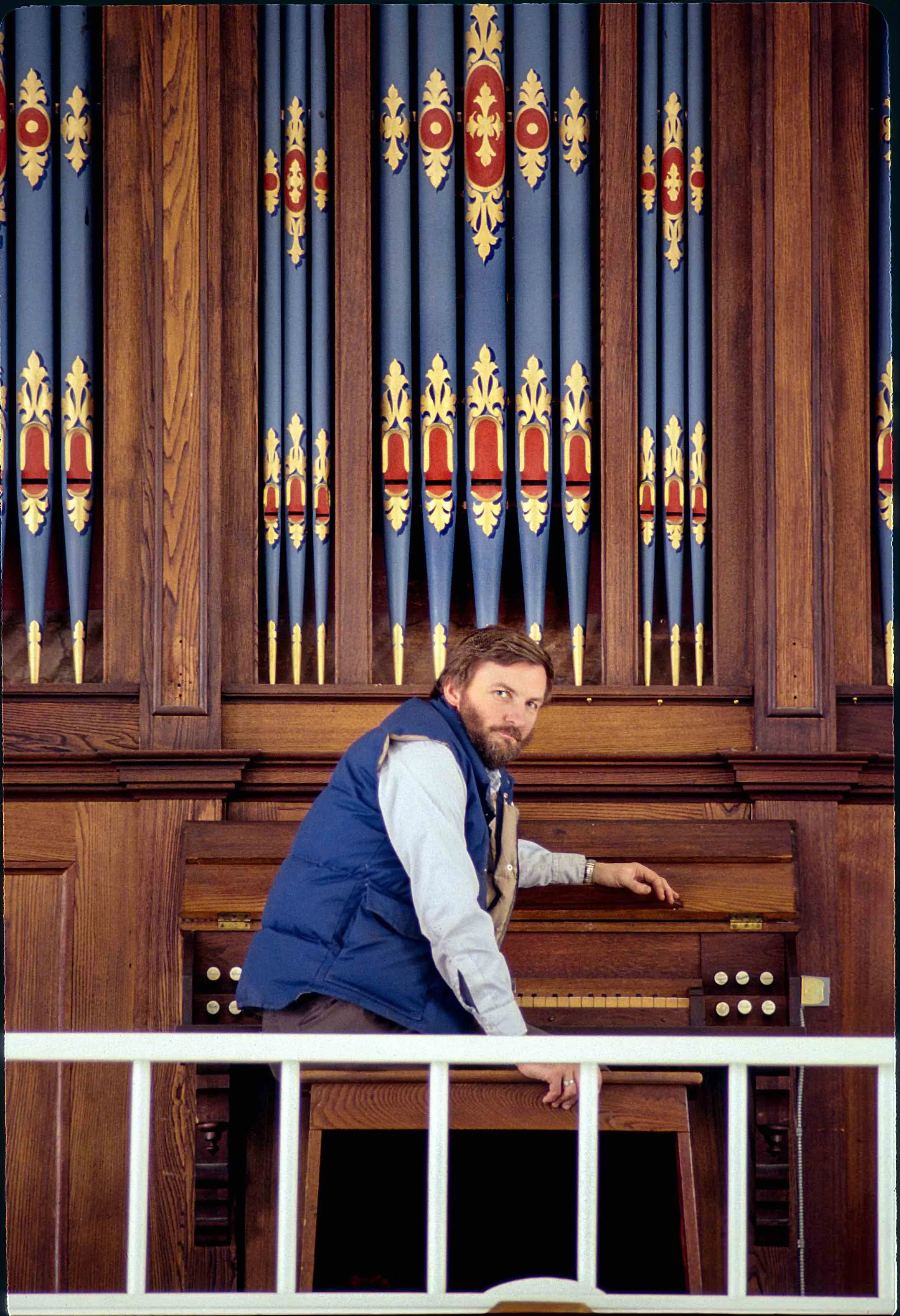
I was exposed to the theory and practice of pipe organ restoration in my earliest days in an organ workshop, working for Bozeman-Gibson & Company during the summer of 1975 when they were carrying out the restoration of an organ built in 1848 by George Stevens for the First Church in Belfast, Maine. You can see photographs and a description of the organ at pipeorgandatabase.org/instruments/8014. Those were my first weeks working as a fledgling organbuilder, and I was fascinated by the instrument’s antiquity. As a newbie, I was not involved in decisions regarding the restoration, but it was fun to pick up what morsels I could process and stow away.
The word restoration implies a particular type of project and is often misused. If a local organ company releathers reservoirs and pouchboards, upgrades a console with a solid-state control system, and perhaps adds a pedal reed, they should not announce the “complete restoration” of the organ. I consider that sort of project to be a renovation. Renovation derives from the Latin verb renovatio, which means to renew. In this context, restoration implies returning an instrument to its original condition, and as I mentioned earlier, a basic decision driving a restoration is whether the restored organ will be playable. I believe that restoring an organ should produce a playable instrument.
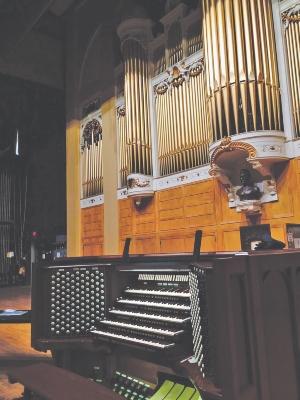
I served on the board of directors of Friends of the Kotzschmar Organ (FOKO) in Portland, Maine, for over twenty years. The organ was a gift to the city from Portland native Cyrus H. K. Curtis, the publishing magnate most famous for The Saturday Evening Post and Ladies’ Home Journal. Curtis’s father had recruited the German organist Hermann Kotzschmar to Portland to serve as organist of First Parish Unitarian Church. Kotzschmar founded and directed an orchestra and choral society and became a beloved public figure. The elder Curtis was so enamored of Hermann that he named his son after him, hence the middle initials H. K.
In 1908 Portland City Hall burned down, the fire ironically caused by a short circuit in a new-fangled electric fire alarm in the city electrician’s office. A new building was designed by Carrère & Hastings, famous for the design of the New York Public Library, and was completed in 1912. The building and the organ were dedicated on August 22, 1912.
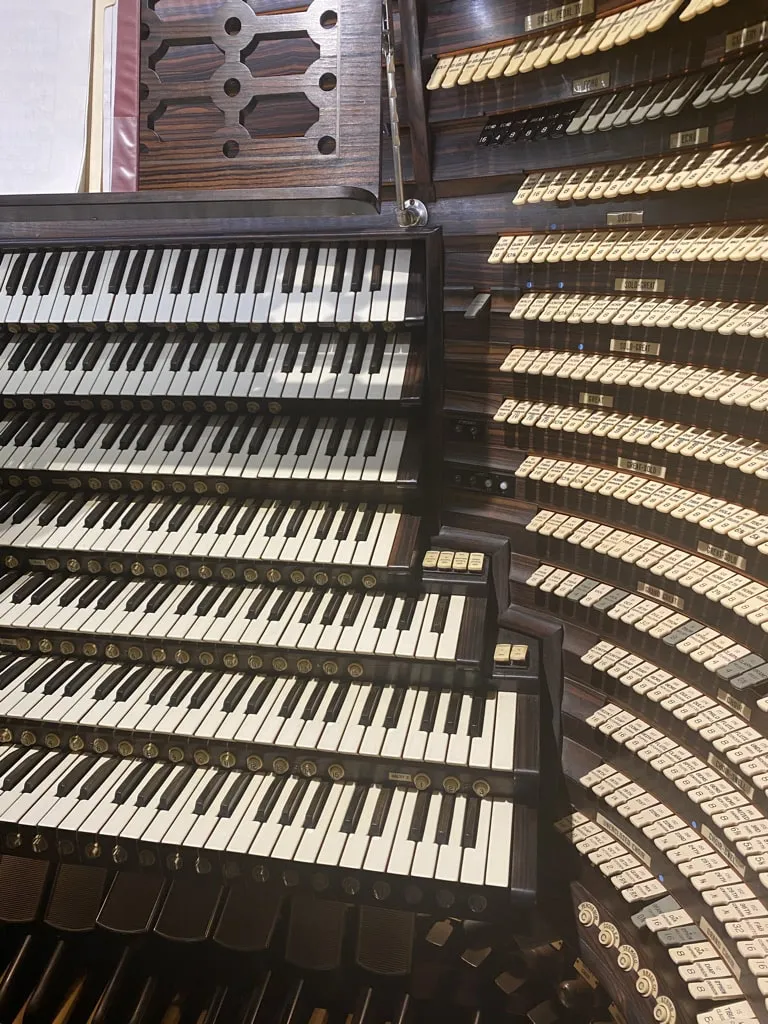
Early in my tenure on the board, we realized that the organ’s condition was deteriorating to the extent that a major rehabilitation project was needed and undertook a renewal project. I was chair of the organ committee responsible for planning the renewal. Members of the board started referring to this as the “restoration” of the organ, but since we were not planning to return the organ to its original condition, the organ committee purposefully named the project the Centennial Renovation. A new five-manual console had been built in 2000, a five-rank Mixture had been added to the Great, and a new 32′ reed had been added to the Pedal. The original 32′ Diaphone had been removed as it was never successful. We planned to add a new 32′ Double Open Wood and 32′ Contra Bombarde and to rework the added Mixture. All of these changes were reasons we could not call the project a restoration. Foley-Baker, Inc., of Tolland, Connecticut, was chosen to perform
the renovation.
On August 22, 2012, exactly one hundred years after the dedication of City Hall and the organ, a centennial concert was played by Municipal Organist Ray Cornils and Peter Conte, Grand Court Organist of the Wanamaker Store (then Macy’s) in Philadelphia. The program included many pieces played at the original dedication, and the concert ended with a thrilling piece of nostalgic theater. Ray and Peter played “Auld Lang Syne” on the organ, with four hands and four feet, while the organ’s interior lights were turned on, and the staff of Foley-Baker came on stage wearing hard hats and carrying step ladders and started to remove the gold façade pipes as the audience sang and wept.
Wait, there’s more.
I promised you three “R’s.” “Refurbish” means “to clean, repair, or improve an item or space to make it look fresh and work well again without changing its core structure.” That word’s apparent origin “furbish” is not commonly used but has a very similar definition, “to polish or shine or renovate something to make it look bright and new again.” The word “furbish” is used most widely by antique firearms enthusiasts. Might a nitpicker claim that you cannot refurbish something unless you have previously furbished it?1
What tasks might you accomplish when refurbishing an organ? I would clean the console, including keyboards, pedalboard (collecting pencils and paper clips). I would polish the cabinet and stopjambs and clean the music rack. Vacuum the interior surfaces like reservoir tops and walkboards and give the instrument a thorough tuning and tonal regulation. You could go a step further by removing the pipes and vacuuming windchest surfaces. That would make the tuning take longer. This might take a week or two for a twenty-stop organ, depending on whether you removed the pipes. I would consider it a step more than a simple service call.
Restore, renovate, and refurbish are not interchangeable terms. They each describe a different project. As you plan work on an organ, think about how you describe your project.
When can we alter an organ?
In my work with the Organ Clearing House, I have frequent conversations about the treatment of historic organs. If a church is considering purchasing a historic organ by E. & G. G. Hook or the Skinner Organ Company, should I advise the buyer not to make any changes? What if a church would purchase a venerable tracker organ, but only if they would add electric stop action and a combination action? Would it be better to guide such a project so it is not invasive to the original organ and could be reversed to return the organ to original condition or have the sale fall through and the organ languish?
Mr. Skinner was a genius at designing four-manual organs with twenty-five to thirty-five ranks. They would typically include four 8′ Diapasons, at least seven various reeds, two or three pairs of “celesting” strings, and a variety of flutes—a marvelous palette of tone colors. I have helped with the sale of several organs like that, and I consider them masterpieces. The Great division might have four stops, 8′ Diapason, 8′ Clarabella, 8′ Gemshorn, and 4′ Octave. What if the buyer wants to add 2′ Super Octave and IV Mixture? Those would be logical, useful additions, completing the chorus and adding brilliance to the organ. That would violate the organ’s historicity and increase its usefulness. What if the sale depends on the buyer’s ability to make those additions? We typically do not get many chances to sell an instrument. The organ is owned by the seller, so I am not authorized to forbid changes. I can, however, recommend how to accomplish such a change without diminishing the integrity of the organ. We can find precedents in other instruments where Mr. Skinner himself included those two stops in the Great division of a comparable organ. The organ was conceived and built as a romantic symphonic organ, so the two new stops should not be powerful and brilliant but should be scaled and voiced to complement the original stops and form a cohesive chorus. They should be placed on a replica windchest, so the action response is the same as the original stops, or better yet, a renovated authentic Skinner windchest.
There are organs that should absolutely be preserved intact without changes, and my experience is that when I get involved with such an instrument, it is easy to know that it deserves that treatment, but I have also learned that in many circumstances, it is better to arrange the sale and relocation of an organ knowing that some thoughtful and discreet changes will be made than to lose an instrument to a developer’s wrecking ball.
§
We learned recently of the death of organbuilder Martin Pasi at the age of seventy-two. Martin was born in Austria and apprenticed with Rieger Orgelbau. After moving to North America, he worked for Jaeckel, Inc., Karl Wilhelm, and Fritts-Richards before establishing his eponymous workshop in Roy, Washington. I visited him in Roy several times and collaborated with him on a project in Chicago. When he closed his workshop, he moved to Collegeville, Minnesota, to help the Benedictine monks of Saint John’s Abbey form Saint John’s Abbey Organbuilders. He was a gentleman of the purest sense with a soft voice and lovely smile who had a vast knowledge of organs and impeccable skills as an organbuilder. His shop produced twenty-nine organs including two monumental cathedral instruments, and his influence is felt throughout the industry. I feel fortunate to have known him and am sorry for his loss.
Notes
1. Wordplay. I once had a lively conversation with a well-known author about English words that sound like they should have an opposite but do not, such as listless, wistful, feckless, hapless, disgruntled, disheveled, nonchalant, disgusting, grateful, nonsensical, and improvisation. They’re known as “unpaired words.”