In the Wind: Travels to the Netherlands, part 3
My week in the Netherlands
In the previous two columns, I wrote about my trip to the Netherlands last summer, including my visits to organs in Groningen, Oosthuizen, and Alkmaar. I wrote that I made the trip alone so I could immerse myself in the rich culture of pipe organ history. I spent the week within a couple hundred kilometers of Amsterdam and saw six organs ranging in age from 514 to 287 years.
Flentrop Orgelbouw
I was twelve or thirteen years old when I first experienced a Flentrop organ (circa 1968), when a mentor took me to hear E. Power Biggs play a recital at the Busch-Reisinger Museum (now Busch Hall) at Harvard University. When Biggs finished the last of the pieces on the printed program, he slipped out from behind the Rugwerk and told the audience that he would love to play another piece, but had run out of Baroque music, so he let us have Charles Ives’s Variations on America. I was amazed. The Flentrop organ there was commissioned by Biggs, completed in 1958, and was the vehicle for the spectacularly successful and influential series of Columbia recordings, E. Power Biggs plays Bach Organ Favorites. How many of us grew up with those beauties? When I first heard the organ, it was only ten years old, and it was a huge sensation.
I arrived at the Oberlin College Conservatory of Music as an incoming freshman in 1974, just in time for the dedication of the marvelous Flentrop organ in Warner Concert Hall, and I labored for four years practicing on smaller Flentrop organs in Oberlin’s Robertson Hall. My mentor John Leek, a first-generation Dutch immigrant, was an old friend of the Flentrop firm, and we helped install the three-manual organ at Trinity Episcopal Cathedral in Cleveland in 1977 and several smaller instruments in Ohio and western Pennsylvania. Over the years I have visited and worked on many Flentrop organs, notably the four-manual instruments at Duke University Chapel, Durham, North Carolina, and Saint Mark’s Episcopal Cathedral in Seattle, which sports a superb 32′ Prestant made of copper.
I’d love to.
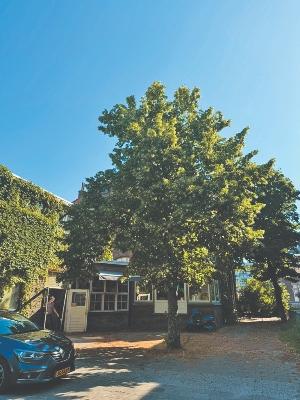
As I planned my trip to the Netherlands, I was thrilled to be invited to spend two days with Flentrop’s managing director, Erik Winkel. Erik started at Flentrop in 1998 and was named deputy director in 2009 and managing director in 2016. On Tuesday, July 1, we would spend the day at the workshops in Zaandam, fifteen kilometers northwest of Amsterdam, and we would drive together to Zwolle on Thursday to visit the empty organ case of the Schnitger organ there, now under restoration by Flentrop. I had been given directions to enter the workshop through the door under the green linden tree—I chuckled, remembering Sweelinck’s variations on Onder een linde groen—and I entered past a large rotary metal planer into the room where pipe metal has been cast for hundreds of distinguished organs.
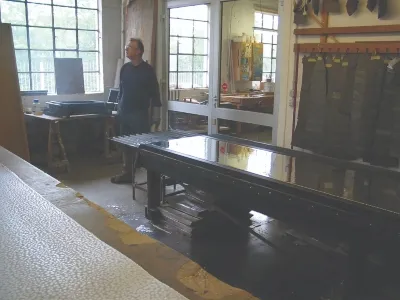
One of the first things I noticed was a small cement mixer that piqued my curiosity until a pipe maker explained that they use it to sift the fine-grained sand on which they cast all their pipe metal. The sand is spread evenly on a hard flat surface, and the molten metal is poured across the sand. That technique was used by Arp Schnitger and his eighteenth-century contemporaries, and at Flentrop they feel it is the best way to emulate that distinctive Dutch sound as they repair and replace pipes for older organs and make pipes for their new instruments.
I have visited many pipe-making workshops, all of which have gas-fired furnaces for melting and mixing tin and lead. At Flentrop, the melting furnace is a wood-burner, the first I had seen. I did not ask if they thought that contributes to an authentic tone. A sturdy array of shelves runs the length of the room, loaded with cast sheets of pipe metal, rolled and carefully labelled according to metal content. A pallet jack is used to lift and move bins of heavy ingots from storage to the melting pot.
Another pipe maker was busy making a replica of the 8′ Viool di Gamba in the Hoofdwerk of the Van Hagerbeer/Schnitger organ in Alkmaar, replacing that in the Onderwerk of the Zwolle organ. There are five pieces of metal in each resonator to achieve the distinctive taper-bulge (two pieces, out and in) taper-flare profile. I heard that unusually colorful stop at Alkmaar, and hope I get to hear the new one at Zwolle. It must be an expensive thing to make.
The space occupied by the pipe shop is a one-story addition to the original Flentrop residence. Having entered at the back of the building, we passed through an employee kitchen into the two-story residence that now houses offices, drafting tables, and photographs of many Flentrop organs. I imagined Dirk Flentrop meeting with Biggsie (and Peggy?) in those rooms, discussing plans for the Busch-Reisinger organ. I suppose Fenner Douglass was there to talk about organs for Oberlin and Duke University? The rooms where all those organs were conceived and designed are as magical as the rooms where they were built.
Witnessing
Erik and I drove across Zaandam to the principal workshop that houses woodworking machines, an erecting space, and large workrooms with windchests and console frames on workbenches and sawhorses. I noticed twenty-foot-long rollerboards standing on end in a corner, restored rollerboards from the Zwolle organ. I felt a nostalgic twitch. Those rollerboards were in that organ clattering away in 1964 when Biggs made his landmark recording The Golden Age of the Organ that I wrote about in the first paragraph of my essay in the September 2025 issue. I had the same strange feeling when visiting the workshop of Harrison & Harrison in Durham, England, and saw the pipes of the 8′ Tuba from King’s College, Cambridge. O come, all ye faithful, as sung by that storied choir, popped into my mind’s ears instantly.
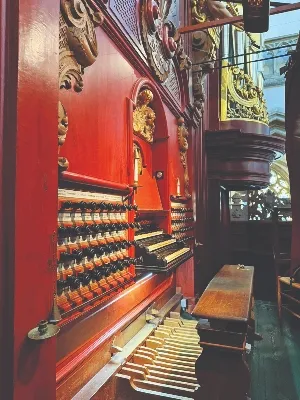
Flentrop completed the restoration of the Rugwerk of the Zwolle organ earlier this year; it was dedicated on March 22, 2025. The top three keyboards are in process in the workshop now. How many people have played on those keys in the 304-year history of that organ? And how about that intricate ebony-ivory marquetry? I loved seeing the handwriting of the Schnitger worker who wrote the note names on the keys sometime around 1720.
Assembly of a two-manual organ for Japan was just beginning in the erecting space. A steel floor frame was in place that would connect the main case with the Rugwerk. That rigid frame will serve at least two functions—to maintain the exact distance between the two organ cases so the adjustment of the tracker action will not fluctuate, and to serve as an immovable base for the organ in case of an earthquake. The keydesk action chassis was in place, which includes the mechanical pedal and manual couplers, and the rollerboard for the Rugwerk was lying flat in its position that will be beneath the pedalboard and bench. The keyboards were in position with temporary legs, comically hanging from the ceiling on a chain hoist and canvas slings, and casework frames were stacked neatly against the wall, ready for deployment.
France to England to Holland
Another project in process is the restoration of the large Cavaillé-Coll organ from Manchester Town Hall, Manchester, England. The organ was built in Paris in 1877, and Cavaillé-Coll added a fourth manual and 32′ Soubasse in 1893. Two manual windchests were on workbenches where Erik and longtime worker Geert Sprong had a lengthy conversation about spacing and connections of the sliders. I have played on several Cavaillé-Coll organs, but this was my first experience seeing major components dismantled, which allowed close-up viewing, a treat for an organbuilder.
Throughout my career, I have reveled in witnessing the marvelous craftsmanship of our ancestor organ builders—it is apparent even in how they sharpened their pencils to get the most accurate markings. It almost seems as though you are standing next to the person who built the thing. We have all heard so much about Cavaillé-Coll’s personal influence on generations of French organists and composers, and those great organs (remember Saint-Sulpice, Widor, and Dupré) sound wonderful in their huge churches, but I was privileged to examine up close the brilliance of the individual factory worker. I wonder if that guy with the sharp pencil ever got to hear any of the organs he helped build?
Erik showed me the massive new replica console they are building for the Manchester organ, and his explanations hinted at the extensive research they had done to prepare for construction. I guess I will need to get to Manchester in a year or two.
Flentrop has a third facility in Zaandam that we did not visit, a large building used mainly for storage, but also as the space where the largest Flentrop organs are assembled during construction. The erecting space I described that is presently occupied by the two-manual organ for Japan is not tall enough for the organs I have mentioned like Oberlin; Duke; Saint Mark’s, Seattle; Trinity Cathedral, Cleveland; Cathedral of the Holy Name, Chicago; and dozens of other instruments across Europe.
Conservation
The amount of care Flentrop takes with the conservation, restoration, and maintenance of Holland’s pipe organ heritage is inspiring. The two ancient organs I described in the October issue in Alkmaar and Oosthuizen each have newer wind systems built by Flentrop. The host/curator at Oosthuizen, Herman van Leuven, told of a retired Flentrop worker who still liked to make service calls on the 1521 organ. Frank van Wijk, my host in the church at Alkmaar, mentioned studies about the corrosion of lead pipes caused by acid. The heating system in the church in Alkmaar was emitting CO2, which forms carbonic acid that was causing significant corrosion of the lead pipes in the 1511 Van Covelens organ. According to Frank, the mayor of Alkmaar was instrumental in organizing the replacement of the heating system in the interest of preserving the organ.
Erik described how Rembrandt (1606–1669) made his white paint by combining lead and oak to produce “lead white” (lead carbonate), corroding lead intentionally to create a toxic brew he applied to canvas. It made wonderfully effective and durable paint that gleams on museum gallery walls, but it is easy to imagine how that must have affected his health, something like the mad-hatter brushing felt hats with mercury.
Many hardwoods, especially white oak, emit acetic acid. White oak was commonly used for toeboards and rackboards in Holland’s ancient organs and its acid emission has contributed to the corrosion of organ pipes over the centuries. Erik showed me a large plank of American elm, which among hardwoods emits one the lowest amounts of acid, and described experimentation with replacing original toeboards with elm to slow corrosion. The Dutch National Heritage Agency (Rijksdienst voor het Cultureel Erfgoed or RCE) has funded research about the corrosion of lead organ pipes, and Erik participates in a task force with a university professor and a specialist from RCE to continue research. It was fun to hear about a federal government participating in the care of its cultural heritage, but I doubt we will soon see the government of the United States taking part in that sort of effort.
§
I am fortunate to have visited dozens of pipe organ workshops in the United States and in Europe. The first two I visited were Noack and Fisk—I do not remember which was first, but like my first moments with the Flentrop at Busch Hall in Cambridge, my early mentors took me to open houses at both shops when I was a young teenager. I have always considered organ shops to be deep expressions of the humanities and marvel that we are still able to build beautiful instruments based on the heritage that I was immersed in during that trip.
I thank Erik Winkel for his generosity, sharing the work and philosophy of that venerable company, for treating me to a fine lunch, and continuing the comeradery that I have always felt with my colleagues and peers. I will tell you about my second day with him next month.
When John Leek and I helped install the Flentrop at Trinity Cathedral in Cleveland, Gerrit Passenier of Flentrop was part of the crew. Gerrit and I had a lot of fun together during those several weeks. Erik told me that Gerrit was a “lifer” at Flentrop and had retired ten years ago. That organ had been shipped from Rotterdam, across the Atlantic, up the Saint Lawrence Seaway, and across Lake Erie to the Port of Cleveland. The name of the ship? Calliope. It’s fun to remember.