In the Wind: Travels to the Netherlands, part 4
My week in the Netherlands, part 4
This will be the last in my series of four essays about my trip to the Netherlands in June of this year. In the September issue I wrote about the conception and beginning of the trip, time spent in Barcelona and Besalú, Spain, with Wendy, taking the train with her to Paris where I went on to Amsterdam alone as I wanted to visit some iconic historic organs at my own speed, and my visit to the Schnitger organ in the Martinikerk in Groningen. In the October issue, I wrote about visits to ancient organs in Oosthuizen (1521) and Alkmaar (1511), and the grand Van Hagarbeer (1646)/Schnitger (1725) organ that shares space in the Grote Kerk of Alkmaar with the 1511 organ. And in the November issue I wrote about a day spent touring the workshops of Flentrop Orgelbouw with Erik Winkel, managing director. I wind up this travelogue with visits to two organs that I believe are the largest and most widely admired of the fleet.
Zwolle
In the beginning of my essay in the September issue, I wrote about hearing E. Power Biggs’s recordings of the great Schnitger organs when I was first taking organ lessons around 1968. I was especially thrilled by the magnificent four-manual Schnitger organ built in 1721 for Sint-Michaëlskerk, the Grote Kerk in Zwolle. With sixty-four stops and ninety-four ranks, it is the largest of the monumental eighteenth-century organs across the north of Holland and Germany, and it is currently under restoration by Flentrop. I saw many parts and components of the organ during my visit to the workshop in the hands and on the workbenches of the artisans there—keyboards, pedalboard, windchests, tracker action parts, and many boxes of pipes. Restoration of the Rugwerk had been completed and dedicated in March 2025, and I was thrilled with the idea of climbing through the organ free of all those pesky pipes that can be in the way.
Erik picked me up at my hotel in Haarlem for the seventy-five-minute drive to Zwolle, east-by-northeast of Amsterdam. We parked in a municipal garage and had a five-minute walk on pedestrian streets to the central square that surrounds the Grote Kerk. The jacket of Biggs’s 1958 recording, Bach at Zwolle, shows a historic map of the center of Zwolle, surrounded by a circular canal, with the church looming in the center. (A modern map shows that the canal is actually a jagged circle.) The church dominates the center of the square, surrounded by open-air café tables, and I had a strange sense of déjà vu, as if listening to that recording and handling the jacket when I was twelve years old implied that I had been there before.
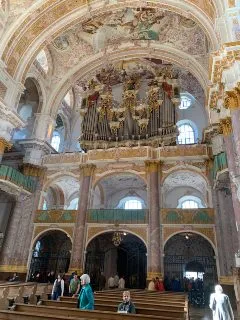
Like the Grote Kerk in Alkmaar, the church in Zwolle is sunny and airy inside. There is a delicate stained-glass pattern in one of the tall Gothic windows, but almost all the leaded panes are clear. There is an ornate dark wood pulpit capped with a heavy lid adorned with minarets and a towering turret. Since the building is no longer used for regular worship, the floor of the nave and transepts is open, magnifying the simple elegance of the vast interior space.
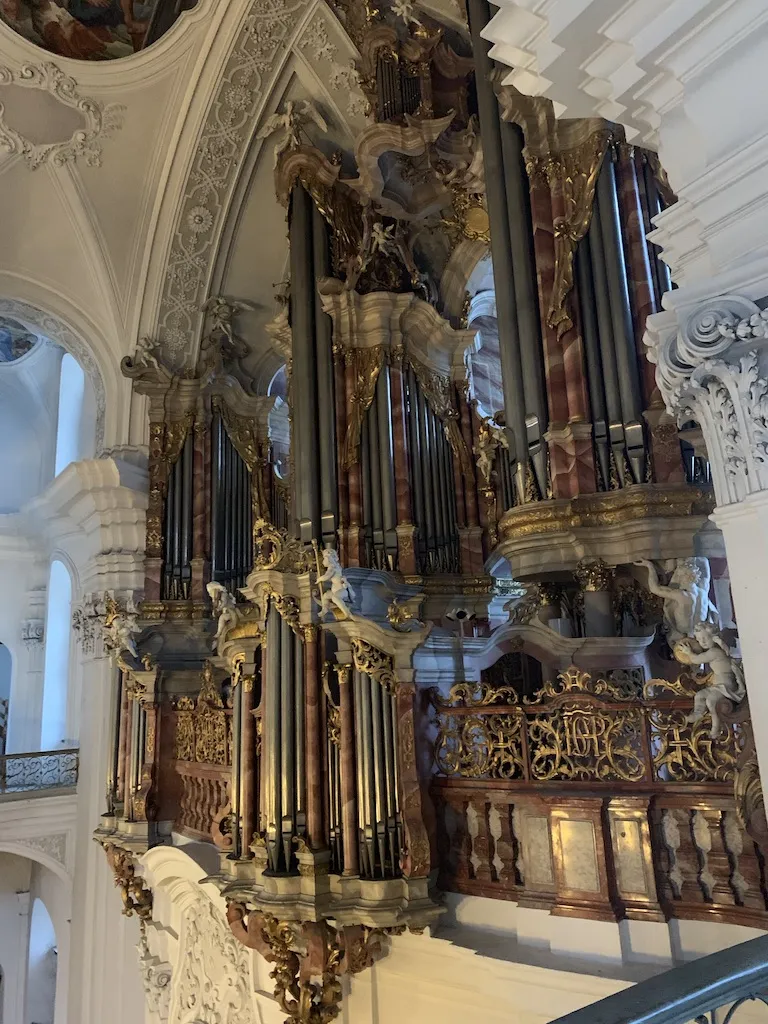
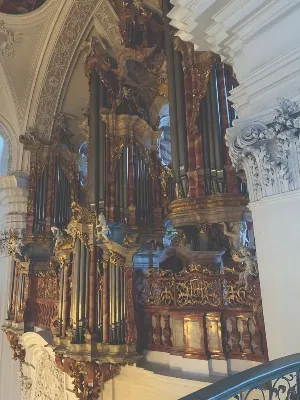
And there is the extravagantly ornate organ, dazzling in the sunlight with its newly applied gold leaf. The Rugwerk is supported by a buxom angel surrounded by a gaggle of putti, some sporting brilliant gold-leafed trumpets and violins. The main case is festooned with ten-foot-tall trumpet-wielding angels, the round bases of the pedal towers are supported by brutish angels, and the facial expressions of the convocation belie a sense of duty and purpose. The carved pipe shades are as ornate as I have seen, especially as they gleam in their fresh goldness.
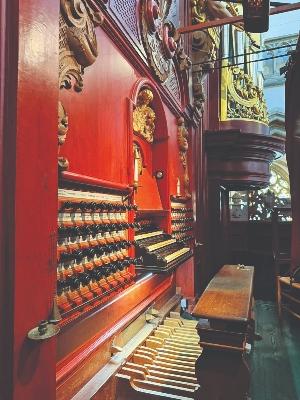
We climbed the endless, worn, narrow, spiral stone stairway to the balcony, a narrow space between the keydesk and the Rugwerk case. I thought of the Flentrop organ in Warner Hall in Oberlin that I knew so well, realizing how authentic is the design of that new (well, fifty years old) organ—the organist who played the Zwolle organ in the 1720s would feel right at home in Oberlin. As I mentioned earlier, the restoration of the Rugwerk is complete, and the four-manual keydesk is missing the top three—I saw them in the workshop two days earlier. We inspected the interior of the Rugwerk, where I could see repairs to pipes with new metal soldered on the tops. Erik explained the unusual composition of the Cimbel III. Instead of comprising a selection of fifths and octaves for the various ranks like most mixtures I know, the Cimbel has fourths and octaves, producing a unique brilliance. It is reminiscent of a Tertscimbel (as found in the Bovenwerk of the Oberlin Flentrop) with thirds, fifths, and octaves, but produces a distinct spicy effect that I had never heard before.
We climbed ladders to the Onderpositief (Manual III) and stood on temporary plywood platforms as the windchests had been removed. The side panels of the case were replaced by temporary panels so pipes, windchests, and other parts could be removed for restoration without disturbing the façade pipes.
The Hoofdwerk (Manual II) is at the very top of the case, maximizing the distance between its choruses and those of the Rugwerk. Again we were standing on temporary platforms so we could examine the façade pipes in detail. It is amazing to note that while the Hoofdwerk is an unusually large division with fourteen stops, including three sixteen-footers, the case is just over fifty-five inches deep. I could stretch out my arms and easily touch both the façade and the rear wall.
Erik pointed out holes drilled through the inside of the crowns of the huge pedal towers for use as hoisting points. I wrote earlier that shipbuilders were engaged to do the heavy woodworking building these huge organ cases and the timber ceilings of the church buildings. It is fun to imagine a troupe of them hauling on the rope of a block-and-tackle sailor-fashion, hoisting that heavy, intricate piece of woodworking into place.
The wind supply for the organ is in the tower of the church, above and behind the organ. The original pumping station with twelve large wedge bellows enclosed in a little house is restored and operable. There is a raised bar to stand on, a row of twelve six-inch by six-inch pedals that raise the bellows, and a long handrail for the pumpers to hang on to. A family named Bur Bach had a monopoly on the organ pumping. “Peter Bur Bach 1784” is carved in that handrail in three-inch letters, inscribed when the organ was sixty-three years old. Of course, there is an electric blower that allows the family Bur Bach some time off. You can see more photos and the specifications of the organ at arpschnitger.nl/szwolle.html.
I thank Erik Winkel for being so generous with his time, sharing this organ and the Flentrop workshops with me on Tuesday and Thursday of my week in Holland. He had other business in Zwolle, so he dropped me at the train station there for my ride back to Haarlem.
And then there’s Haarlem.
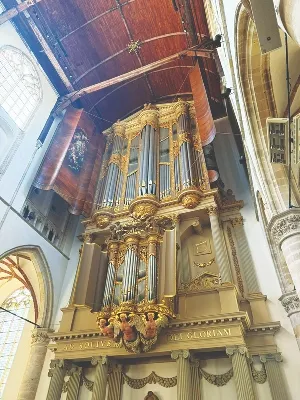
I visited five other marvelous organs that week, but that built by Christian Müller in 1738 is alone in its class, and it is the newest organ I saw. I have seen hundreds of photos of the singular organ case, but as we say about the Grand Canyon, nothing can prepare you for seeing it in real time. Like the churches in Alkmaar and Zwolle, Saint Bavo in Haarlem is a lofty Gothic structure with clear glass windows, and the high clerestory windows illuminate the magnificent organ, bringing every curve, angle, gilded surface, and carved detail to life. I have seen other organs that are as tall, I suppose the Flentrop in Saint Mark’s Cathedral in Seattle is pretty close, but somehow the Haarlem organ manages to be both massive and effortlessly vertical in a way that is hard to explain. The perfect proportions defy the weight of the case.
To judge the fantastic height of the case, remember that the large tin pipes in the pedal towers are thirty-two footers—adding the height of the pipe feet brings the physical height of the largest pipe to almost forty feet. Measure the length of your living room and compare.
Like the Schnitger in Zwolle, this flamboyant case is alive with colorful angels and putti. Twelve-footers hang off the sides of the main case, and a pair sitting atop the pedal towers are playing a harp (C-side) and a viol (C-sharp-side). The only full-sized angels I can find that are not playing instruments is the pair of bare-breasted six-footers sitting on the Rugwerk case, and there are two heroic lions at the very top holding up the seal of the City of Haarlem, adding an extra story to the height of the organ.
I heard Matthias Havinga, organist of the Oude Kerk in Amsterdam and professor of organ at the Conservatory of Amsterdam, play a recital on Tuesday evening, after my day at the Flentrop shop. Havinga played music of Buxtehude and Bach, Benoit Mernier (born in 1964), and Bert Matter (born in 1937), and ended with Vierne’s Symphony III to show the extraordinary versatility of that stupendous organ.
Anton Pauw has been city organist in Haarlem since 1991, so he knows the Müller organ better than anyone. He met me at the church at dusk to show me the instrument, and night fell as we played and listened. Standing in the narrow loft, the round bases of the massive pedal towers are at head level. Stand under them and look straight for a seemingly infinite sense of height.As I write remembering that evening, I am still dazzled by the accomplishment of the eighteenth-century artisans who conceived, designed, and built it. It is also a thrill to say that it is not a lost art. Organs of that size, beauty, and scale are being built today.
I can hardly imagine how many times Anton has demonstrated the organ throughout his thirty-four-year tenure. If he has done so twenty times a year, it would be nearly 700 demonstrations, but I bet it is a lot more than that. He presented and compared individual voices, small ensembles, and big choruses, and built crescendos to climaxes on different families of stops and with the full organ.
Building a pipe organ requires a sophisticated understanding of what I think is a magical balance between pipe scales, wind pressures, metal composition, and acoustics. It is especially difficult to attain with a large organ in a large room. The Haarlem organ was built about three-hundred years after the inception of north European organ building, and the people who built it understood that balance.
§
In the series of essays about my Dutch organ crawl, I have not included much technical detail. There is plenty of documentation about them available online that includes specifications and histories, especially about the two Schnitger organs I have described. You can read about city council actions on organ contracts and reactions to completed projects. Arp Schnitger was the darling of many city councils.
I am grateful to have finally seen these organs and appreciate their standing as monuments of human achievement. Their tonal structures are so sophisticated, and their sounds are timeless, as proved by the varied program played by Matthias Havinga. It is an interesting study to trace the development of organbuilding through the centuries, the Baroque splendor I have been describing, the Romantic instruments of Ladegast in Germany, Cavaillé-Coll in France, and Hook in the United States. The introduction of electricity to organbuilding in the early twentieth-century allowed the spatial expansion of monumental organs and new tonal styles based on the availability of limitless high wind pressure, with a nod to the family Bur Bach in Zwolle. Mr. Biggs’s landmark recordings in the 1950s and 1960s dazzled American audiences and played an important role in sparking the resurgence of that style of organbuilding.
I thank my Dutch hosts for their hospitality and generosity, sharing the deep heritage of organbuilding in their country, and thanks to Wendy for supporting me in my solo adventure. While I was negotiating scary staircases, she was touring Paris with an old friend. It sure was fun to get home and
compare adventures.