In the Wind: Travels to the Netherlands, part 2
How old is old?
Last month I began writing about our trip to Europe in late June of this year, how Wendy and I spent a week together in Spain and took a train to Paris where we split up. She stayed in Paris with a friend, and I went on alone for a week in the Netherlands. I am grateful for the opportunity to spend a week as an organ nerd, immersing myself in the culture of the iconic historic organs I have read about and listened to on recordings for fifty-seven years. I filled my calendar with visits to organs, meals with organists and organbuilders, and a visit to the workshops of Flentrop Orgelbouw, where so many marvelous organs have been built.
I wrote about the organ completed by Arp Schnitger and his son Franz Caspar Schnitger in 1729 for the Martinikerk in Groningen where the brilliant and gregarious organist Sietze de Vries was my host. In addition to the up-close-and-personal visit to the keyboards, I was privileged to attend the Sunday morning service played by Sietze. I had an overwhelming sense of the timelessness of the pipe organ, that an instrument that’s 296 years old is just as relevant a tool for worship as one that is brand new.
Oosthuizen
On January 3, 1521, Pope Leo X excommunicated Martin Luther, and on March 6 of that year, Luther was ordered to appear before the Diet of Worms to be given a chance to recant his controversial beliefs. Between April 16 and 18 he stood before the Diet of Worms and Emperor Charles V and refused the request.
The French composer Josquin des Prez died on August 27, 1521, and it would be forty years before the birth of Jan Pieterszoon Sweelinck. Only twenty-nine years had passed since Christopher Columbus set sail from Castile, Spain, to find a route to India, but tripped over North America. In 1521 a one-manual organ was built for the Grote Kerk of Oosthuizen, thirty kilometers north of Amsterdam.
On my summer excursion, my wallet had been stolen in Spain the week before I visited Oosthuizen. Through the marvel of internet banking, I was able to cancel all my cards and load replacements into my Apple wallet, but I had no driver’s license, so could not rent a car. My friends at Flentrop introduced me to a retired tennis pro in Zaandam who would be my driver for a day. He picked me up at my hotel, and once we broke free of the construction-laden traffic snarls in Amsterdam, the drive to Oosthuizen was through farms with fields of potatoes and sunflowers (66% of the Netherlands is farmland) and along tree-lined dykes. We crossed a canal to enter the village and found the Reformed Church.
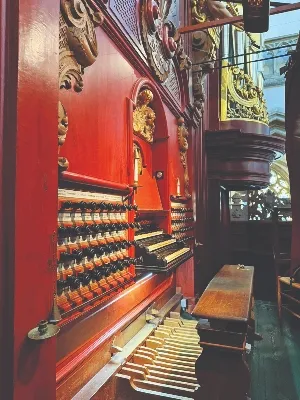
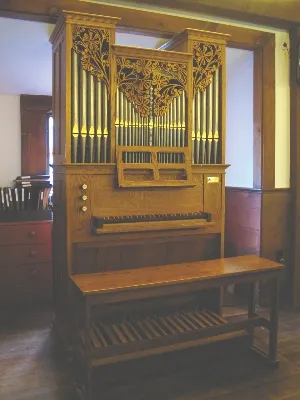
Herman van Leuven, ninety-four years old and the self-appointed curator of the organ, greeted us, and we entered the sunlit room that was built in 1511. The building is no longer operated as a church, but because it is a national heritage site, funding is available to maintain the organ and sustain the building as a community center that is used for meetings, weddings, exhibitions, and concerts. No ceremony, just go up and play. I have been in sailboats that had easier stairways, but the climb was worth it. Usually when you visit an artifact that is 504 years old, there is a velvet rope around it, and you are forbidden to touch it. I sat on the ancient bench (I have no idea if the bench is original to the organ), drew some stops, and played.
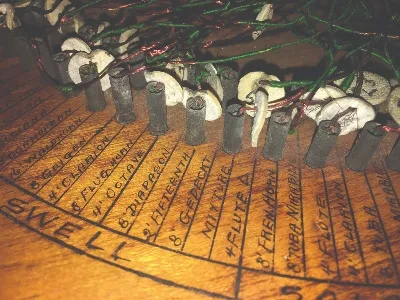
I wrote “drew” some stops. Now that is just not just right. You push a knob in to turn on a stop. Later in the week, I spent a couple days with Erik Winkel, director of Flentrop (I will write about that soon), who told me the theory that the keyboard was originally at the back of the organ, and the instrument was altered by reversing the lower case, which caused the stop action to work in reverse. The windchest was also reversed inside the upper case, so the orientation of the keyboard action remained the same.
Several of the ivory key coverings had obviously been replaced, but I wondered how many were original, more than 500 years old. It was a special sensation for me as my fingers touched the keys. How many people have played that organ? I know quite a few people who have played it.
E. Power Biggs was there over sixty years ago. Who was there in 1620? Who was there when the American Revolutionary War began when the organ was only 250 years old? What music did they play? Did they like it? I did. The organ is tuned in meantone, which means you must choose key signatures wisely, but otherwise the organ’s tone is bold, bright, and colorful. It has seven stops and ten ranks with a sophisticated blend of mutations (Quint, Sexquialter, and Mixtuur). I marvel at how well the builder understood the complex mathematics of pipe scales, mouth widths, mouth heights, metal composition, wind pressure, and all the other bits of magic that make a pipe organ go.
The gilded mouths of the façade pipes are arranged in neat diagonal lines, and there’s an embossed façade pipe in the center tower. The case towers are capped with ornate “steeples” (bird cages), and there are hinged doors that can cover the façade. When viewed from a distance, the rail of the organ loft appears to curve in toward the center, a visual trick as the rail is straight for its entire length. It was a treat to spend that time with such an ancient organ, communing with my fellow organbuilders of five centuries ago.
Alkmaar
Alkmaar is a city of 111,000 people about twenty kilometers west of Oosthuizen, widely known for its weekly cheese market. It is the hometown of my early mentor John Leek, whose widow Maria gave me the addresses of some of their childhood haunts, the homes they grew up in, the workshop of Pels Orgelbouw where Maria’s father was superintendent and John was an apprentice. I saw the matching pair of stone steps at City Hall that couples climb, one on each set of stairs, for their civil marriage, and the church John and Maria walked to for their wedding.
I walked up Langstrasse to the Grote of Sint-Laurenskerk, a large Gothic church centered on the city square. It is no longer in regular use for worship, except for Christmas, according to my host, sub-organist Frank van Rijk. There is a spacious coffee bar installed in the north transept, enhancing the secular use of the building, which houses an active theater company, exhibitions, concerts, weddings, and festivals. The cheese market (Kaasmarkt) is held every Friday from March to October, and the organists of the Grote Kerk perform heavily attended free Kaasmarkt organ recitals at 11:00 a.m. and 1:00 p.m. The church is owned by the Stichting Behoud Monumentale Kerken Alkmaar (foundation for the preservation of heritage churches in Alkmaar).
The edifice is home to two iconic organs, one of which is ten years older than that at Oosthuizen that we had just left, built in 1521. On August 14 of that year, the first half of Michelangelo’s Sistine Chapel ceiling was unveiled for dignitaries; it was opened to the public the next day.
The brilliant choir organ by Jacob van Covelens is perched on the left wall of the ambulatory to the left of the chancel of the tall Gothic room that was opened in 1470. Frank led me up another daunting stairway to the tiny swallow’s-nest loft. This organ has two keyboards, the second being a later addition, and thirteen stops including an independent 8′ Trompet in the Pedaal. Several of the stops increase the number of ranks toward the treble. Doof, which is 8′ Principal, and the 4′ Koppeldoof increase to two ranks in the treble, Mixtuur goes from two to six ranks, and Scharp goes from three to six. When those four stops are drawn as a chorus, there are seven pipes speaking for each note in the bass range, increasing to seventeen in the treble. The result is a chorus of exceptional brilliance. Again, I was amazed by the sophistication of those sixteenth-century organbuilders. Frank’s chromatic scale was a dramatic demonstration.
In 2013 I was showing an organ that the Organ Clearing House had installed in a church in Manhattan’s Upper East Side to family members who knew little about organs. Our daughter asked, “If the stops turn on when you pull a knob, shouldn’t they be called ‘Goes?’” I turned that question into a lecture I gave on the history of pipe organ stop action during the New York Chapter of the American Guild of Organists Presidents’ Day Conference in 2014.
Many early organs had multiple ranks with no stop action, called a Blockwerk, and I learned that some of the earliest stop actions had the function of turning off all the ranks of a Blockwerk except the 8′ Principal. “Doof” is an old Dutch word that can mean either deaf or dumb, and the stop control was named Doof. A Dutch friend told me that her grandmother used “doof” to describe her grandfather, and the family was not sure whether she meant that he was deaf or dumb, but assumed that both could apply.
Frank demonstrated the organ for me with a casual familiarity tempered with deep affection. He and Peter van Dijk, the municipal organist whom I met briefly, have done considerable research and written books and articles about the instruments in Alkmaar, and I was excited and impressed with the depth of his knowledge about the history of that ancient organ. The fun part is, old as it is, 514 years, you can play it pretty much like any organ. It is not set up with AGO standard dimensions, but you will get used to it.
Go west . . . .
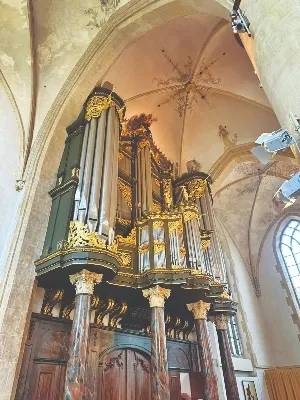
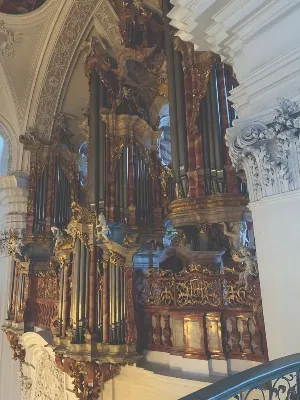
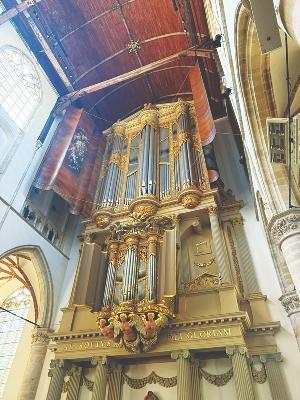
The great Van Hagerbeer/Schnitger organ is in a gallery high on the west wall—I faced another treacherous stairway. Van Hagerbeer finished the organ in 1646, and after several other smaller intermediary projects, Frans Caspar Schnitger, son of Arp, expanded and completed the organ between 1723 and 1725. This is a massive, broad-shouldered organ with three manuals and fifty-five stops. You can read a lengthy detailed history of the organ here: https://orgelfestivalholland.nl/storage/uploads/VanHagerbeerEN.pdf.
I can hardly describe the scale of this instrument. The organ case is huge. The impost frame must be more than twenty feet off the gallery floor, far higher than any organ I have seen. Since there are only three manuals, the manual choruses are more fully developed, and there are more bass stops than in an organ of the same size with four manuals. There is plenty of upperwork with eleven compound stops (mixtures and cornets) and eleven single-rank flue stops above 4′ pitch, but there are also extra goodies at lower pitch like a Quint 5 1⁄3′ on the Hoofdwerk and a 12′ (you know it as 10 2⁄3′) Rohrquint in the Pedaal, not to mention that there are thirteen reeds for your listening pleasure. Frank demonstrated the organ with imagination fed by the depth of his knowledge and enthusiasm for the monumental thing.
Late that evening, I sat in my hotel room reviewing notes and photographs, basking in the privilege of experiencing the organs in person. The seventeenth- and eighteenth-century mayors of Alkmaar sure inspired wonderful creations in the zeal for raising the stature of the city. I will be back next month with stories about two more organs. Thanks for reading.