In the Wind: The Kotzschmar Organ
Cover art
Wendy and I live in Stockbridge, Massachusetts, where the great American illustrator Norman Rockwell (1894–1978) lived, worked, and lives on as a vital part of the town’s heritage. The Norman Rockwell Museum is here, and his studio was moved from its original location on South Street to the museum grounds. His grave is in the cemetery behind our house, frequently visited by admiring artists and fans who leave tubes of oil paint and other artistic mementos on the headstone in tribute to his contribution to American illustrative art. One of our granddaughters makes a point of running out to say hi to Norman during each visit. “Let’s go see Norman. . . .”
Rockwell first submitted a painting to The Saturday Evening Post in 1916, and it was published on the magazine’s cover on May 20 of that year. Over the next forty-seven years, 323 of Rockwell’s paintings were published on the covers of the magazine. The museum includes a gallery that displays them all.
The Saturday Evening Post was founded and published by Cyrus H. K. Curtis, a Philadelphia publishing magnate whose empire included the similarly fabulously successful Ladies’ Home Journal, Philadelphia Public Ledger, The Philadelphia Enquirer, and the New York Evening Post. Curtis’s devotion to the arts kindled the tradition that the famous weekly magazine would feature commissioned original art on its covers.
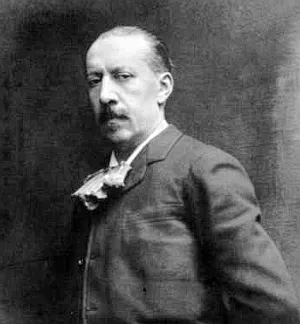
Cyrus H. K. Curtis was born in Portland, Maine, where his father, Cyrus Libby Curtis, was an interior decorator and enthusiastic member of the choir at First Parish in Portland. The elder Curtis recruited a brilliant young German organist who had settled in Boston, Hermann Kotzschmar (1829–1908), to move to Portland to join the musical community there. Kotzschmar became the music director at First Parish and conductor of Portland’s Haydn Association, a choral society that was founded with a performance of Franz Joseph Haydn’s Creation.
After his arrival in Portland, Kotzschmar lived with the Curtis family for a year. Cyrus Libby Curtis was so devoted to Kotzschmar that he named his son Cyrus Hermann Kotzschmar Curtis, hence the middle initials “H. K.” Kotzschmar was organ teacher for both father and son Curtis, as well as an early teacher of John Knowles Paine, who became America’s first professor of music and first composer of full-scale orchestral works.
An alarming fire
In January 1908 a newfangled electric fire alarm system located in the office of the city electrician caused a fire that destroyed Portland’s city hall. The architectural firm of Carèrre & Hastings, designers of the New York Public Library on Fifth Avenue in Manhattan, was engaged to design the new city hall, and Cyrus H. K. Curtis donated a large pipe organ built by the Austin Organ Company of Hartford, Connecticut, to be installed in the city hall auditorium. The new building and organ were dedicated on August 22, 1912, and Cyrus Curtis addressed the crowd:
Mr. Mayor,
I present to the City of Portland through you, this memorial to Hermann Kotzschmar, who for more than fifty years was pre-eminent in this city as organist, composer, and teacher, a man who was loved by all classes for his kindly spirit, his high ideals, and his devotion to music.
He cared little or nothing for material things or fame—he never sought them, but here is his monument—a monument to one who did something to make us better men and women and to appreciate that indefinable something that is an expression of the soul.
In addition to his gift of the Kotzschmar Organ, Curtis was a founder and benefactor of the Philadelphia Orchestra and major donor to the Franklin Institute, the Drexel Institute of Technology, and the University of Pennsylvania. He purchased the huge Austin organ that had been on display at the Philadelphia Sesquicentennial Exhibition of 1926 and donated it to the University of Pennsylvania for installation in the newly built Irvine Auditorium. His daughter Mary Louise Curtis Bok founded the Curtis Institute of Music in Philadelphia in memory and honor of her father.
The Friends of the Kotzschmar Organ
With the dedication of the Kotzschmar Organ (colloquially known as “KO” or “TKO,” a knock-out of an instrument), the Portland City Council founded the City Music Commission, which engaged William C. Macfarlane as the first municipal organist. Macfarlane served from 1912 until 1918 and again from 1932 to 1934. The legendary organist Edwin H. Lemare was municipal organist of Portland from 1921 until 1923.
The City of Portland continued presenting concerts for over sixty years, but after years of diminishing budgets, the city council voted to discontinue funding the organ in 1980. In 1981 a group of interested citizens founded the Friends of the Kotzschmar Organ (FOKO), dedicated to maintaining the organ and presenting it in concert, and the regular annual concert series were continued.
Originally known as the Portland City Hall Auditorium, the hall was rebuilt and renamed Merrill Auditorium in 1997. The organ was removed before the start of the renovation and placed in storage. Although there was a faction in the city that did not prioritize the return of the organ, FOKO was able to raise funds to make major repairs and arrange for its installation in the newly opened hall. David Wallace, curator of the Kotzschmar Organ, gave a herculean effort with limited funding to bring the organ back to Merrill and make it playable again.
The Centennial Renovation
In 2001 Wendy and I moved into a house in Newcastle, Maine, about an hour up the coast from Portland. (In Maine the north-south orientation of the coast is actually east-west, hence the expression “down-east Maine,” which means far up the coast. As you drive along the coast on U.S. Route 1, you drive into sunrise and sunset.) As we settled in, I was eager to visit and hear the Kotzschmar Organ, and we started attending concerts. Portland’s Municipal Organist Ray Cornils and I had been pals twenty-five years earlier when we were both organ performance majors at Oberlin, and it was fun to reunite with him. Ray had settled comfortably into his post as one of the most prominent musicians in Maine and was widely admired by a large following, serving as the organ’s ambassador to audiences from Portland and beyond.
As we attended concerts, we learned about the work of the Friends of Kotzschmar Organ and responded to their fundraising appeals by making modest donations. It was obvious to me that the organ was not in great condition, but I admired Ray’s ability to present it to the public in its best light, deftly avoiding the crevasses and canyons of mechanical disrepair. He knew and avoided the nooks and crannies where ciphers lurked, and the audience went away enriched each time.
I suppose I saw it coming. Ray called asking if I could meet with him and a member of the FOKO board, who was also a choir member at the church where Ray was organist; it would be a nice chat over a cup of coffee. I was nominated and elected to the board of directors of the Friends of the Kotzschmar Organ in 2003.
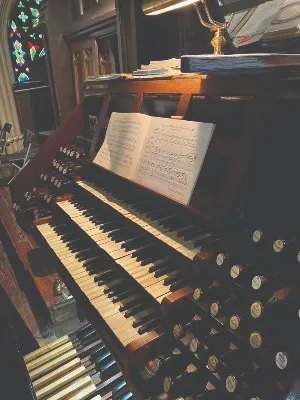
When I started attending meetings, I was amazed at the reverence and enthusiasm board members had for the organ. I was made chair of the organ committee, which is responsible for the condition of the instrument. Several years after I joined the board, one of FOKO’s patrons offered to make a gift for the addition of a couple stops, including a 4′ Clarion for the Swell and a 32′ pedal reed. I invited a premier “organ reed guy” to visit the organ and make a proposal. He brought along two colleagues who were experts in Austin organs to help with the assessment, and when they were finished, they told me they felt that the organ’s condition was bad enough that it might not survive such invasive work.
I shared that observation at the next board meeting, and there was a stunned response, absolute silence in a room with twenty people. I think they were hardly breathing, until one person broke the spell, saying, “I thought we restored the organ in 1997,” which was less than ten years earlier. Later, I read contemporary headlines in the Portland Press Herald that bugled, “Merrill Auditorium Organ Restored.”
The board was quick to accept the challenge. The next few years were exhilarating as we shifted into high gear and rallied around the renovation of the organ. (We deliberately chose the word “renovation” because we decided early on that we would not return the organ to its original condition.) In August of 2007 we hosted a symposium, inviting Yale University organ curators Joe Dzeda and Nick Thompson-Allen, Yale University organist Thomas Murray, Wanamaker organist and organ curator Peter Richard Conte and Curt Mangel, theatre organist Walt Strony, and organ historian and consultant Jonathan Ambrosino to participate. Craig Whitney, New York Times reporter, international bureau chief, managing editor, and author of All the Stops (Public Affairs, 2003), served as scribe, writing a report and prospectus following the event.
Our group of experts came to Portland for a weekend to familiarize themselves with the organ, climbing through the instrument, playing, and listening. We shared meals together, discussed observations, objectives, and possibilities, and I moderated a public roundtable discussion in a hotel meeting room that was attended by members of the staff of the city manager, Merrill Auditorium, and the public. The panel of experts offered compelling reasons in favor of the renovation of the organ, and as the organ’s centennial was coming up, we should get cracking. This was followed by an intense process of developing a request for proposals and evaluating and comparing those proposals leading to our choice of Foley-Baker, Inc., of Tolland, Connecticut, to accomplish the renovation as an effective and successful fundraising effort made the project possible.
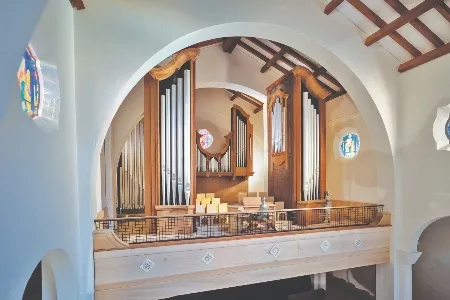
On August 22, 2012, FOKO presented a centennial organ concert that featured an array of prominent organists playing the Kotzschmar Organ to a sold-out auditorium. At the close of the concert, Peter Richard Conte and Ray Cornils shared the bench for a four-hands, four-feet arrangement of “Auld Lang Syne.” As the audience sang, the organ’s interior lights were turned on, and the staff of Foley-Baker came on stage with hardhats and stepladders and started removing façade pipes. It was a thrilling and emotional moment to begin the landmark project. The renovated organ was dedicated on September 24, 2017, a little over twenty-five months after the centennial concert. You can read a more detailed essay about the centennial renovation at FOKO.org: https://foko.org/about/history/a-brief-history-of-the-centennial-renovation/. Craig Whitney wrote the cover feature for the organ in the August 2014 issue of The Diapason. You can read my essay, “A Brief History of the Centennial Renovation,” on the FOKO website at https://foko.org/about/history/a-brief-history-of-the-centennial-renovation/.
Shortly after the completion of the organ renovation, Municipal Organist Ray Cornils announced his retirement after more than twenty-five years. Ray was admired by Maine’s musical community for his brilliant playing and quiet, dignified demeanor. He played his final recital to another full house in Merrill Auditorium, during which Portland Mayor Ethan Strimling presented Ray with a key to the city.
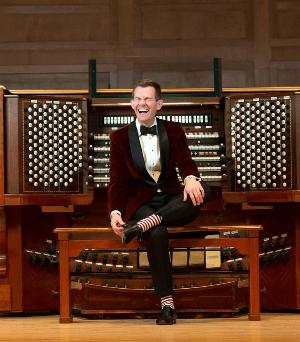
The FOKO board formed a search committee that received scores of applications from across the organ world. After narrowing the search to five finalists who were invited to Portland for auditions and interviews, the committee unanimously chose James Kennerley to be Portland’s eleventh municipal organist. James arrived in Portland in 2017, and his winning stage presence, audience appeal, and stunning virtuosity quickly established him as a leader of Maine’s musical community.
James had hardly settled into his new role before the pandemic struck in the spring of 2020, challenging performance organizations around the world. FOKO responded by offering concerts streamed online, managing to build a new virtual audience, moving carefully to mask-wearing, double-spaced live audiences, ultimately returning to fully attended concerts as before the outbreak.
Because Wendy and I now live primarily in western Massachusetts, three-and-a-half hours from Portland, I am leaving the FOKO board at the end of 2025 with gratitude for the rich experiences and deep friendships over more than two decades. Portland, Maine (population 68,000), and San Diego, California (population 1,370,000), are the only two cities in the United States that can boast municipal organists. That vast spread in population and the related availability of funding for the arts emphasizes the achievement of Portland and FOKO in maintaining, renovating, and advocating that great organ. Visit FOKO.org to see upcoming programming, buy tickets, and plan your trip to Maine’s largest city, which boasts wonderful dining and lodging and gets you to Maine’s iconic rocky coast. Here’s a teaser: dynamic organist and social media phenomenon Anna Lapwood will play a recital in Merrill Auditorium on May 10. Word is that more than half the tickets in the 1,900-seat hall have been sold as of this writing in mid-December. You know you want to be there.
Remembering an old friend
Culver (Cullie) Lunn Mowers died in Fresno, California, on October 20, 2025. He was eighty-three years old. A life-long resident of Central New York, he had relocated to the Fresno area to be near family after his retirement. He was a graduate of Syracuse University and the Episcopal Theological School in Cambridge, Massachusetts. For over forty years, Cullie served as rector to several Episcopal churches in the Diocese of Central New York, most notably at Saint Thomas Episcopal Church in Slatersville.
Cullie was also devoted to the pipe organ. He was a skillful tuner, technician, and restorer, and served as president of the Organ Historical Society from 1979 until 1983. I knew Cullie as cheerful, knowledgeable, and diligent. He was a great friend of Organ Clearing House founder Alan Laufman and participated in many of Alan’s schemes in the early days of the company when like-minded people gathered to rescue noble organs as labors of love. Those projects were worthy of legend—hard, heavy, and dirty work with little or no remuneration and crews camping on neighboring living room floors.
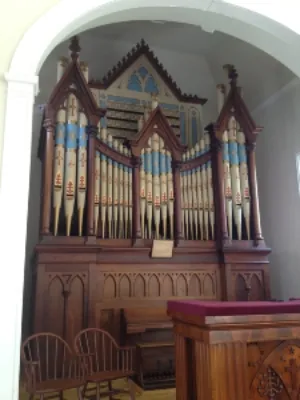
One of Alan’s most ambitious projects was the relocation of E. & G. G. Hook Opus 576, built in 1871, an organ with forty-five stops and fifty-five ranks, a very large organ for the 1870s, built for Saint Alphonsus Catholic Church in lower Manhattan, New York. The church building was to be razed to make way for a parking garage in the age of indiscriminate urban renewal. A band of organ technicians and companies gathered in 1982 to dismantle the organ and move it to Saint Mary Catholic Church in New Haven, Connecticut. The group included, among others, Alan Laufman, David Storey, Larry Trupiano, Ed Boadway, Tony Meloni, and my OCH colleague Amory Atkins, who was around eighteen years old at the time. It was a huge undertaking, the largest to date for the Organ Clearing House, and Cullie Mowers was part of that ambitious group.
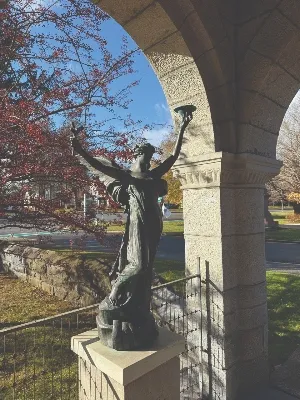
Cullie told me that he transported the two seven-foot angels from the tops of the organ’s largest towers in the back of his beach wagon. (How many of us remember calling them beach wagons?) A highway toll booth attendant noticed them lying in the back of the car and asked Cullie, “Where are you taking them?”