In the Wind: the Hook organbuilders
Elias, George, and Frank
The organbuilding company made great by the brothers Hook and their later partner Frank Hastings built more than 2,600 organs between 1829 and 1935. Elias Hook (1805–1881) and George Greenleaf Hook (1807–1880) were sons of a cabinet maker in Salem, Massachusetts. They apprenticed with William Goodrich (1777–1833) in Boston starting in 1822 (Elias was fifteen years old). George built a chamber organ in 1827, Elias built one in 1828, and in 1829 they started building organs together. Their opus list as published by the Organ Historical Society in 1991 shows Opus 1 (1829) as the first instrument the brothers built together.
George S. Hutchings (1835–1913) joined E. & G. G. Hook in 1857 and occupied senior positions in the workshop until he formed his own successful company in 1867. Francis Hastings (1836–1916) came to work for E. & G. G. Hook in 1855 as a draftsman, and like Hutchings, quickly rose to prominence within the firm. He developed significant improvements in manufacturing processes including the invention of “shop model” instruments allowing many organs to be built from one set of plans. A client could “customize” their organ by adding an optional Trumpet or Oboe to the specifications. The Hook Opus List published by the Organ Historical Society in 1991 includes facsimiles of sales brochures for several of those models. “Size No. 1” was a one-manual organ with five ranks and a pull-down pedal costing $600. “Size No. 6” had two manuals and ten ranks including a 16′ Bourdon for $1,500.
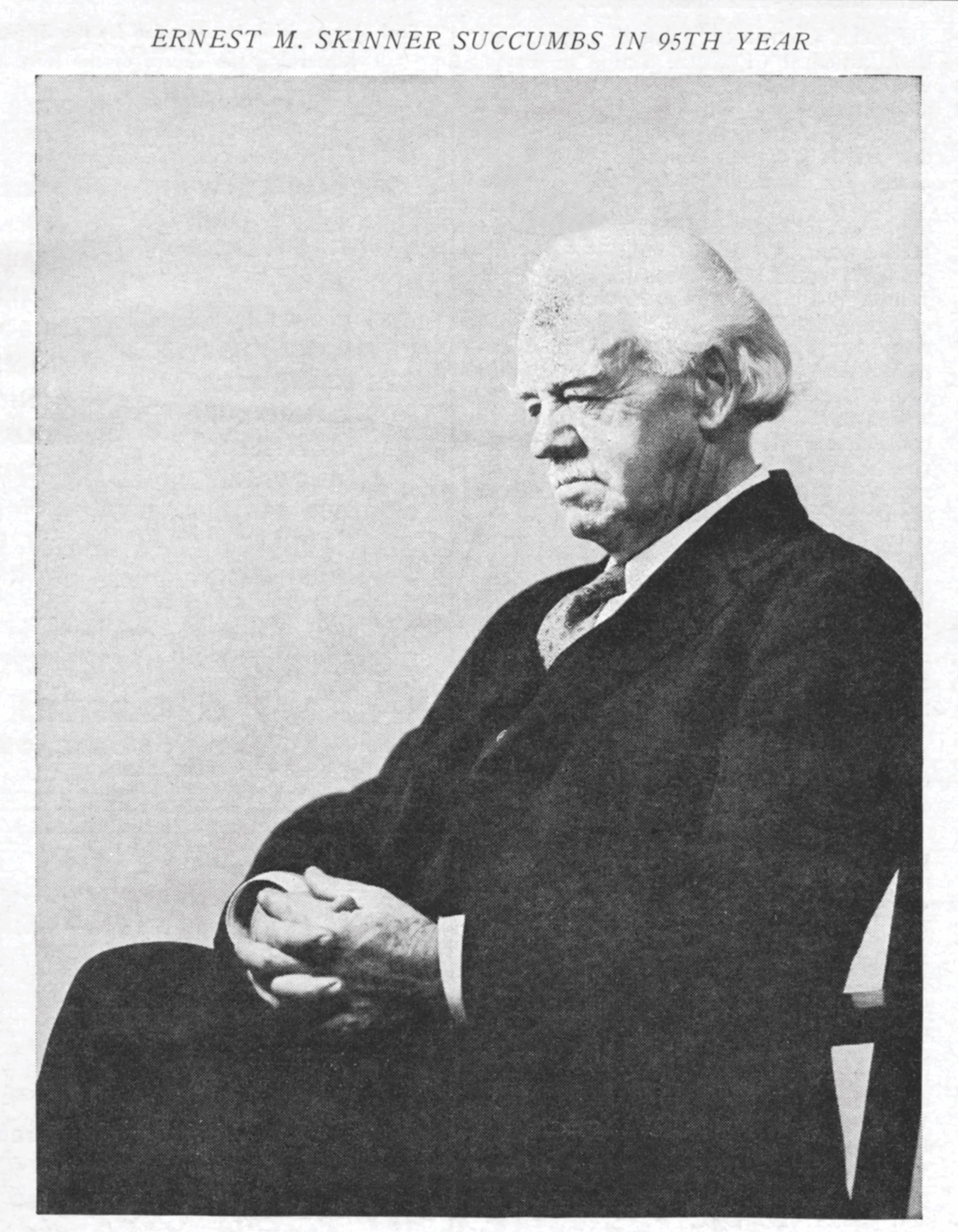
Frank Hastings was a sales representative and in 1872 became a partner in the firm—the company’s name was changed to E. & G. G. Hook & Hastings. When Elias Hook passed away in 1881 at the age of 76, the name of the firm was changed to Hook & Hastings.
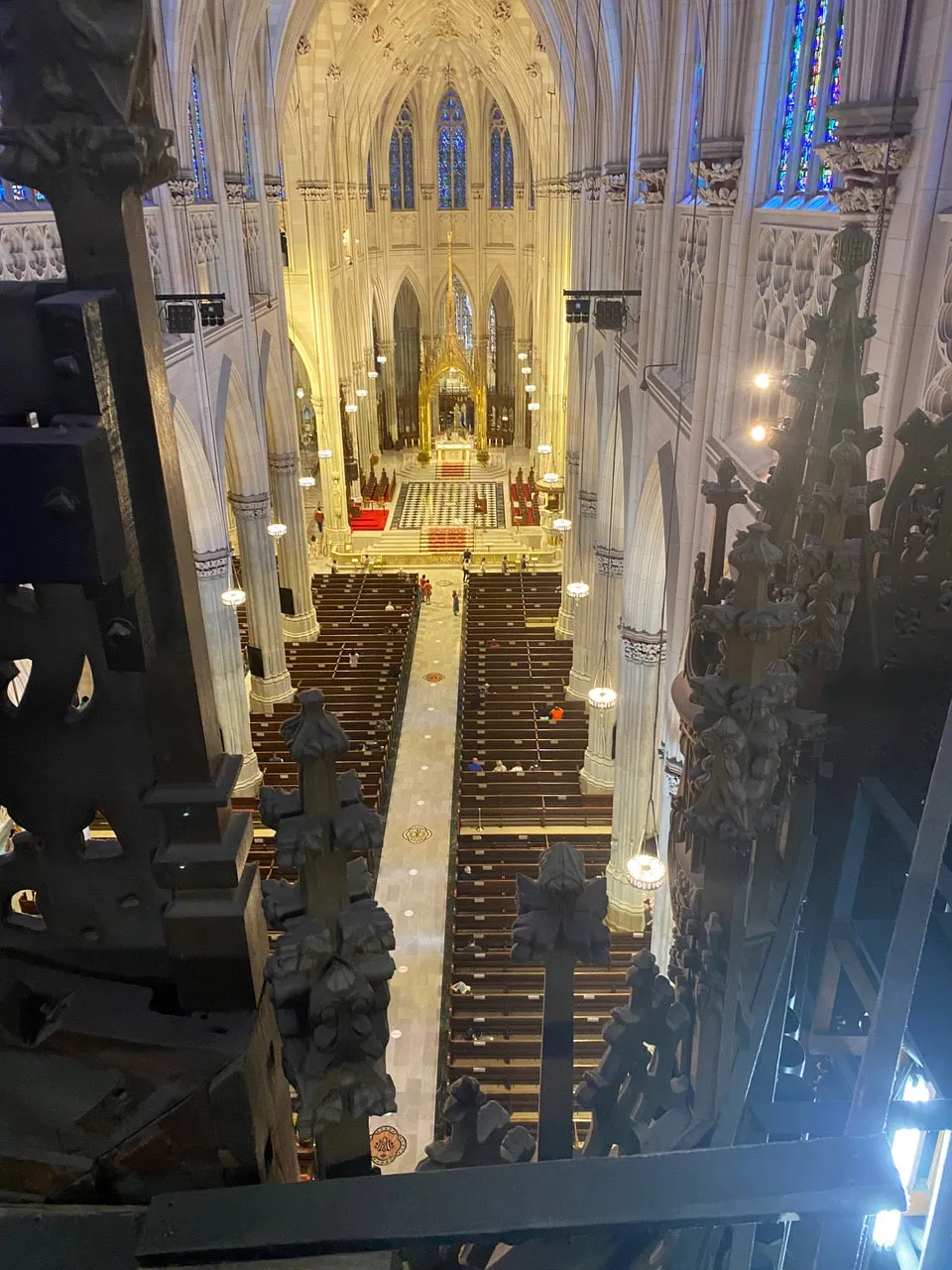
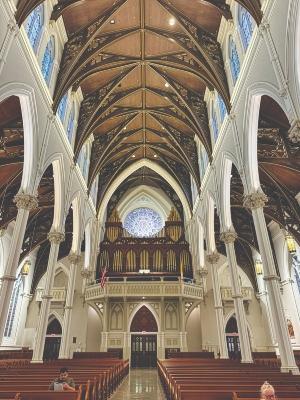
I am thinking about the heritage of the Hook firm under its various names because I had contact with three of their instruments this past Sunday and Monday. On Sunday, September 27, Rosalind Mohnsen played a recital celebrating the 150th anniversary of the dedication of E. & G. G. Hook & Hastings Opus 801 built in 1875 for the Cathedral of the Holy Cross in Boston, Massachusetts. With 101 ranks and nearly 5,300 pipes, it was one of the largest organs in the world at that time.1 The cathedral was about a half-hour walk from the Hook factory, and Mr. Hastings enjoyed walking with prospective clients to show the cathedral organ as one of the company’s great achievements.
As Rosalind played, I reveled in the instrument’s rich sounds. Readers may recall that I took a study trip to the Netherlands in July of 2025, where I visited organs both large and small built between 1511 and 1738. I marvel at the seemingly miraculous understanding organ builders had in ages past of how to match an organ with the acoustics of a room. I consider it a human achievement comparable, though perhaps not as important, as the astronomers who observed and described the motion of planets and moons in our solar system and beyond. Those ancients sitting on hillsides in Greece or Peru surely were not distracted by their mobile phones.
Through my career, I have worked on many organs built by Hook under their various names, and am always aware of how well they blend with the acoustics and architecture of their buildings. The Cathedral of the Holy Cross in Boston is the largest church building in New England, 364 feet long, 90 feet wide, and 120 feet to the peak of the ceiling. Its seating capacity is close to 2,000, and the capacity of the space is something like 4,000,000 cubic feet. When whispering, the 150-year-old organ is audible throughout the massive building and full registrations are simply thrilling. There are eighteen 8′ stops on the three manuals that provide a vast variety of tone colors—no two are alike, and there are four 16′ flue stops and three 16′ reeds on the manuals. The Great has three mixtures totaling fifteen ranks plus a five-rank Cornet, and there are altogether thirteen reeds in the organ including a high-pressure Tuba.
The fourteen-stop Pedal division boasts a 32′ Bourdon, three open 16′s, one stopped 16′, a five-rank Cornet, and reeds at 16′ and 8′, a remarkable assortment of heavy bass stops for an organ that originally had mechanical action. Their impact in the great room is profound.2
When the Organ Clearing House was installing the restored Erben organ at the Basilica of Old Saint Patrick’s Cathedral in New York City early this year, I wrote that the church was close enough to the Erben workshop that Henry Erben often walked to the cathedral during the original installation and after it was complete.3 I loved thinking of the grand man walking the same streets as we were while looking for lunch or coffee. It is fun to imagine Frank Hastings doing the same in the Roxbury neighborhood of Boston. I think of my weekday lunches with colleagues and clients and wondered what the menus looked like in 1875? A quick internet search showed that oysters were among the most popular lunch items in those days. Organs and oysters would make a fine outing. Can I sell you a pipe organ today? Do you like horseradish with your oysters or sauce mignonette?
Rosalind has been organist at Immaculate Conception Parish in Malden, Massachusetts, for forty-three years, and she played a beautiful recital on the cathedral organ. A big part of my career happened in Boston, but I have not lived there for fifteen years. It was fun to see some of my old pals there and wonderful to hear that masterpiece of one of America’s great organ companies.
An organ for a whaling capital
New Bedford, Massachusetts, is in the southeast corner of the state, south and west of the southern mouth of the Cape Cod Canal. It was established as part of the Massachusetts Colony in 1652 after the land was acquired from the Wampanoag tribe of Native Americans. It was an important center for the whaling industry in the nineteenth century and was the wealthiest city in North America per capita at the height of that era. It has been an important center for commercial fishing throughout its history and still today is home to the highest-producing fishing fleet in the United States. The port facilities at New Bedford have been redesigned to handle the importing of 350-foot blades for wind turbines from a manufacturing plant in Canada. The New Bedford Whaling Museum is a marvelous celebration of the history of whaling, and there are many wonderful restaurants, especially Portuguese and seafood.
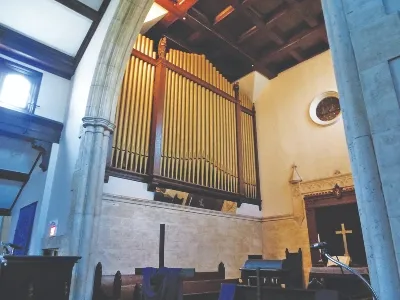
On Monday morning, I visited the now-closed building of a large Methodist Church in downtown New Bedford, which is home to E. & G. G. Hook’s Opus 244. The organ was built in 1859, which makes it part of the diminishing collection of pre-Civil War Hook organs. The church building is decrepit. There was a classic New England Nor’easter going on the day I visited, and there were dozens of plastic buckets strewn about the building in a vain effort to catch rainwater. Upstairs in the sanctuary, a lot of plaster had fallen from walls and ceiling, but the fabulously ornate organ case loomed in the semi-darkness above the speakers’ platform. I was happy to learn that the ceiling above the organ’s interior is made of hardboard, there is no plaster to fall inside the organ. There is plenty of evidence that a lot of birds have taken up residence in the building.
I met with the contractor who is managing the building while the owners determine its future, and we have listed the organ for sale on the website of the Organ Clearing House. This is a spectacular example of the height of the art of organbuilding nearly 170 years ago, and I sure hope we can find it a caring new home. You can see photos and information about the organ’s availability at https://www.organclearinghouse.com/organs-for-sale#/3288-hook-new-bedford-ma.
Opus 1674
After my visit with the New Bedford organ, I drove a half hour north to Taunton, Massachusetts, a city with about sixty-thousand residents, and the seat of Bristol County. The former Saint Mary’s Church was founded in 1830, the first Catholic church in Taunton. The present Gothic Revival building was designed by Patrick Keely (who also designed the Cathedral of the Holy Cross in Boston) and can seat about 1,200 people. The parish was suppressed (closed) on September 15, 2025.
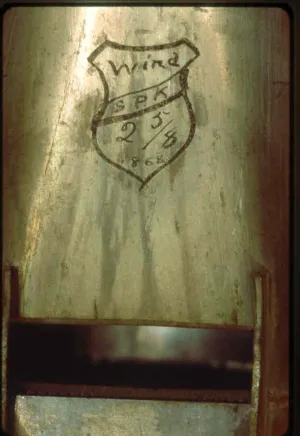
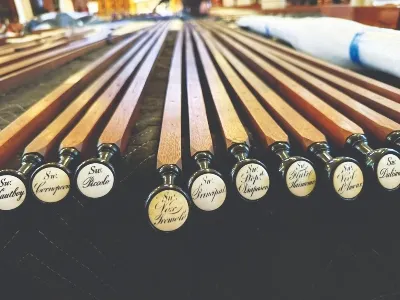
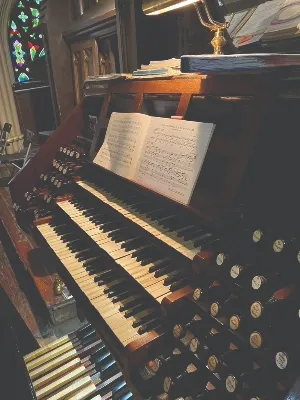
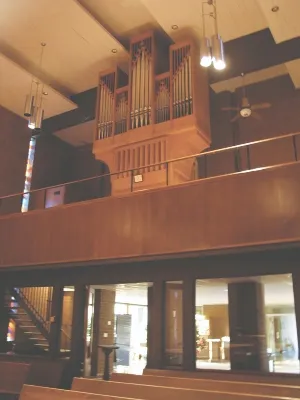
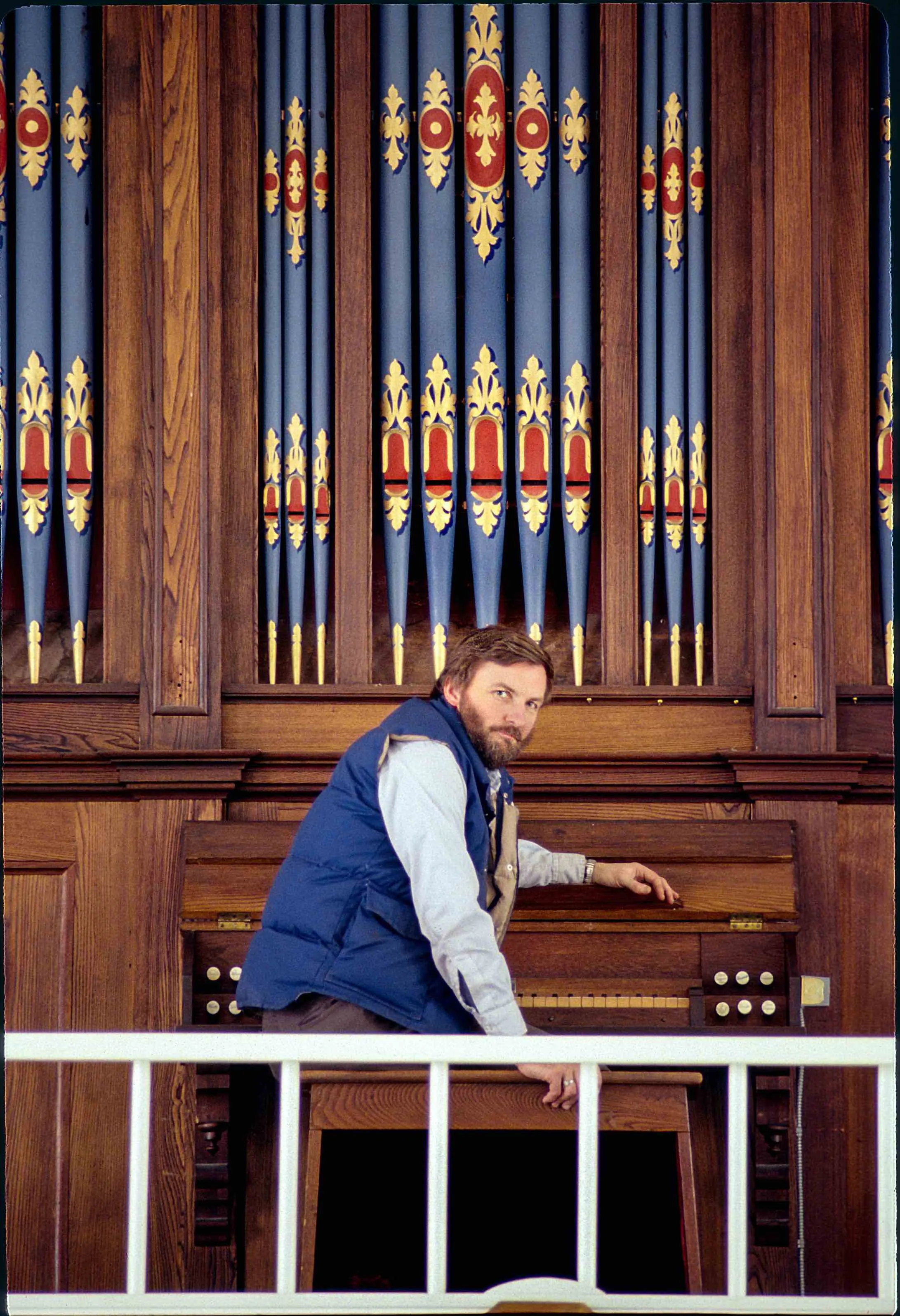
Hook & Hastings Opus 1674 was built in 1895 and is housed in an elegant and spacious rear gallery. It features a detached, reversed console, an unusual feature for a mechanical-action organ in those days. The engineering and geometry of the complex key and stop action is a wonder to see. There are large stop-action trundles that connect to the stopknobs, pivot at the middle of their length, and connect to stop action traces that go under the console and floor to the organ case. This requires a raised platform for the console to sit on that creates the space for those mechanical actions.
With thirty-seven ranks, this organ is much smaller than Opus 801 in Boston, but still there are ten 8′ stops on the three manuals. The grand case is thirty-two feet high and twenty-four feet wide and occupies the perfect location high on the rear wall of the building. The organ was maintained until the fall of 2025 and is still in playable condition. You can see photos and further information about the Hook & Hastings organ at https://www.organclearinghouse.com/organs-for-sale#/3284-hook-hastings-taunton-ma.
The former Saint Mary’s Church is on the corner of Broadway and Washington Street at Saint Mary’s Square. Across Broadway from the church building is a large white frame structure with turrets and towers and the sign of a funeral home with Gothic lettering. There was a realtor’s “For Sale” sign in front of the building. I supposed that when that large, active parish closed, the funeral business slowed abruptly.
Hook & Hastings in Weston
During the period that the company was known as E. & G. G. Hook & Hastings, the factory at Roxbury Crossing had as many as two hundred workers, and at their busiest in the 1860s and 1870s, they were producing as many as sixty organs a year. After Elias Hook passed away and the company was renamed as Hook & Hastings, Frank Hastings went to work to realize a dream he had likely been working on for years. He was a native of Weston, Massachusetts, a small farm town with 1,700 residents (now a busy suburb with close to 12,000 people). His father Jonas Hastings was a bootmaker and farmer, handy because Weston was home to a large tannery, and the Hastings homestead where Frank was born is still standing and occupied.
The mid-1880s was a time of labor unrest across the country with violent railroad strikes. In 1886 an anarchist detonated a bomb in Chicago’s Haymarket, and the American Federation of Labor was formed. Frank dreamed of creating a “community of labor,” moving the company to Weston and building houses so he could offer low-interest mortgages to his employees. In 1885 he built a large house directly across the street (now North Avenue, Route 117) from the Hastings homestead. He purchased nearly two hundred acres of adjoining land, and by 1889 the new factory was complete and the business had moved. Frank Hastings built dozens of small houses and cottages, a community center named Hastings Hall, and a schoolhouse.
The company’s 2,000th organ was completed in 1904. The firm hosted a banquet and organ recital on March 3 of that year, with over 150 employees and their families. The newspapers praised the event for the obviously high level of friendship and community at the gathering.
Frank Hastings had one son, Francis Warren Hastings (1862–1903), who served as an officer in the company, but his health was poor, and he became a resident of Bermuda in 1895 where he died of consumption at the age of forty-one. Arthur Leslie Coburn became secretary of the corporation and superintendent of the factory in 1897. Two years later, Coburn became Frank Hastings’s brother-in-law when Frank married his sister, the schoolteacher Anna in 1899.
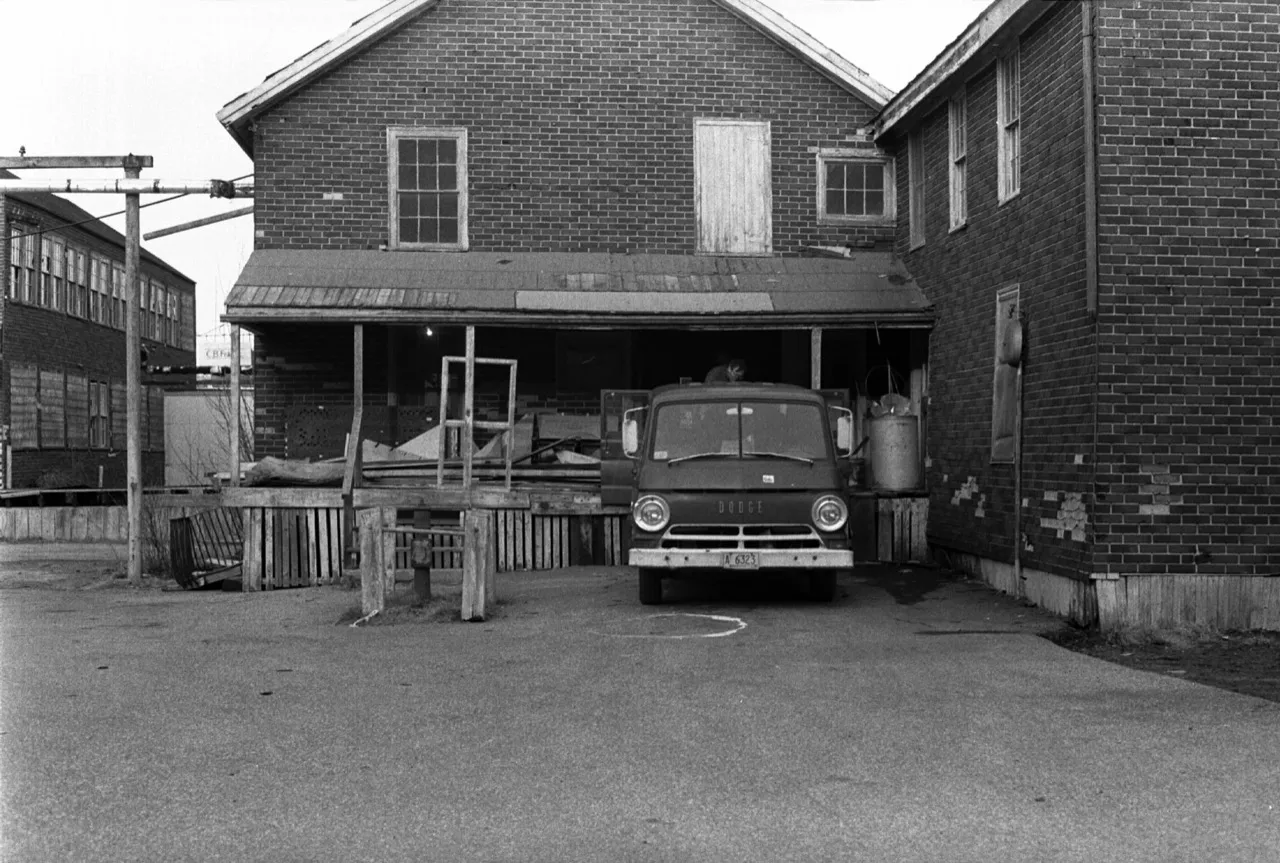
After Frank’s death in 1916, Arthur Coburn became president of the company. When he died in 1931, the then-secretary of the corporation Alfred Pratt became president. Anna Coburn Hastings was aware that the quality of the company’s organs was declining. She was quoted, “The company motto was always ‘Quality First—and Always.’ My husband always quoted quality. He never quoted price. Today organ makers are quoting price, and I decided it was time to tear it down!”4 The company ceased operation in 1936. That June, the Mystic Building Wrecking Company of Chelsea, Massachusetts, was engaged to demolish the factory.
I was first made aware of this history during the convention of the Organ Historical Society in Boston in 2000 when Pamela M. Fox gave a lecture on the subject. Her subsequent tome, From Farm Town to Suburb, The History and Architecture of Weston, Massachusetts, was published in 2002 (see endnote 4). I have wondered if Anna Hastings had been watching the decline of quality while her brother was president of the firm, so she waited until he had died to close the factory.
The original Hastings homestead, Frank Hastings’s house across the street, and many of the homes built for the factory workers are still maintained and occupied on Route 117 in Weston. The railroad tracks that serviced the factory are now part of the MBTA (Massachusetts Bay Transportation Authority) Boston Commuter Rail. Hastings is still an active stop on the Fitchburg Line.
Organs built in and around Boston
The three different iterations of the company started by the Hook brothers built more than 2,600 organs. The last opus lists of Skinner and Aeolian-Skinner goes to about 1,500. George Hutchings built around 500, George Stevens built over 800, and George Ryder built about 175. C. B. Fisk, Inc., is at around 175, Noack is past 170, and Andover Organ Company is at around 115. There have been smaller builders active in the Boston area like Robert Roche, George Bozeman, S. S. Hamill, and I won’t forget the earlier builders like William Goodrich and Thomas Appleton. I once spent several hours doing a more careful count and believe it is safe to say that around 7,000 pipe organs have been built in the Boston area since about 1820.
Compare that with M. P. Möller of Hagerstown, Maryland. They operated for 117 years between 1875 and 1992 and built more than 12,000 instruments. I remember from my teenage years when the magazine published by the American Guild of Organists was called Music: The A.G.O Magazine (lots of us referred to it as Music Agogo. . . .)—there was a full-page advertisement on the back cover with the headline, “Seventeen Churches in Hagerstown Can’t All Be Wrong.”
Notes
1. In 1884 Walker Orgelbau of Ludwigsburg, Germany, built an organ for the Cathedral in Riga, Latvia, that had 144 ranks and over 6,700 pipes. That instrument held the title of largest in the world for many years.
2. The organ at the Cathedral of the Holy Cross was electrified by William Laws in 1929, including a theatre-organ style horseshoe console. The Andover Organ Company built a replica of the original console in 2003, though the electric action was retained.
3. When the Erben organ at “Old Saint Patrick’s” was built in 1868, that church was still the cathedral of the Archdiocese of New York. “New” Saint Patrick’s on Fifth Avenue was opened in 1879.
4. Pamela W. Fox, Farm Town to Suburb, The History and Architecture of Weston, Massachusetts, 1830–1980 (Peter E. Randall Publisher, 2002), page 217. The history of the Hook & Hastings company in Weston begins on page 202 of this book.