In the Wind: Basilica of St. Patrick's Old Cathedral
And to Think that I Saw It on Mulberry Street.
That’s the title of Theodor Geisel’s (a.k.a. Dr. Seuss) first children’s book, an imaginary romp of a parade of animals. A little boy named Marco thinks it would be fun to tell his father of all the wonderful things he had seen, but sitting on the sidewalk, he had only seen an old horse pulling a cart. He spun for himself a magical tale of a procession that included zebras, elephants, circus wagons, the whole shooting match, but Marco could not muster the courage to tell such a tale, so he dutifully reported the horse cart. Geisel’s book was rejected by twenty-seven publishers before it was finally published in 1937, starting Dr. Seuss’s legendary career writing books for children that included Horton Hears a Who!, Green Eggs and Ham, The Cat in the Hat, How the Grinch Stole Christmas, and The Butter Battle Book, among many others.
Geisel was born on Mulberry Street in Springfield, Massachusetts, and later lived in New York’s Greenwich Village. Several years ago, the New York Public Library exhibited a collection of the hats from Dr. Seuss’s characters, inspired by the seventy-fifth anniversary of the publication of The 500 Hats of Bartholomew Cubbins. Remember, Bartholomew was the star of another of Dr. Seuss’s classics, Bartholomew and the Oobleck. Mulberry Street in New York is in the Manhattan neighborhood of Nolita (North of Little Italy) and is near the site of Geisel’s grandfather’s bakery.
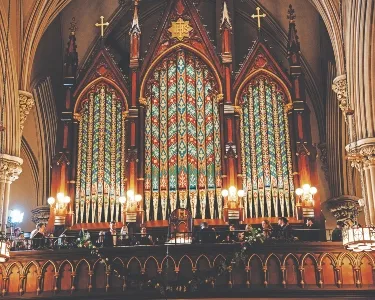
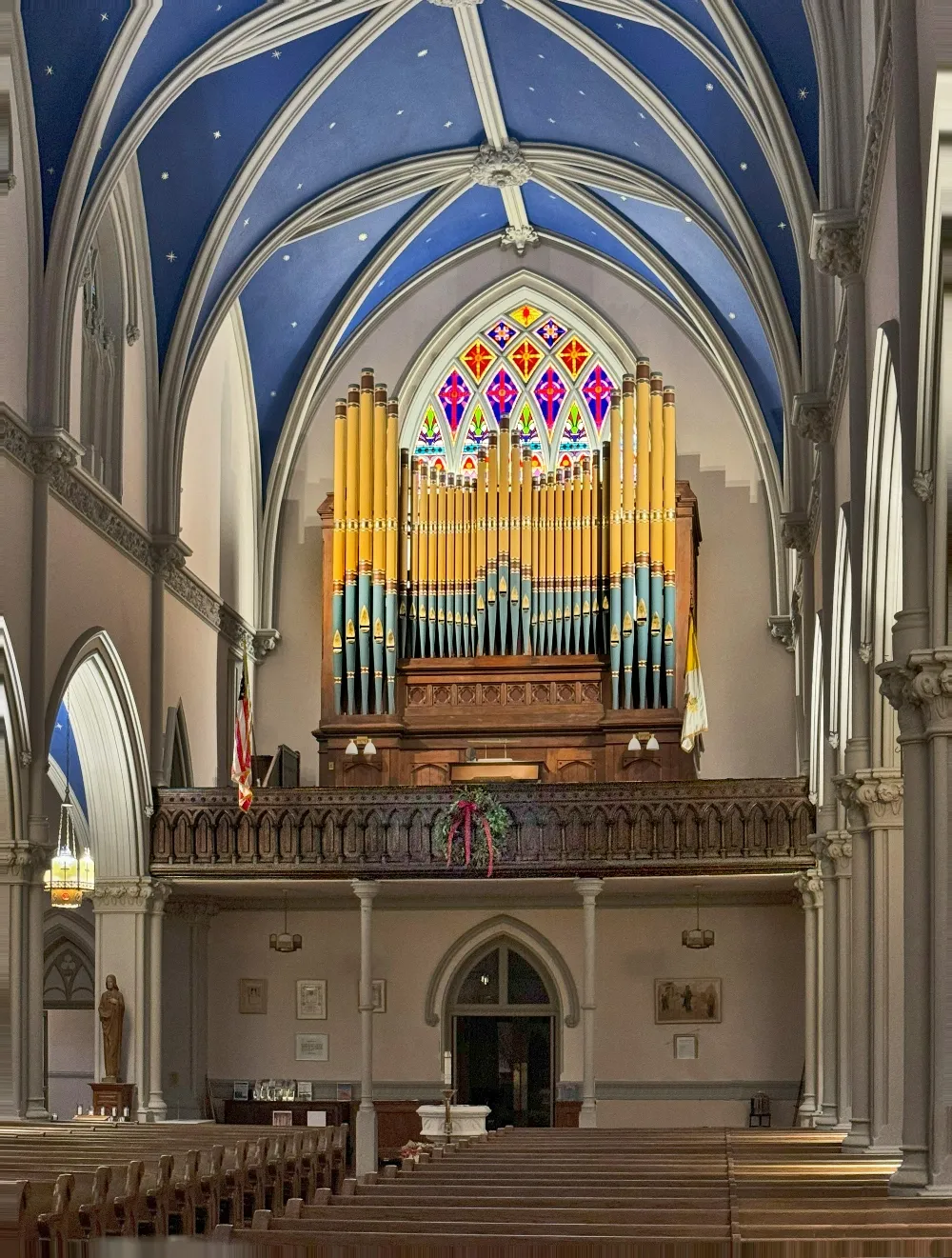
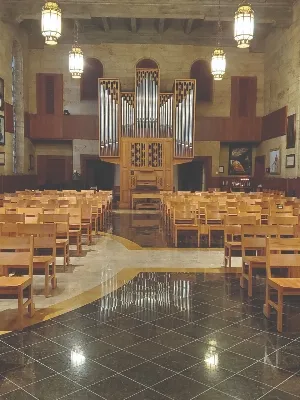
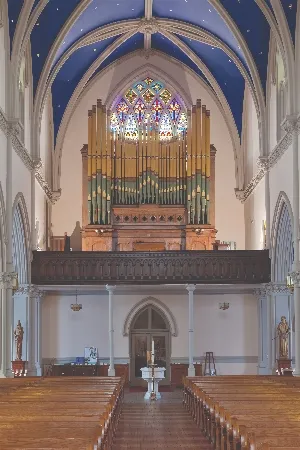
Dr. Seuss popped into my mind when I placed a large order in January for rental scaffolding to be delivered to 263 Mulberry Street in New York, the location of the Basilica of Saint Patrick’s Old Cathedral, familiarly known as Old Saint Patrick’s. Saint Patrick’s Cathedral was built in the Gothic Revival style between 1809 and 1815 and served as the seat of the Archdiocese of New York until the “new” Saint Patrick’s Cathedral was opened on Fifth Avenue in 1879. The basilica is home to a breathtaking forty-stop organ built in 1868 by Henry Erben. You can read the specifications of the organ at https://www.nycago.org/Organs/NYC/html/StPatrickOldCath.html.
This was the second time I have placed an order for scaffolding on Mulberry Street. During the winter of 2023, the Organ Clearing House removed the Erben organ from the building for restoration. That work is complete, and now, during a blizzard and zero-degree windy cold, we are returning the restored organ to its original home. The scaffolding is used to construct towers on which we mount hoisting equipment for raising and lowering heavy organ components from nave floor over balcony rail with safety for the workers and the instrument. Dr. Seuss’s lyrical verse rattled through my head as I shivered my way to the church.1
Henry Erben’s (1800–1884) organ building workshop was located on Wooster Street near Canal Street in the Manhattan neighborhood known now as SoHo (South of Houston—the New York pronunciation is HOW-stun), perhaps a twenty-minute walk from Old Saint Patrick’s. I imagine that the sixty-eight-year-old organ builder walked between his shop and Saint Patrick’s Cathedral many times while the organ was being installed and later to show the instrument to potential new clients. It is reminiscent of Frank Hastings of Hook & Hastings walking between his workshop and the E. & G. G. Hook & Hastings hundred-rank beauty at Boston’s Cathedral of the Holy Cross (Opus 801, 1875).
A round-trip ticket
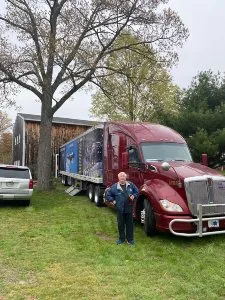
Two years ago, the Organ Clearing House dismantled Saint Patrick’s Erben organ and delivered it to the Lancaster, Pennsylvania, workshop of Brunner & Associates, the firm chosen for its restoration. As that work was nearing completion, we visited a couple times to plan for its return to New York, and the Organ Clearing House crew went to the workshop in mid-January 2026 to help dismantle the organ and pack it for transportation. It was handy to be able to dismantle the organ a second time in preparation for returning the thousands of parts to the church in the right order, and it was great to see the organ in its restored condition.
Every organist should witness the delivery of a pipe organ to a church at least once to get an idea of what goes on inside the instrument. Organ parts are spread across the backs of the pews in the vast church in a mind-numbing variety, from heavy and bulky to small and delicate. They are wrapped in foam and blankets to protect them during transit and labelled as to where in the organ they belong—swell rollerboard, manual couplers, C-sharp side Pedal Gamba 16′ racks, Choir rackboards, etc.
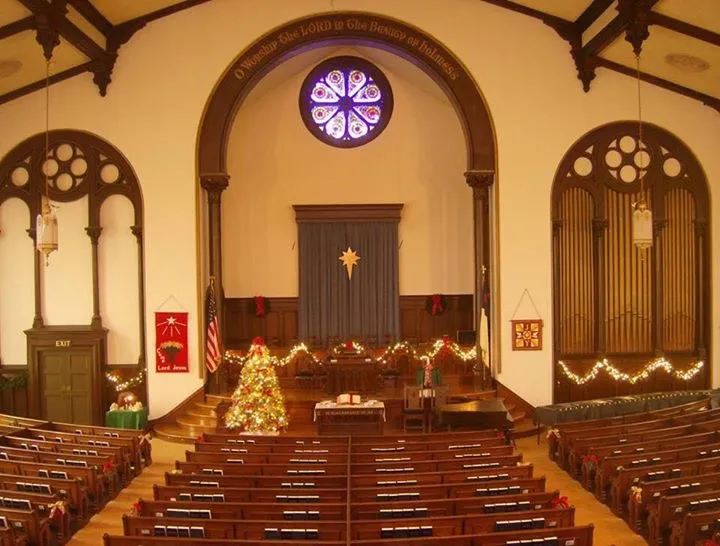
Twenty years ago, we delivered a three-manual Casavant organ to a church in Midlothian, Virginia. The parish had organized a party around the arrival of the truck, and members of the congregation helped unload the organ under the supervision of our crew. As the church filled up with fancy, obscure, and complicated parts, a member of the board of trustees told me that until that moment he had no idea why pipe organs had to be so expensive. A glance across the array made it obvious.
It’s all about wind.
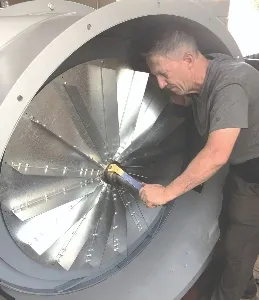
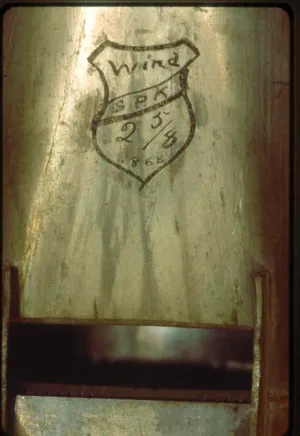
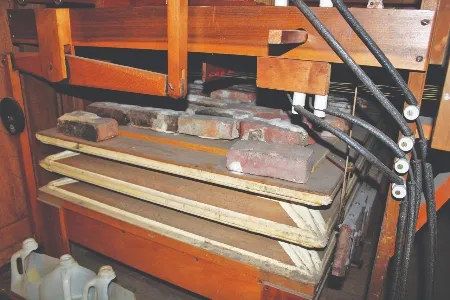
In nineteenth-century American organs, the bellows are typically on the floor of the organ. This is true for a ten-stop organ as well as those much larger. The most common arrangement is a large “double-rise” reservoir with two opposing rounds of ribs and two or three “feeder bellows” underneath. The feeders are like huge fireplace bellows that are operated by a pumping handle or other mechanism, filling the reservoir with pressurized air. The air pressure is established by weights (usually bricks or stones) on top of the reservoir. Of course, most older organs have been retrofitted with electric blowers, and the feeders are left dormant.
When the organ is being played quietly with just a few stops, it does not take much effort on the part of the pumper to keep up with the demand, but if the organist wants to use a lot of stops, the pumper has to work hard. During my tenure with John Leek in Oberlin during the 1970s, we restored an organ by William H. Clarke for a church in Bethlehem, Ohio, a project that included the restoration of the original hand-pumping system. I was to pump the organ for the closing hymn of the dedication concert played by Oberlin organ professor Garth Peacock. Garth and I could see each other around the corner of the organ case as he played and I pumped, and I knew from the glint in his eye that he was intentionally using as much wind as he could, delighting in watching me flail that pump handle to keep the wind pressure up.
In the Old Saint Patrick’s organ, there are two reservoirs in the bottom of the organ. One has three feeders, which in turn feeds directly into the second. The feeders are connected by a heavy steel shaft that is rotated by a large steel wheel, and that has forged cams that are connected to the feeders with heavy wood levers. The shaft is turned by a heavy steel wheel outside the organ case to operate the feeders. This is a sizable organ with lots of large-scale stops like Double Open Wood Diapason, that (beautiful) 16′ Bell Gamba, and plenty of manual 8′ stops. The feeder system was defunct before restoration, so I have not experienced pumping the organ by spinning that wheel with full organ playing. However, I did pump the organ in the workshop before it was shipped. The pedal stops were not installed, but I can imagine that it will be very heavy work to pump for full organ.
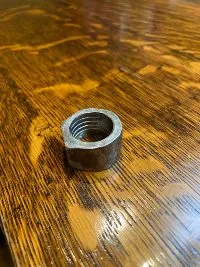
Mounting the reservoir and bellows on the floor of the organ is logical enough as windlines can be run easily to the various windchests, but there are two big disadvantages. One is that the pedal key action is typically under the reservoir. That is not a problem if the pedal windchest is at the back of the organ because it is easy enough to reach both ends of the trackers for repair and adjustment. But if the pedal is divided on both sides of the organ, there is usually a “pedal cross” directly under the bellows with leather nuts holding trackers to upright rollers that splits the action into C and C-sharp sides and sends it laterally to both sides. When installing such a rig, the pedal action gets assembled on the floor first and the reservoir placed on top, so the mechanical action can no longer be reached for adjustment or repair.
I have modified pedal cross actions by connecting the trackers permanently so there is no adjustment point under the bellows. Still, you say a little prayer when you put the bellows in place, hoping that nothing ever goes wrong with it. In a worst-case scenario, you would have to dismantle most of the organ to fix a broken tracker.
The other disadvantage shows up when it is time to releather the reservoir. In a few instances over the years, I have been able to open the lower case on one side of the organ, dismantle lots of action and windlines, make a temporary leg to support the upper case on the front or back corner, and slide the reservoir out the side of the organ. If there is not enough space beside the organ to accept the long side of the reservoir as it slips out, the organ must come down to get the bellows out.
In the organ at Old Saint Patrick’s, the people in the Erben shop built a complicated pedal key action that goes from the pedalboard to left and right along the front of the case and makes a spidery turn toward the back of the organ. It works fine, and there are no action parts under the reservoirs, but you would still face a big dismantling job to get them out for releathering.
Where the action is
You can stand in a narrow passageway behind this organ and look across the inside at ground level. The massive Pedal division—16′ Double Open Wood Diapason, 16′ Bourdon, 16′ Contra Gamba (with flared bells), 8′ Violin Cello (also with flared bells), 4′ Claribel Flute, and 16′ Trombone—is divided on each end of the case, with bass ends at the back of the organ and extra-wide walkboards that accompany each windchest. The tracker key action for each pedal chest runs handily along the walkboards.
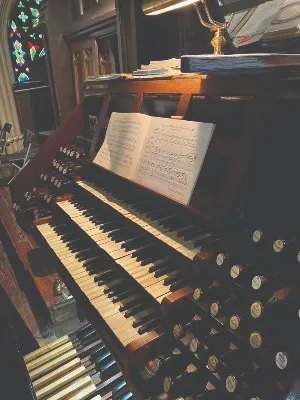
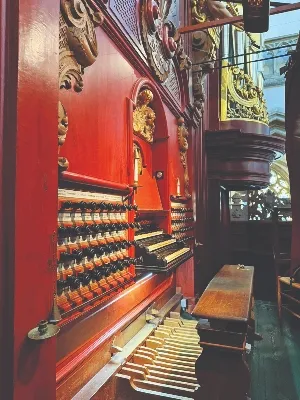
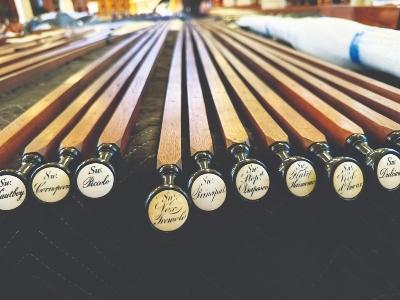
The center of the organ at ground level above the reservoirs is dedicated to the manual key and stop actions. The keydesk extends a few feet away from the front of the organ case—add that to the immense depth of the organ, and you find that the stopknobs of the Swell are over twelve feet long. You would hardly imagine that when pulling out stops to register a piece. Those knobs connect to iron squares that turn the action ninety degrees to connect to massive trundles that pivot to move the sliders.
The thirteen-stop Great division is in the usual position behind the façade pipes, and the nine-stop unenclosed Choir is directly behind the Great. The eleven-stop enclosed Swell is above the Choir. Each division has a large rollerboard that transfers the action from chromatic keyboard order to the diatonic windchests with whole tones starting on CC on one side of the windchest and whole tones starting on CC-sharp on the other.
It is all pretty simple. There are five big windchests mounted on strong frames. The three manual windchests have fifty-eight notes each. The two pedal windchests that are nearly as large as the manual chests have fifteen notes each—each is half of the thirty-note compass of the pedal. Fifteen notes for six stops means that each pedal chest supports just ninety pipes. Wood windlines conduct the wind pressure from the reservoirs to each windchest, and each windchest is connected to its keyboard (I count the pedalboard as a keyboard). The stop action starts with those twelve-foot drawknobs, connecting each knob to its designated slider, and that’s it. That’s the organ. Tens of thousands of pounds of wood and metal built in lower Manhattan in 1868.
In that year United States President Andrew Johnson was impeached by the House of Representatives and later acquitted by the Senate, the fourteenth amendment to the United States Constitution was ratified granting African Americans full citizenship, Christopher Latham Sholes patented the typewriter, and George Westinghouse invented the air brake for railroad cars. Tchaikovsky’s Symphony Number 1, Brahms’s Ein deutsches Requiem, Wagner’s Die Meistersinger, and Grieg’s Piano Concerto in A Minor were premiered in 1868. The great Cavaillé-Coll organ at the Cathedral of Notre-Dame in Paris was dedicated.
I wonder what news items were in Henry Erben’s mind as he walked back and forth from his workshop to Saint Patrick’s. Contemporary photos of the neighborhood show horse-drawn carts on the streets. Maybe Mr. Erben rode in one; maybe he had a driver? As I walked from the Bleeker Street subway station along Houston to Mulberry Street, I imagined that I was retracing Henry Erben’s footsteps.
Henry Erben’s son, also named Henry Erben (1832–1909), was an officer in the United States Navy. He was promoted to Commander in 1868, the same year his father finished the organ at Saint Patrick’s, and retired as a rear admiral. I wonder if he walked with his father to visit the organ. It’s fun to remember that pipe organs and sailing ships were among the most complex machines created by humans at that time. Maybe the younger Henry gained mechanical ability by helping in his father’s workshop when he was young.
Life work
Henry Erben’s career spanned about fifty-seven years. His company suffered several workshop fires and was reorganized more than once, so there are gaps in the firm’s record keeping, but it is safe to say that the firm produced more than thirteen hundred organs. Henry was not alone. George Jardine & Son, Hilborne and Frank Roosevelt, Reuben Midmer & Son, and J. H. and C. S. Odell were prolific organbuilders in New York along with smaller firms like Richard Ferris (later Ferris and Stuart), and Hall & Labagh (later Hall, Labagh, and Kemp), among others.
Besides New York, Boston was the other great center of American organbuilding during the nineteenth century, with firms like Thomas Appleton, William Goodrich, E. & G. G. Hook (later E. & G. G. Hook & Hastings, still later Hook & Hastings), George Stevens, and George Hutchings. Ernest Skinner was first an employee at the Hutchings workshop and founded his eponymous company in 1903, starting a storied career that continued through Opus 872, built in 1931 for Girard College in Philadelphia. The first Aeolian-Skinner was Opus 873, built in the same year for Saint Mark’s Episcopal Church, Hoosick, New York.
The OCH crew is spending more than five weeks assembling the great Erben organ. They will be followed by the good folks at Brunner & Associates, who will accomplish voicing, tuning, and fine adjustments. I was there for less than a week and was in and out as I had meetings and appointments elsewhere in the city. It was a thrill to see the organ coming together and to imagine a connection, even a conversation with Henry Erben as I walked the streets that were familiar to him. I am looking forward to returning to hear the finished organ. I’ll be sure to report.
Notes
1. On March 2, 2021, And to Think That I Saw It on Mulberry Street was withdrawn from publication along with six other Dr. Seuss titles by Dr. Seuss Enterprises because of images they deemed “hurtful and wrong” that easily passed under the social radar of 1937.