In the Wind: visits to Casavant, Létourneau, and MPR
Out and about
It is a few days before Easter. Since I stopped leading church music when I joined the Organ Clearing House twenty-five years ago and retired from the “real work” of organ building such as climbing, lifting, and crawling, I am enriched by the many social media posts of friends and colleagues as they publish ambitious music lists for Holy Week. Those who have driven hither and yon tuning and repairing organs have my admiration, reminding me of the days when I did the same, carrying tools in and out of two or three churches a day, then racing to my church for a pizza-shop supper before leading a marathon choir rehearsal.
As an old-timer, I chuckle thinking that you guys today have it easy. Imagine arranging a hectic schedule of service calls, checking ahead to be sure the heat is set, and rescheduling when something goes wrong in the days before mobile phones. I knew all the useful phone booths on my route, those where you would not have to wait and where the surroundings were quiet. I remember leaning on the little triangular steel shelves making notes while holding the telephone receiver to my ear with my shoulder and freezing during snowy tuning days.
My workshop/office is about forty-five minutes from home, and while its hot water radiator heating system is comfortable and quiet, the heat comes up slowly. I installed a thermostat that I control from my phone. I turn it up as I leave the house, and the building is warm when I get there. How about requiring tuning clients to install a gizmo so the tuner could take responsibility for turning up the heat in the churches before a service call?
§
While all of you were off tuning, planning, filling choir folders, and leading rehearsals, I went a-visiting. On Saturday, March 21, two weeks before Holy Week, there was an open house at the Ortloff Organ Company in Needham, Massachusetts, a western suburb of Boston, about ten miles out. Founded in 2014 by Jonathan Ortloff, their Opus 6 was on display. The organ is built for Saint Mark’s School in Philadelphia and has two manuals and about twenty stops. Several organists were present to showcase the superb flexibility of the organ. Many of my old pals and colleagues were present, and it was simply a blast to celebrate the fine work of this young company. There was beer on tap along with soft beverages, and lots of great snacks including a hotdog roller with favorite condiments. You can read more about Ortloff Opus 6 at ortlofforgan.com/blogs/news/opus-6-st-james-the-less-episcopal-church-philadelphia-pa-2026.
A few days later, Wendy and I drove to Montreal, four hours north of our home in Stockbridge, Massachusetts, where she planned to visit an artisan, and I had invited myself to visit the two prominent organ companies in Saint-Hyacinthe, a town with population of about 58,000 that is forty minutes northeast of Montréal.
Casavant Frères
My first stop was the legendary workshop of Casavant Frères, Ltée. As I left the highway and turned on to Rue Girouard Est, I thought of the thousands of organs that have passed along that road on the way to churches, schools, and concert halls around the world. The most recent contract signed is for Opus 3962. My friends there tell me that in the early days there were many organs that were not counted, so they are sure the actual number is well over 4,000. The company was founded in 1879 by Claver (1855–1933) and Samuel (1859–1929) Casavant—the 150th anniversary is three years away. Tonal director Alain Goneau and project manager Jens Petersen led me on a comprehensive tour of the 100,000+ square-foot facility. We entered the building through a brick structure that is closest to the road, the original Casavant homestead, connected to the first of a suite of large industrial buildings. They led me through building after building, a novel way to get in 10,000 steps. The huge facility once supported as many as 250 workers building between fifty and seventy organs a year; 1958 was their zenith. The largest Casavant organ was built for Broadway Baptist Church, Fort Worth, Texas, in 1996 and has 191 ranks and 10,615 pipes.
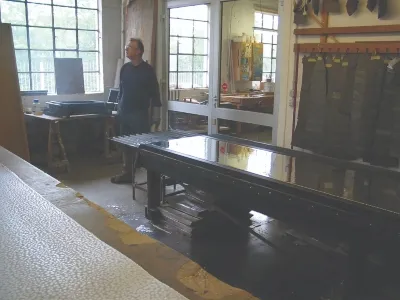
If we guess that an average pipe organ has about 1,750 pipes and you were building seventy organs a year, you would need 122,500 pipes that year. The pipe-making facilities at Casavant are extraordinary. There is a huge furnace for melting metal, several casting tables, dozens of workbenches, and hundreds of jigs and patterns hanging on the walls. Large windows provide plenty of sunlight, and high ceilings ventilate the soldering fumes.
Casavant had a furniture department that was active between 1938 and 1981, so the woodworking capacity is immense. Their most prestigious furniture project was for the main chamber of the Supreme Court of Canada. There were also many projects where they delivered an organ along with a church full of pews. Vast rooms house carefully placed machines all connected to central vacuum systems to collect sawdust. Despite high capacity, the workshops are notably dust-free.
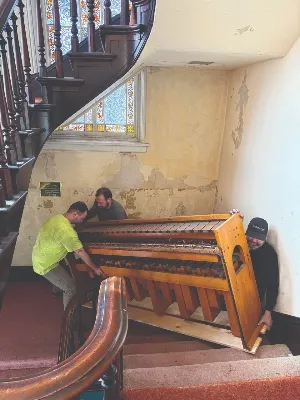
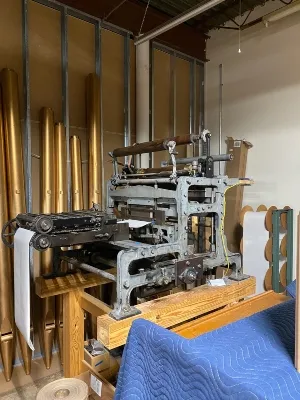
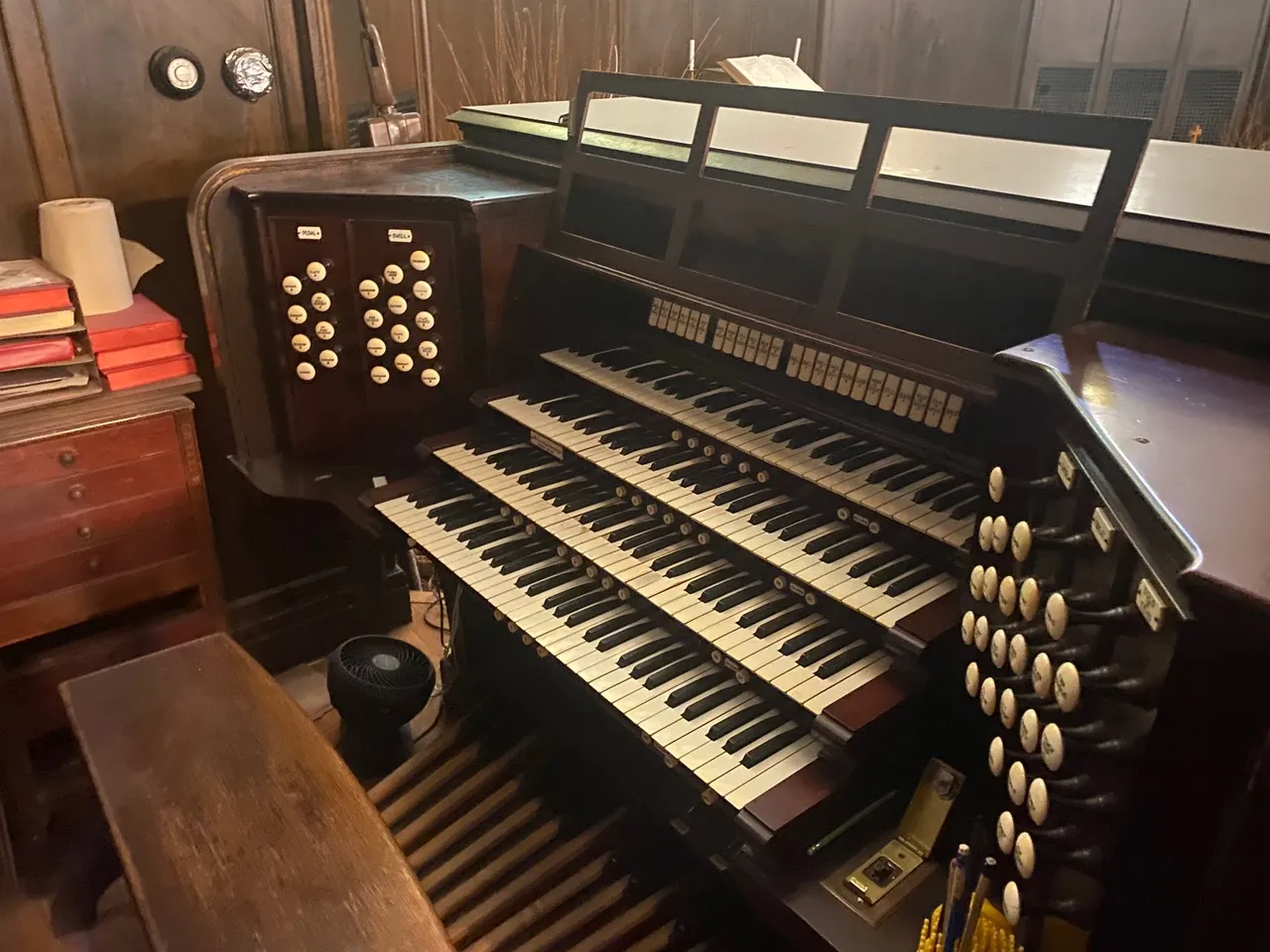
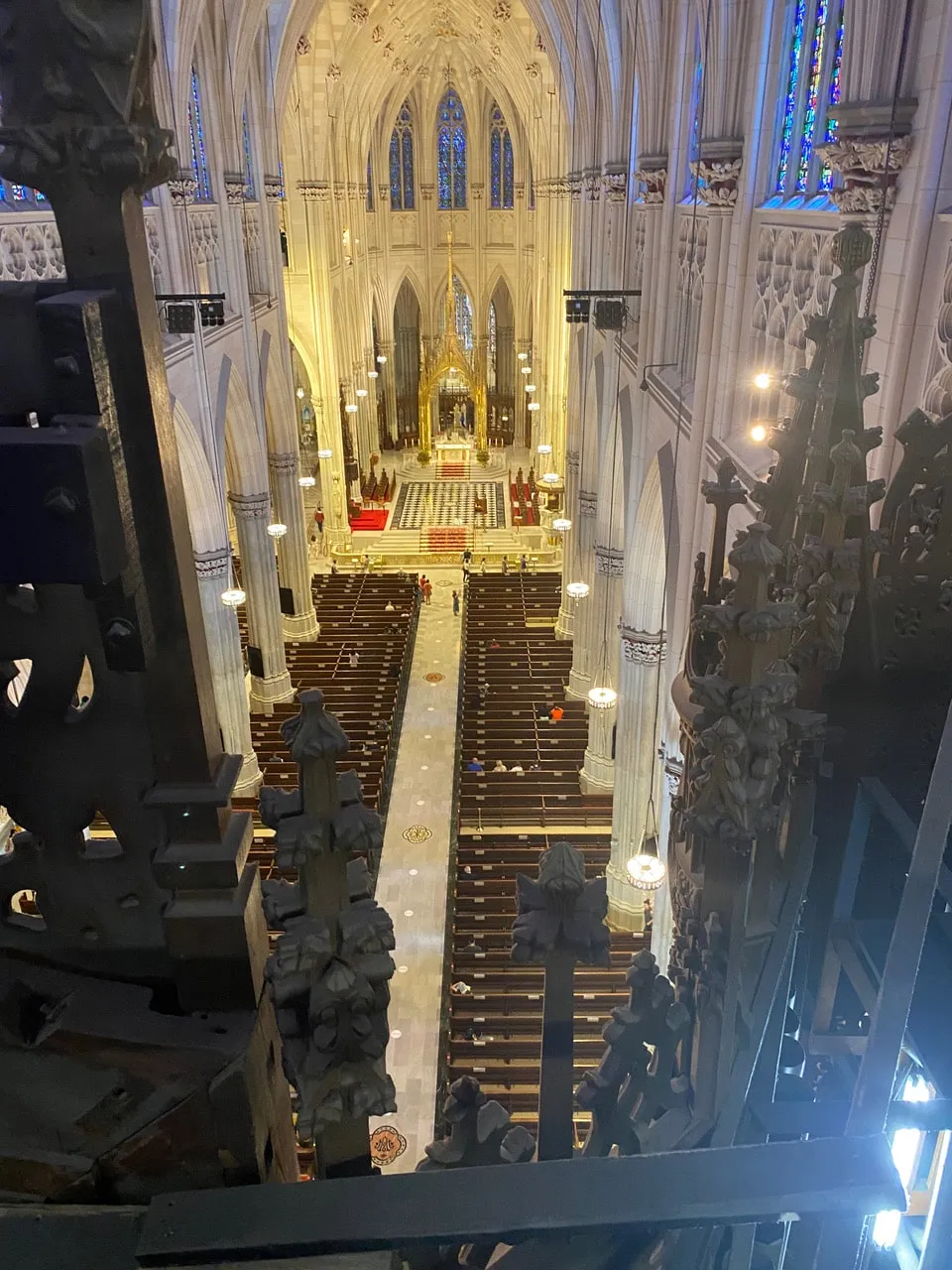
I was excited to see the massive Kilgen organ from Saint Patrick’s Cathedral in New York City in the workshop where it is being treated to a much-needed extensive renovation. Built in 1930 under the direction of cathedral organist Pietro Yon, composer of the beloved Christmas anthem “Gesu Bambino,” the heroic organ has 116 ranks. It was in poor condition, frustrating the wonderful musicians who play for daily Masses and countless festivals in that busiest of churches. Alain Goneau described the voluminous research he has done as he planned the tonal restoration of the organ. The two massive five-manual consoles are standing back-to-back while they are being packed with new innards. Dozens of pipe trays are stacked on specially constructed dollies. Parts of the organ are distributed throughout the specialty workshops for electrical work, leather work, voicing, and the dozens of other tasks involved in renovating a massive organ for what must be one of the most important churches in the world.
After our shop tour, Jens, Alain, and I met Simon Couture for lunch, continuing the rich conversation for a couple hours. My thanks to them for the fine lunch and stimulating, fascinating morning.
Orgues Létourneau
Fernand Létourneau founded his eponymous company in 1979 after working as a voicer at Casavant Frères for about fifteen years. By the time he retired in 2019, the company had produced more than 120 organs, a terrific life’s work over a forty-year career. Andrew Forrest is president of Létourneau.1 He and I have been friends for years, and he shared his afternoon with me, touring through the many rooms of the bustling workshop. He showed me the Swell division of the new organ for Marvin Methodist Church in Tyler, Texas, that is currently in the erecting room, which can be seen both at floor level and from a high balcony at the back of the room. He showed me the furnace for melting metal to make organ pipes and the rotary planer that smooths the metal and produces accurate thickness. We saw rooms equipped for voicing, leather, electrical work, and, of course, woodworking equipment. The console department was busy with the four-manual console for the Tyler, Texas, organ.
Orgues Létourneau builds organs with tracker action, with electric-slider windchests, and with electro-pneumatic actions. The opus list published at letourneauorgans.com shows organs throughout Canada and the United States, Austria, the United Kingdom, New Zealand, and many in Australia.
Montréal is a great restaurant destination. After our separate excursions, Wendy and I met up for the second marvelous meal of our short trip with lodging provided by some of my many Bonvoy Marriott points, a lovely perk from continuous business travel.
The Twin Cities
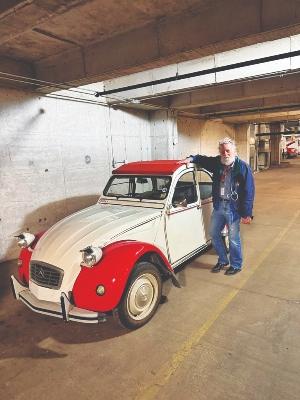
During Holy Week, when my organist pals were hard at work and my tuner pals were scurrying about the countryside, I flew to Minneapolis for a consultation appointment. My schedule there left an afternoon free, and Michael Barone, founder and host of Pipedreams on Minnesota Public Radio, picked me up at my hotel to give me a generous tour of some of the city’s finest organs. Before I tell you about the organs, let’s talk about the car. Michael is a notorious collector of classic Citroën cars, and as I was waiting on the sidewalk for him to arrive, I saw this adorable white and red car with bug-eye headlights buzzing down the street. My first thought was that it was the car that Pink Panther’s Inspector Clouseau drove into a swimming pool.
It is a 1986 2CV model “Dolly.” Dolly refers to the Art Deco two-color paint scheme. The 2CV was introduced by the French auto maker Citroën in 1948 as France’s answer to the Volkswagen Bug, created to bring cars to rural French peasants who farmed in regions where there were few roads. Citroën manufactured the car until 1990. Michael’s Dolly is from 1986 with a twenty-nine-horsepower, front-mounted, air-cooled engine that drives the front wheels, and a four-on-the-dash transmission. I squeezed into the tiny car next to Michael, managed to compress myself enough to get the door closed, and off we went. My shoulders neatly filled the gap between the passenger window and Michael’s right shoulder. I drive a Chevy Suburban, the big SUV that United States presidents ride in, so I am used to a spacious interior and lots of luxury appointments. Riding in Dolly was like rolling down a hill in a telephone booth. What a treat.
Northrop Auditorium, Minneapolis, Minnesota
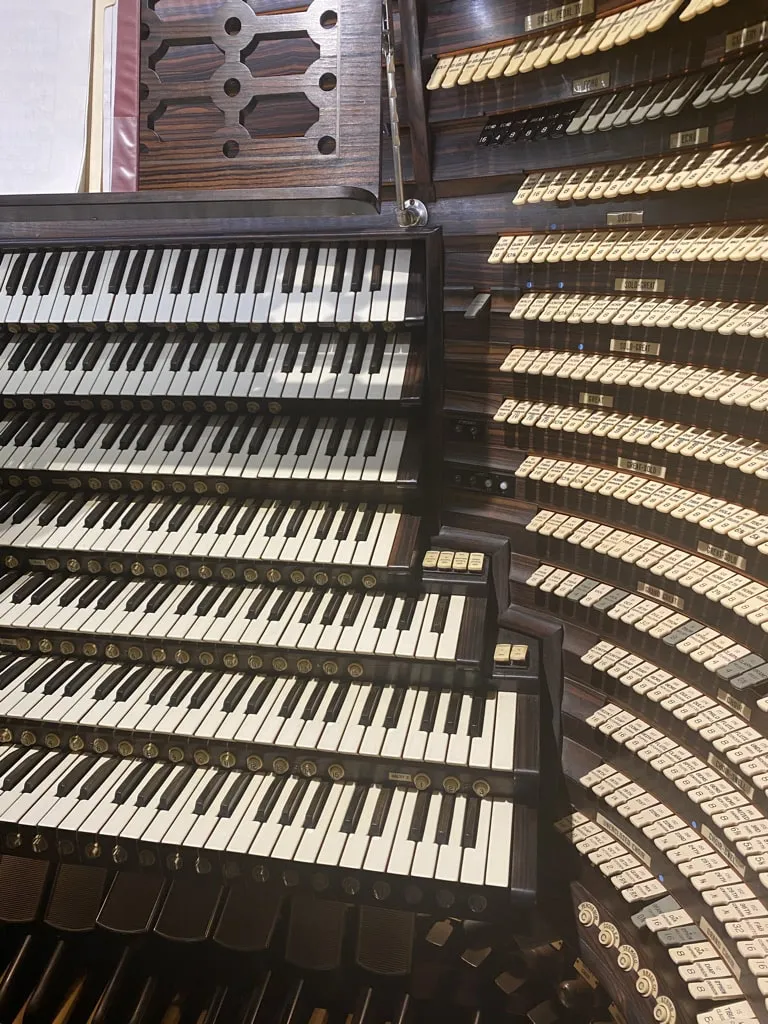
Our first stop was Northrop Auditorium of the University of Minnesota in Minneapolis, home to a stupendous 108-rank Aeolian-Skinner organ built in 1936. Northrop Auditorium was opened in 1929. Starting in 2011, the building was radically renovated, reducing the size of the main auditorium and forming smaller performance spaces, and office, technical, and storage spaces. The revised auditorium has 2,700 seats and sophisticated back-stage equipment to support complex theatrical performances. The massive organ was located above the proscenium in a lofty but remote space. The reconstruction of the hall allowed a new platform above the stage made of a heavy steel grate, with the various divisions of the organ arranged in a row of looming black expression boxes, the exposed Great, and the massive pedal stops including a 32′ Double Open Wood of huge scale located on a lower floor level at each side of the stage, standing straight up without mitering. The movable console is at stage level, easily rolled out of the way when not needed, connected to the organ’s control system with a Cat 5 cable. I count five 8′ diapasons, seven pairs of Celestes, nineteen ranks of reeds, and seven open 16′ ranks.
The renovation of the organ was performed by Foley-Baker, Inc., of Tolland, Connecticut, who famously renovated organs at Boston Symphony Hall, Duke University Chapel, Merrill Auditorium in Portland, Maine, and The First Church of Christ, Scientist (The Mother Church) in Boston. Northrop Auditorium is not the largest on this list (the Aeolian-Skinner at The Mother Church has 240 ranks), but because of the new structure on which the renovated organ is placed and the extreme height of the chamber (we climbed more than a hundred stairs to get to the organ), it may have been the heaviest and most difficult.
The organ’s tone is varied, rich, and refined. With full combinations drawn it is a powerhouse, and the huge bass stops are especially impressive. What a joy to see such an important instrument cared for so beautifully. You can see photos and specifications of the Northrop organ at pipeorgandatabase.org/instruments/24656.
House of Hope Presbyterian Church, Saint Paul, Minnesota
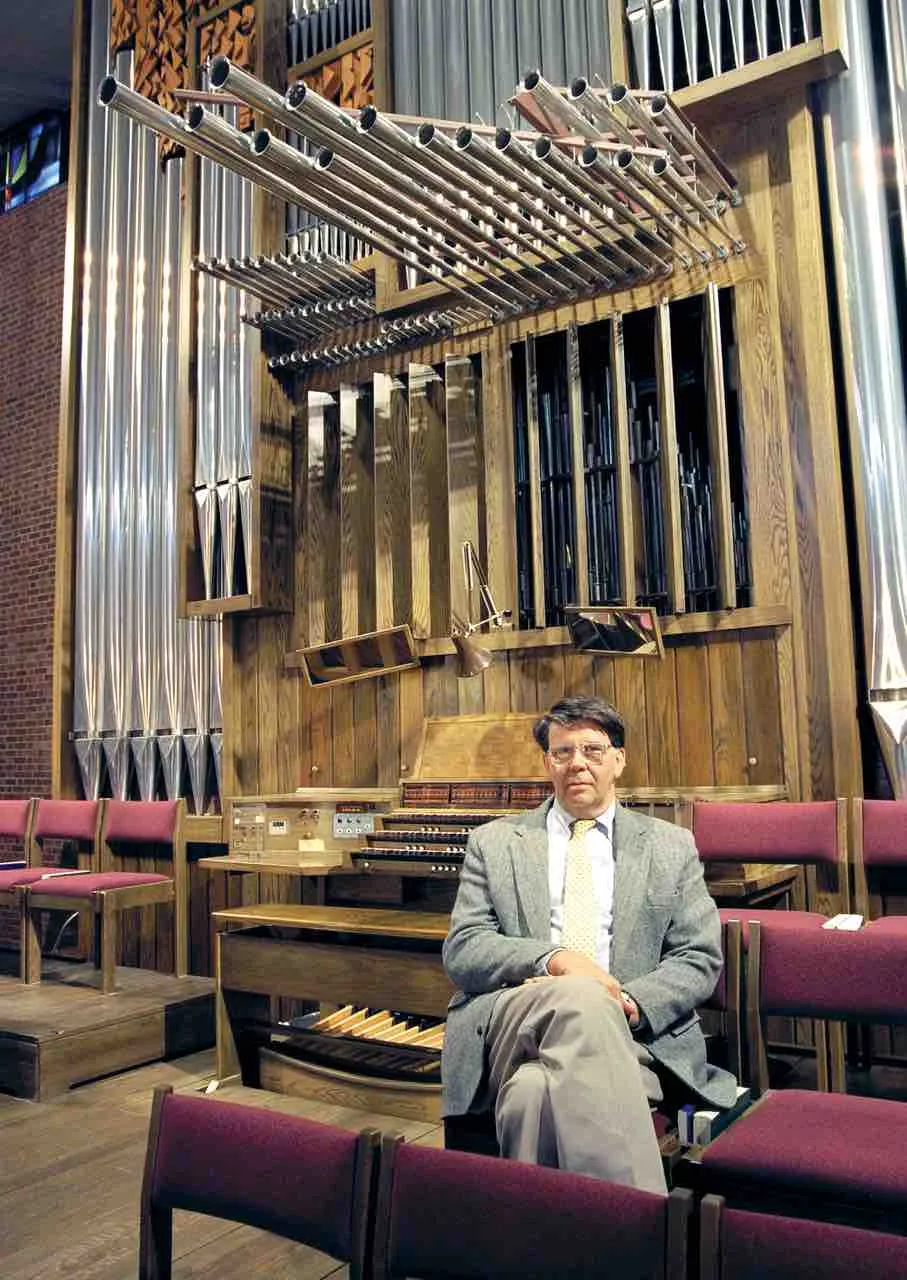
Michael and I climbed back into Dolly to drive fifteen minutes east to House of Hope Presbyterian Church in Saint Paul, Minnesota, home of C. B. Fisk’s Opus 78 built in 1979, one of the builder’s largest organs with nearly 100 ranks on four manuals. The high number of ranks is largely due to the presence of ten compound stops, mixtures, sesquialters, and cornets, including a Mixture VIII–XII on the Great—there is a job for an expert tuner. The Great, Swell, and Brustwerk are all housed in the tall but surprisingly sleek main case with the keydesk built in. The Rückpositiv is in the usual location on the balcony rail, and the Pedal is in two separate cases, also mounted on the balcony rail as in the Schnitger organ in St. Jacobi, Hamburg, Germany. I’m guessing that this is the first organ built in the United States with that classic layout.
I have known about this organ since it was dedicated, but this was the first time I saw it, and I was overwhelmed by its majesty and beauty. It is an exceedingly important instrument—perhaps the largest free-standing classic-style tracker organ built in this country, especially before 1980 or even later. It is approaching fifty years old, and it is a statement of refined elegance and North European brilliance. It is also beautifully equipped and voiced for the rich language of the French Classic literature—there are five tierces including those in compound stops.
This majestic organ is testimony to Charles Fisk’s genius. It is a stand-out monument from the exciting days of the twentieth-century renaissance in American organbuilding and has influenced countless organs that followed it.
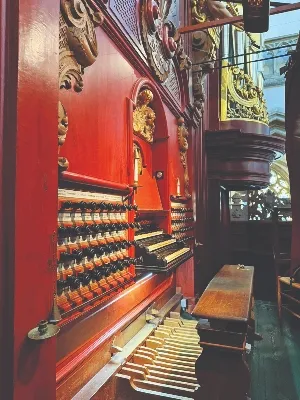
The chancel of House of Hope is home to an organ built by Joseph Merklin (1819–1905), who was born in Germany, established his organ shop in Belgium in 1843, in 1855 bought the firm of Ducroquet in Paris, and finished his career working there. Although Merklin spent his career in the shadow of Aristide Cavaillé-Coll, his organs were widely appreciated. The large organ he built in 1867 for the basilica in Nancy won a gold medal at the Exposition Universelle in Paris, which secured for Merklin the title of Chevalier of the Légion d’Honneur.
The Merklin organ was brought to House of Hope by C. B. Fisk in 1987, eight years after the completion of the famous gallery organ. You can see photos and specifications of both organs at pipeorgandatabase.org/instruments?location=House+of+Hope&sort=-year&limit=15.
Maternity of Mary Catholic Church, Saint Paul, Minnesota
The last organ of the day was Casavant Opus 3302, built in 1977. Remembering that Casavant has signed a contract for Opus 3962, I did the math. That is an average of over thirteen organs a year for forty-nine years. After visiting a couple of hundred-rank jobs, it was refreshing to see this twenty-two-rank beauty that has a strong principal chorus with an 8′ Trumpet on the Great and a gentle Brustwerk nestled underneath. It is a lovely organ with a brilliant voice in a large room, exquisitely voiced and intimately musical with a delicate mechanical action. The visit was a reminder of the breadth of the world of the pipe organ, that one can experience a thirty-ton monument and a gentle, songful beauty by driving about ten miles in Dolly. You can see photos and specifications of this organ at pipeorganlist.org/OrganList/data_mn/MN-StPaulMaternityOfMary-CASAVANT-3002.html.
Minnesota Public Radio
To cap off the afternoon, Michael gave me a cook’s tour of Minnesota Public Radio (MPR), founded in 1967, where he was hired as the first music director in 1968. Michael has been at MPR over fifty-seven years through the establishment of forty-five network stations across Minnesota, the construction of impressive headquarters buildings in downtown Saint Paul, and the accumulation of more than a thousand awards for MPR News. And through it all, he has brought Pipedreams to an admiring throng of organ enthusiasts since 1982, establishing him as a leading advocate for the organ. There is a link on the Pipedreams website that lists the more than two hundred stations that broadcast the show each week. What a heritage. Thank you, Michael, for all you do for the organ, and for the swell adventure we shared last week—and thank you for introducing me to Dolly. We three survived to tell the story.
Notes
1. Since this writing, we have learned that Andrew Forrest has been appointed executive director of the Canadian International Organ Competition and has left Létourneau. I thank Andrew for the many collaborations we have shared and wish him the very best as he moves into his new role.