In the Wind: Benefactor in the Village
Benefactor in the Village
Sir Alfred Grenville Manton (1909–2005) was born in Essex, England, and grew up in Westcliff-on-Sea. Although he received a scholarship to attend Cambridge University, he followed the advice of his uncle who introduced him to an executive of the Caledonia Insurance Company in Paris. He worked there from 1926 until 1933 when he was offered a position with the nascent American International Underwriter Group as a casualty underwriter. He became president of the company in 1942 and chairman in 1969, during which time the tiny company grew to become the insurance giant AIG with more than 50,000 employees, and Manton amassed a fortune.
After World War II, Manton started to collect art, especially the works of British painters. Through the 1960s and 1970s, he built one of the largest private art collections in the world. He was friends with Leslie Parris, deputy keeper of the British collection at Tate Britain, and donated many millions of dollars toward Tate’s acquisition of significant artworks, and many more millions for the development of new galleries to house the collection. Manton is the second most prolific benefactor of Tate Britain, second only to Sir Henry Tate (1819–1899), who founded the institution with his own personal collection. Manton was knighted by Queen Elizabeth in 1994 for his influence on the Tate.
Manton, and later the Manton Foundation, was also a significant benefactor of the Clark Art Institute in Williamstown, Massachusetts. The Clark and neighboring Williams College jointly run a two-year program preparing students for careers as museum curators and senior staff.
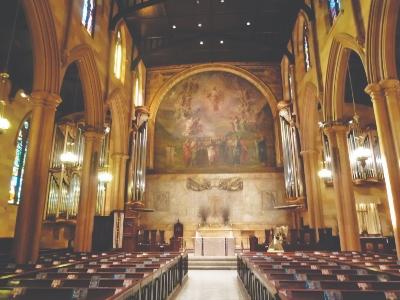
For more than fifty years, Manton was a member of Church of the Ascension, an Episcopal church in Greenwich Village on Fifth Avenue between Tenth and Eleventh streets in New York City. The church was such an important part of his life that Manton (colloquially known as Jim) and his wife Florence (colloquially known as Gretchen) lived in an apartment next door to the parish house. Jim served the church as warden and vestryman through most of those years until his death at home in October of 2005.
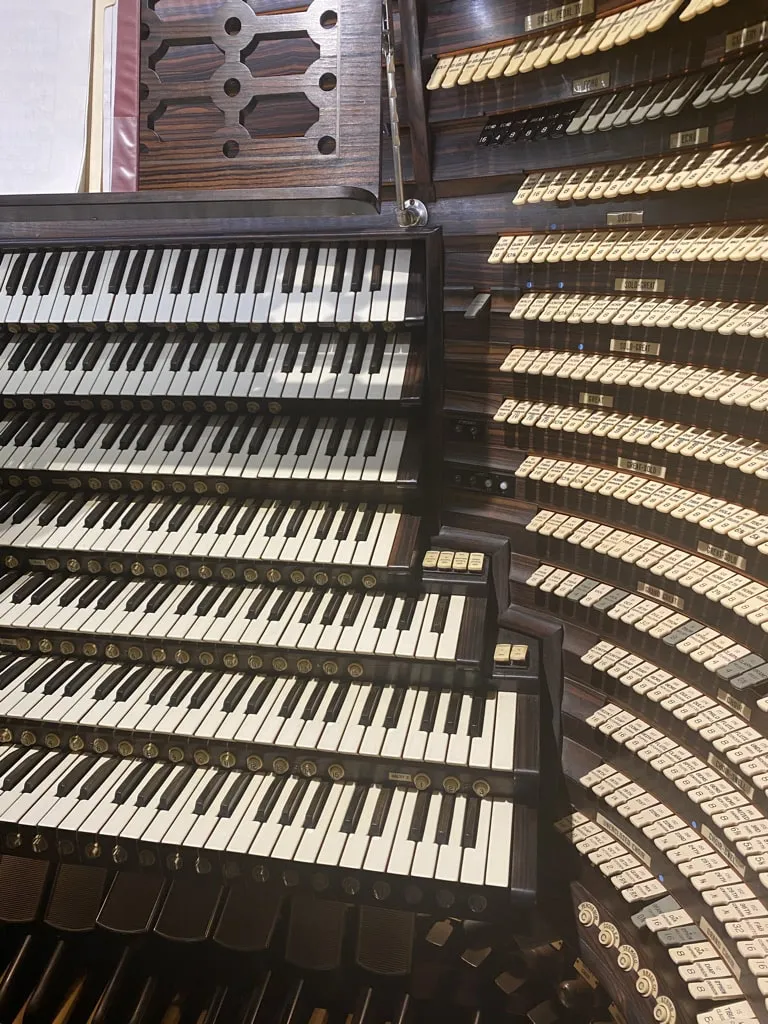
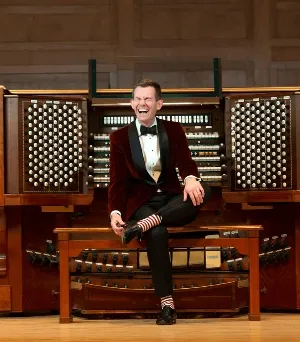
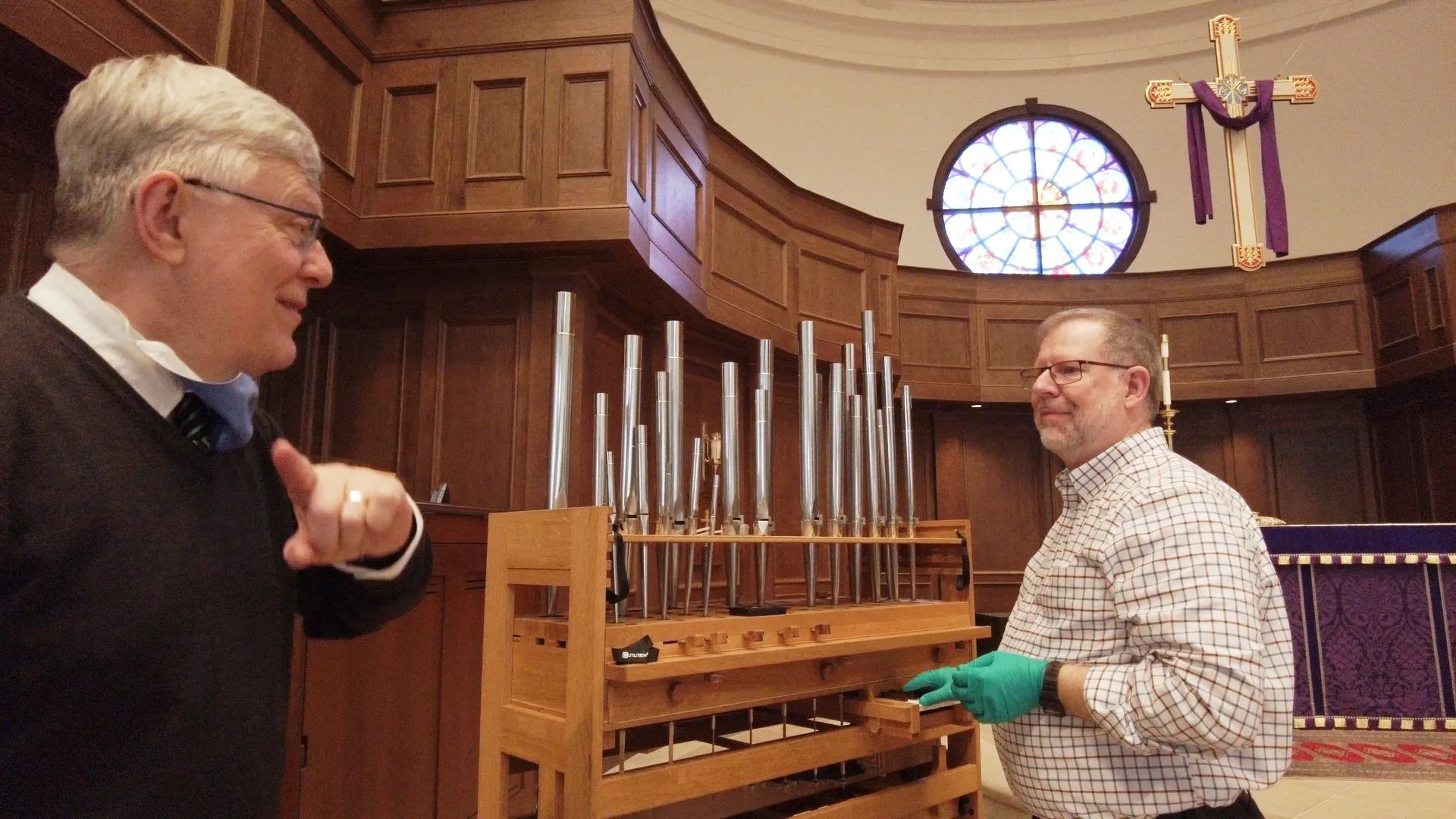
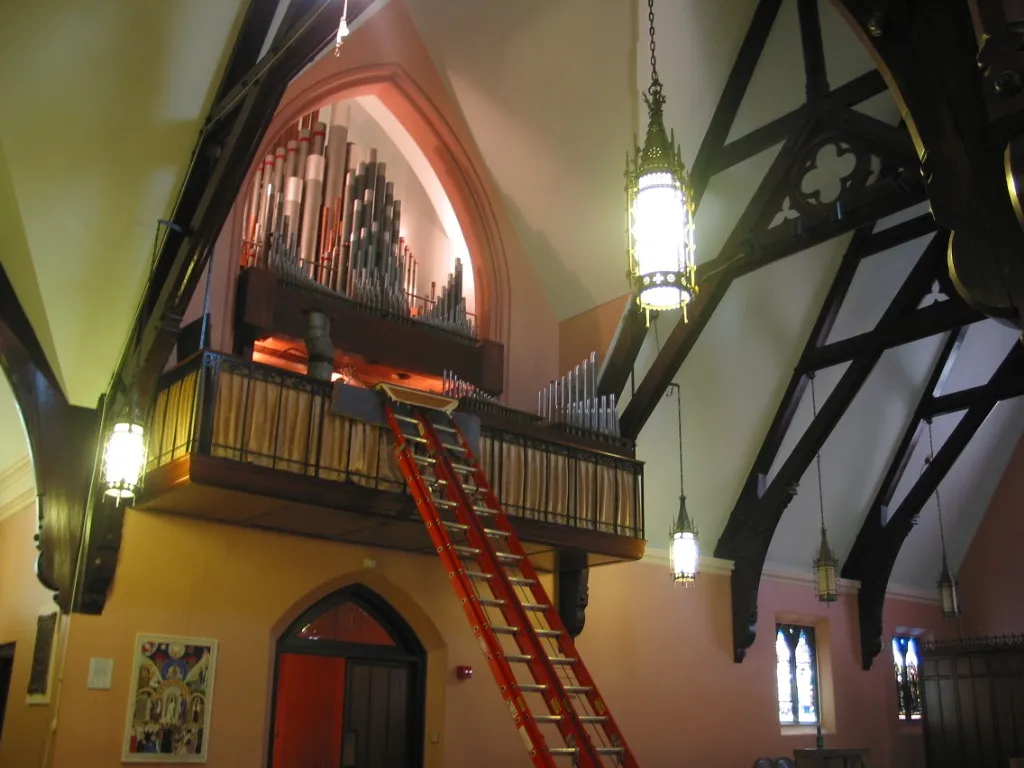
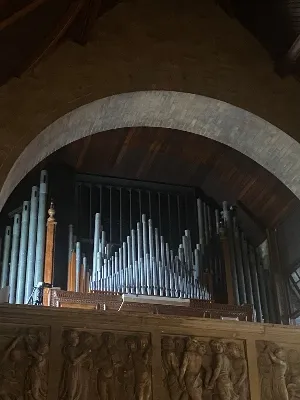
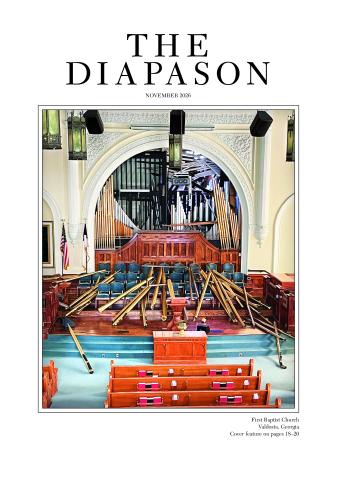
I first visited Church of the Ascension in 2008 when they had commissioned a new pipe organ to replace the 1967 Holtkamp with four manuals and eighty-one ranks, and Dennis Keene, who recently retired after forty-five years as organist there, invited me to visit the church to inspect the organ so the Organ Clearing House could offer it for sale. The new organ built by Pascal Quoirin of Saint-Didier, France, was dedicated in 2010. (See cover feature, November 2011 issue.) As I wrote in these pages last month, it is a monumental instrument with ninety-five stops and 111 ranks. In fact, it is two organs in one, a three-manual, mechanical-action classical French organ, and a four-manual console that plays the tracker organ with electric action plus a Grand-Récit Expressive and massive Pedal division, allowing the performance of the great Romantic literature.
Wendy and I lived in Greenwich Village at Ninth Street and Broadway for ten years, three blocks from Ascension, and we often attended services and recitals there. Jon Gillock playing Messiaen and Stephen Tharp playing Widor’s Symphonie Romane and all three Franck Chorals (with after-party in our apartment) stand out as exceptional musical experiences. Dennis founded Voices of Ascension Chorus and Orchestra in 1990, and we were excited to attend several of their concerts over the years. (Their 2026–2027 season ends on April 15, 2027, with a performance of Bach’s Mass in B Minor.)
Dennis and I occasionally met for breakfast at a bistro called French Roast at Sixth Avenue and Eleventh Street, an easy walk from home for me, and to the church for him. One morning over croque madames he told me a marvelous story about the conception of the Quoirin organ. The 1967 Holtkamp at Church of the Ascension was aging, becoming increasingly unreliable, and as they studied the issue, the people of the church realized that while they would be able to manage the renovation of the organ, a significant new organ would be out of reach unless a donor could be identified.
Dennis drafted a letter to Manton proposing that he provide funding for a new organ. They made an appointment to meet to discuss the proposal, but ninety-six-year-old Manton fell ill and passed away—the meeting never happened. A month later, Manton’s son-in-law Hugh Morton knocked on the door of the parish house and asked to speak with the rector, the Reverend Andrew Foster. In the rector’s office, Morton said that his family members were sorting out Manton’s affairs and found Dennis’s proposal on his desk with Manton’s notes. They could see that he intended to fund the organ and decided to fund the project as a memorial to their parents. Reverend Foster called Dennis on the intercom saying, “Dennis, you should come to my office now.”
Dennis assumed the task of selecting an organ builder and started traveling to visit organbuilders’ workshops and their instruments. As he expanded his search to European firms, he wrote to Manton’s daughter Diana to inform her of his plans. She responded with a grant of $25,000 to cover the cost of the travel.
On the advice of his former teacher, André Isoir, Dennis visited Orgues Quoirin in Avignon, a town with about 95,000 residents in Provence, in the south of France, along the Rhone River. It was Quoirin’s proposal that seemed right, and the marvelous organ they built is testament to the generous gift of the Manton Foundation and the memory of Manton and Florence Tate.
The Clark Art Institute
Robert Sterling Clark (1877–1956) inherited wealth from his grandfather, who was an executive of the Singer Sewing Machine Company, and with his wife Francine he started collecting art in Paris in 1911. The Clarks lived in New York City where they anticipated leaving their collection to the Metropolitan Museum of Art, but as nuclear armaments were increasing during the Cold War, they worried about the safety of their collection in case of an attack on New York. They searched for a remote location where they could develop a museum as a safe home for it. They settled on Williamstown, Massachusetts, in the Taconic Mountains in the utmost northwest corner of the state. Sterling’s father and grandfather had both been trustees of Williams College in Williamstown, and talks with the college and town led to the inception of the Clark Art Institute, which opened to the public in 1955, the year before Sterling Clark’s death.
An impressive new building was added in 1973 that includes exhibition galleries, gift shop, café, and event spaces. That building houses the Manton Collection of British Art of more than three hundred artworks and the Manton Research Center, an extensive library and archive. The exterior architecture includes reflecting pools, outdoor seating, and gorgeous vistas. The 140-acre campus includes walking and hiking trails through grazing pastures with cattle, adding recreational depth to the exquisite museum. It is not a large museum, but it is home to thousands of artworks including many paintings by Claude Monet, Rembrandt, Winslow Homer, Pierre-Auguste Renoir, Édouard Manet, and many others.
Aso O. Tavitian (1940–2020) was born in Bulgaria and emigrated in 1961 to earn a master’s degree at Columbia University in nuclear engineering, paying his way by working as a taxi driver in New York. He founded a software company in 1969, which earned him a fortune. He lived in New York City and Stockbridge, Massachusetts, in a grand hilltop house that is visible from the cemetery behind our house. He left his collection of more than 330 works of art to the Clark, along with a $45,000,000 grant to fund a curator and build a new building adjacent and between the existing galleries. The Tavitian Gallery is due to open in 2028.
Wendy and I live in Stockbridge, about an hour from Williamstown, home of the Clark Institute, and we visit there frequently. The galleries are spacious and beautifully curated, and the museum is free of the throngs one battles in the great urban art museums. The Metropolitan Museum of Art in New York received 5.72 million visitors in 2025, while the Clark received about 200,000. It is possible and comfortable to stand, study, and absorb a painting by Monet or Rembrandt without being bustled about or feeling that you are taking time from other visitors.
Because of the outdoor trails, the Clark is a great place for a family outing. We have taken our grandchildren and their parents for hikes scaled according to age, visits to the galleries timed for the attention span of a four-year-old, and lunch in the café. Sterling Clark, Edwin Manton, and Aso Tavitian have given the region a cultural gem. I invite you to explore the Berkshires for a cultural reset. Besides the Clark we have Mass MOCA (Museum of Contemporary Art) in North Adams, Massachusetts, the next town east of Williamstown, which is housed in a reclaimed factory building, and the Norman Rockwell Museum in Stockbridge. Tanglewood, the summer home of the Boston Symphony Orchestra that offers hundreds of concerts and programs in July and August, is six miles from our house. The Red Lion Inn in the center of Stockbridge is a classic, slightly rickety New England Inn that features a huge collection of teapots, and there are many hotels, inns, and air b-n-b’s in the area. Let me know when you’re coming.
Pinecones and overtones
Through the window over my desk I see several hemlock trees, a “schöne Lindenbaum” (linden tree), and a large Norway Spruce that is festooned with six-inch pinecones. In 2017 I wrote a lecture that included a hint about the math behind pinecones and how that math relates to the musical overtone series. The lecture started with an account of a vacation trip we took with three other couples, chartering a sailboat to visit six islands in the Aegean Sea. Samos was one of the six, home of the mathematician Pythagoras, who lived seventy-five years from 570 to 495 B.C., a long lifetime in those days.
Pythagoras is the one who gave us the eponymous theory, A2 + B2 = C2, which defines the hypotenuse of a right triangle, but I esteem Pythagoras especially for his discovery of the overtone series that is the foundation of tonal music. Listening to the sound of hammering in a blacksmith shop, he noticed that different workers were producing different musical pitches. He assumed that the difference was because of the size of the hammer but quickly realized that it was the size of the anvil. You can prove that yourself quickly by finding something that rings, a bell or wine glass for example. Strike it with a pencil and then a hammer (don’t break the glass), and you will get the same pitch.
He further noticed that each ringing tone was made up of different pitches. His experimentation included the construction of a stringed instrument with one string with which he proved that stopping the string at half its length produced an octave, the first overtone, stopping the string at two-thirds its length produced a twelfth, the second overtone, and so on.
Using the interval of the fifth, which is a factor of the second overtone, we realize the circle of fifths: A, E, B, F-sharp, C-sharp, G-sharp, D-sharp, A-sharp, F, C, G, D, and back to A. These get sorted into order as the notes of the keyboard. Play each note in a single octave in sequence with a fifth above, and you have parallel fifths. Include the fourth overtone, which is a third above the root note plus two octaves, and you have built a triad. Think it through, and you can trace the origin of tonal music. My visit to that Greek island was a pilgrimage to the inventor of music, but not the inventor, the discoverer of music. It was there all along, someone just had to notice it. Smart guy.
Leonardo Fibonacci (1170–ca. 1245) was an Italian mathematician who realized that a certain series of numbers related exactly to many facets of nature. The series is simply the sums of subsequent equations: 1 + 1 = 2, 1 + 2 = 3, 2 + 3 = 5, 3 + 5 = 8, 5 + 8 = 13, etc. The series applies to the graduation of sizes of the leaves of an artichoke, the exterior cells of a pineapple, the elegant spirals in the Italian broccoli called Romanesco, and yes, the blades of pinecones. The Fibonacci series also applies directly to the musical overtone series. It is amazing, almost fanciful that the series of numbers relates to so many aspects of life and exemplifies the deep connection between science and nature. Smart guy. I am also amazed to realize that those two mathematicians discovered those two sequences that relate so closely with each other eighteen hundred years apart.
My 2017 lecture applies these theories to the origin of the pipe organ, the development of various organ stops at different pitches, and how that led to the invention of stop action to control those organ voices. I also describe how Johann Sebastian Bach used the Fibonacci series to structure fugues. There are over 120 slides illustrating all this.
I originally gave that lecture during the Presidents’ Day Weekend program of the New York Chapter of the American Guild of Organists in February of 2017 and gave it again that summer in Montreal for the joint convention of the AGO and Royal Canadian College of Organists. I would be happy to dust it off and present it to your AGO chapter, class of organs students, or any group you think would be interested. I’ll bring broccoli and pinecones for everyone. Send me a note at [email protected]. We’ll have fun.
Well done, good and faithful servant
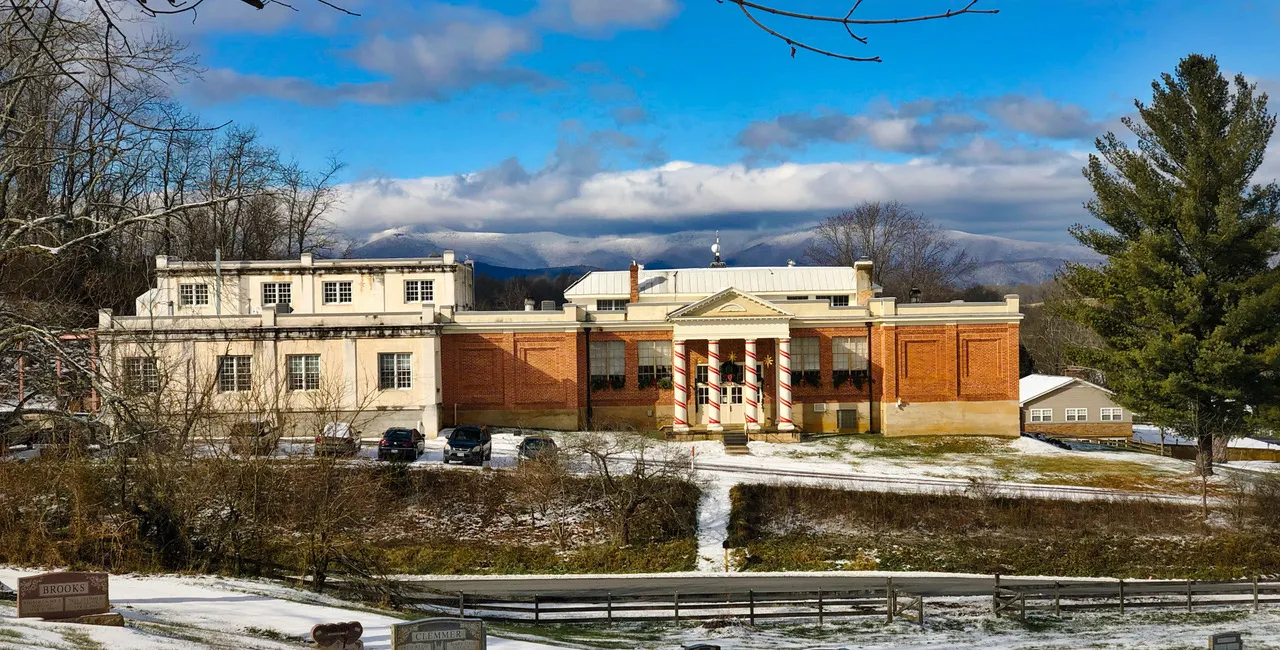
George Taylor, co-founder of the widely admired organbuilding firm Taylor & Boody, passed away on February 13, 2026. He apprenticed with Rudolf von Beckerath in Hamburg, Germany, on a grant from the Ford Foundation and returned to join the workshop of John Brombaugh in Germantown, Ohio, where his coworker was John Boody. When Brombaugh planned to move his company to Oregon, George and John chose to start their own firm, moving to Staunton, Virginia. Taylor & Boody has completed almost ninety organs since their founding in 1979. Their workshop is in a large airy building that was originally a public school where big windows let in lots of sunlight, fostering an atmosphere of quiet collaboration and creation.
I have been fortunate to visit the workshop several times, and to visit with both John and George around the country at different events. Both had retired, and the company is now in the hands of John’s son Erik, Aaron Reichert, Robbie Lawson, and the well-established team of craftsmen and women. That decades-long partnership has influenced and informed countless organists and added significantly to the history of the American pipe organ.