In the Wind: How long have you been playing there?
How long have you been playing there?
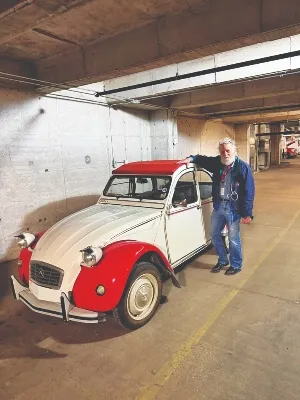
Last month I took a driving trip from home in western Massachusetts to Buffalo, through Québec to Ann Arbor, and on to Chicago where the Organ Clearing House was working on a project. I drove home through Champaign, Illinois, and Columbus, Ohio. I visited several organs that I am involved with, had meals with friends and colleagues, and enjoyed the new car that I wrote about last month in these pages—the odometer showed about nine hundred miles when I set out.
Stephen Schnurr, editorial director and publisher of The Diapason, and I have worked together for years preparing this column, but we have met rarely in person. Stephen is based in northwest Indiana, about an hour from Chicago, and as I was passing by we shared a delightful meal on a stormy afternoon near Gary, stormy enough that as we were finishing, the restaurant lost power during a tremendous squall with lightning and thunder. As we chatted, Stephen mentioned that he had been director of music at Saint Paul Catholic Church in Valparaiso, Indiana, for thirty-six years. Driving away, I reflected on that kind of dedication and listed in my head organists whose names were inseparable from the organs they played.
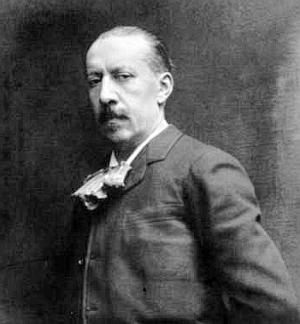
The best known is Charles-Marie Widor, who served as organist at Saint-Sulpice in Paris for sixty-three years (1870–1933) and composed a tremendous body of literature inspired by that singular organ. He was succeeded by his student Marcel Dupré, who stayed there thirty-seven years until his death in 1971. Those two luminaries covered just over a century on that most famous of organ benches. In more modern times, Daniel Roth was titulaire there for thirty-eight years from 1985 until 2023. And speaking of Paris, Louis Vierne was organist at Notre-Dame de Paris from 1900 through June 2, 1937, when he died at the console during his 1,750th recital in the cathedral, his left foot falling on low E of the pedalboard. Maurice Duruflé was standing by the console when Vierne died.
§
When I was curator of the large Aeolian-Skinner organ at The First Church of Christ, Scientist (The Mother Church), in Boston, Thomas Richner (1911–2008) was the organist, a sprightly man in his mid-seventies with a sly wit and a devilish grin who served the church for twenty-two years. I worked there every week for about twelve years, and Tom and I often had lunch together—Au Bon Pain was his favorite. He had previously been organist at Fifth Church of Christ, Scientist, in New York City, where he was a devoted follower of David McK. Williams, organist and choirmaster at Saint Bartholomew’s Church on Park Avenue from 1920 until 1946, perhaps best known to church musicians today as composer of the swashbuckling anthem, In the Year That King Uzziah Died. Williams led a proficient professional choir at “St. Bart’s” that famously presented an oratorio every Sunday afternoon. Tom’s eyes glowed when he described Williams ending an improvised prelude with a decrescendo down to whispering Aeolines and starting the opening hymn with the impressive choir processing down the long center aisle of that beautiful church. He described it as a magical experience, and he and his friends attended frequently.
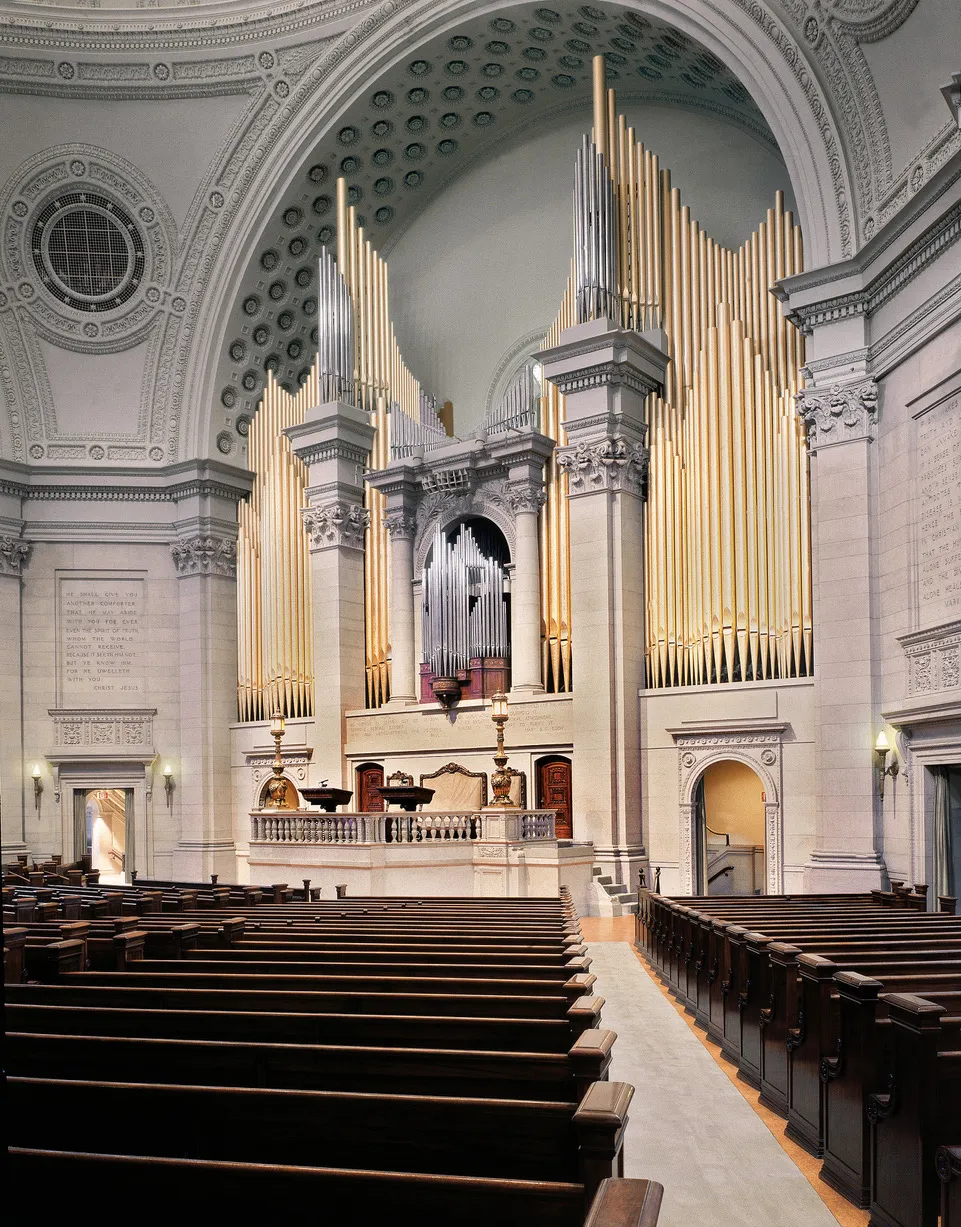
Tom Richner introduced me to Clay Christiansen (born 1949), another storied organist who served the Mormon Tabernacle in Salt Lake City for thirty-six years from 1982 until 2018. The organs at The Mother Church and the Mormon Tabernacle can be considered sisters, as they both have over two-hundred ranks, and were both built by Aeolian-Skinner—the Tabernacle organ in 1948, and the Mother Church organ in 1952. Clay was visiting Tom when we first met during one of my tuning days.
§
John Obetz (1933–2015) had a productive tenure as organist at the Community of Christ Auditorium of the Reorganized Church of Jesus Christ of Latter-Day Saints in Independence, Missouri. His relationship with the Aeolian-Skinner organ there, built in 1956 as Opus 1309, was widely known as he played weekly recitals on the organ that were broadcast nationally by radio. The program was called The Auditorium Organ, and I listened to it often along with thousands of others. Because of that program, John was likely one of the most-heard organists of the time, and I imagine he had among the largest repertoires of any organist. His influence was expanded through his thirty years of teaching organ at the University of Missouri-Kansas City’s Conservatory of Music.
John’s student Jan Kraybill followed him as auditorium organist, and by now she is as widely associated with that organ as was John. Jan is also organist and curator of the 2011 Casavant Opus 3875 in the Kauffman Center for the Performing Arts in Kansas City, Missouri, the product of a twenty-year study named EPOCH (Experiencing Pipe Organs in Concert Halls), chaired by John Obetz, which persuaded philanthropist Julia Irene Kauffman to include a pipe organ in the proposed concert hall.
§
Dorothy Papadakos (born 1960) had a relatively short tenure as organist at the Cathedral of Saint John the Divine in New York, New York, serving there between 1990 and 2003, but I associate her distinctive style of playing with that organ because of her 2001 recording, Café St. John. Some of the tracks on the compact disc were recorded live during services and events at the cathedral, notably her quirky improvisation on “Take Me Out to the Ball Game,” complete with a fanfare on the State Trumpet, chromatic harmonies, and the grand organ’s fleet of 32′ stops that she played as a postlude during the fall of 2000 when baseball’s World Series was played between the American League champion New York Yankees and the National League champion New York Mets, famously known as the Subway Series. (The Yankees beat the Mets four games to one.)
Wendy attended the funeral of former New York mayor John Lindsay at the Cathedral of Saint John the Divine in 2000 and reported that the postlude was Dorothy’s improvisation on New York, New York, the familiar song made famous by Frank Sinatra. While there have been several other wonderful organists at the cathedral during my lifetime—Alec Wyton was organist there when I was a kid—I have long associated Dorothy’s unique voice with that wonderful organ.
§
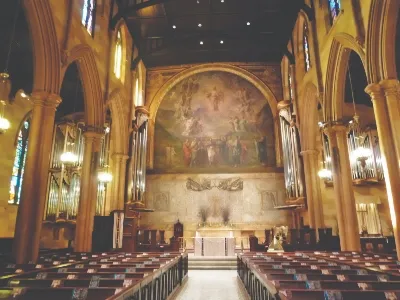
Wendy and I lived on the corner of Broadway and East Ninth Street in New York for ten years, kitty-corner from Grace Church, home of Taylor & Boody Opus 65 (2013), and across the street from the former New York Wanamaker store, which housed a 118-rank organ built by the Wanamaker organ shop in the top floors of the flagship store in Philadelphia. Louis Vierne played recitals on that organ, and I loved imagining him walking the sidewalks of our neighborhood. Two blocks west and one block north is the Church of the Ascension, resplendent with interior decoration by Stanford White and four stained-glass windows and a magnificent mural, The Ascension of Our Lord, by John LaFarge. Dennis Keene has just retired as organist and director of music there after forty-five years. He succeeded Vernon de Tar, his teacher at The Juilliard School of Music, who served Ascension for forty-two years. Vernon de Tar oversaw the design and installation of a four-manual organ by Holtkamp in 1967, and Dennis Keene followed with the installation of a four-manual organ with ninety-five stops built by Pascal Quoirin in 2010. The Quoirin organ is unique with a double personality, a complete three-manual mechanical-action French Classic organ at its core, played from a three-manual keydesk, plus a large symphonic French Grand-Récit Expressif playable from a massive four-manual console that also controls the classical organ. (See cover feature, November 2011 issue.)
In addition to his work as organist and music director at Ascension, Dennis founded Voices of Ascension Chorus and Orchestra in 1990, a superb ensemble that presents regular concerts in the Church of the Ascension. The 2026–2027 season features six concerts culminating with Bach’s Mass in B Minor on April 15, 2027. While he is retired from the church staff, he continues as artistic director and conductor of Voices of Ascension.
§
Ray Cornils and I were students together at the Oberlin College Conservatory of Music in the 1970s. After graduation we went in different directions and did not meet again until Wendy and I settled into our house in Newcastle, Maine, in 2001, and started attending concerts presented by the Friends of the Kotzschmar Organ in Merrill Auditorium of City Hall in Portland, Maine. The Kotzschmar Organ was given to the city by Portland native Cyrus Curtis, publisher of The Saturday Evening Post and The Lady’s Home Journal, and dedicated along with the new City Hall building in 1912. The previous building had been destroyed in a 1908 fire that was caused by a new-fangled electric fire alarm system in the office of the city electrician.
Ray was appointed municipal organist in Portland in 1990 and was well established as one of Maine’s best-known musicians by the time we moved there. Ray and I were reacquainted, and he and a member of the Friends of the Kotzschmar Organ’s (FOKO) board of directors invited me to join the board, a position I just left in December of 2025. Ray developed educational programs that had him dressing up as Johann Sebastian Bach and presenting events at public schools in the Portland area, dramatically expanding his audience around the state. By the time I got involved in FOKO, Ray was a beloved figure in the area, famous for his low-key spoken program notes delivered with wry wit in his gentle bass voice, and his way of walking on and off the stage, a gait that is best described as a “glide.” Somehow it didn’t appear that his legs or hips were moving, but sure enough, he got there. Ray was an effective ambassador for the organ, and his performances were widely admired. At Ray’s last recital on the Kotzschmar Organ, Portland Mayor Ethan Strimling presented him with a key to the city. Ray was succeeded by the ebullient and virtuosic James Kennerley who is approaching his tenth year as Portland’s eleventh municipal organist.
§
Jean Guillou (1930–2019) was titulaire at Saint-Eustache in Paris from 1963 to 2015. He was a student of Dupré, Duruflé, and Messiaen, and known especially for his fiery improvisations. I heard him play twice in Dallas during the 1994 convention of the American Guild of Organists. The first was his performance of Joseph Jongen’s Symphonie Concertante played on the then-new C. B. Fisk Opus 100 in Meyerson Symphony Hall with the Dallas Symphony Orchestra, a daring, thrilling, evocative reading of that monumental work. The second was less grand but singularly intriguing. At the entrance to the convention’s exhibit hall, Schlicker had installed a modest two-manual organ as their sales exhibition, and throughout the week we heard countless organists taking it for a spin, most of whom started either with the first bars of “Jesu, Joy of Man’s Desiring” or “Toccata in D Minor” (I don’t need to name the composer). In the blur of so many gentle renditions, there suddenly came a mighty roar from that little organ. I ran to see who it was, and there sat Guillou with signature white hair flashing about. Of course, who else could it have been?
As an aside, I remember a cute moment during the setup of the exhibitions for that convention when Ted Alan Worth was helping at the Ruffatti booth, unpacking boxes of brochures and hissing that “They’re treating me like a stevedore.” That may be the only time I’ve heard someone use the word stevedore in conversation.
§
It’s fun and humbling to think of the careers of so many great musicians spent serving great churches for decades. The list is endless, and I am sure you could easily add to it. Think of Gerre Hancock at Saint Thomas Church in New York City and John Scott’s tragically short tenure there, Paul Manz and David Cherwien at Mount Olive Lutheran Church in Minneapolis, or Charles Dodsley Walker at Church of the Heavenly Rest in New York. Peter Sykes has just retired as director of music at First Church in Cambridge, Massachusetts, after forty years. He played the service there for the last time on Sunday, May 31.
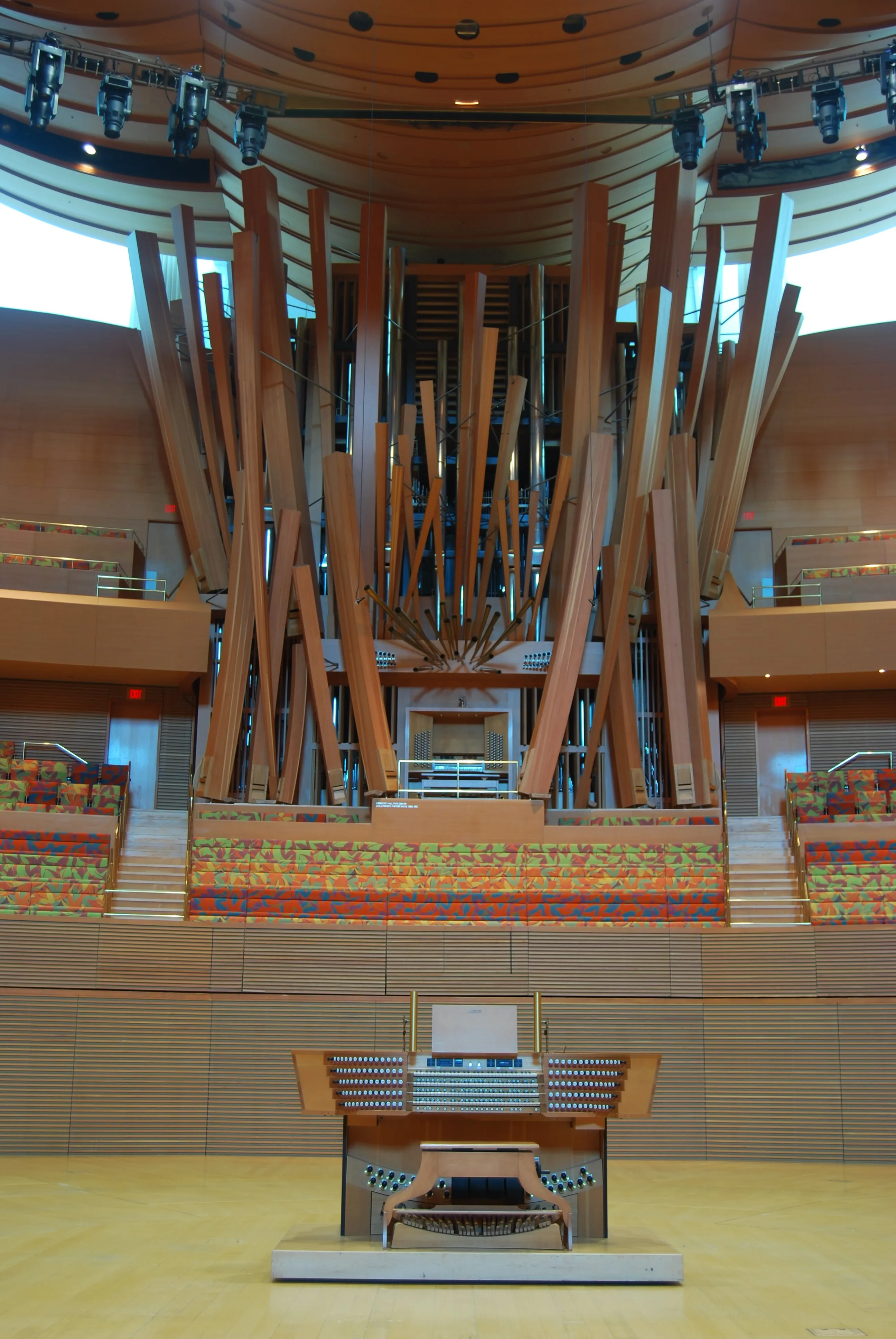
Now that I have written about the distinguished tenures of several organists, some personal friends, and some admired luminaries, I would like to switch to an organbuilder who is integrally associated with one of the most influential modern American organs, Manuel Rosales and the Rosales/Glatter-Götz organ in Walt Disney Concert Hall in Los Angeles, built in 2004. I have been privileged to visit with Manuel at that organ several times and know him as a wonderful host and brilliant impresario at this spectacular organ.
The visual design is by the late architect Frank Gehry, who rebelled against straight lines in most of the buildings he designed. Traditional designs for the façades of pipe organs are generally based on straight lines and carefully planned proportions, and Gehry blew the world of organ design wide open with his radical approach. Massive 32′ wood organ pipes, both flues and reeds, are displayed in apparently random order rather than neat rows, and to top it off, they’re curved. I visited the Glatter-Götz workshop in Pfullendorf, Germany, in 2019 and learned from the engineer Heinz Kremnitzer there that the curves of the largest pipes are segments of a circle with a radius of nearly 170 feet, and the smallest of the curved display pipes are based on a radius of about forty feet. It didn’t take long for the unusual appearance of the organ to gain the nickname, “A Large Order
of Fries.”
In the more than twenty years since the organ was built, Manuel has welcomed countless brilliant recitalists and is known for hosting “after parties” behind the organ. There is a large wood wall in the back of the organ that bears the signatures and inscriptions of dozens of widely known musicians.
In November of 2008 I spent a long evening in the organ with Manuel. The time stamps on the photos I took show about 9:30 until 11:30 p.m. Sitting together inside the organ, Manuel told me of the process of planning and building the instrument, after which he started the sequencer replaying some recent performance and led me up into the superstructure above the hall where we looked down on the organ from high above, a brilliant sight. I will never forget his generosity of time and spirit sharing that instrument with me so intimately.
Closing a chapter
I mentioned our house in Newcastle, Maine, earlier, and have often written about it as a center of our lives for the past twenty-five years. During that time, we have also had homes in Boston, New York, and now Stockbridge, Massachusetts—the house in Newcastle has been our second home. The workshop where I rebuilt six organ consoles and three small electro-pneumatic-action organs including an Aeolian residence organ with a roll player was there. As we have grown older, our children have become parents and our priorities have changed, and we have realized that it is time to focus on our home in Stockbridge, Massachusetts, so a new family will begin loving the Newcastle house next month. We were married there, have had a boating career there, had scores of wonderful evenings and weekends with friends and family, and we are grateful to have shared that bit of heaven on earth. In Stockbridge, we live in the shadow of Tanglewood and in an area rich with culture and the beautiful landscapes of the Berkshire and Taconic mountains. We can take an easy train to New York City, and located two hours west of Boston, we have a head start to anywhere else we are traveling. We are grateful for the time we spent in Newcastle and are excited to be moving on.