The Unique Sound of the Pipe Organ: an Exploration of Its Ancient Roots
Editor’s note: The Diapason offers here a feature at our digital edition—five soundclips. Any subscriber can access this by logging into our website (thediapason.com), click on Magazine, then this issue, View Digital Edition, scroll to this page, and click on each <soundclip> in the text.
Prologue
If Bach had never lived we would celebrate the works of Dieterich Buxtehude and Nicolaus Bruhns as the crowning expressions of the pipe organ’s unique sound. Often portrayed as stylus phantasticus, the fiery pyrotechnics, toe-tapping rhythms, and magnificent organo pleno meantone chords in their works reflect a sense of optimism and hope in the late-seventeenth-century society of Lübeck.
The voice of the pipe organ’s unique sound is its principal chorus. Spanning the range of hearing, it was fully developed in the fifteenth-century organ of Lorenzo di Giacomo da Prato at San Petronio, Bologna, whose lowest 24′ F pitch creates a sound that we equally feel and hear. Organbuilders in Lübeck added thundering pedal reeds to underpin this core sound.
The foundation of the principal chorus and Western tonality is the natural harmonic series, but it is poorly rendered in the mistuned thirds of modern equal temperament. Before the advent of equal temperament, the pipe organ’s principal chorus was magnificently expressed in quarter--syntonic comma meantone’s superb rendering of the natural harmonic series. Meantone was invented in fifteenth-century Italy, and its description was published in 1523 by Pietro Aron (1490–1545). It survived virtually intact in the very late eighteenth-century work of Samuel Green in England.1
In an astute criticism of the pipe organs of his time Igor Stravinsky complained that “The monster doesn’t breathe!”2 His point is that orchestral wind instruments can subtly raise their pitch, increase their power, and brighten their timbre with more blowing pressure. Stringed instruments can independently vary their pitch, power, and timbre over a vastly larger range with intense emotional impact. The pipe organ’s swell box can vary power and timbre dependently, much like orchestral wind instruments, but not pitch. Some historic pipe organs, however, breathe with great emotional impact, and we will see how that breath in the wind emerges.
The impact of acoustics on warmth
The full emotional impact of many historic European organs is not often heard in the United States. There are many reasons for this, but foremost among them is acoustics. Sounds higher than 1′ in pitch will diminish in power as they move through the air in both live and dry acoustics. But bass sounds, like those of fog horns, will travel great distances with little loss of energy. Bass sound disappears through thin, modern walls, but thick stone and thick concrete walls reflect and reverberate bass tone over long distances and time. Reverberant acoustics have the profound effect of amplifying the bass and mellowing the treble.3
Organbuilders have to compensate for the acoustics in which they build organs. The bass of Aristide Cavaillé-Coll’s manual stops often have lower pressures than their trebles, and the lowest wind pressures in his organs are found in the pedal.4 The vast distances and stone walls of French acoustics solidly underpin Romantic sounds and make the lower pressure power of a Cavaillé-Coll bass warm and grand. In dry American acoustics the highest wind pressures are very often found in the pedal.
The impact of acoustics on tempos
Long reverberation forces us to slow our tempos. American acoustics are designed to support rapidly spoken, amplified oratory, and these very dry acoustics nudge us to faster tempos when there is no reverberation to fill a pregnant pause. Our wind supplies have evolved to support faster tempos in dry acoustics, and in the process we have lost some of the drama and grandeur of Europe’s best sounds. Listen to a magnificent example in the closing measures of Bach’s Toccata and Fugue in E Major, BWV 566, in <soundclip 1>. The slow tempo here is perfectly matched to the grand acoustics of Weingarten Abbey and the slow breath of wind in Joseph Gabler’s 1750 organ.5
A breath in the wind
A slow surge of sound is produced by a slow rise in the wind pressure. Such sounds are typically associated with very large organs with bellows that operate with heavy weights to supply great volumes of wind to many windchests.
To see why weight is important, try to visualize the heavy “land barge” American sedans built in the 1960s and 1970s. This memory will be vivid if you are as old as the author. Those who are younger can watch these massive cars hit bumps, wallow on their springs, and slowly pitch and heave in the 1977 romantic comedy Smoky and the Bandit with Sally Field and Burt Reynolds. But when a small sports car hits the same bumps we feel sharp and uncomfortable jolts with no wallowing or heaving on the springs. The difference is the weight, and heavy weights on a bellows will respond more slowly when you pull all of the stops and “bump” its wind system with a tutti chord.
From this example it is obvious that American organs in dry acoustics need as little weight as possible on their bellows to achieve fast wind and fast tempos. And that is exactly what you will find—many smaller reservoirs with springs to achieve the required wind pressure. This is an elegant solution for dry American acoustics, but we will never hear the drama in soundclip 1 with this wind system.
Could we design a system to supply both faster and slower wind? A short tour of the features that affect wind will give us the tools to control it.
Wind surge is a resonance
The wind in the bellows of a pipe organ resonates because its air acts like a compressible spring. The air will resonate many times per second if we use springs instead of weights to achieve the pressure, and in organs of the Reform movement we sometimes heard this resonance as a nervous “wind shake.” Unlike the tremulant, which produces exactly the same effect, wind shake is an uncontrollable distraction. Wind shake resonances are eliminated in fast modern wind systems with the use of winkers, which are very small, sprung wedge bellows attached to windlines and windchests. Endnote 6 explains how they work. Organs that achieve their pressure with weights will resonate much more slowly, not with a nervous shake in the wind, but with a dramatic surge in the wind.
A longer surge needs more mass and volume
If we want to create the very slow, very dramatic resonance heard in soundclip 1 in an organ of modest size, we will need to add considerable weight to its bellows. Additional weight on the bellows will increase its pressure, and we want to add weight without increasing the pressure. One solution is a rotating beam with balanced weights at its ends and a link to the bellows top plate. This will add no weight to the bellows, but it adds the inertia of its mass. Mass and weight are the same on earth as the pull of earth’s gravity gives weight to the mass. Mass in outer space far from earth’s gravity will have almost no weight, but it will be just as hard to get moving in space as it is on earth. When we have balanced the weight on the beam so that it adds no pressure, the inertia of its mass will slow down the resonance and lengthen the surge in the wind.
How much mass do we need to add for a longer surge of wind? The equation to calculate this, seen below, is simpler than it appears, and a fully worked example from the author’s Opus 5 is provided in Endnote 7. We need to account for the spring rate of air, which has the same effect as the stiffness of the springs on a car. This equation was proposed by Stig Magnusson in 1974 to calculate the resonance in the wind system of a pipe organ with a vertical rise bellows:8
• f0 is the resonant frequency in cycles per second, or Hz. If we invert this, 1 ÷ f0, we get the period, which is the length of the wind surge in seconds;
• A is the area of the bellows top plate in meters2;
• M is the mass of the bellows top plate in kilograms;
• V is the volume of air in the system in meters3;
• 60 is Magnusson’s spring constant for air.
What does this equation tell us? With the mass M in the denominator, the surge in the wind gets slower and more dramatic as we increase the mass on the bellows. The surge also gets slower with more volume V of air in the bellows, windlines, and pallet boxes.
The area A of the bellows is in the numerator. The surge will appear to be faster with larger areas, but a larger bellows area will have more volume in the bellows V and more mass on the bellows M to maintain the same wind pressure. The equation tells us smaller and larger bellows with the same wind pressure will have the same length of surge!
The surge will be slower if we add more windchests and windlines with larger volumes of air, and it will be slower if we raise the pressure and add more mass. The large volumes of air in the many windchests and windlines of large organs will produce a slow surge if they are all connected to the same bellows, and this explains why fast American wind systems have a separate bellows for each division, minimizing the volume of air in each division for faster wind.
Opus 5’s balanced mass
Constraints in Opus 5’s available space forced the use of additional mass when calculations showed that the additional volume of air for the wind surge we hear in soundclip 1 would have consumed the space taken up by seven 55-gallon drums! This gives us some idea of the volume of air in the bellows, windlines, and pallet boxes in the monumental Gabler organ in its 1975 configuration.
The worked example in Endnote 7 tells us that the natural resonance of Opus 5’s 6-foot by 3-foot wedge bellows is 1.3 Hz with 67.3 kilograms of weight to achieve a wind pressure of 85 millimeters. If we invert that with 1 ÷ 1.3 Hz, we get a wind surge typical of nineteenth-century American organs at 0.77 seconds. The equation tells us that the addition of 400 kilograms (880 pounds) of mass will slow Opus 5’s resonant surge to a grand 2.03 seconds.
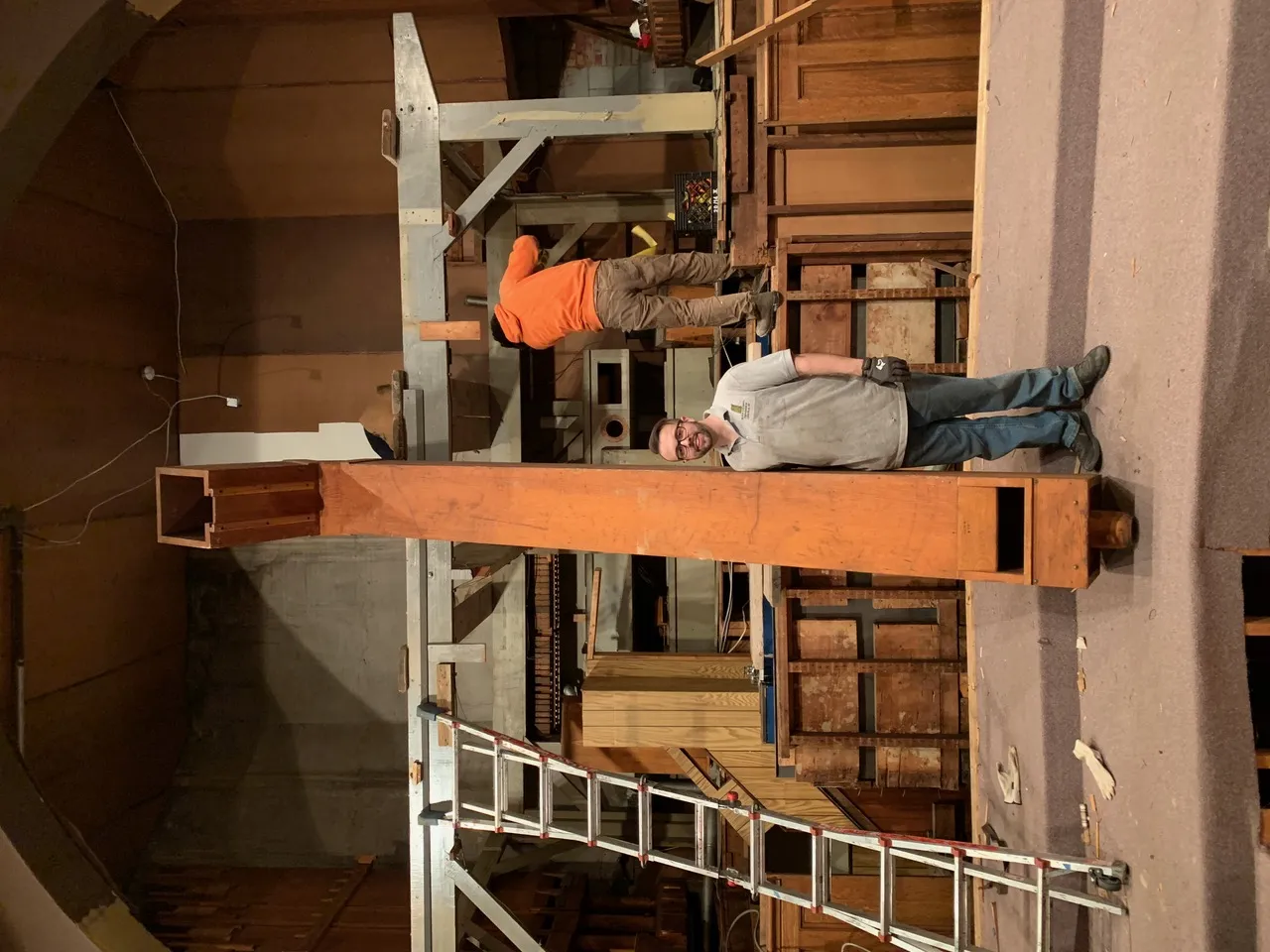
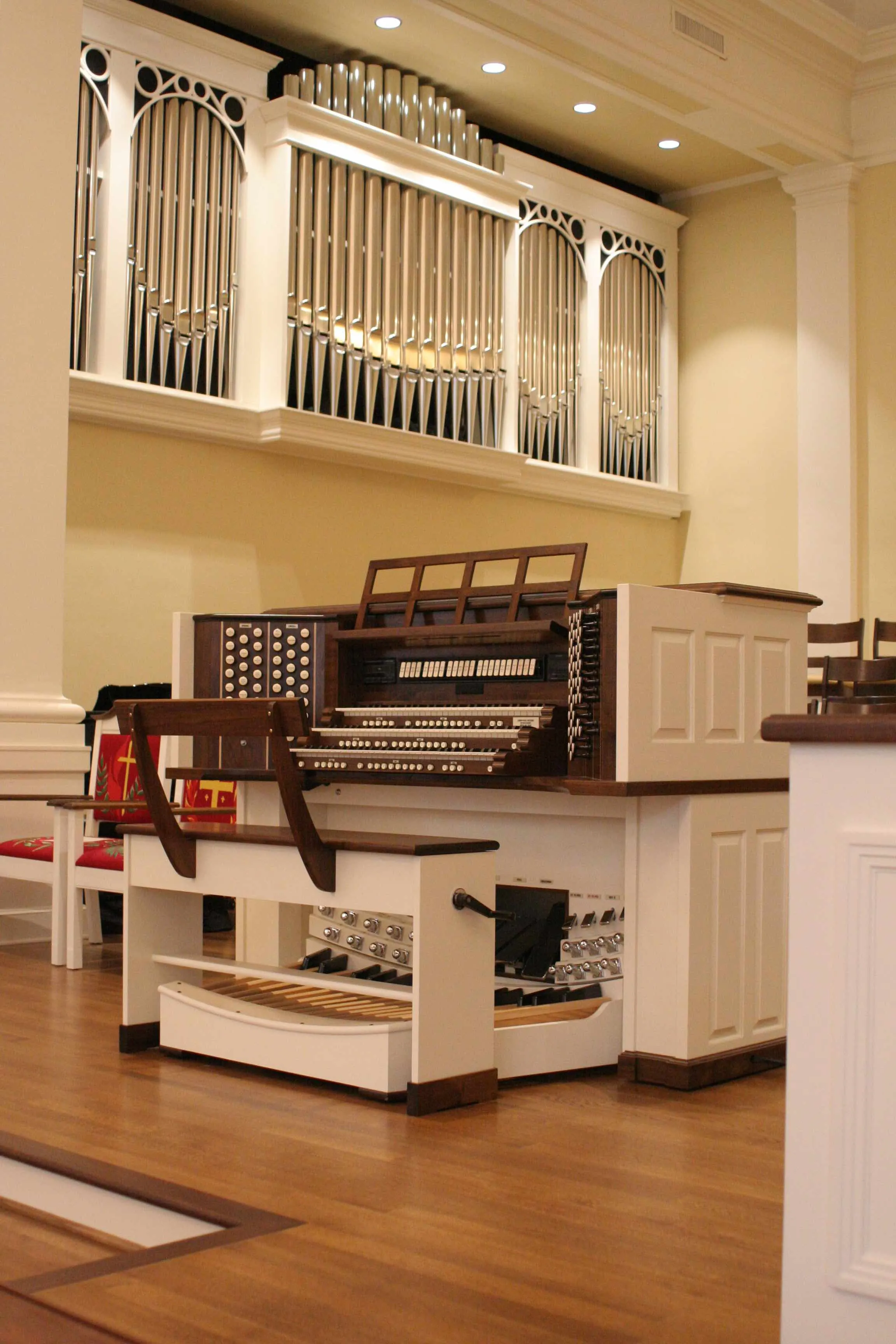
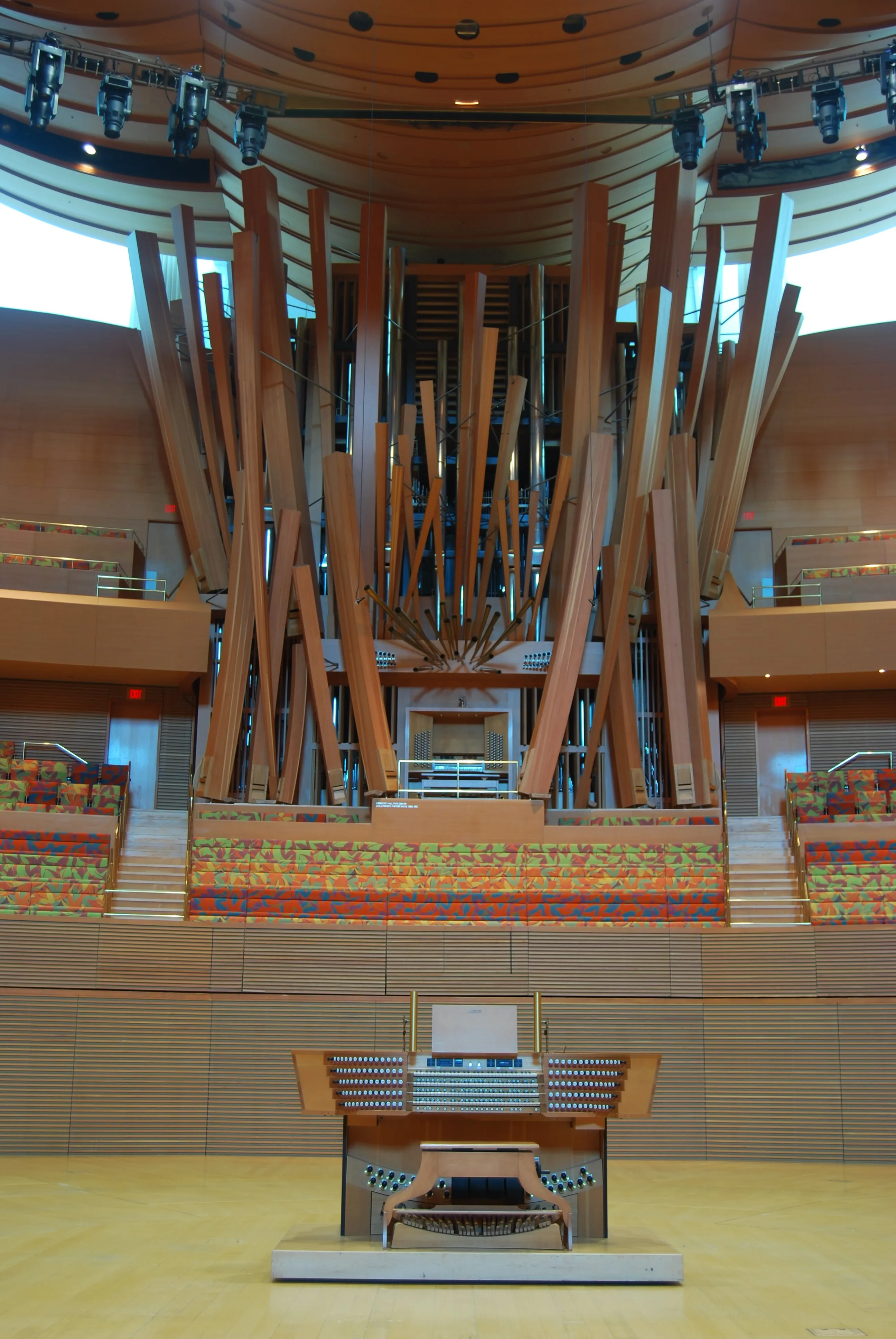
Figure 1 (see page 18) shows the realization of a rotating beam with balanced weights connected to the top plate of Opus 5’s wedge bellows. The ends of the balanced beam allow for the addition of balanced pairs of weights that correspond to the wind surge values seen in Figure 2. Adding 400 kilograms (880 pounds) of weight to this balanced beam would have required a very substantial frame and bearings. The solution was a simple application of Archimedes’ levers—the rod from the bellows was connected to a point one fourth of the distance from the center of the beam to the weights at one end of the beam. This made the leverage worse by a factor of 4, requiring only one fourth of the mass. With 100 kilograms total mass, or 50 kilograms (110 pounds) at each end of the beam, the system produces a full two seconds of surge.
Wind systems with a slow resonance will still respond quickly with little audible surge if a single stop is drawn because it consumes little wind and the bellows barely drops to feed it. But if we draw a full plenum of stops and play a big chord with pedal notes, the bellows will drop a great distance to supply the needed wind, and a big drop awakens the surge.
A deeper surge is less area
At this point we need to separate what we hear in the length of the surge from a deeper and more audible surge. A deeper surge is heard as a greater rise in pitch, and it emerges from a bellows with a smaller area and less stiffness, much as weaker springs on a car will produce a deeper bounce. A bellows with more area will drop less to provide the needed wind, and we will hear a shallower depth in the surge.
Flexible wind
What is “flexible wind,” and why are wedge bellows noted for it? The hinge on a wedge bellows gives it half of the effective area of a vertical rise bellows. But a wedge bellows also has half of the volume and half of the mass to achieve its pressure, and the length of its surge will be the same as a vertical rise bellows. But with half of the effective area a wedge bellows will have to drop twice as far to provide the needed wind, and this larger drop produces a deeper and more audible surge. Surge depth is what we hear in flexible wind. This is why fast American wind systems use a vertical rise bellows with more effective area.
The pioneering work of Manuel Rosales
In the 1980 timeframe I had interesting conversations on the topic of wind surge with Manuel Rosales. His Opus 9 emerged from the drawing boards as a two-manual and pedal organ with grandly scaled and voiced 16′ flue and reed choruses playing on windchests with alternating Great and Pedal channels. To supply the large quantity of wind consumed by these choruses Rosales built a single 8-foot by 4-foot wedge bellows that produced a grand surge in the wind. To achieve fast wind Rosales built sets of light-weight, floating concussion plates that formed the floor of plenums under the windchests. These plenums shared a wall with the pallet boxes, and a slider was placed on the shared wall with many large borings to open or close the flow of wind between the pallet boxes and the floating concussion plates. The large combined area of the floating plates compensates for the slower response of the wedge bellows, and with the slider open the wind is very fast. If memory serves, the length of the wind surge with the slider closed is about half of what we hear in the soundclip of the Gabler organ.
Lessons learned
Opus 5’s nine stops reproduce the power and emotional impact of the principal chorus of larger seventeenth- century meantone organs. A major goal of this project was the development of a wind system that could reproduce the drama of the wind in large historic organs yet still be able to supply faster wind. To accomplish this in an organ of so few stops meant having to understand the physics that produce this drama. Swell expression, although not remotely Romantic in its dynamic range, moderates the power of the reeds and its ancient vocale flue voicing. There are two swell pedals, one activating the front shades and another activating doors at the sides. The side expression is especially useful with the foundations in accompaniment.
Funded by its builder, Opus 5 provided the freedom to explore the dynamics of wind systems and the impact of quarter-syntonic comma meantone on a brilliant principal chorus voiced in the ancient vocale manner. Father Thomas Carroll, SJ, put the organ through its paces about a month after it was finished, and the first literature confirmed the calculated length of its surge from Magnusson’s equation, but the surge was far deeper than expected with the wind-hungry pedal pipes. The source of this deeper surge is Opus 5’s single, 6-foot by 3-foot wedge bellows, which has 25 percent less surface area than the bellows of Rosales Opus 9. The number of Opus 5’s stops is very small, but these stops are the powerful core of a much larger organ. Opus 5’s bellows was narrowed by one foot and shortened by two feet to accommodate the available shop space, and with its smaller effective area it has to work harder and drop farther to maintain the flow of wind. A floating concussion plate was added to make the surge shallower.
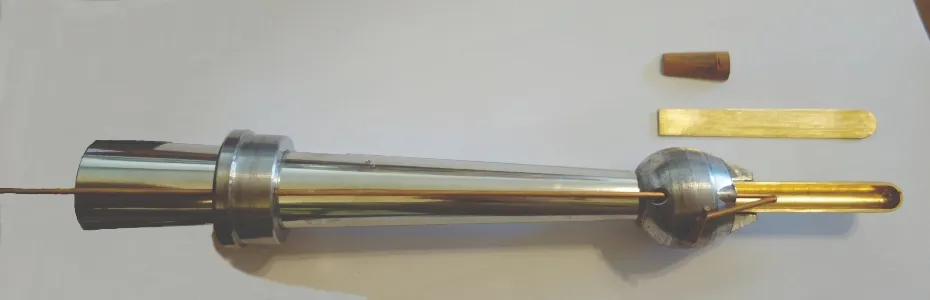
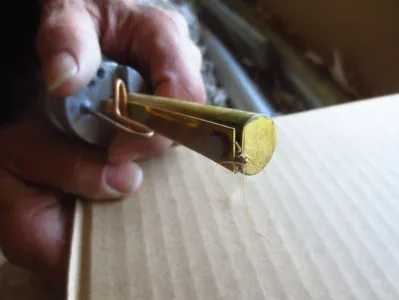
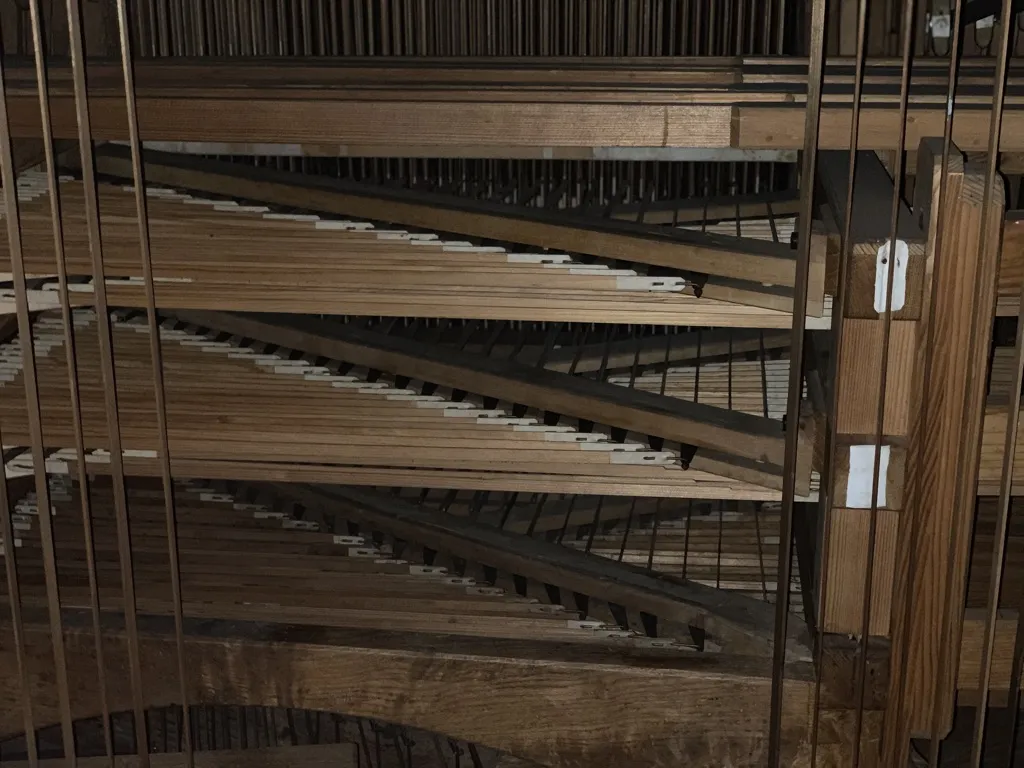
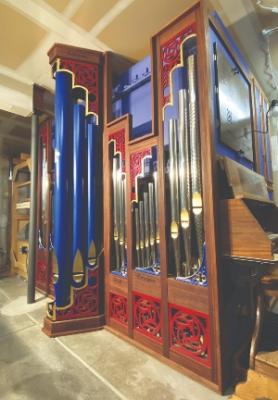
The area of the floating concussion plate seen in Figure 3 is equal to the swept area of the wedge bellows, and it can be engaged or disengaged with a pallet controlled by the knob seen in Figure 4. When engaged, the surge depth is shallower but not eliminated. The fastest possible wind with the shallowest possible surge would be obtained with a vertical rise bellows using springs to achieve the wind pressure. And to this bellows we could add extra mass on a balanced beam for a deeper and longer surge.
The lessons learned from Opus 5 explained the sources of the very long and very deep surge of wind in the 1975 recording of the Gabler organ in soundclip 1. Restorations of this organ in the nineteenth century replaced the original ten wedge bellows with a single bellows that supplied wind to the whole organ. The smaller area of the single bellows feeding the large volume of air in the organ’s many windlines and pallet boxes produced the sound we hear in the soundclip. In the 1980 restoration Kuhn restored the original ten wedge bellows, and the wind between the manuals and the pedal was split as Gabler had originally intended. The surge of the restored wind system is much shorter and shallower. The interventions of the nineteenth century provided us a likely unintentional example of a very dramatic surge of wind on a magnificent principal chorus.9
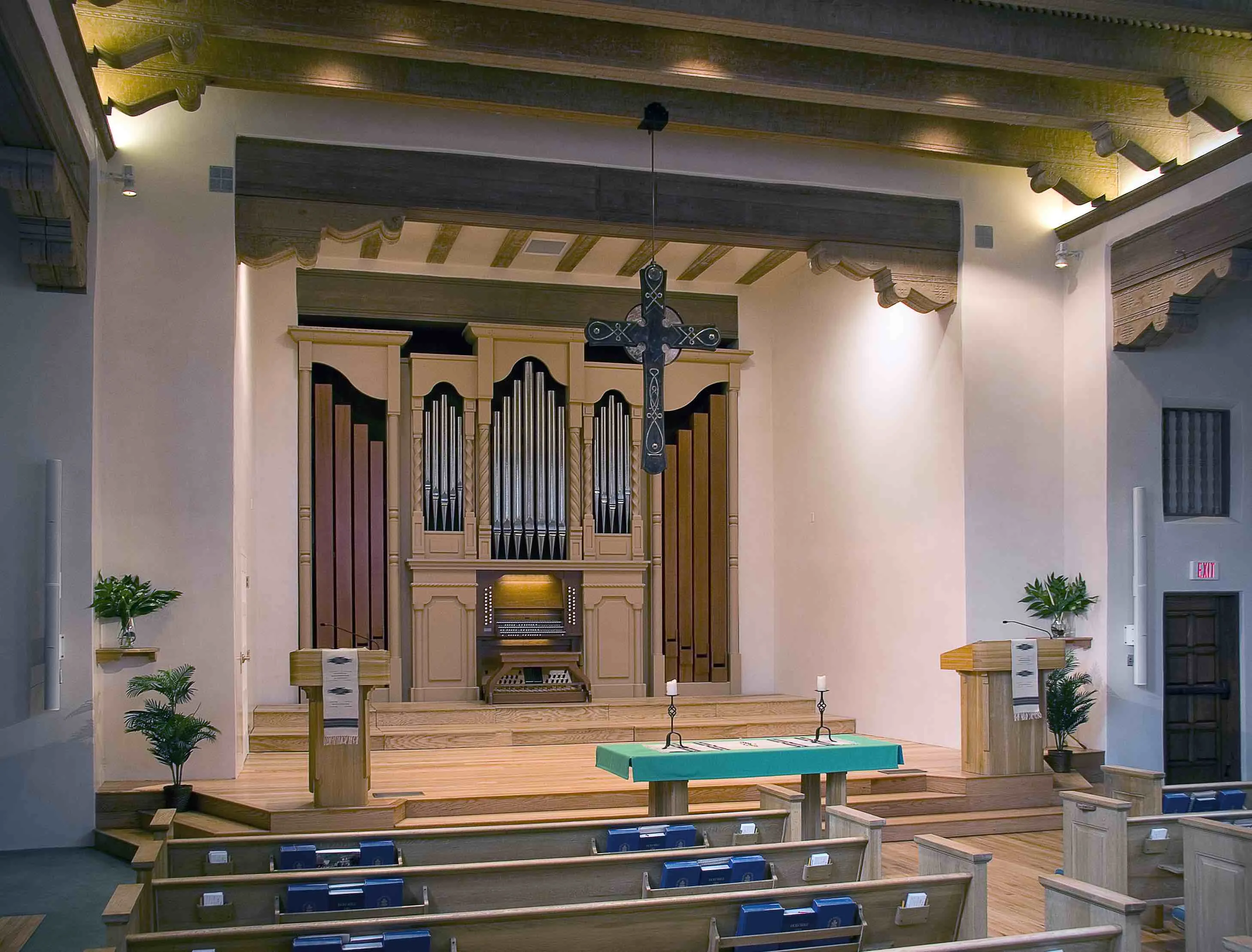
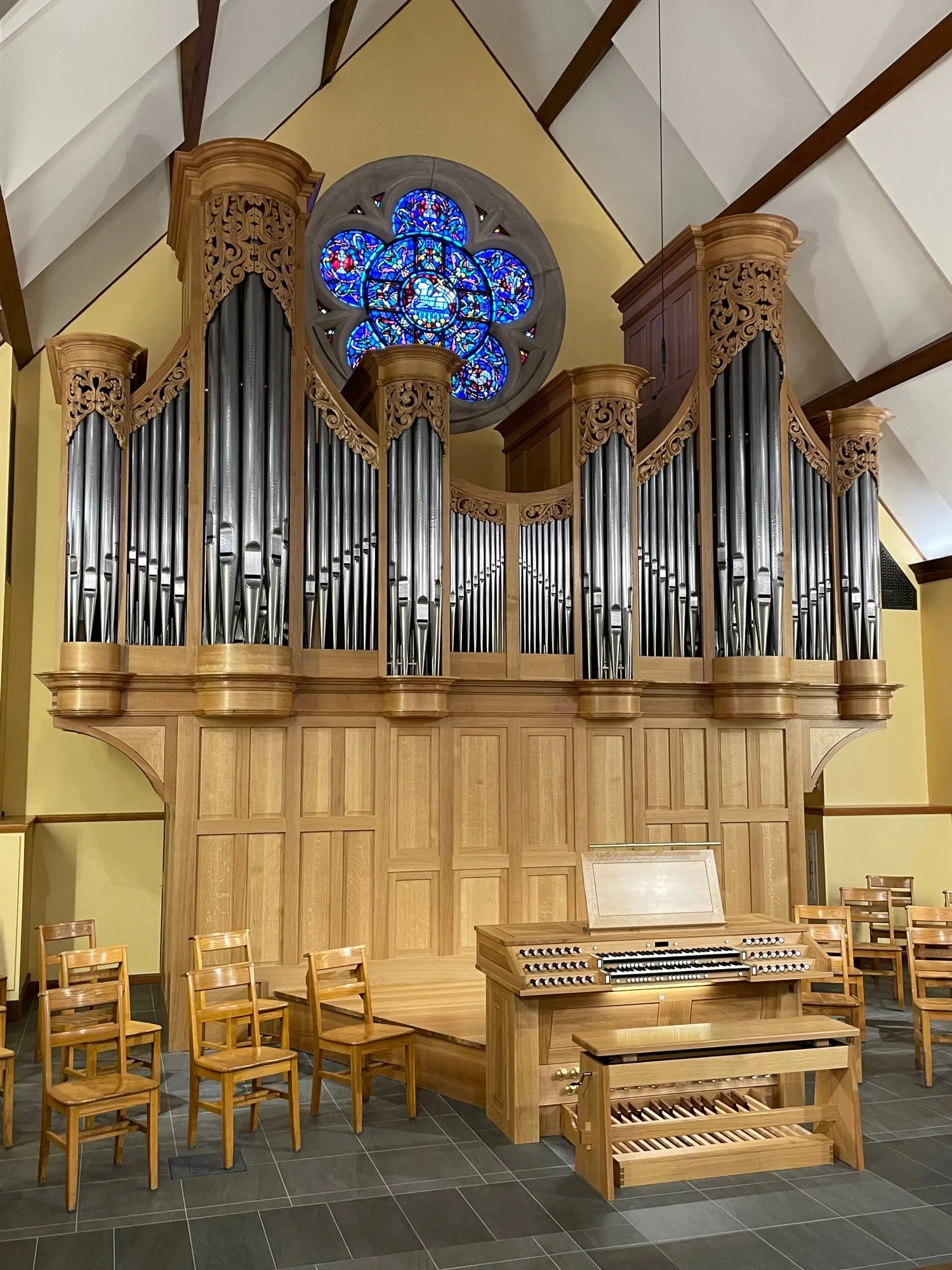
One-quarter syntonic comma meantone, Pietro Aron, 1523, C Major and A Minor acoustic tonality, equal beating; mechanical key and stop action, permanent manual to pedal coupler; 695 pipes.
Notes on the pipework: 1. Façade, C–B is borrowed from the Pedal Bourdon; 2. C–B is borrowed from the Chorus Flute; 3. C–c-sharp0 is L/2; d0–b0 is L/1; c′-d′′′ is 2L harmonic; 4. C–d0 is borrowed from the Pedal Bombarde; 5. C–B is a resultant; 6. C–B is full length, mitered, 200 mm Ø, tapered shallots with weighted tongues; c0–d′ is Callinet construction.
The sound of Opus 5
The full range of Opus 5’s wind dynamics are heard in the next three soundclips. The Doxology, Old Hundredth, is performed twice in each soundclip by Solomon Wickline. The first example in each soundclip features the manual 8′ Principal, which draws little wind and does not awaken the surge. The second example features a robust flow of wind with the 16′ Praestant, 8′ Principal, 4′ Octave, and III Fourniture, then adding the pedal 16′ Bombarde in the Amen. The low C pedal note with its 16′ Bombarde pipe and its two resultant 16′ Bourdon pipes consumes as much wind as a full organo pleno chord in the manual, and the surge awakens.
In <soundclip 2> we hear Opus 5’s natural 0.7 seconds of surge, but with the floating concussion plate engaged the surge is shallow and the wind is faster.
In <soundclip 3> the floating concussion plate is disengaged, and we hear more depth in Opus 5’s natural 0.7 seconds of surge.
In <soundclip 4> all of the mass is added to the balanced beam. We hear a full two seconds of deep surge in wind.
In <soundclip 5> we hear the hymn THAXTED from the middle movement of “Jupiter” in Gustav Holst’s The Planets, performed by Wickline from memory with the 16′ Praestant, 8′ Principal, and 8′ Chorus Flute played an octave higher on the manual and at 16′ pitch coupled to the pedal. The temperature drop in a late December recording session produced a deep chorus effect from subtle mistuning. The façade 16′ pipes had cooled, and they made a warm celeste with the 8′ Principal and the widely scaled and romantically voiced 8′ Chorus Flute in the swell box. Meantone is not suitable for much of modern literature, but it deepens the emotional impact of this lovely hymn.
The Doxology was published in the Geneva Psalter by John Calvin in 1551 with a harmonization attributed to Loys Bourgois (circa 1510–circa 1560). The Doxology quickly appeared in London in 1563 in the key of G major, which interestingly aligns with the lowest note of 16′ G in the manuals of meantone English organs.10 In the soundclips we are hearing the Doxology in its original quarter-syntonic comma meantone with all of the consonant purity heard in sixteenth-century London Huguenot churches.
These soundclips were recorded in the very small shop in which Opus 5 was constructed, and the sound is overbearingly powerful and bright in this constrained and completely dry acoustic. The sound was equalized to reproduce its effect when heard at a greater distance in a larger room where the brightness would subside. The near-field effects from the small shop space also produced power variations in different notes of the compass, and while these power variations are not correctable with equalization, they would disappear in a larger acoustic.11
The decline and disappearance of the pipe organ’s unique sound
Bach vehemently argued for a temperament that would enable the construction of his complex architectures with seamless modulations into all keys. Organbuilders delivered these seamless modulations with the well temperaments, directly on the path to equal temperament.
The transition from meantone to equal temperament in continental Europe came gradually over the course of the eighteenth century, but the loss of purity came very quickly. We might assume that the early transitional versions of one-fifth- and one-sixth-syntonic comma meantone preserved some pure major thirds, but we would be wrong—there are no pure thirds in these temperaments. Purity is required to generate meantone’s rich bass sonority, and purity survived in England because English organs had no pedals or pedal stops. Pure meantone intervals vanished in England with the nineteenth-century introduction of pedals and pedal divisions into English organs.
A brilliant principal chorus is the ancient core of the pipe organ’s unique sound, but its brilliance greatly amplifies the dissonance of equal temperament’s grievously mistuned thirds. There are ten jarring beats per second in an equally tempered middle C and E third, and this dissonance becomes much more intense as these beats double with each higher octave of the compass. The mixtures in a principal chorus speak many octaves above the unison, and this explains why an equally tempered third played with a mixture becomes an unblending screech.
An observant sage once quipped that “The best stop in a pipe organ is the acoustics of its room.” While Bach’s compositions sound best with a brilliant principal chorus, they also require a temperament very close to equal temperament’s jarring dissonance. Bach’s wonderful legacy sounds grand in the warmth of the reverberation of European churches, but not in dry American acoustics.
The dissonances in meantone’s impure intervals resolve in the purity of its eight pure major thirds, but equal temperament’s dissonance never resolves in any key. Equal temperament is not compatible with brightness, and this gave birth to the warmth of the Romantic organ and a new literature. The reduction in the brightness of the pipe organ culminated in the genius of Ernest M. Skinner. His sound is adapted to equal temperament in dry American acoustics with smooth orchestral timbres at unison pitch. His unison terrace dynamics replaced the dramatic effect of incrementally adding the brightness of higher-pitched stops to the foundations. Skinner built low-pitched mixtures in a few organs when pressed by the early Organ Reform Movement, but their timid voicing produced a pale imitation of the organ’s unique sound.
Cavaillé-Coll found different solutions for his Romantic sound. His low-pitched mixtures speak a smooth harmonic at an overblowing octave, abandoning the fire of the classical French Plein jeu. But his chorus reeds preserve a brilliant classical fire tamed only by the grand acoustics found in nearly all French churches. Cavaillé-Coll’s chorus reeds, like brilliant mixtures, are overbearing when transplanted to dry American acoustics.
In the mid-nineteenth-century work of Cavaillé-Coll the pipe organ’s unique sound withered; in the early-twentieth-century work of Skinner the pipe organ’s unique sound became a whisper of its former glory. In the high-pressure theatre organs of the early twentieth century we see the ultimate answer to equal temperament in dry, bass-deficient acoustics, and in these wonderful organs the pipe organ’s unique sound completely disappeared. Taking its cue from the smooth tibias of the theatre organ, the pioneering and commercially successful Hammond B3 electronic organ brought its ultra-smooth and equally-tempered sound back to life with a frantic surge of wind in a very fast, very deep, and omnipresent vibrato.
Reflections
The mid-twentieth-century Organ Reform Movement produced some wonderful insights, but it ignored the wisdom of George Santayana, who in 1906 opined that “Those who do not remember the past are doomed to repeat it.” And repeat it we did. The dissonant screech of the Organ Reform Movement’s high-pitched, equally tempered mixtures in dry American acoustics provoked a predictably intense reaction in current American organ building. D. A. Flentrop used sophisticated scaling and voicing techniques to find the optimum balances in a brilliant principal chorus, but his equally tempered sound was most successful in the warmth of the grand acoustics of the Busch-Reisinger Museum and the Duke University Chapel.12 We had to painfully relearn the limits of dry acoustics.
The sound of G. Donald Harrison was very popular in the mid-twentieth century, and it continues to be popular today. Charles Fisk praised Harrison for his open-flueway voicing. The author grasped early in his career that Harrison had very gradually and very carefully pushed the limits of brightness in his equally tempered principal chorus, but there was a dramatic quality missing in his sound. Harrison made a tour of continental European organs when the Organ Reform Movement gained momentum in the 1930s, but he quickly stopped taking notes. He emphatically rejected slider chests and continued to embrace the electro-pneumatic chests and sprung, vertical-rise bellows of his Aeolian-Skinner organs, excellent designs for dry American acoustics. But Stravinsky’s observation was the answer to the missing quality in Harrison’s sound—it doesn’t breathe. And this is why E. Power Biggs stopped working with Harrison and championed the work of D. A. Flentrop.13
The success of an organ from any era depends on the trade-offs it makes in its brightness, the acoustics in which it resides, its temperament, and the dynamics of its wind system. Skinner found the keys to equal temperament in dry acoustics with an orchestral Romantic sound. Harrison pursued a compromise, and while it worked very well in dry American acoustics, it only suggested the emotional depth of the range of literature Harrison claimed his organs could play.
The pipe organ’s ancient, unique sound comes alive in works of Buxtehude and Bruhns with a brilliant principal chorus underpinned by acoustical warmth, mean-tone’s emotional depth, and breath in the wind. Exuberant optimism and hope in their works undoubtedly inspired seventeenth-century parishioners of Lübeck’s churches. It can inspire us today.
Notes and references
All images reside in the collection of the author. The use of Sony MDR 7506 headphones or their equivalent is strongly recommended for the soundclips. Earbuds will not faithfully reproduce bass sound.
1. Michael McNeil, “The Art of Mis-tuning,” The Diapason, volume 116, number 10, whole number 1391, October 2025, pages 16–21. Readers will find the physics and neuroscience behind the emotional impact of pure quarter-syntonic comma meantone. All original tablature manuscripts of the organ works of Buxtehude and Bruhns have been lost, and their later transcriptions into modern notation have introduced serious errors that have made some of them unplayable on the meantone, short-octave compasses of the organs on which they were composed and performed. Corrections have been suggested by the author in “The Organ Works of Buxtehude and Bruhns,” The Diapason, December 2023, pages 15–17. The compositions of George Frederick Handel were often performed on the organs of Samuel Green, who preserved the sound of quarter-syntonic comma meantone into the very end of the eighteenth century with six pure major thirds. English organs of this time had no pedal but extended the manual to 16′ low G in the bass, omitting the G-sharp. See Michael McNeil, “The Sound of Samuel Green,” The Diapason, volume 117, number 4, whole number 1397, April 2026, pages 18–24.
2. Peter Hurford, Organist Peter Hurford, A Conversation with Bruce Duffie, 1990, bruceduffie.com/hurford.html.
3. Michael McNeil, The Sound of Pipe Organs, 2012, pages 13–14.
4. Why would Cavaillé-Coll have gone to the trouble to supply a lower wind pressure to the bass of his manual windchests when he could have simply closed down the pipe toes? The answer is that more open toes promote faster speech. The slow, sluggish speech of many early-twentieth-century American Romantic organs was the result of their very high pressures and extremely closed toes.
5. [00:52] <Soundclip 1>. Johann Sebastian Bach, Toccata and Fugue in E Major, BWV 566, organbuilder Joseph Gabler, 1750, Weingarten Abbey, organist Peter Alexander Stadtmüller, Musical Heritage Society, MHS 3195, 1975.
6. Winkers are attached to windlines and windchests; they are very common in American wind systems. In order to cancel fast wind shake resonances, the movement of the winker must be 180 degrees out of phase (opposite in timing) with the wind shake. This is accomplished by placing a resistance to the flow of wind in the form of a small slider between the winker and the windline it stabilizes. The slider reduces the flow of wind and slows the movement of the winker to the point where it is opposite to the movement of the shake, and the shake disappears. With a wide-open boring between the winker and the windline, the winker will just move with the resonance to no effect.
7. The Magnusson equation applies to a vertical rise bellows. A wedge bellows requires three modifications that are described in the following worked example from Opus 5’s wind system.
Step 1, calculate the area. We will start with the numerator, “60A.” In our example the bellows measures 0.838 meters wide by 1.829 meters long. Multiply these to get the area A: 0.838 × 1.829 = 1.533 meters2. Then multiply this area times 60, the spring constant for air: 60 × 1.533 = 91.962. Now we divide 91.962 by two because we have a wedge bellows that is hinged at one end, not a vertical rise rectangular bellows, and we get 45.981, our numerator, “60A.”
Step 2, calculate the volume. Now we tackle the denominator, starting with the volume V. Add up the volume of air in the system (depth times width times length), including the wind trunks, the pallet boxes, and the wedge bellows. For the bellows this is length times width times the extended height of the bellows; then divide by two because it is not a box but a wedge. Measure all of this in meters to keep the units straight. For Opus 5 the total volume, “V,” is 0.473 meters3.
Step 3, calculate the mass. We need to know the total mass M of the bellows top plate, including the mass of the plate itself and the weights added to it to achieve the desired wind pressure. We do not have to take apart the bellows and put the pieces on a scale to do this. We only need to know the wind pressure in millimeters of water and the area of the bellows plate in meters2. We know from Step 1 that the bellows plate area is 1.533 meters2.
Now to get the total mass, we need the pressure, which is 85 millimeters, water column. We need to find how 85 millimeters of pressure relates to the standard atmospheric pressure of 10,000 millimeters, so we divide 85 millimeters by 10,000 millimeters, and we get the ratio of the organ’s pressure to the atmospheric pressure: 85 ÷ 10,000 = 0.0085. Now we multiply this ratio by 10,332 kg/meters2, the force that the atmosphere exerts on a square meter of surface (at sea level) to give us the force per square meter on our bellows plate: 0.0085 × 10,332 = 87.812 kg/meters2. The rest is simple: we multiply the 1.533 meters2 area of our bellows plate times the 87.812 kg/meters2 of force and we get a total mass for the bellows top plate: 1.533 × 87.812 = 134.6 kg. This mass is acting on a hinged bellows plate, so again, we divide by 2 to get the effective mass M of 67.3 kg (148 pounds). That will be the effective mass of our bellows top plate when we have added enough weight to achieve 85 millimeters of wind pressure.
Step 4, calculate the resonant frequency. With the mass and the volume of our system we now have the M and V in our denominator. We multiply the mass times the volume, M times V, and we get: 67.3 × 0.473 = 31.839.
Now we find the square root of 31.839, which is 5.643.
Multiply 5.643 by 2 and multiply again by π (this is pi, roughly 3.14159. . .) and we get: 2 × 3.14159 × 5.643 = 35.454. (The multiplier 2π comes up often when we deal with things like resonance that are periodic in nature.)
And with simple division we at last get a resonant frequency of 1.30 Hz:
Opus 5’s wind resonates at 1.30 cycles per second, noted as 1.30 Hz, in honor of the great physicist, Heinrich Hertz. Invert that on your calculator, 1 divided by 1.30, and we get the period, 0.77 seconds, the time it takes for Opus 5’s wind system to achieve full pressure and power. This is Opus 5’s natural wind surge.
Step 5, slowing the surge. We now have a wind system with a moderate wind surge of 0.77 seconds, and if we want it to be fast, we engage the floating concussion plate. If we want the dramatic wind surge we hear in <soundclip 1>, we need to add 400 kg (880 lbs) of mass on a balanced beam, which is connected to the top plate of the bellows. Go back to the first equation in Step 3, and add 400 kg to 67.3 kg, for a total of 467.3 kg of mass. Recalculate, and we get 0.49 Hz resonance; invert it and we get a very dramatic 2.03 seconds of wind surge.
We just solved the classical equation for resonance. This wonderful equation accurately predicts the ultra-slow resonances in the wind systems of pipe organs and the ultra-fast resonances in the electrical circuits of our disk drives. United States patent 5,671,098, a personal favorite, is an application of resonance tuning in the circuits of disk drives, making the stored data more reliably read. The concept of resonance tuning explains much of what we hear in pipe organs.
8. Stig Magnusson, “The Tonal Effects of Bellows-Reverberations,” ISO Information Number 12, April 1974, pages 827–830. In the illustrated equation the author made some changes to Magnusson’s notation.
9. Michael McNeil, “The 1750 Joseph Gabler Organ at Weingarten,” The Diapason, volume 112, number 1, whole number 133, January 2021, pages 12—16. This article explores the magnificent sound of the Gabler organ’s principal chorus.
10. www.hymnologyarchive.com/all-people-that-on-earth.
11. Soundclips 2, 3, and 4 were recorded on March 10, 2026, and soundclip 5 recorded on December 20, 2025. A Shure MV88 condenser microphone was attached to an Apple iPhone 11 Pro with volume suppression and all equalization effects turned off. Equalization was added with AVS Video Editor software, and reverberation was added with Audacity software.
12. Michael McNeil, “The Sound of D. A. Flentrop,” The Diapason, volume 115, number 9, whole number 1378, September 2024, pages 14–20. Dirk A. Flentrop’s last opus was the organ at the Duke Chapel, Duke University, in Durham, North Carolina. In a personal communication Flentrop related that the acoustic tiles in the chapel were painted to improve the acoustics. The organ committee hesitated when it discovered that this treatment would cost more than the price of the organ. Flentrop gave the committee time to reflect on this, and they ultimately signed the contract. After hearing the acoustics with a coat of paint on the tiles, Flentrop told the committee that the tiles needed a second coat. The acoustics are a wonder, and the organ is a priceless gem. I visited the chapel in 2003, and seeing no one present, I made a strong clap of my hands to test the length and frequency distribution of the reverberation. A chapel warden instantly appeared and chastised me for breaking the silence so rudely. She walked away, quietly muttering, “Organbuilders!”
13. E. Power Biggs personally funded the famous 1958 three-manual D. A. Flentrop organ in the Busch Reisinger Museum. The acoustics are grand, and the Flentrop sound made Bach come alive on radio broadcasts and vinyl recordings. This organ, more than any other, energized the Organ Reform Movement in the United States. The author spent countless hours listening to Biggs’s recording of the fugue in Bach’s BWV 543 on this organ. Biggs and the Flentrop made the architecture transparent as no other performance has done since, building to an incredibly powerful and emotional climax. It took us decades to relearn that this organ’s bright sound and its equal temperament is overbearing in dry acoustics.