The Art of Mis-Tuning: Its Perception and Emotional Power
Prologue
The sounds of pipe organs are incredibly diverse, and organs that are intensely musical, both old and new, can transport us into new emotional dimensions. What are the sources of this emotional impact? The acoustician R. Murray Schafer shed some light on the essence of this quality with this counterintuitive insight:
A sound initiated before our birth, continued unabated and unchanging throughout our lifetime and extended beyond our death, would be perceived as—silence.1
Schafer’s point is that only changing, dynamic sounds will capture our attention. Spotless tuning is a worthy goal, but it can diminish the sense of change in a chorus. Robert Zatorre and colleagues have shown that music engages the pleasure circuits in our brains that involve both expectations and rewards.2 Mis-tuning, in the right manner and degree, engages these pleasure circuits, and it is far more important than we might imagine.
§
The pure and unchanging sounds of early electronic organs were a pale imitation of pipe organs. The groundbreaking Hammond B3 organ brought its electronic sound to life with a frantic vibrato, its primary source of tonal change. Organbuilders achieve a musicality that far surpasses the Hammond, but the Hammond was popular because it was portable, reliable, and it could be amplified to fill any venue. A very large part of the emotional impact of the pipe organ lies in its ability to produce a sense of chorus. We will look at how pipe organs produce chorus depth from both unintentional mis-tuning and the mis-tuning produced by wind systems, temperaments, and mixtures.
Let’s start with soundclips from the organs in the Basilica of San Petronio in Bologna, one constructed in 1475 by Lorenzo da Prato, and the other by Baldassarre Malamini in 1596. At the time of the 1975 recording of these organs by the Musical Heritage Society, the da Prato organ had survived largely intact for five centuries. In <Soundclip 1>, we hear Luigi Ferdinando Tagliavini and Marie-Claire Alain playing Bernardo Pasquini’s Sonata for Two Keyboard Instruments.3 We first hear the Principale stops in alternating passages between the two organs, and towards the end of the clip we hear both of them play together with a “bloom” of chorus depth in the sound. In <Soundclip 2>, the same organists play Floriano Canale’s La Balzana á 8′ for two organs.4 We first hear the alternating foundations of the two organs, and in the dramatic final chords we hear the combined full principal chorus of both organs. The emotional impact of this sound rivals anything produced by the Romantic organ. (Sony MDR 7506 headphones or similar quality alternatives are strongly recommended; earbuds do not reproduce the rich bass sound of these organs.)
The perception of mis-tuning
What is the source of this emotional impact? Its essence is mis-tuning, and its emotional impact derives from a constant change in the sound. We hear the same effect in the beating “wah-oh-wah-oh. . .” sound of lovely string and flute celestes. The process that produces the celeste is the same process that produces the emotional impact of the chorus depth at San Petronio, the drama in some exceptional wind systems, and the key color we hear in temperaments.
We can understand this process in visual terms. A very smooth flute like the Hammond B3 will produce a sound with a pure fundamental. The sine wave in Figure 1 represents the vibrations of pressure in a pure fundamental tone, and our brains perceive these vibrations as a pitch and an unchanging “wah. . . .” An 8′ pipe has about 65 pressure vibrations in one second, and the vibrations double for each ascending octave. The frequency of a pitch in “Hz” (cycles per second) represents the number of these pressure vibrations in one second.
In Figure 2 we see two sine waves of the same pitch. The two sine waves are shifted in time (also known as a phase shift), and the vibrations mirror each other. We can add the values of these sine waves at each point in time to see what would happen if both sounds were played at the same time. If we add the first peak in pink at “+10” to the first peak in plum at “-10,” we get zero! The same addition to zero occurs everywhere at each point in time on these two sine waves, and they cancel each other. The result of adding these two waveforms is seen in the flattened green line, and it is a continuous zero of silence, an unchanging “oh. . . .”
Sounds of the same pitch will cancel each other into silence if they are “opposite in phase” as we see in Figure 2, but what would happen if they are positioned “in phase” and coincide with each other? Your intuition is correct—they reinforce each other with twice the amplitude and a louder “wah.”
The “wah-oh-wah-oh. . . .” beating sound of the lovely celeste is the result of two pitches playing at the same time that are not quite in tune. This would look like the sine waves in Figure 2, but one would vibrate faster at a slightly higher pitch with more peaks in the same length of time.
In Figure 3 we see two such sine waves, one in pink and one in plum, and there are more peaks of the higher-pitched plum sine wave. The green pressure wave in Figure 3 is the result of adding the pink and plum sine waves. When the peaks of the pink and plum sine waves align, the green pressure wave is twice the amplitude, and when the peaks of the pink and plum waves are opposite each other, the green pressure wave drops to zero. The green pressure wave illustrates how we get the changing power of the “wah-oh-wah-oh. . . .” beating sound when two pipes are out of tune.
Figure 3 is an illustrative example, and if those sine waves represented middle-octave pitches, the beat rate would be very fast. The beat rate we hear in two mis-tuned pipes is simply the subtraction of their frequencies (vibrations per second). Here is a worked example of a slowly beating celeste: if one pipe speaks at 263 Hz and another pipe speaks at 262 Hz, then the beat rate is: 263 Hz – 262 Hz = 1 beat per second, which is a very warm and lovely sound at about middle C.
This is the source of the emotional impact of the two organs at San Petronio. The subtle “bloom” of the two principals playing together is the result of very slow celesting from very slight mis-tuning, and in the short time these notes are sustained we hear only a changing “waaah. . . .” Subtle mis-tuning is a crucial component of the emotional impact of massed Romantic foundations. Their chorus depth will disappear if we tune them perfectly, and we will hear only a louder and different timbre as we add more stops.5
Combined foundations will bloom when two organs like those at San Petronio are slightly out of tune with each other, but the beat rate of higher pitched pipes will be faster with more change in the sound; beat rates double with each ascending octave. The combined sounds at San Petronio are magical. Perfectly tune these two organs together, and the magic disappears.
Schafer got it right. We notice sounds that change, and our emotions respond to the change. Consider the emotional power of the compositions of Enya. Much of the appeal in her work resides in her masterful use of layered sounds that employ subtle mis-tuning and long reverberation to produce rich chorus depth. Here is the opening of her Book of Days <Soundclip 3>.6
Mis-tuning from the wind system
Reverberation is a source of dramatic tonal change, and loss of reverberation greatly reduces the emotional impact of the pipe organ. The reverberation at San Petronio is nine clearly audible seconds, and perhaps twice that if measured by our specious architectural standards (which are based on the maximum range of human hearing, not what we hear in the context of music). American wind systems have adapted to our modern preference for the rapid delivery of amplified speech in the very dry acoustics that make it clear. Dramatic musical pauses have much less impact without reverberation, and much faster tempos have evolved to fill the acoustic void. The last century of American organbuilding has produced exceptionally fast wind systems that support very fast tempos.
In the live acoustics of Europe’s stone churches we see very different wind systems that take advantage of the slower tempos suited to long reverberation. Those wind systems respond more slowly, and in some remarkable cases, they do not supply sufficient wind to the full organ.
Bach famously criticized organs with insufficient wind. His music is based on a complex mathematical architecture supported by stable pitches. But a slow and insufficient wind system can produce an arresting sound. The 1673 Mundt organ in the Týn Church in Prague provides an excellent example of such drama. Note the crispness in both the pitch and the attack in the middle of <Soundclip 4> when chords are briefly played alone in the manual. The drama of the opening and final full-organ chords is amplified with complex celesting in the chorus, the result of insufficient wind caused by the demand of the pedal.7 This is a Romantic effect. Listen to Michel Chapuis in <Soundclip 5> playing the 1754 Joseph Riepp organ at Dole with its scintillating chorus of Callinet reeds added in 1789.8 A significant part of the chorus depth of this Romantic sound results from a subtle pressure drop in a slightly wind-starved tutti with slow celesting.9
Mis-tuning in the temperament
The foundation of Western harmony is the natural harmonic series. It is elegantly simple: the pitch of a sound is its first harmonic, also known as the fundamental; the second harmonic is exactly twice the frequency of the fundamental (sounding the octave); the third harmonic is exactly three times the frequency of the fundamental (sounding the fifth above the octave); the fourth harmonic is exactly four times the frequency of the fundamental (sounding the superoctave); the fifth harmonic is exactly five times the frequency of the fundamental (sounding the major third above the superoctave), and so forth. Here is the key concept: the natural harmonics are the source of timbre in a sound, and all these natural harmonics are in perfect tune with the fundamental with no beats.
The intervals in our Western twelve-tone system align with very few of these harmonics, and the fewest intervals align in equal temperament.10 When the intervals of our twelve-tone system are in perfect tune with no beats, their pitches will be in ratios that align with the natural harmonic series. Here are the interval ratios for the first five natural harmonics:
1 to 1: the first harmonic at the fundamental.
2 to 1: the second harmonic at the octave to the first harmonic at the fundamental.
3 to 2: the third harmonic at the fifth to the second harmonic at the octave.
4 to 1: the fourth harmonic at the superoctave to the first harmonic at
the fundamental.
5 to 4: the fifth harmonic at the major third above the superoctave to the fourth harmonic at the superoctave.
We rarely hear perfect tuning in the intervals of our twelve-tone system, but there are interesting exceptions. The chanters of Scottish bagpipes play perfectly tuned natural harmonics (which is also known as just intonation), giving the sound its unique color.
Calculating the beats in interval ratios
Two pipes that are mis-tuned will produce slow beats if they are close in pitch like a celeste, but the beats will get much faster as they get further apart in pitch. This is what we see in Figure 3. But there is a different source of beating when two pipes speaking an interval are not in tune with the ratios of the natural harmonic series seen above.11 This is what we hear in the beating of tempered intervals.
We can calculate the beats in a mis-tuned interval with some very simple arithmetic: m × lower pitch – n × higher pitch = beats per second.12 The ratio of the pure interval is m:n, and the lower pitch and the higher pitch are the frequencies of the lower and higher notes in the interval. Here is a worked example for the equally tempered major third on middle C and middle E: The ratio of the pure major third is 5:4, so m = 5 and n = 4.
The lower pitch of middle C is 261.6 Hz, and the higher pitch of middle E is 329.6 Hz. Put these numbers into the equation to get the beat rate:
5 × 261.6 Hz – 4 × 329.6 Hz = 10.4 beats per second.
This is a very dissonant beat rate, and the interval does not align with the natural fourth and fifth harmonics. Here are the frequencies of the same middle C major third in meantone with pure consonance and a perfect alignment with the natural fourth and fifth harmonics:
5 × 263.2 Hz – 4 × 329 Hz = 0 beats per second.
The natural harmonic series is the basis of consonance in sound, and it is ubiquitous in nature. We hear perfectly tuned natural harmonics in violin strings, in the air columns of organ pipes, and in (pleasant) human vocal cords. A human scream is unpleasant because it produces dissonant, mis-tuned pitches with fast beats.13
Today we take equal temperament for granted, and it is unquestionably the solid foundation of Romantic and modern music, but with the exception of octaves and the interval of a fifth, it does not align with the natural harmonic series. The equal temperament interval of a fifth aligns closely, but not perfectly. It slowly celestes at about one “wah-oh” beat per second on middle C, and this is a source of very rich chorus depth. But as we saw in the previous example, the equal temperament major third beats 10.4 times per second on middle C, and this is not a lovely chorus effect. All equal temperament major thirds have this strong dissonance, and these dissonant beats double with every ascending octave.
We might ask why the jarring dissonance of the equal temperament major third seems normal to us. The answer comes from recent research in neuroscience—our Western brains have been enculturated to accept and expect the dissonance in the equal temperament major third. Dr. Zatorre explains why we tolerate this and why earlier generations learned to tolerate the dissonance of the worst meantone intervals:
. . . another principle of neuroscience is plasticity, and the brain can get accustomed to any set of sound parameters and their relationships, so I would assume that people familiar with that tuning system [meantone] would have adjusted what we scientists refer to as the ‘internal model’ which is the representation of what stimuli should sound like, such that we can make predictions about them.”14
Our enculturated acceptance of the equal temperament major third is relatively recent in historical terms. Meantone was devised in Italy in the early Renaissance, and its sonority made it ubiquitous in Europe through the end of the seventeenth century. It survived in diminished purity into the late eighteenth century in continental Europe and well into the nineteenth century in England. The heart of meantone is a pure major third with no beats, and in its original ¼-syntonic comma form it has eight pure major thirds. The remaining four Pythagorean thirds are much more dissonant than the equal temperament third. Meantone’s pure major thirds result from eleven fifths that beat at about twice the rate of the equal temperament fifth.15 This is still a very musical beat rate, much like a celeste, and it is a rich sound in a major triad with a pure major third. The price we pay for the eight pure meantone thirds is the howling 26 beats per second of the “wolf” fifth on middle G-sharp to the E-flat above.16
The music of Bach and modern Romanticism requires the ability to smoothly modulate into all keys, and equal temperament’s dissonant major third is the price we pay for this flexibility. Today we use a fast and deep pitch vibrato in the string sections of our symphony orchestras to mask the dissonance of the equal temperament major third. Recall that a classical French organist who encountered an out-of-tune Vox Humana was advised to engage the vibrato of the tremulant to mask the mis-tuning of the reed. Régis Allard has also noted that the tremblant fort was used in the full chorus of reeds in the Grands Jeux to mask mis-tuning.17 It is no accident that our modern vibrato appeared at the time equal temperament became universal. String quartets, however, rarely use vibrato. Their appeal is not in chorus depth, but in their frequent achievement of perfectly tuned intervals (which is not equal temperament). The sonority of a good string quartet is grounded in the natural harmonic series, and aligning with the natural harmonic series in our twelve-tone system is a tour de force of constant pitch readjustment.
The first five natural harmonics define the heart of Western tonality, a major chord, but the equal temperament major third does not align with the fifth natural harmonic. Meantone preserves the purity of the major third, aligning with the natural harmonic series, and this is why it was so popular and so satisfying to the ear. In meantone we hear the essence of Western tonality, an essence we sacrificed for the ability to freely modulate in our twelve-tone system.
Luigi Ferdinando Tagliavini, Marie-Claire Alain, and Anton Heiller taught a masterclass for American organists in 1972 at the American Guild of Organists convention in Dallas, Texas. Tagliavini spent much of his life as the titular organist at San Petronio, and his frustration with the equal temperament of the famous American organ in the concert hall of Southern Methodist University finally became an intolerable impediment. His lecture came to an unexpected halt, and to the utter astonishment of about 150 American organists, he walked to the harpsichord on the stage and proceeded to quickly tune it by ear to ¼-comma meantone. He used the harpsichord for the remainder of his lecture on Frescobaldi’s Fiori musicali. (I attended this masterclass as a neophyte observer.) All three Europeans complained that the organ that was designed to “play all literature” played none of their literature convincingly (to be fair, that organ and its equal temperament performed well with Heiller’s interpretations of Bach but failed miserably with the French and Italian literature). American ears began to open to new sonic vistas.
The tonal gravity of meantone
Meantone produces significant tonal gravity, a result of subtones produced by its pure major thirds. The nearly pure fifths of equal temperament closely align with the second and third natural harmonics to produce a subtone one octave lower (the fundamental harmonic), and we use these subtones to produce 32′ “resultants” in pedal divisions. In meantone we hear a much deeper gravity from its pure thirds that perfectly align with the fourth and fifth natural harmonics to produce a subtone two octaves lower. Figure 4 shows how the peaks of these harmonics align to produce a subtone. While the real power of subtones is low, research has shown that our brains perceive a very substantial power when hearing them.18
Calculating the beats that produce subtones
Subtones are produced by the beats of two mis-tuned pipes, the same process that produces the lovely celeste, but it is much faster and much more mis-tuned. Figure 3 shows us how a celeste produces beats, and if the beats are fast enough, we begin to perceive them as a new pitch. As we saw in the example of the celeste, the frequency of the beats is simply the subtraction of the frequencies of the two mis-tuned pipes. We can use the pitches in the earlier example of a pure meantone major third on middle C and middle E to find the frequency of its subtone:
329 Hz – 263.2 Hz = 65.8 Hz, which is low C!
The dissonant, equally tempered major third also produces a deep subtone, but it is not in tune with the octaves, and the sense of 16′ gravity disappears!
The recording by Régis Allard, Magnificat 1739, performed on the Louis-Alexandre Clicquot organ at Houdan, France, was published in 2017 by Editions Hortus. It is a showcase for the tonal gravity produced by meantone. The smooth, original voicing of the Clicquot organ is perfectly matched to its meantone, very unlike the shrill and overbearing sounds produced by neo-Baroque voicing. When a French Classical composer employs a pure major third in the tenor with an 8′ chorus (the pitch is 4′ in the tenor), the combined 4′ pitches of the pure major third produce a 16′ subtone.
In <Soundclip 6> we hear the end of the Suite du premier ton, Livre d’orgue, “Fugue” by Louis-Nicolas Clérambault.19 Allard employs the classical French Jeu de Tierce in this slow and stately fugue, which has five stops speaking the first five natural harmonics, 8′, 4′,2 2⁄3′, 2′, 1 3⁄5′ (C, c0, g0, c′, e′). The purely tuned and smoothly voiced natural harmonics of the Jeu de Tierce clearly define the pitch of the notes in the tenor and enhance the subtone effect. The only celesting we hear in the final chord is the interval of the fifth, and it adds chorus depth to the profound gravity of the D-major third. This performance by Allard demonstrates what we lose by playing this fugue in equal temperament.
The Clicquot organ at Houdan has three manuals but no 16′ stops. The organ’s Pedal has no stops and only a coupler to the Grand Orgue. Meantone is the source of the rich 16′ gravity in the Clicquot sound. Allard also notes that the Fourniture includes a 5 1⁄3′ rank, the third harmonic of a 16′ pitch, and he often uses a quint in the bass when playing the full plenum to enhance the perception of 16′ gravity.20
The perception of pleasure in music
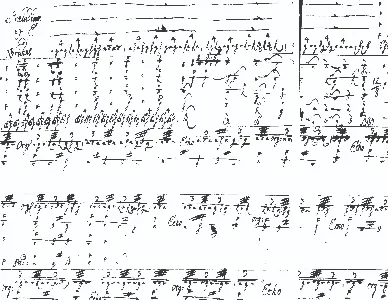
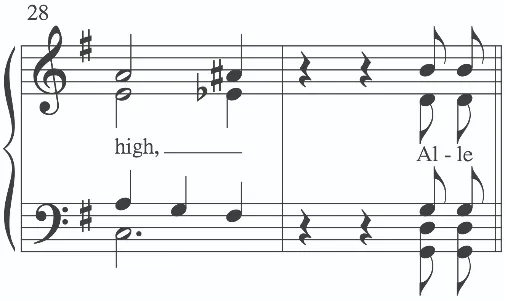
Modern received wisdom would have us believe that meantone’s dissonant intervals were avoided in historic practice, but Bédos has passionately explained that French composers and organists consciously used these dissonances to produce emotional effects.21 This is in fact the basis of what we describe as key color, but it is a modern fiction to ascribe key color to any key in equal temperament—all keys in equal temperament are equally impure, and key color within major or minor tonalities simply does not exist (it is present between major and minor tonalities, where the minor thirds beat much faster than the dissonant major thirds).22 Examples of key color in meantone abound in <Soundclip 7>, where we hear Allard play a few measures of the Suite du deuxième ton, Livre d’orgue, “Plein jeu” by Louis-Nicolas Clérambault.23 The opening arpeggiated chords quickly pass through some very dissonant intervals, and at the end of the clip we hear a richly consonant chord. In a clear refutation of modern received wisdom, we see in Figure 5 that Clérambault employs the “wolf,” the worst of meantone’s intervals.
Robert Zatorre and colleagues have shown that music engages the pleasure circuits in our brains.24 Our brains preserve the dissonant, fleeting pitches of Clérambault’s arpeggiated chords and the tension they create in short-term memory. This tension sets up our expectations for a consonant resolution, and just the anticipation of a resolution releases dopamine in our brains. The actual resolution of this dissonance in the richly consonant D-major chord at the end of the clip with its pure third and 16′ subtones releases another reward with a spike of more dopamine.25 Play Clérambault in equal temperament and a great deal of the sublime beauty and pleasure disappears.26
Atonal music, a creation of the early-twentieth century, was short-lived for the simple reason that it rejected the natural harmonic series and featured unresolved dissonant tension. This was, perhaps, a violent musical expression from the violent times that produced two world wars and the Great Depression. Musical pleasure can be increased with dissonance, but the sense of pleasure rests on the expectation that the dissonance will be resolved with a reward of consonance. The natural harmonic series is the foundation of consonance, and it is hard-wired into our perception of sound. Atonal music was a rather unpleasant affair.
Enhancing chorus depth with mixture design
The design of mixtures can enhance the emotional impact of a principal chorus. The technique was mastered by French Classic organbuilders in the many identical pitches of the Fourniture and Cymbale. The French Cymbale, unlike the German Zimbel, does not sit on top of the pitches of the Fourniture. It has more ranks than the Fourniture but typically exceeds the pitch of the Fourniture in the bass by only the interval of a fifth, with all of the lower pitches in the Cymbale duplicating those in the Fourniture. The pitches of the Cymbale in the high treble will duplicate and descend below the pitches of the Fourniture (the Cymbale has more breaks). Chorus bloom and depth arise in the combination of French mixtures because the identical pitches are distant from each other on different sliders. These identically pitched pipes do not draw each other into perfect tune, as do pipes that are closely spaced and share common wind on the same slider.
Any tuner will tell you that a mixture with doubled pitches is more difficult to tune. Two closely spaced pipes of the same pitch will pull each other into tune without beats, even when as individual pipes they beat strongly out of tune with the reference rank (when one of the doubled pipes is muffled). But when closely spaced pipes of the same pitch are solidly in tune with the reference rank, they tend to stay that way. Doubling of pitch within the same mixture is the key to the tuning stability of many Germanic mixtures.
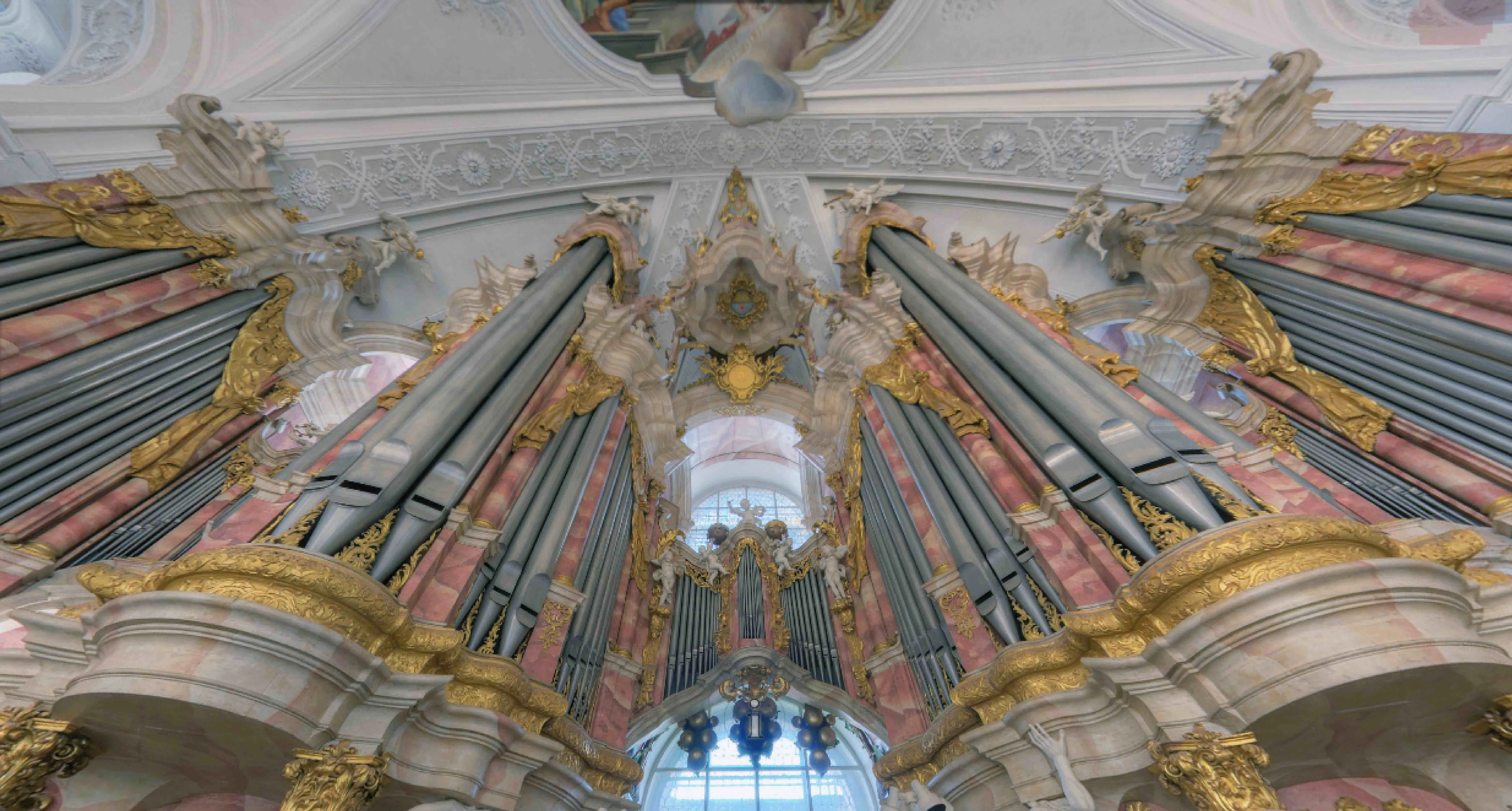
The chorus of the 1750 Joseph Gabler organ at Weingarten is a rare and remarkable example of tuning stability and chorus depth. Each mixture is composed of many ranks, most of them tripled for each pitch, solidly locking in the tuning. Gabler put three of these enormous mixtures in his Hauptwerk alone, and most of the pitches, like the French model, are similar in all three mixtures. Each mixture is stable in its own tuning, but the combination of all three mixtures on their separate sliders creates subtle mis-tuning. This organ pushes the limits of tonal change with a very slow wind response and dramatic chorus effects in Peter Stadtmüller’s stunning interpretation of Bach’s Toccata in E major, BWV 566, the end of which is heard in <Soundclip 8>.27
We all strive for spotless tuning, but mis-tuning is the essence of chorus depth and a source of great musical pleasure. Literature of different eras and different styles will gain immensely from careful applications of mis-tuning, but just as there is no one style of organbuilding that will play all literature, there is no one universal style of mis-tuning that will suit all literature. The art is in finding what types of mis-tuning to apply and to what degree.
Notes and references
Images not credited reside in the collection of the author or the public domain.
1. R. Murray Schafer, The Tuning of the World (New York: Alfred A. Knopf, 1977), page 262.
2. Robert Zatorre, From Perception to Pleasure: The Neuroscience of Music and Why We Love It (New York: Oxford University Press, 2024). This new book ties together decades of research by Zatorre and many others to explain how our brains perceive sound and reward us with pleasure when hearing music.
3. <Soundclip 1> [00:53] Bernardo Pasquini (1637–1710), Sonata for Two Keyboard Instruments, Musical Heritage Society, MHS 1534, 1975.
4. <Soundclip 2> [00:49] Floriano Canale (died 1500s), La Balzana á 8 for two organs, Musical Heritage Society, MHS 1534, 1975.
5. Subtle shifts in tuning will result from a pressure drop in the key channel of a slider chest as more stops are drawn. Electro-pneumatic chests provide stable and unchanging wind pressure to each pipe, no matter how many stops are drawn. Part of the magic of the Cavaillé-Coll organ is its exclusive use of slider chests and the subtle chorus depth they promote.
6. <Soundclip 3> [00:32] Enya, Book of Days, Shepherd Moons, Reprise Records, 9 26775-2, 1991.
7. <Soundclip 4> [00:38] Johann Speth (1664–1720), Magnificat quinti toni, 1693, organbuilder Hans Heinrich Mundt, 1673, Maria před Týnem (Tyn Church), Praha (Prague), organist Klaas Stok, LBCD 75, Lindenberg Productions, 1999. This historically important recording was made in 1996, two years prior to the restoration of the organ.
8. <Soundclip 5> [00:32] Michel Chapuis (1930–2017). “Michel Chapuis joue la suite gothique à Dole,” a Youtube video by Frederic Munoz, January 25, 2018. www.youtube.com/watch?v=oxWHMPS6Lp4. Callinet and Clicquot reeds are Romantic in design, and Cavaillé-Coll retained them in many of his organs. The organ we see in Notre Dame today was built by François Thierry in 1730. François-Henry Clicquot replaced the reed battery in 1783, and Cavaillé-Coll preserved these reeds when he expanded the instrument in 1864.
9. Michael McNeil, The Sound of Pipe Organs (Mead, Colorado: CC&A, 2012). See pages 119–127 for an analysis of the wind flow of the Isnard organ at Saint Maximin that shows the purposeful and carefully calculated starvation of wind in its famous reed chorus.
10. McNeil, page 132. Kirnberger I temperament (not to be confused with the common Kirnberger II and III versions) has a remarkable degree of purity in its intervals, perhaps the most possible in a twelve-tone system. A chord playing C major and G major simultaneously, C-E-G-B-D, is in perfect tune with no beats. Middle C and G align with the second and third harmonics of tenor C; middle C, E, G, B, and D above align with the fourth, fifth, sixth, seventh, and ninth harmonics of low C. Early keyboards with sixteen keys to the octave were devised to get better alignment with the natural harmonic series, but it was very expensive (33% more pipes, action, and space). It eliminated most of the dissonance that served to create the anticipation of consonant rewards, and it was obviously difficult to play. The 1475 da Prato organ at Bologna has a lovely compromise with one extra key in the middle three octaves of its FFF to a′′ compass, splitting the dissonance of the wolf on separate G-sharp and A-flat keys.
11. Claudio Di Veroli, Unequal Temperaments, Theory, History and Practice (e-book, Bray Baroque, fourth edition, 2017, pages 18–23). Di Veroli shows how an interval can produce both faster beating (a subtone) and slower beating (when an interval does not align with the natural harmonic series).
12. Most textbook descriptions of intervals use the concept of cents, which is independent of pitch. While this is very useful, the math to calculate cents is more difficult with logarithms. Beat rates and subtones are what we hear, not cents, and the math for describing them with frequencies is very easily grasped.
13. Zatorre, pages 28 to 30, 33 to 35.
14. Zatorre, personal communication, September 2, 2024.
15. Ross W. Duffin, How Equal Temperament Ruined Harmony (and Why You Should Care) (New York: W. W. Norton & Company, 2007), page 34. If you want a very clear presentation of the relationship of temperaments to the natural harmonic series and how it affects consonance and dissonance in harmony, buy this book. The original form of meantone is described as “¼-comma” because it represents the difference in pitch between four successive pure fifths, C-G-D-A-E, and the interval of two octaves and a pure major third C-C-E. The E derived from the succession of pure fifths is considerably higher in pitch than the purely tuned E above the two octaves, and the difference between the two is the “syntonic comma.” In meantone, this difference is equally distributed between the four fifths, preserving the pure third C-E, hence the term “¼-comma.” Later versions of meantone reduced some of the dissonance in the worst intervals but sacrificed the pure thirds, reducing both the dissonant tension and the consonant rewards.
16. Owen Jorgensen, Tuning the Historical Temperaments by Ear (Marquette, Michigan: Northern Michigan University Press, 1977). This scholarly work describes the beat rates and sonority of fifty-one unequal temperaments using eighty-nine methods of tuning them by ear. J. Murray Barbour’s 1951 work on early temperaments describes unequal temperaments with cent deviations from equal temperament, but this tells us nothing about the purity or impurity of the intervals. In Unequal Temperaments, Theory, History and Practice, Claudio Di Veroli uses cent deviations from pure third and fifth intervals to describe temperaments, revealing the consonances and dissonances we hear when playing them. This book can be purchased online as a PDF document.
17. Régis Allard, personal communication with the author, November 8, 2024.
18. Zatorre, page 28. Our brains clearly discern a fundamental pitch even when it is not present but perceived only by a few of its higher natural harmonics. The natural harmonic series is hard-wired in our brains.
19. <Soundclip 6> [00:45] Louis-Nicolas Clérambault (1676–1749), Suite du premier ton, Livre d’orgue, “Fugue,” organbuilder Louis-Alexandre Clicquot, 1739, Houdan, organist Régis Allard, Magnificat 1739, Editions Hortus, 2017. Download from editionshortus.com. The tuning of the ¼-comma meantone in this recording is spotless.
20. Régis Allard, personal communication with the author, November 8, 2024.
21. François Bédos de Celles, O.S.B, The Organ-Builder [an English translation by Charles Ferguson of the original L’Art du facteur d’orgues, 1766–1778] (Raleigh: The Sunbury Press, 1977), pages 230–231, §1135. Bédos here utterly demolishes the modern notion that dissonant meantone intervals were avoided in historic practice. This is an essay on the use of key color in meantone. Bédos abhorred equal temperament as a vain, mathematical construct of theoreticians.
22. Meantone has three very impure minor thirds. The nine good minor thirds in Pietro Aaron’s equal-beating ¼-comma meantone beat proportionally at exactly twice the rate of the eleven good fifths. See Jorgensen, pages 173–177. For example, middle C to E-flat in equal temperament has fourteen harsh beats per second, while in meantone it beats only five times per second.
23. <Soundclip 7> [00:28] Louis-Nicolas Clérambault (1676–1749), Suite du deuxième ton, Livre d’orgue, “Plein jeu,” organbuilder Louis-Alexandre Clicquot, 1739, Houdan, organist Régis Allard, Magnificat 1739, Editions Hortus, 2017.
24. Zatorre, pages 239–241. Zatorre describes the complexity of the pleasure circuit in the perception of music, which involves both expectations and rewards. The dorsal striatum releases dopamine in response to dissonance and the anticipation of its resolution, and the ventral striatum releases an additional spike of dopamine in response to the consonant resolution.
25. Zatorre, pages 239–241. Zatorre shows the experimental evidence for the release of dopamine in both anticipation and reward.
26. Chinese philosophy long ago explained the basis for the inseparability of musical tension and consonance in the more general concept of yin and yang complementary opposites, where one does not exist without the other. We sense the difference in tension and consonance. Pure, unchanging, and unending consonance would not reward us with dopamine.
27. <Soundclip 8> [0:52] Johann Sebastian Bach (1685–1750), Toccata and Fugue in E Major, BWV 566, organbuilder Joseph Gabler, 1750, Weingarten Abbey, organist Peter Alexander Stadtmüller, Musical Heritage Society, MHS 3195, 1975. This historically important recording was made about six years before the organ’s restoration. The tuning is 1/5-comma meantone, which was revised in the restoration (at the instruction of a committee) to accommodate Bach with much less tension and purity. An analysis of the organ’s wonderful sound can be found in the author’s article, “The 1750 Joseph Gabler Organ at Weingarten,” The Diapason, volume 112, number 1, whole issue 1334 (January 2021), pages 12–16.
28. Oscar Mischiati and Luigi Ferdinando Tagliavini, Gli Organi della Basilica di San Petronio in Bologna (Bologna, Italy: Pàtron Editore, 2013). This stunning 577-page book has a wealth of information and illustrations from the restoration of both organs but regrettably omits the crucial voicing data of pipe toe diameters and flueway depths for the world’s best-preserved Gothic organ. The scaling information of the pipes is presented in diameters for some stops and in circumferences for other stops, but not noted as such. Clarifications of the scaling nomenclature and an analysis of its sound can be found in the author’s article, “What the Scaling of Gothic and Baroque Organs from Bologna and St. Maximin can teach us,” The Diapason, volume 107, number 10, whole issue 1283 (October 2016), pages 24–25.