The Sound of Samuel Green
Editor’s note: The Diapason offers here a feature at our digital edition—two soundclips. Any subscriber can access this by logging into our website (thediapason.com), click on Magazine, then this issue, View Digital Edition, scroll to this page, and click on each <soundclip> in the text.
Prologue
On July 4, 1841, the new railroad from Boston pushed westward across the Connecticut River to West Springfield, Massachusetts, and a new station was built about a mile from the center of nearby Westfield, opening up the region to heavy freight from Boston.1 In the spring of 1843 a twenty-seven-year-old carpenter and bricklayer named William A. Johnson was finishing the work on the new Methodist church in Westfield when crates of organ parts for E. & G. G.
Hook’s Opus 50 began to arrive.2 He helped the Hooks install this organ, and the experience sparked Johnson’s passion for pipe organs and his future career as a famous American organbuilder. Johnson’s sound is very different from the sound of the Hooks. Who was Johnson’s tonal muse?
A surprising answer might be found in Dominic Gwynn’s documentation of an organ built by Samuel Green in 1787 for a London residence. This remarkably complete documentation is published on the website of Martin Goetze & Dominic Gwynn Ltd., Organ Builders and Restorers.3 With this data we can take a deep dive into the sound of Samuel Green and explore some of the striking parallels to the work of Johnson. How could Johnson have been exposed to the work of the English organbuilder Samuel Green? The careful research of the late Barbara Owen gives us a vital clue.
§
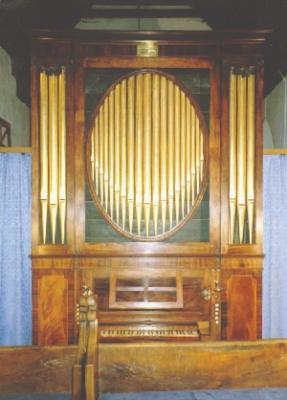
It is extremely rare to find documentation that allows us to fully understand the sound of a pipe organ, but in the work of the organbuilders Goetze & Gwynn we find such documentation for many early English pipe organs. Samuel Green’s one-manual organ of 1787, originally built for a London residence, was later moved to the Church of Saint Mary the Virgin in Edith Weston, Rutland. The English organs of Green’s time did not have a pedal, but they achieved bass gravity by extending the bass octave in the manual to GG. Bass GG-sharp was deleted with the use of meantone tuning, which was prevalent in England well into the nineteenth century.
In this article we will compare the work of Samuel Green (1740–1796) to the American organbuilders William Allen Johnson (1816–1901) and Elias (1805–1881) and George Greenleaf (1807–1880) Hook. Readers will find descriptions and illustrations of Johnson’s Opus 161, built in 1864, in a series of articles in The Diapason.4 Readers who want more information on the Hooks will find documentation of their Opus 322, built in 1863 for the former Church of the Immaculate Conception in Boston, in a similar series of articles.5 In 1870 Johnson was contracted to build and voice an eight-rank, third-sounding Cymbal on the Great division of the Hooks’ Opus 322.6 The articles on the Hook show how Johnson and the Hooks scaled and voiced mixtures in the same acoustical setting.
Our brains have not evolved to easily grasp relationships from raw numbers. We will visually compare the work of Green, Johnson, and the Hooks with graphs based on Normal Scales. The basis for the graphs and the numerical values they represent can be found in Part 1 of the articles on the Hooks’ Opus 322.
Temperament: a revelation from Dominic Gwynn
The current pitch of the Green organ is A=434 Hz at 15 degrees Celsius, and Gwynn notes that this is consistent with original pipework in other Green organs. In Gwynn’s analysis of Green’s meantone in the middle of Figure 1 we see deviations from purity that are noted in cents between the intervals. The major third intervals here with 0 cents are pure with no beats, and they generate significant bass gravity with their deep subtones.7
Green used a modified form of 1⁄4-syntonic comma meantone. Some modern sources, citing no data, attribute Green’s temperament to 1⁄5- or 1⁄6-syntonic comma meantone, but those later forms of meantone have no pure major thirds. Green’s meantone in his organ of 1787 has purity in six of its major thirds, sacrificing only two of the eight pure thirds, E to G-sharp and E-flat to G, to cleverly distribute the dissonance of the wolf fifth on three equally wide fifths, C-sharp to G-sharp to D-sharp to A-sharp. In Figure 2 we see the beats rates calculated from Gwynn’s data.
Gwynn’s data is incredibly important because it runs counter to the argument that all of the pure thirds in meantone were sacrificed early in the eighteenth century, with a gradual 1⁄5- to 1⁄6-comma dilution of purity before succumbing to equal temperament. Claudio Di Veroli convincingly shows that this was common in continental Europe, but Gwynn’s data shows that this was not the case with Green in England, who built organs for cathedrals at the very end of the eighteenth century and preserved meantone’s 1⁄4-syntonic comma purity.8 The reason for this is obvious: large English organs needed the deep bass subtones of meantone’s pure thirds to generate bass gravity in the absence of an independent pedal. Continental organs, with the powerful deep bass of their independent pedals, could afford to sacrifice meantone’s pure thirds. We should also remember that Dom Bédos utterly demolishes the modern notion that dissonant intervals in 1⁄4-syntonic-comma meantone were avoided in practice—their dissonance was very effectively used to enhance emotional impact, and they were the source of key color.9
An archaic spelling
Green and Johnson used third-sounding ranks in their mixtures, and they both used the archaic nomenclature of Sesquialtra for this stop. Scot Huntington observed that the Hooks used both forms of spelling, with Sesquialtera at New Haven in 1852 and Woburn in 1860, and Sesquialtra at Bangor in 1860. Hook stops of that name sometimes did not include a third-sounding rank, and the Hook mixture stops of this time might sometimes include a third-sounding rank. This is perhaps just a reflection of a chaotic transition in nomenclature in response to the transition to equal temperament, which Huntington notes occurred in about 1850. The historical connection between Green and Johnson in the unusual spelling of their mixtures with third-sounding ranks is tenuous but interesting.10
A third-sounding rank blends seamlessly in a temperament with pure thirds. Equal temperament has a very dissonant major third, and as a result we rarely hear boldly-voiced, third-sounding chorus mixtures in modern organs. To illustrate this point, the Green organ was re-tuned in equal temperament in 1932, and the third-sounding rank was removed from the Sesquialtra. Goetze & Gwynn restored Green’s meantone temperament and the third-sounding rank in 1982.
Pipe diameters: power and timbre
I began to suspect that the Hooks were not Johnson’s tonal muse when I looked at their scaling. Pipe scaling is the adjustment of pipe diameters to control power and timbre. Wider pipes will have more fundamental power, and narrower pipes will have a brighter timbre. Johnson and Green were clearly using similar scaling methods.
The most noteworthy feature of Green’s scaling is the reduction of diameters and power in his upperwork, a practice also seen in the work of Andreas Silbermann and the Isnards. In Figure 3, Green’s 8′ Open Diapason has the widest scaling, and the scaling decreases in smooth progression to a very narrow -11 HT in the Sesquialtra. Another feature is the increase in scaling in the bass and treble within each stop, widening from a minimum scale at about 1′ to ½′ pitch. The widest scales are seen in the bass, and Green uses a powerful manual bass to achieve a full sound in the absence of an independent pedal. As Stephen Bicknell has noted, Green had to be careful to prevent the bass from overwhelming the treble.11 Green’s need for gravity in a powerful manual bass prevented an ascending treble, and Bicknell notes that Green’s sound worked well with dense treble chords of many notes. Both Gwynn and Bicknell observed that Green made on-site scaling adjustments during installation to achieve power balances.
The Hooks used what we would call a constant scale, where all of the pipes in the principal chorus at the same pitch have the same scale. We find versions of this scaling method in the work of Gottfried Silbermann and D. A. Flentrop. For example, the diameter of the 2′ stop at low C would be the same as the diameters of the 4′ stop at tenor C and the 8′ stop at middle C (all of which have the same 2′ pitch). Figure 3 shows the Hooks’ constant scale in the red data points for the 16′ Open Diapason and orange data points for the III Mixture. Note that the Mixture is scaled as widely as the Open Diapason. The Hooks’ constant scale is mostly a flat line from 4′ to 1⁄8′ at 0 halftones, but a constant scale can vary from the Normal Scale as long as all of the pipes at the same pitch are the same scale.
If you want strong evidence that Johnson did not look to the Hooks for tonal guidance, look no further than Johnson’s scaling in Figure 3, which imitates Green’s reduction of scale in the upperwork. Johnson’s range of scaling between his 8′ Open Diapason and his 2′ Fifteenth is more pronounced than Green’s, but they both use the same scaling method. Johnson employed larger foundation scales and a higher pressure for the larger acoustic of a church, while maintaining Green’s very narrow scales in the upperwork.
Key observation: The Hooks’ constant scale is very close to Töpfer’s Normal Scale, which was widely adopted in the nineteenth century, and we use it today for the normalization of scaling (and the graphs in this article). Compared to either Green or Johnson, the scaling method of the Hooks is a very different tonal aesthetic.
The toe constant: visualizing power balances
The next strong clue that Johnson was not imitating the Hooks was found in his treatment of pipe toes. The diameter of a toe controls the wind pressure in the pipe foot, and once the wind pressure in the bellows has been set, the toe is the primary means of controlling power for a voicer. The concept of a toe constant allows us to compare the relative flow of wind in a pipe of any scale diameter, and we can use the toe constant to compare power balances.
A toe constant of “1” is simply the square root of a pipe’s diameter. This is not an “open toe,” which would represent a toe constant of “4” or more. Toe constants reflect areas, not diameters, and the areas are proportional, e.g., an open toe with a constant of “4” has four times the area of a toe with a constant of “1” and will flow four times as much wind. Virtually all organbuilders close the toe to some degree to control power, and “open toe” constants of “4” or more are extremely rare in any pipes but the highest pitches of mixtures and the lowest of wind pressures. Green’s pressure is very low, and his bass is powerful. The wind flow from the generous toe constants of the lower-pitched, offset pipes in the higher-pressure Hook and Johnson in Figure 4 was reduced by restrictions at other locations. The Hooks reduced the flow of wind by placing a small slider under each offset pipe toe. Johnson reduced the flow of wind by placing a lead washer in the topboards where the offset tubing was inserted.
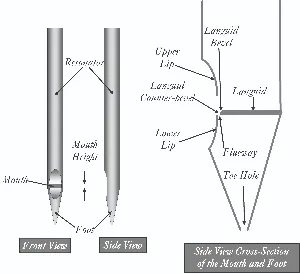
A toe constant also compensates for the flow of wind required by wider or narrower mouths on pipes of the same diameter. A wider mouth will need more wind to feed the larger area of its flueway. You can calculate the diameter of a toe from its toe constant tc, its pipe diameter pipedia, and its mouth width fraction mwfraction (the mouth width divided by the pipe’s circumference) with this simple equation:
In this article I do not show Normal Scale mouth widths because all three builders used a mouth width in the principal chorus that is very close to a 1⁄4 fraction of the pipe circumference, and this normalizes to “1” in the equation: 4 × 1⁄4 = 1. Normal Scale mouth widths are a better indication of power balances than pipe diameters when the mouth widths vary from a 1⁄4 fraction, but Normal Scale diameters and mouth widths are identical for pipes with a 1⁄4 fraction.
“Open toe” and “closed toe” voicing
The toe constants of Green and Johnson in Figure 4 get smaller in stops of higher pitch. These very restricted toes further decrease the power of the more narrowly-scaled upperwork. Taken together, the scaling and toe constants show why Johnson has some of the most refined upperwork of the organs of his time.
Johnson’s toe constants are restrained like Green’s in the upperwork, but his 8′ Open Diapason has much larger toe constants for more wind and more power in the larger acoustic of the church for which this organ was built.
The toe constants of the Hooks are seen in Figure 4 in the red data points for the 8′ Open Diapason and orange data points for the III Mixture. The power implied by these very large toe constants is further amplified by the much wider scaling of the Hook upperwork.
Key observation: For all three builders we see toe constants that descend from bass to treble. In the case of Green, this is due to his need for bass power in the manual to compensate for the absence of an independent pedal. For Johnson and the Hooks, this is a feature of the bass gravity and warmth of Romantic voicing.
But within that Romantic style, the voicing of the Hooks and Johnson are worlds apart. The voicing of the Hooks is essentially open toe, and the voicing of Green and Johnson is essentially closed toe. The toe constants do not prove that Johnson imitated Green, but they clearly show that Johnson did not imitate the Hooks.
Mouth height (“cutup”): timbre
Mouth height, or what is more commonly called “cutup,” controls timbre. Lower cutups create brighter timbres, and cutups will rise with higher foot pressures to maintain the same timbre. Green’s cutups were raised at the time its pressure was raised from 55 to 65 millimeters.12 This was carefully done, and we see the results in Figure 5 (see page 22), where most of Green’s cutups fall within a narrow range of -8 to -4 HT. With a modest wind pressure and the restraint of wind flow in Green’s low toe constants we should expect very low cutups, and that is exactly what we see. The cutups of the Johnson organ exhibit a much wider range from about -7 to +2 HT, and this reflects both the wider range of its toe constants and its slightly higher 76 millimeters of wind pressure.
The very generous mouth heights of the Hooks’ 16′ Open Diapason and III Mixture are seen in the red and the orange data points in Figure 5, and they reflect the large toe constants and great power of the Hook chorus.
Key observation: The wind pressure of Johnson’s Opus 161 is identical to the Hooks’ Opus 322, but Johnson follows the work of Green in the lower cutups of his upperwork, a direct result of Johnson’s restricted upperwork toes and his much more restrained upperwork power.
Flueway depths: power and warmth
Green’s flueway depths in Figure 6 (see page 22) are shallow and unusually consistent. Johnson’s much deeper flueways more closely resemble the red and orange data points of the Hooks’ flueways. Johnson’s flueway depths are much less consistent than those of Green, but they are consistent with his toe constants, and we will explore what that means in the next voicing parameter.
Key observation: While Johnson’s flueways are much deeper than Green’s in general, they do not add power because they receive very little wind from the restricted toes. Opening the flueway of a pipe whose toe area is smaller than the flueway it feeds will produce a warmer sound, not more power, and this warmth is a characteristic of Johnson’s Romantic voicing.13 In contrast, the Hooks’ deep flueways produce great power and brightness from the great volume of wind supplied to them by their very large toe constants.
Johnson and the Hooks have similar and very generous flueway depths, but much of the difference in their sound is produced by the differences in the toes that feed those flueways, and this leads us to the last voicing parameter, the ratio of the area of a toe to the area of the flueway it feeds.
Toe and flueway area ratios: speech onset
The toe constant shows us the amount of wind flowing through a toe relative to its pipe diameter, and in large part this determines the potential power of a pipe. A deeper flueway can increase the power, but only if the toe area is larger than the flueway it feeds. If we compare the areas of toes and flueways, we can begin to understand how they interact to affect chiffing and the promptness of speech. In Figure 7 we see these area ratios for Green, Johnson, and the Hooks. Chiff depends on a fast rise in pressure at the flueway, and if we close the toe, we slow the buildup of pressure in the foot, and we hear less chiff. We can eliminate chiffing with more closed toes and bolder nicking on the languid edge. The sound of the Hooks’ has no chiff, and to achieve this with their very large area ratios they used many bold and deep nicks on all of their languids.
It should come as no surprise that some voicers would focus on area ratios to control the promptness of speech and the degree of chiffing. A remarkable area ratio of “1” appears in the work of Samuel Green, Gottfried Silbermann, and the Isnards in pipes from 4′ to 1′ pitch. An area ratio of “1” still supports faster speech but with a more restrained chiff. If we compare the sounds of these voicers we see aggressive nicking by Green with virtually no chiffing, very fine and few nicks by Silbermann with subtle chiffing, and no nicks by the Isnards with relaxed speech and clear chiffing.
We see something else remarkable in this area ratio of “1”—it is independent of power. Larger toe constants with more power can be combined with deeper flueways to produce equal area ratios of “1”. Similarly, small toe constants with less power will also produce equal area ratios of “1” if the flueway depths are reduced.
• Green’s low-power toe constants start at 0.8 in the tenor and descend with lower power to 0.3 in the treble on 65 millimeters of pressure, while maintaining area ratios very close to “1” with shallow flueways.
• The Isnards’ moderate-power toe constants start at 0.6 in the tenor and moderately ascend with more power to 0.8 in the treble on 83 millimeters of pressure, while maintaining area ratios of exactly “1” with moderate flueways.
• Gottfried Silbermann’s high-power toe constants start at 1.0 in the tenor and strongly ascend with much more power to 1.4 in the treble on 90 millimeters of pressure, while maintaining area ratios of “1” with very deep flueways.
What we see in this data is a wide range of power from Green to Silbermann with an area ratio of “1” for a similar promptness of pipe speech. This ratio appears to be a common thread in many successful sounds with different degrees of power and chiffing. Although Green appears to have intuitively approached an average area ratio of “1,” an analysis of the area ratios of the Isnards and Gottfried Silbermann strongly suggests that they were actually calculating toe and flueway areas.14
Johnson’s toe constants, like Green’s, are very small in the upperwork, but his flueways are much deeper than Green’s, and in Johnson’s upperwork we see very small area ratios well below 0.5. As a result, the wind pressure rises more slowly in Johnson’s pipe feet, and we hear a slower onset of speech in these pipes (not to be confused with slower voicing). The much larger area ratios of Johnson’s 8′ Open Diapason produce more prompt speech than his upperwork, and his bold nicking eliminates chiffing with the Open Diapason’s larger toe constants.
In stark contrast to either Green or Johnson, observe the area ratios of the Hooks in Figure 7, which rise from well over “2” to an astounding “4” at 1⁄8′ pitch. The speech of the Hooks’ voicing is unusually prompt for a Romantic organ. Later Romantic organs of the early-twentieth century had much higher pressures, deep flueways, excessively-closed toes, and a sluggish speech that ultimately produced the neo-Baroque backlash of voicing with excessively open toes.
Key observation: Green’s area ratios are very regular and are close to “1.” Johnson’s upperwork ratios are smaller as a consequence of his deeper flueways, and his upperwork speech is slower. The Hooks’ voicing with its virtually open toes, deep flueways, and large area ratios produces very fast speech and great power. The area ratios of Green, Johnson, and the Hooks show clearly divergent styles, but we might speculate that Johnson’s work evolved from Green’s area ratio of “1,” using deeper flueways to achieve a warmer, more Romantic sound.
Languids: an unsolved mystery
In Figure 8 we see a perspective drawing of Johnson’s languid that is cut away to show its cross-section. The red arrow in this drawing points to an unusually large counterface with a very rare negative angle. I have only observed languids like this in the 1774 work of the Isnards at Saint Maximin. Gwynn notes a small “flattening of the languid edge” in the work of Green, and that with Green’s ears “the [angled] nicking must have been put in before the pipe was assembled.” I found evidence for this in Johnson’s work as well, where very long, deep nicks were cut into the inside surface of the lower lip; this would be very difficult to accomplish after the pipe was soldered up. I noticed the length of these nicks on the inside of the lower lip when looking up through the toe of a Johnson pipe. From this view I also noticed the large counterface on the languid with its negative angle. Gwynn had the opportunity to observe Green’s languids when he cut off the feet of some pipes to make repairs. Green’s languids do not have a counterface, and it is unknown how Johnson came to use a counterface with a very rare negative angle.
Gywnn notes that Green used low languids and pulled-out upper lips. This results in faster voicing, which means that the pipe will more quickly overblow to the octave as the pressure is raised. We see this in Johnson’s work as well. Note the low position of the languid in the pipe at left in Figure 9 (see page 24).
Key observation: Hook languids have many deep nicks and no counterface. The evidence shows that in 1864 Johnson did not imitate the languids of the Hooks or Green, and the mystery of Johnson’s negatively angled counterface is unsolved.
A powerful clue in an aesthetic detail
In the center and right images in Figure 9 we see that Green went to the trouble to make two extra cuts on the ears of the pipes in his principal chorus, one at about 45 degrees at the bottom, and another at about 60 degrees at the top. The shape of these ears appears to be an aesthetic preference. Although it is difficult to see in the image of Johnson’s pipe at the left in Figure 9, Johnson’s ears in his principal chorus have the same two cuts at the same two angles, and this ear shape appears to be unique to Johnson in American organ building. The extra cuts on Johnson’s ears and the extra work required to shape them as an aesthetic detail are compelling evidence that Green was a model for much of Johnson’s work.
Green’s ears are very narrow, projecting a small distance from the mouth, and this preference has a tonal effect. Note in the center and right images of Figure 9 that the relative projection reduces as the pitch rises, and the ears disappear above 1′ pitch. This is exactly what I observed in Johnson’s Opus 161. In nearly all American work of the nineteenth century, including the Hooks, we see normal rectangular ears with a strong projection from the mouth. Large ears can increase the power of the fundamental by 2 dB, which is substantial and equivalent to about 4 halftones of wider scaling. But they also increase the power of a few, random higher harmonics that protrude above the smooth roll-off in power of normal harmonics, impairing the timbre and chorus blend. This is why you see no ears on the principal chorus pipes of the Isnards, Gottfried Silbermann, or the façade pipes of any Cavaillé-Coll organ. Green may have attempted a compromise by reducing the power of the unblending harmonics while preserving some additional fundamental power in the bass.
In his documentation of Green’s organ, Dominic Gwynn includes many photographs of Green’s pipe construction details and aesthetic preferences that bear striking resemblances to the photographs of Johnson’s pipework in the description of his Opus 161. Of special note are the similarities in the construction details and voicing of the wood pipes.15
The sound of Samuel Green
No recordings of Green’s organ at Edith Weston could be found, but the sound of Green can be heard in the groundbreaking recording of Simon Preston and the English Concert under the direction of Trevor Pinnock in their 1984 compact disc, 5 Organ Concertos, George Frideric Handel. The organ in this recording was built by Green for Lichfield Cathedral in 1790 and later moved to the Church of Saint John the Baptist in Armitage, Staffordshire. In <Soundclip 1> we hear Green’s principal chorus, whose third-sounding ranks seamlessly blend in 1⁄4-syntonic comma meantone.16 The use of Sony MDR 7506 headphones is strongly recommended as earbuds cannot reproduce the bass sound in the recording. This is a much brighter sound than we might expect from Green, but as others have noted, this organ was scaled and voiced for a cathedral and now resides in a much smaller acoustical setting. In <Soundclip 2> we hear Green’s 8′ Trumpet, a stop with very strong affinities to the sound of Johnson’s 8′ Trumpet in his Opus 161.17
The interpretation of music by Handel (1685–1759) by Pinnock and Preston is a revelation. The popularity of Green’s sound in his time and its suitability to the work of Handel is demonstrated in Bicknell’s illustration of an organ newly built by Green for Canterbury Cathedral, which was temporarily erected in Westminster Abbey for the Handel Commemoration Festival of 1784 and the twenty-fifth anniversary of Handel’s death.18
Key observation: The modern use of small continuo organs based on delicate, stopped foundations and tuned in equal temperament or any of the well-temperaments does not reproduce the grand sound envisioned by either Handel or Green. The authentic model for the rendition of Handel’s organ concertos is the sonority and gravity of meantone’s pure major thirds, mixtures with third-sounding ranks, and the “booming” power of Green’s manual bass.
§
After assisting the Hooks with the installation of their Opus 50 in the spring of 1843, Johnson wasted no time in building his first organ during the following winter.19 Did the newly inspired Johnson make a trip on the new railroad to see the organs of Boston, perhaps with the Hooks as they returned to their shop? The evidence presented in this article suggests that Johnson fell under the spell of the sound of Samuel Green. America won independence from England in 1783, but still looked to England at this time for many of its pipe organs. Barbara Owen’s research discovered that Samuel Green built an organ in 1792 for the Brattle Square Church in Boston, and she noted that it survived until 1873.20 After I read Bicknell’s descriptions of Green, Owen’s clue suggested that Johnson may have had access to Green’s organ in Boston, which was fifty-one years of age in 1843, and at that ripe age perhaps more available for detailed inspection. There is no doubt that the Hooks inspired Johnson’s passion for pipe organs, but when we listen to the warm bass and refined chorus of a William A. Johnson organ, we may be hearing the distant echo of Samuel Green.
Notes and references
Uncredited images reside in the collection of the author.
1. www.en.wikipedia.org/wiki/Boston_and_Albany_Railroad, accessed June 11, 2024.
2. John Van Varick Ellsworth, The Johnson Organs (Harrisville, New Hampshire, The Boston Organ Club, 1984), pages 16–18.
3. Dominic Gwynn, St. Mary, Edith Weston, The Samuel Green Organ 1786, Historical and Technical Report No. 6 (The Harley Foundation, 1990). www.goetzegwynn.co.uk/reports/, accessed June 9, 2024. In his email of June 24, 2024, Goetze & Gwynn Ltd. director Robert Balfour Rowley noted that Dominic Gwynn had passed away in May, and that Gwynn would have “enjoyed corresponding with you on this subject.” I am deeply grateful to Blair Batty for directing me to the website of Goetze & Gwynn with Green’s data.
4. Michael McNeil, “The 1864 William A. Johnson Opus 161, Piru Community United Methodist Church, Piru, California,” The Diapason, Part 1, volume 109, number 8 (August 2018), pages 16–20; Part 2, volume 109, number 9 (September 2018), pages 20–25; Part 3, volume 109, number 10 (October 2018), pages 26–28; Part 4, volume 109, number 11 (November 2018), pages 20–24.
5. Michael McNeil, “1863 E. & G. G. Hook, Opus 322, Church of the Immaculate Conception, Boston, Massachusetts,” The Diapason, Part 1, volume 108, number 7 (July 2017), pages 17–19; Part 2, volume 108, number 8 (August 2017), pages 18–21; Part 3, volume 109, number 9 (September 2017), pages 20–22. See Part 1 for tables of the numerical values of Normal Scale diameters, mouth widths, and cutups.
6. Scot L. Huntington, Barbara Owen, Stephen L. Pinel, Martin R. Walsh, Johnson Organs, 1844–1898 (Cranbury, New Jersey, The Princeton Academy of the Arts, Culture, and Society, 2015), page 17.
7. Michael McNeil, “The Art of Mis-Tuning: Its Perception and Emotional Power,” The Diapason, volume 116, number 10 (October 2025), pages 16–21.
8. Claudio Di Veroli, Unequal Temperaments, Theory, History and Practice, fourth edition (Bray Baroque, 2017). Di Veroli’s research is very deep, and he has made an excellent case that meantone quickly lost all of its pure major thirds in continental Europe early in the eighteenth century, and its dilution of purity increased with time. Green’s temperament of 1787 with its six pure major thirds demonstrates that a very different aesthetic was prevalent in England.
9. François Bédos de Celles, O.S.B, The Organ-Builder [an English translation by Charles Ferguson of the original L’Art du facteur d’orgues, 1766–1778] (Raleigh, North Carolina, Sunbury Press, 1977), pages 230–231, §1135.
10. Scot L. Huntington, personal communication of December 21, 2024, on the nomenclature of the Hooks. Goetze & Gwynn document Green’s mixtures as a Sesquialtra. According to a document supplied by Bill Van Pelt on the 1785 Green organ at Bruton Parish Church, Williamsburg, Virginia, that organ had a Sesquialtra bass mixture (Samuel Green Organ of 1785, John R. Watson and David Blanchfield, Colonial Williamsburg Foundation, 2005, page 2). Nearly all stoplists of Green’s organs in the literature spell this stop as a Sesquialtera, an apparent modern revision of the nomenclature. We see revisions like this in the transcribed stoplists of Johnson organs where the mixtures are spelled as Sesquialtera in virtually all of the resources on Johnson available to me, but Johnson seems to have consistently used the spelling of Sesquialtra in his original documents, which are imaged by Scot Huntington, et al., on pages 217, 219, 221, 225, 227, and 229 in the reference cited in note 6. Preservation of original nomenclature is important for making historical connections.
11. Stephen Bicknell, The History of the English Organ (Cambridge, Cambridge University Press, 1998), pages 185–187.
12. Gwynn, page 3.
13. When toe areas are smaller than the flueway areas they feed, further deepening of the flueway will cause the pressure to drop in the flueway and the timbre will have less brightness.
14. Michael McNeil, “The Sound of Gottfried Silbermann,” The Diapason, Part 1, volume 113, number 12 (December 2022), pages 12–17; Part 2, volume 114, number 1 (January 2023), pages 13–19. Michael McNeil, The Sound of Pipe Organs (Mead, Colorado, CC&A, 2012), see page 166 for the Isnard Grand Orgue area ratios.
15. See the documentation referenced in notes 3 and 4.
16. <Soundclip 1> [00:51] George Frideric Handel: 5 Organ Concertos, The English Concert, Trevor Pinnock and Simon Preston, ARCHIV Production, D 150066, 1984, Concerto in D Minor, opus 7, number 4, track 5. A source for this recording was found in this link: https://www.discogs.com/release/4830229-George-Frideric-Handel-Simon-PrestonEnglish-Concert-Trevor-Pinnock-Organ-Concertos-Op-7-Orgelkonzert srsltid=AfmBOoqYlvxvxHpixRBHRo6lXldp1h4OvhSeDRRrVt2iO1NxIwoynzyz.
17. <Soundclip 2> [00:36] George Frideric Handel: 5 Organ Concertos, The English Concert, Trevor Pinnock and Simon Preston, ARCHIV Production, D 150066, 1984, Concerto in B-flat Major, opus 7, number 3, track 15. Scales of the resonators, blocks, shallots, tongues, and boots of Johnson’s 8′ Trumpet in his Opus 161 can be found in Part 2 of the articles referenced in note 4.
18. Bicknell, page 173.
19. Ellsworth, page 18.
20. Barbara Owen, The Organ in New England (Raleigh, Sunbury Press, 1979), pages 18–19 and 422. Owen died just weeks before this article was finished, and I regret that she did not have the opportunity to make comments. I met her when she played a recital on Johnson’s Opus 161 on November 8, 1987. The depth of her research is her lasting legacy.