Albert Schweitzer Organ Festival Hartford 2026: Young Professional Division Competition
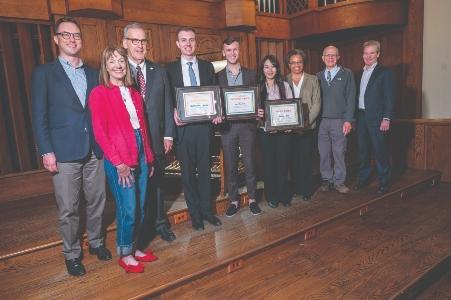
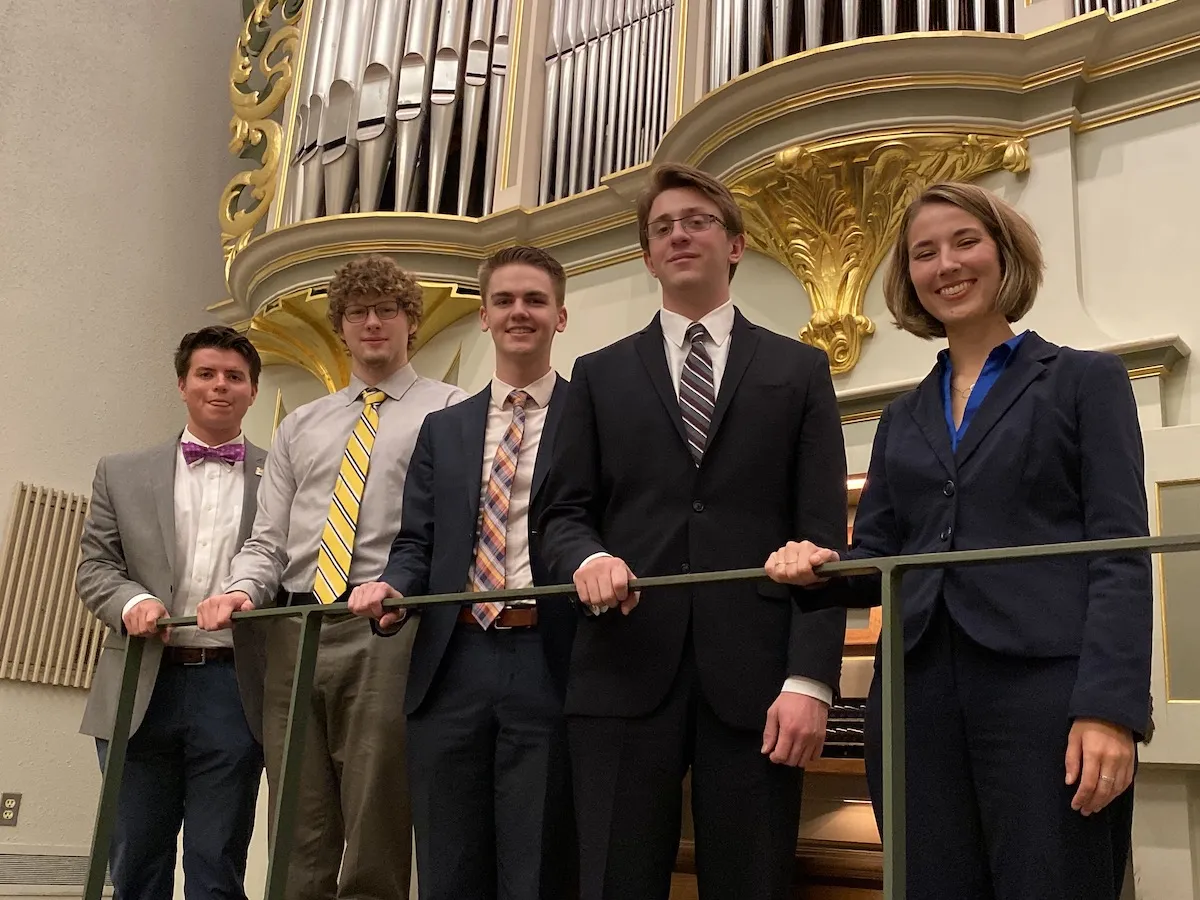
September 2026 marked a decade since the Albert Schweitzer Organ Festival Hartford (ASOFH) began its residency at Trinity College in Hartford, Connecticut. From the festival’s founding in 1997, then held at First Church of Christ in Wethersfield, Connecticut, to the present, it has grown to be one of the premier events of its kind in North America. This year featured the biennial Young Professional Competition with three highly accomplished organists chosen in a preliminary round from submitted audio recordings.
The 2026 festival opened Saturday morning, September 26, with three recitals each with a required repertoire consisting of a major work of Johann Sebastian Bach, one of the three Franck Chorals, a virtuosic work from the twentieth or twenty-first century, and a work by a woman or Black, Indigenous, and People of Color composer. The distinguished jury for the competition consisted of three concert artists and professors of organ: Ken Cowan of Rice University, Nicole Keller from the University of Michigan, and Todd Wilson of the Cleveland Institute of Music.
The first to perform was Jon Runion from Rochester, New York, currently a graduate student at The Juilliard School in the studio of Paul Jacobs. His recital opened with the “Great” Fantasia and Fugue in G Minor, BWV 542. His choice of a twenty-first-century work was “Eaux natales” (Natal waters) by French organist and composer Thierry Escaich. This transcription of one of the composer’s own choral works is typical of Escaich’s style with its insistent ostinati and unmistakably French aesthetic. “Lumen Christi” from Aspects of Light by American organist and composer Brenda Portman followed. (Ms. Portman served as a jury member for the 2025 ASOFH High School Competition and won first prize in the 2006 Young Professional Competition.) Composed by commission, the work celebrates the light of the Transfiguration using the Gregorian communion chant for the Feast of the Transfiguration, including a fugue whose subject is derived from the chant, and a final grand harmonization of the melody. Runion then concluded his recital with Choral No. 1 in E Major of Franck.
Jaehee Won from South Korea and currently a graduate student at the Jacobs School of Music at Indiana University was second to perform. Max Reger’s Introduction and Passacaglia in D Minor, WoO IV/6, opened her program. Ms. Won next offered Bach’s Trio Sonata No. 3 in D Minor, BWV 527. The work’s restrained and spare textures made for a pleasing contrast with the Reger though both were in the same key. Shifting from the Teutonic to the Gallic for the second half of her recital, Ms. Won continued with Choral No. 3 in A Minor of Franck and concluded with Jeanne Demessieux’s Te Deum, opus 11.
A lunch in the Trinity College Chapel cloister provided a break before the final recital given by Nathan Ringkamp. A Pennsylvania native, he is a graduate of the Peabody Conservatory and is currently pursuing an artist diploma with Jean-Baptiste Robin at the Conservatoire à Rayonnement Régional de Versailles, France.
Like Runion, he opened with Bach’s Fantasia and Fugue in G Minor. This was followed by Étude Héroïque, opus 38, by the late French Canadian organist and composer Rachel Laurin—a dramatic and virtuosic work very much in the French tradition. The obligatory Choral of Franck was the first in E major, while the “Toccata” from Suite, opus 5, by Maurice Duruflé served as the finale.
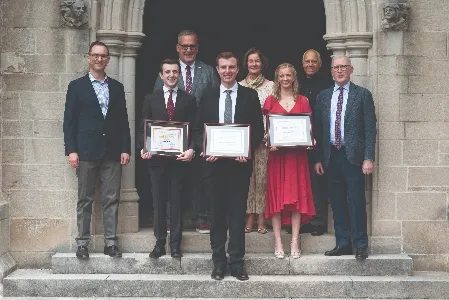
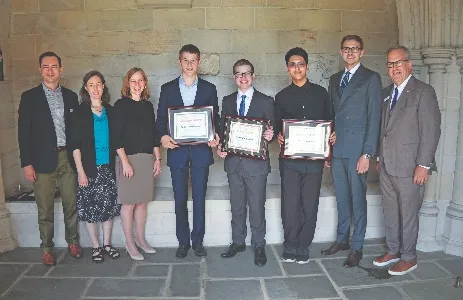
The playing of all three of these prodigiously talented artists was of a very high standard. Third prize and $3,500 was awarded to Jaehee Won; second prize and $7,500 to Jon Runion; and both the first prize of $15,000 and the audience prize of $2,000 were awarded to Nathan Ringkamp. As winner of the competition, Ringkamp was invited to play during the final festival concerts on Saturday evening and Sunday afternoon. The prize also included the opportunity to perform a full recital as part of the 2027 ASOFH.
Saturday evening and again Sunday afternoon the Hartford Symphony Orchestra, directed by Carolyn Kuan, joined the festival for the fourth time for a concert, “Music in a Gothic Space.” Trinity College Chapel is indeed a neo-Gothic space, and the acoustic was ideal for both the orchestra and the marvelous Austin organ in a program consisting almost entirely of twentieth-century American music (excepting Canadian Rachel Laurin’s work reprised by Nathan Ringkamp).
ASOFH artistic director and John Rose Distinguished College Organist, Director of Chapel Music, and Artist-in-Residence Christopher Houlihan was soloist in Horatio Parker’s Concerto for Organ and Orchestra in E-flat Minor, opus 55, of 1901–1902. It is surprising to note that Massachusetts-born Parker was a year younger than Claude Debussy, yet his music is firmly nineteenth century in style, seemingly unaffected by the more modern trends of his time. The concerto, however, manages to be quite original in any case. The first movement is, in effect, two movements. The grand Romantic gestures of the opening “Allegro Moderato” remarkably give way to an “Andante” of more subdued and quietly colorful writing featuring harp, solo violin, and French horn, functioning in effect as a slow movement for the concerto. The orchestral solos were beautifully played by Hartford Symphony members Susan Knapp Thomas, Lisa Rautenberg, and John Michael Flavetta, respectively. Parker’s second movement lightens the mood with a quasi scherzando “Allegretto ma ben marcato,” while the final “Allegro moderato, molto risoluto” provides the more expected ingredients of a fugal exposition, pedal cadenza, and grandiose conclusion. Kuan and Houlihan drew a perfectly blended combination of sonorities from the orchestra and organ assisted by the marvelous acoustic of the chapel.
Following the Parker, Houlihan entertained the large audience with two of his own arrangements of songs by Stephen Sondheim: “Not While I’m Around” from Sweeney Todd and “Everybody Says Don’t” from Anyone Can Whistle. The latter was cleverly set with toccata-like rapid manual figurations (think Henri Mulet’s “Tu es Petrus”) with single sixteenth chordal swipes at the en chamade on the Solo manual to both virtuosic and charming effect.
After intermission, Ringkamp revisited Rachel Laurin’s Étude Héroïque. His dynamic performance was impressive.
The full orchestra was given a chance to shine on its own in two works by Samuel Barber: First Essay for Orchestra, opus 12, of 1937 and the well-known "Adagio for Strings," originally from his String Quartet, opus 11, from 1935–1936. These lyrical, introspective works, both of a somber yet intensely emotional character, reveal the unique and thoroughly American voice that Barber contributed to the country’s musical landscape and repertoire.
As a finale, Christopher Houlihan, Carolyn Kuan, and the orchestra teamed up for yet another Barber work, Toccata Festiva, opus 36, from 1960. Composed for the dedication of the Aeolian-Skinner organ at the Academy of Music in Philadelphia, the work at times evinces the more aggressive and dissonant idiom associated with the zeitgeist of the 1960s, yet includes passages of the kind of aching lyricism one values so much in Barber’s music. Every section of the orchestra had its moment of bravura, and Houlihan’s execution of the pedal cadenza, and indeed the whole work, was brilliant.
On both Saturday and Sunday ASOFH presented a pre‑concert talk featuring three distinguished participants: Sean Duffy, who recently stepped down as executive director of the Albert Schweitzer Institute at Quinnipiac University; Christopher Houlihan; and Carolyn Kuan, music director of the Hartford Symphony Orchestra. Duffy opened the session with an engaging overview of Schweitzer, the renowned polymath whose work spanned theology, philosophy, medicine, and music. He highlighted Schweitzer’s deep love of the organ, noting that when Schweitzer founded his hospital in Africa, he brought a reed organ with him to provide music for services. Duffy brought this very instrument to the festival, and it was demonstrated for the attendees. He also described how the Albert Schweitzer Institute continues to honor the many facets of Schweitzer’s legacy.
Following Dr. Duffy’s presentation, Carolyn Kuan and Christopher Houlihan participated in a lively discussion about the collaboration between symphony and organ in preparing the concert program. Both artists spoke enthusiastically about the creative partnership that shaped the performance, and their mutual respect was evident throughout the conversation.
This year’s ASOFH boasted the largest attendance in its history. The event again displayed the high level of talent and accomplishment among the younger generation of organists in this country.