Fifty Years Ago, 1976, “The American Organ Sonata”: A Bicentennial Program Revisited
Sometime late in 1973 or early 1974, a student of mine showed me a copy of a dissertation, “The Organ Sonata Since 1845,” by Rudolph Josef Kremer (1927–2005). I have no idea as to why this student brought this material to my attention, since she was not playing any large works at that time, and I do not remember any discussion we may have had on the subject.
I borrowed the copy, read it, and found it very interesting—so much so that I decided to get a copy for myself from University Microfilms. The dissertation covered the organ sonata in Germany, England, the Netherlands, Scandinavia, Italy, the Czech Republic, Poland, Russia, France, Belgium, and finally the United States.
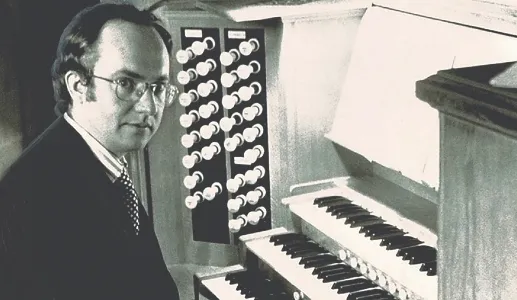
My interest in it at that time may have been related to thoughts I was having regarding our country’s upcoming bicentennial celebration in 1976. Since I became organist at California’s Garden Grove United Methodist Church in 1965, I had presented a concert every year, and the upcoming celebratory date of 1976 was bringing fresh ideas to mind regarding doing something different for the occasion.
In reading chapter 8, “The American Organ Sonata,” I saw that there was a wealth of information about American composers and their organ sonatas that I personally had not seen before in print or heard in concerts or recordings. What surprised me the most, as I was reading, was the fact that seventy-six sonatas, the work of forty-eight composers, had at some time been published here in the United States; five of these were published abroad in the late 1800s, in the early 1900s, and afterwards, and available to whomever wanted to play them. And they probably were played, since they were available in print. I thought that was amazing! Then I asked myself how many large American organ works were published in the twentieth century?
I started to think, “Why haven’t I heard performances of some of this music? Or discussions? Or read articles about them in those days of the 1960s and 1970s?” It was not because I wasn’t aware of what was going on in the profession. I remembered that in 1959 as a new immigrant and fledgling organist I joined the American Guild of Organists and subscribed to every organ-related magazine available in my eagerness to know all that might be possibly connected with that profession. For years I attended every organ concert in the area covered by the three AGO chapters of the region, avidly read The Diapason, then the official publication of the AGO, read the “Organ Recital” section, which, in those days, occupied many pages, to see what music organists in general were playing. I did the same with The American Organist, then an independent publication. I do not recall reading about performances of entire American organ sonatas. I thought, surely there may have been some that perhaps never reached the printed page. Yes, I was just one person in one small area of our country having these thoughts. The country was large, and so was the AGO membership, and my memory, perhaps short, and I, a newcomer, not totally aware of the profession’s history.
As for sonatas in general, of course, I knew of and heard the sonatas of Felix Mendelssohn—also, Julius Reubke’s Sonata in C Minor on the Ninety-fourth Psalm (circa 1871). I remembered that everybody in those days played the traditional music of the French composers—Franck, Vierne, Dupré, Langlais, Duruflé, and others. I was aware that then, as even today, the eyes and ears of organists seemed to be drawn to the famous churches of Paris, France, and their also famous organists and their music, past and present. Yes, César Franck created a new way of composing. The harmonic extensions, the new forms, gave us a new and beautiful vocabulary, very attractive, and almost musically inebriating—and so did many others.
The question arose, had the novelty of new sounds, through time and the influence of teachers and institutions, particular tastes of performing artists, writers, caused us to neglect this rather large portion of our American heritage? Were we thinking that the music of “today” that is what everybody was playing at that time and playing now fifty years later, was somehow better than that of the past? I thought that perhaps in this regard, we should be using the word “different,” but better? I wasn’t sure.
Were comparisons being made and possibly judging this heritage of ours as of lesser value? I thought that it may have happened, and if it did, it seemed to me to have been unfair. Opinions are abundant, and judging things around us seems, at times, to be a game we play, individually and as a society. It is a daily thing we do almost automatically and without much thought attached.
I thought that a period in the history of music “is what it is” (to put it plainly) and can stand on its own (or fall on its own, some may say) (opinions again). We call things “dated” or perhaps “unsophisticated” or not “first-class” judging solely by the standards of today. We cannot forget that other people and sometimes important people may have their own thoughts and ideas (and also prejudices) regarding what great art is.
An example: here is what the American composer and music critic Virgil Thomson (1896–1989) wrote in The New York Herald-Tribune in 1945:
. . . in two centuries scarcely twenty pieces have been written for the organ that can be called first-class music. . . . César Franck, perhaps did the best, though none of his half-dozen best organ pieces is as commanding a work as any of his half-dozen best chamber and orchestral works. Also, Franck’s position as a major composer in any medium is doubtful.1
Wow! Opinions again. What we treasure, sometimes other people put down or diminish its value. I asked myself, how many professionals in our line of work, past and present, willingly or unintentionally, have put themselves as judges of other people’s music, old and new, and even of the heritage of an entire musical period. Something to ponder. It would help to recall what the composer Jean Sibelius (1865–1957) said once on this subject, “Pay no attention to what the critics say. A statue has never been erected in honor of a critic.”
Seventy-six organ sonatas represent a large portion of one nation’s art work—the aspiration and work of educated and dedicated people through long periods of time. Again, was this music considered unworthy to be performed? Or was it just forgotten? To me, this was a large part of the world’s music, part of a country’s history, and had an intrinsic value worthy of our respect and worthy of bringing to life. The neglect was sad.
Of course, all the foregoing was this writer talking to himself. Just one person. The questions? Legitimate? Maybe at the time, they might be so today.
I remember that during the years 1974 and 1975, with the bicentennial celebration in 1976 approaching, the country was preparing to take a look at achievements in the two hundred years since its independence. It seemed the right thing to do, highlighting the progress in every area of endeavor, and for me, as an organist, in my particular area of interest, my brain seemed to be doing the same. The idea was forming in my mind of playing a series of concerts. I would call the series “The Romantic American Organ Sonata.” “Romantic” would directly inform the public of the era in which they were composed, the nineteenth century.
I started looking for copies of these sonatas. Toward the end of Mr. Kremer’s dissertation there was a “Dictionary of Organ Sonatas and their Composers.” Besides short and basic information about each composer, there was a listing of the companies that had published these compositions. Since I could not possibly obtain (or play!) all seventy-six sonatas, I decided to look for the oldest according to the birth date of the composers and the date of publication of the works.
Why the oldest? I do not know now. It was a thought that came to my mind then that I cannot now explain. Many of the publishing houses had ceased to exist. The ones still in operation in the United States and in Europe provided me with what they had in their archives, only a few works. The next step was to go to the Library of Congress, and someone mentioned that the Boston City Library could also be a good source. I learned that for a fee they would provide photocopies of what they had, if they had it. I did that and got quite a few copies of these sonatas in an 8-1⁄2 by 11 format. All loose pages, of course. Next, I took them to a printing place and had them all spiral bound. By that time, I must have had close to thirty scores.
There was a problem finding one composer’s work, that of Whitney Eugene Thayer (1838–1889), who had four sonatas published in Germany. I could not find those even in the Library of Congress. They had been published by the German publisher Bote & Bock in 1866. These sonatas, being the earliest published of an American composer, got my interest, and I thought I must have them. Therefore, I contacted Bote & Bock in Germany via what we today call “snail-mail.” Air mail, as fast as it was in those days and still is, still took time. The writing, sending, and waiting for replies took precious time. But the replies came, saying that they could provide me with a bound reproduction of the original for the “round figure” of $100 (strong money in those days) “post-paid.” I accepted the cost, and after sending a check, within a fortnight or so, I had a copy of the four sonatas. The move proved to be of benefit to me since I used them quite a bit in subsequent years.
During the search, two interesting things happened as a result of this process. In talking with an editor of the H. W. Gray publishing house (still in business in those days) regarding the planned series, mention was made of two of the sonatas they once published and their composers, who were Russell Hancock Miles and Philip James. The editor told me two interesting things: one was that Mr. Miles was still living in the Chicago area (then in his 80s), and that he had an address that he would give me if I would be interested in contacting him. The other, that the wife of the then deceased Mr. James was still living, and that he had her address and could also give it to me in case I wanted to get more information on her husband. I took both offers.
With the scores in my hands, I started to give them a serious look. A couple of them (the earliest) surprised me. I saw in them an unexpected and charming simplicity, even a naïveté I did not expect. Could this have been what triggered in the mind of some critics the seeming negative attitude of neglect and applied it to them all? It could have been. I thought of these earliest composers as “pioneers” in this area of music, and whatever they had produced and considered fine, should stand. Beginnings come in a variety of humble ways, and then follows growth. An obvious truth in every area of endeavor, not just in regard to the country as a whole, but also in everything else that is part of it. There is no reason to reject simplicity, because within it, one can often find unexpected originality.
In many of the others I saw great artistic skill, and such a variety of approaches to composition and great artistic talent, that made my heart rejoice—traits worthy to be compared with any of their European counterparts. I had then enough variety to put together a series that would have form as well as quality.
Joseph Kremer in his dissertation wrote the following, at the beginning of his commentaries on the American organ sonata:
Because of the cosmopolitan nature of America, practically every possible outside influence has affected the development of music in this country. Some composers were born in Europe and emigrated to America. Many others who were born in America studied in one or more of the European countries. After 1900 these outside influences gradually became less noticeable in American music. But, in the 19th century, almost all American composers were affected by the ideas of European composers, particularly those of Germany.
Now, with all this information and the available scores, I formatted the series to be presented on the first Sunday of each month in five concerts consisting of four sonatas in each, beginning on March 7 and ending July 4, 1976. Totally unaware of the amount of work required, I began to practice.
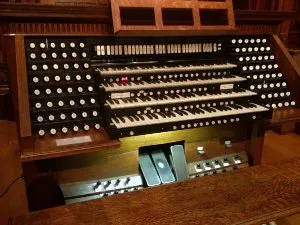
The series would be called “A Bicentennial Concert Series”–“The Romantic Organ Sonata in America” at Garden Grove United Methodist Church, Garden Grove, California, with its 1966 Reuter organ of three manuals, forty-eight ranks. I got the City of Garden Grove to co-sponsor the series, it providing additional publicity. I came up with some “patriotic” names for each one so as to give the printed program some connection with the past and present. Here are the programs for each of
those Sundays:
March 7, “To the Founding Fathers”
Sonata in F Major Whitney Eugene Thayer (1838–1889)
Allegro Maestoso (Canon)
Alla Pastorella
Variations on “America”
Sonata in D Minor, opus 22 (Third) Henry Morton Dunham (1853–1929)
Adagio Assai
Poco Piu Mosso
Allegro con Brio
Intermission
Sonata Romantica Pietro Alessandro Yon (1886–1943)
Introduzione ed Allegro
Adagio
Finale
Sonata Dramatica Thomas Frederick Handel Candlyn (1892–1964)
Passionato
Song Without Words
Paean
Eugene Thayer began guitar and piano lessons at age twelve and organ at fourteen. At twenty, he connected with organist-composer John Knowles Payne and performed with him at the opening of the Boston Music Hall. He studied in Germany with Carl August Haupt (1810–1891) and Wilhelm Friedrich Wieprecht (1802–1872) and received a doctoral degree from Oxford University.
Henry M. Dunham graduated from the New England Conservatory in 1873 and the Boston University School of Music in 1875. He later became professor at the conservatory. He was a Fellow of the AGO and wrote three sonatas for organ; Cortege for Organ and Orchestra; Concerto for Organ and Orchestra, “Aurora”; a symphonic poem for organ and orchestra; and many other pieces.
Pietro Alessandro Yon was born in Italy in 1886 and studied at the Milan and Turin conservatories. In 1901 he won a scholarship to study piano, organ, and composition in Venice. He was organist at the Vatican and the Royal Church in Rome. After coming to the United States in 1907 he became organist at the Church of Saint Francis Xavier and later at Saint Patrick’s Cathedral, both in New York City. Furthermore, he wrote many pieces for organ and choir.
Thomas Candlyn was born in England and in 1892 graduated from the University of Durham. After emigrating to the United States in 1915, he became organist at Saint Paul’s Episcopal Church in Albany, New York. He received the AGO Clemson Medal, the $500 Austin Purse of the National Association of Organists medal, and The Diapason Prize. He published over two hundred works during his lifetime.
April 4, “The Freedom Concert”
Sonata in One Movement in C Minor Henry Stephen Cutler (1825–1902)
Largo (Chorale)
Andante
Allegro
Sonata in G Major (The Chambered Nautilus) Humphrey John Stewart (1856–1932)
Allegro Giocosso
Adagio
Allegro maestoso (quasi tempo rubato)
Intermission
Sonata III in F Major, opus 45 Herbert James Wrightson (1869–1949)
Allegro con Moto
Adagio Cantabile
Allegro Grandioso, ma con brio
Sonata Cromatica in D Minor Russell Hancock Miles (1895–1983)
Allegro Maestoso
Andante Espressivo
Allegro Moderato (Fugue)
Henry Stephen Cutler studied in Germany from 1844 until 1846 and later attended Columbia University in New York. He moved to England to study church music before returning to the United States, whereupon he was appointed organist at the Church of the Advent in Boston in 1852. His music is published in five volumes of sacred music, and he composed twenty organ pieces. His best known works are the hymns, “The Son of God Goes Forth to War” and “Brightest and Best of the Sons of the Morning.”
Humphrey John Stewart was born in 1856 in London, England, and came to the United States in 1886. He earned a doctoral degree from the University of the Pacific and was one the founders of the AGO. After two years as organist of the Church of the Advent in Boston, he returned to San Francisco. He was for many years organist at Balboa Park in San Diego, California. He composed dramatic music, romantic and comedy operas, choruses, motets, and other music.
Herbert James Wrightson was born in Sunderland, England, in 1869. After studying in Germany, he came to the United States in 1899 and joined the faculty of Wheaton College. He created dozens of original works including several sonatas, piano pieces, and choral works.
Russell Hancock Miles studied under Adam Geibel and William Berwald. In 1922 he was appointed professor of organ at the University of Illinois. A concert organist and a Bach scholar, Miles is known for his organ and choral compositions and for the radio series he conducted on the life and music of Bach.
May 2, “The Heritage Concert”
Sonata in D Minor, opus 57 Carl Christian Muller (1831–1914)
Moderato e Marcato
Andantino Grazioso
Risoluto e Marcato (Fugue)
Sonata III Eugene Whitney Thayer (1838–1889)
Maestoso
Andante con Tenerezza
Variations on “The Austrian Hymn”
Intermission
Second Sonata in C Major Felix Borowski (1872–1956)
Allegro
Andante
Allegro con Spirito
Sonata No. 2 in B-flat Minor Lily Wadhams Moline (1878–1966)
Fantasie
Intermezzo (Canon)
Seraphic Chant
Toccata
Carl C. Muller was born in Germany and emigrated to the United States at age twenty-three. He played in Barnum’s Museum Orchestra and later became its leader. He taught harmony at New York College of Music and was later associated with the Gran Conservatory, New York Conservatory, and other schools. His works include sonatas, choruses, piano pieces, a symphony, and an overture.
Eugene W. Thayer (see above)
Felix Borowski was born in England in 1872 and arrived in United States at age twenty-five in 1897 to join the faculty of Chicago Musical College, where he later became its president. Having served as a critic for Chicago newspapers, during the 1950s Borowski became Chicago Music Critic for The Christian Science Monitor. He composed twenty musical works.
Lily Wadhams Moline was the daughter of a Swedish Lutheran organist and native of Sioux City, Iowa. She was a founder and became the first president of the Chicago Club of Women Organists. In 1914 she graduated from the Bush Conservatory in Chicago with a Bachelor of Arts degree. She studied organ under William Zeuch, Wilhelm Middelschulte, and Harrison Wilde. Moline was also a recitalist who served for over twenty years at First Church of Christ, Scientist, in Oak Park, Illinois, presiding over a three-manual W. W. Kimball organ, and from 1940 until her death at Second Church of Christ, Scientist, in Long Beach, California. Moline (who later became Lily Wadhams Moline Hallam upon marriage) and Tina Mae Haines (longtime organist for Saint James Methodist Episcopal Church of Chicago) were two of the most respected female organists in Chicago in the first quarter of the twentieth century. Lily Wadhams Moline published a number of organ works, principally with Clayton F. Summy of Chicago.
June 6, “The Liberty Concert”
Sonata IV Eugene Whitney Thayer (1838–1889)
Canzona: Religioso con Espressione
Canzonetta: poco giocoso
Fuga a 5 Voci
Sonata Cromatica (Second) Pietro Alessandro Yon (1886–1943)
Andante Rustico
Adagio triste
Fantasia e Fuga
Intermission
Sonata 2 in C Minor Mark Andrews (1875–1939)
Allegro
Evensong
Scherzo
Finale
First Organ Sonata Philip James (1890–1975)
Andante-Allegro
Andante Cantabile
Finale
Eugene W. Thayer (see above)
Pietro A. Yon (see above)
Mark Andrews was born in England and studied under Sir John Thomas Ruck at Westminster Abbey. After emigrating to the United States in 1902, he helped found the American Guild of Organists. He distinguished himself as a concert and church organist and lived all his later life in Montclair, New Jersey, where he was organist of three churches: Saint Luke’s Episcopal Church (1902–1912), First Baptist Church (1912–1917), and First Congregational Church (1917–1939). Andrews composed over three hundred works for organ and voice, both sacred and secular.
Philip James served as commanding officer and band leader of the American Expeditionary Forces General Headquarters Band during World War I. In 1932 the National Broadcasting Company (NBC) awarded him $5,000 for his satirical suite Station WGZBX. He furthermore received awards from the Philharmonic Symphony Society of New York and The Juilliard School of Music. He was a professor of music and chairman of the music department at New York University and also taught music at Columbia University. A prolific composer, he wrote numerous works for theater, orchestra, chorus, chamber groups, piano, and organ.
July 4, “Concert of Americana”
Sonata II Eugene Whitney Thayer (1838–1889)
Maestoso (Fuga a 5 Voci)
Adagio con Tenerezza (Ein Lebewohl)
Variations on “The Star-Spangled Banner”
Second Sonata, opus 16 Henry Morton Dunham (1853–1929)
Introduction and Fugue
Adagio
Finale
Intermission
Sonata in E-flat Minor, opus 65 Horatio William Parker (1863–1919)
Allegro Moderato
Andante
Allegretto (Scherzo)
Fugue
Sonata Gothique Roland Diggle (1885–1954)
Allegro Assai
Adagio
Allegro Vivo
Eugene W. Thayer (see above)
Henry M. Dunham (see above)
Horatio William Parker was the son of Charles Parker, architect, and Isabella Jennings, known for her literary and musical talents. Parker studied under his mother, and they later collaborated on some of his important works. In 1881 he went to Germany to study organ technique. After his return to the United States, he became organist, choirmaster, and teacher at the National Conservatory of Music under Antonín Dvořák. In 1893 Parker won a series of prizes from the conservatory for The Dream King and His Love. Later he became organist and director of music at Trinity Church in Boston, Massachusetts. In 1893 he joined the faculty of the Yale University School of Music in New Haven, Connecticut, serving as dean of the school from 1904 until his death. In 1902 he was awarded a doctoral degree from Cambridge University. Parker composed over seventy works.
Roland Charles Diggle was born in 1885 in London, England, studied at the Royal College of Music, and emigrated to the United States in 1904. He was organist at Saint James Episcopal Church in Wichita, Kansas, Saint John Episcopal Cathedral in Quincy, Illinois, and Saint John’s Episcopal Church in Los Angeles, California. He was a recitalist at the San Diego and San Francisco exhibitions and made recital tours throughout the country. His compositions include works for organ and orchestra.
A happy surprise took place when, as I mentioned earlier, I was given the address of the only the living composer, Russell Hancock Miles. I decided to write to him and tell him that I had planned to perform his Sonata Cromatica on the second Sunday of the series, April 4, 1976. A few weeks later I received a reply saying that he would like to attend the concert.
Living in Champaign, Illinois, and not fond of airplane flights, Mr. Miles said he would be taking the train to Santa Barbara, California, where a son and his family lived, and that they would find their way to Garden Grove in Orange County on that date and time.
He did, and so we met before and after the concert at a reception held in his honor; an official of the City of Garden Grove greeted him, and in an informal ceremony Mr. Miles was given a “Key to the City.” He was also welcomed by the pastor of the church, the Reverend Miles Acker. Mr. Miles expressed his thanks to the city officer, the church, and this performer, and made some interesting comments. He related that his father, C. Austin Miles (1868–1946), had been a musician and the composer of the famous hymn “In the Garden” in 1912 and also the poetry of that hymn, and that the experience to hear his own music played after many decades of silence was for him, in his own words, “An oasis in the desert of retirement.”
Then came the May, June, and July concerts. I was amazed at the following the series had. By then, I was almost exhausted. The hours of practice among the other responsibilities of family and employment took its toll physically and mentally. Although I had a friend to faithfully record the programs with his reel-to-reel recorder, with the tension of the moments, agreed upon cues and signals to be given at the beginning of movements were forgotten, and ended up with missing measures of many movements and even at the end of some, by running out of tape.
Would I do this again? No. It was an overly ambitious undertaking that required too much work. But I was fifty years younger and full of energy and ambition. What did I learn from the experience? I did get thoroughly acquainted with the music of sixteen composers of the nineteenth and early twentieth centuries and the fifty-one individual movements of their sonatas, which I played many times over as preludes, offertories, and postludes for many years afterwards. It was a trip into the minds of these musicians born in another century.
But not just these. There were other sonatas by many other composers that I had collected. The separate movements of which through the years were also used during concerts, lectures, Sunday services, and personal enjoyment. Some come to mind as truly outstanding. The Sonata in B Minor in one movement, opus 39, by Sidney Homer (1864–1953) comes to mind, as a steady source of prelude music for many an Easter Sunday, for the grandeur, majesty, and emotional content of his music. The Grand Sonata, opus 25, of George E. Whiting is a truly tour de force for the accomplished organist.
Outstanding in this series was the inclusion of the only woman composer mentioned in Mr. Kremer’s dissertation—Mrs. Lily Wadhams Moline (1878–1966), whose published music I was lucky to obtain from the then (1974) organist at the Second Church of Christ, Scientist, in Long Beach California, Mrs. Moline’s last post before her death. She led a very interesting professional life for a woman organist born in 1878 who wrote attractive but unpretentious music. Her Sonata No. 2 may have been the earliest published work by a woman composer/organist in the United States in 1923.
I learned also that there is value in our past. In the process, I was experiencing and learning what those composers themselves learned from their experiences, hard work, and from the musicians of their own time. All that seemed to come out of the pages of their music, plus the idea that all of them at different times and yet together had built an “epoch,” an extended period of time that produced unique music, something sui generis distinctive, a fusion of artistic minds that can stand on its own, “unique in its characteristics” as sui generis is translated into English, music worthy of being performed and enjoyed.
After all this has been stated, I must say that it has been an encouraging matter to have read in our profession’s journals that in the past decade, Eugene Thayer’s five sonatas have been re-published in this country. Also, that great artists among us have revived some of the sonatas and other works of these nineteenth-century composers and even recorded them—those of René-Louis Becker, Clarence Dickinson, Dudley Buck, and Horatio Parker to name a few. There may be others. A great beginning, to say the least, the example of which should be followed to vindicate those courageous souls that have left us such treasure for the enjoyment of generations to come.
Notes
1. Virgil Thomson, A Virgil Thomson Reader (Boston: Houghton Mifflin, 1981), pages 272–273.