Albert Schweitzer Organ Festival Hartford 2025: High School Division Competition
Alan MacMillan is a Connecticut-based organist and composer whose works have been published by Paraclete Press, Augsburg, and Lorenz. He has served on the board of the Albert Schweitzer Organ Festival Hartford since 2022.
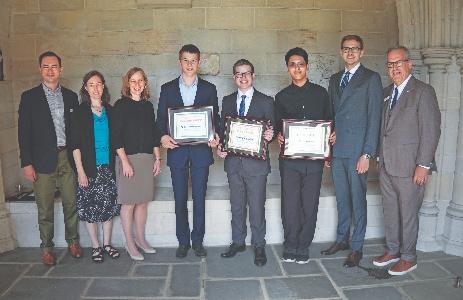
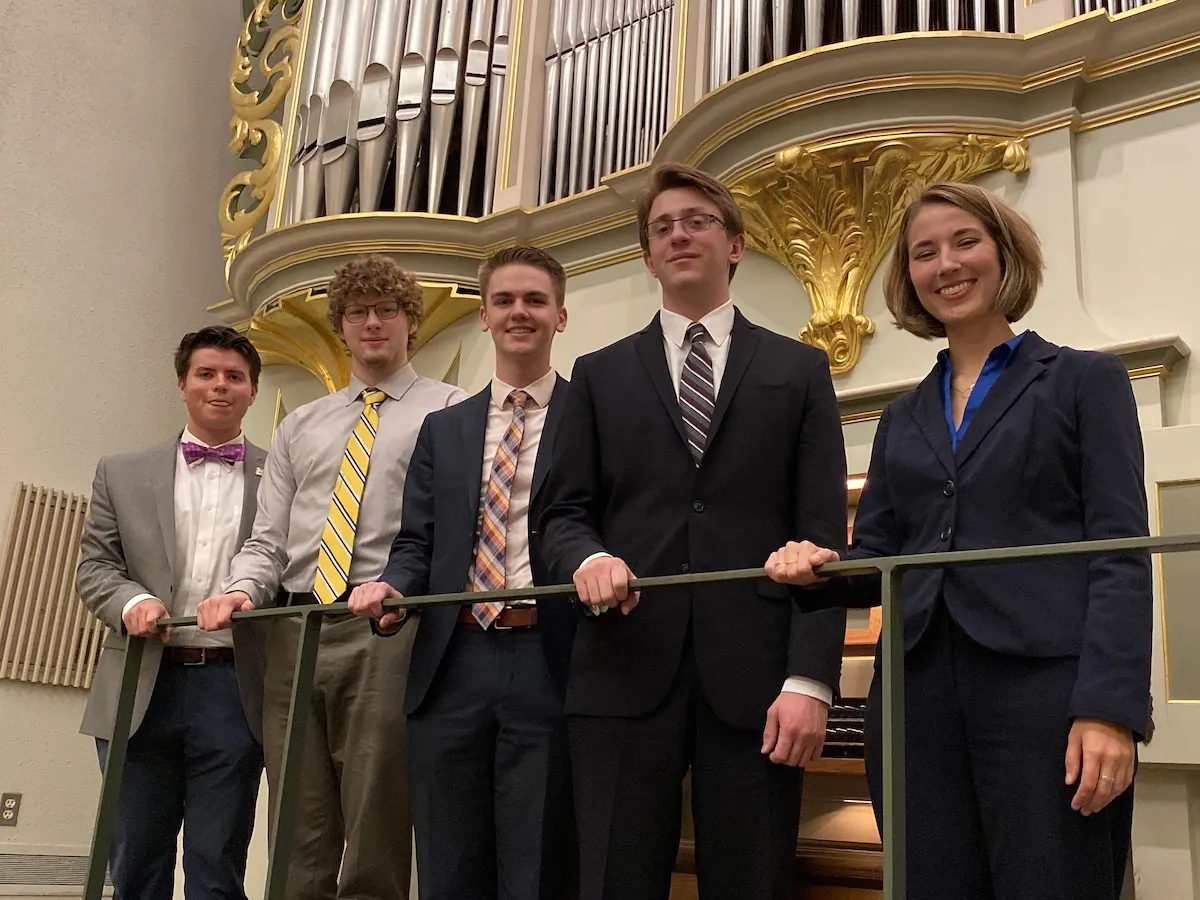
If one had attended the competition portion of the twenty-eighth Albert Schweitzer Organ Festival Hartford blindfolded this year, it would have been difficult to tell that the contestants were teenagers, all still in high school; such was the level of accomplishment of the three finalists who performed on Saturday morning, September 27, 2025, on the Austin organ of Trinity College Chapel. In addition to the Bach Prelude and Fugue in G Major, BWV 541, and “Andante Sostenuto” from Widor’s Symphonie Gothique, each contestant was required to play a work of their own choice composed after 1937. In each case these were works played with skill by all three of the young organists. Seventeen-year-old Henry Dangerfield from Minnesota offered George Baker’s L’Envoi; Virginian Kalan Warusa played the fiery “Vers l’espérance” from Poèmes by Theirry Escaich; and Connecticut native Philip Tummescheit the demanding “Allegro deciso” from Dupré’s Évocation opus 37, number 3. It was also required of each organist to accompany the attendant congregation in a full four-verse rendition of the hymn “God of Grace and God of Glory” to the tune Cwm Rhondda.
The competition jury included three concert artists: Anne Laver, associate professor of organ and university organist at Syracuse University, Syracuse, New York; Colin MacKnight, director of music at Trinity Episcopal Cathedral in Little Rock, Arkansas; and Brenda Portman, composer and resident organist at Hyde Park Community United Methodist Church in Cincinnati, Ohio.
Henry Dangerfield received the first prize of $7,500 as well as the David C. Spicer Hymn Playing Prize of $750 for his rendering of Cwm Rhondda with harmonizations that served the text in a meaningful way. The second prize of $3,500 as well as the audience prize of $750 was awarded to Philip Tummescheit, and the third prize of $1,500 to Kalan Warusa.
The festival opened on Friday night, September 26, with a recital by the ASOFH 2024 Young Professional first prize recipient, Jacob Gruss, a member of The Diapason’s 20 Under 30 Class of 2025. Having completed his undergraduate studies at The Juilliard School where he studied with Paul Jacobs, he is now a first-year graduate student at the Yale Institute of Sacred Music studying organ with James O’Donnell while also serving as director of music at Saint Matthew’s Episcopal Church in Bedford, New York.
In his spoken introduction, Gruss expressed his gratitude not only for the experience of last year’s festival, but for the opportunity to share a program of music that was particularly meaningful to him. Playing the entire program from memory, he began with Choral in E Major of Franck, in which a gradual crescendo to the end made for a moving performance. The Bach Prelude and Fugue in D Major, BWV 532, followed. Gruss’s performance clearly demonstrated his theory that in this work, Bach was taking a humorous approach to the form of which he was the unmatched master. The recital continued with Howells’s third Psalm Prelude on Psalm 23:4 from the opus 32 set. Interestingly, this choice served to bring a nice symmetry to the festival as a whole, where Psalm 23 was reprised during Saturday night’s festival concert program by both the Rutter setting and the second movement of Bernstein’s Chichester Psalms. Less well known perhaps, was the next pairing: “Toccata” and “Fugue” from Reger’s Zwölf Stücke, opus 59. In the first, the alternatim of rapid triplet flourishes and highly chromatic chorale-like passages results in a kind of miniaturized reimagining of a Bach toccata in late Romantic style. The fugue, on the other hand, proceeds in a more diatonic and largely academic manner until a marked, long and steady stringendo culminates in an outrageous final four bars of unmistakable Regerian chromaticism.
“Pastorale” from Guilmant’s first sonata provided a welcome palate cleanser; the velvety flutes of the Austin organ playing the part of a shepherd’s pipe, calming the nerves and offering yet another nod to Psalm 23. Jeanne Demessieux’s challenging and celebratory Te Deum brought the recital to a stirring conclusion.
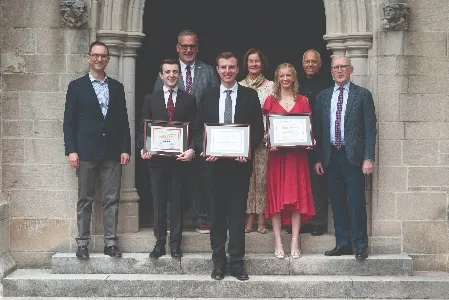
Saturday morning’s competition was followed by a luncheon in the chapel cloister. This ended with the awarding of prizes by the jury, ASOFH president Robert Bausmith, festival artistic director Christopher Houlihan, and treasurer Reilly Xu.
The festival concluded Saturday evening with a gala concert of music for organ, choir, oboe, harp, and percussion consisting almost entirely of settings of texts from the book of Psalms. Minnesota composer René Clausen’s “All that Hath Life and Breath, Praise Ye the Lord,” a festive setting of verses from psalms 96 and 22, opened the program. The only unaccompanied choral work in the concert, it gave a welcome opportunity to hear the combined choirs of Chorus Angelicus and Gaudeamus, The Schola Cantorum of Saint Joseph’s Catholic Cathedral, Hartford, guest singers from Saint James’s Episcopal Church, West Hartford, and the Chapel Singers of Trinity College on their own. John Rutter’s Psalm 23 setting from his Requiem featured the choirs and organ with solo oboe, beautifully played by Ling-Fei Kang. It was a delight to hear William Walton’s “Jubilate Deo” (Psalm 100), not often enough performed and, in this case, its rhythmic, dancing quality enhanced by the percussion skills of Doug Perry.
Preceding intermission, first prize winner Henry Dangerfield had the opportunity to revisit George Baker’s L’Envoi or “Sending.” Originally composed as a postlude for Baker’s daughter’s wedding, it is in effect a toccata with scintillating manual configurations and a memorable tune tossed between the left hand and pedal. It was dispatched with accuracy and panache by the young organist.
Swiss harpsichordist and composer Marguerite Roesgen-Champion’s (1894–1976) Nocturne No. 1 for oboe and organ, the only work on the program not specifically associated with a psalm, nonetheless provided an appropriate prelude to the second half of the festival concert with its wistful lyricism. The ASOFH next had the privilege of presenting the North American premiere of “A Psalm for Chichester” by British composer Joanna Marsh. It was commissioned by Chichester Cathedral for its 950th anniversary and premiered there this past May. Marsh’s setting offered a different perspective on the words of Psalm 90, well known from Isaac Watts’s metrical version: “O God, our Help in Ages Past.” Here, in selected verses from the King James translation, the triumphal bearing of the traditional hymntune Saint Anne gives way instead to a musical meditation on the transitory yet significant lives that have kept the faith: altogether a fitting tribute to the cathedral of Chichester and all who served there in its near millennium of existence.
Sixty years previously, the cathedral had commissioned Leonard Bernstein for his Chichester Psalms, which served as the final and most substantial work of the concert. Drawn from six different psalms and cast in three movements sung in Hebrew, Bernstein likely had in mind the idea to create his own “Symphony of Psalms” in the mold of the iconic Stravinsky work of 1930. Bernstein composed two versions: one for choir, soloists, brass, harp, strings, and percussion, and another for soloists, organ, harp, and percussion. The latter was the one used for this performance. The choral and instrumental forces were expressively conducted by Gabriel Löfvall, director of the Schola Cantorum of Saint Joseph’s Catholic Cathedral in Hartford. The demanding organ accompaniments throughout the concert were masterfully registered and performed by ASOFH artistic director and Trinity College director of chapel music Christopher Houlihan. The soloists were Caroline Christopher, soprano; Rhiannon Elliott, alto; Michael McAvaney, tenor; and Jermaine Woodard, Jr., bass. The boy treble in the second movement was Lorenzo Virello. The variety of the repertoire as well as the high standard of performance made this year’s festival a most satisfying musical experience and surely one of the finest events of its kind in New England.