Spotlight on Improvisation, Part 6: An Interview with Jeffrey Brillhart
Editor’s note: Part 1 of this series (Matthew Glandorf) may be found in the May 2022 issue, pages 20–21; Part 2 (Mary Beth Bennett) in the September 2022 issue, pages 12–13; Part 3 (Jason Roberts) in the July 2023 issue, pages 16–17; Part 4 (Dorothy Papadakos) in the December 2023 issue, pages 12–14; and Part 5 (Patrick Scott) in the October 2024 issue, pages 14–15.
Introduction
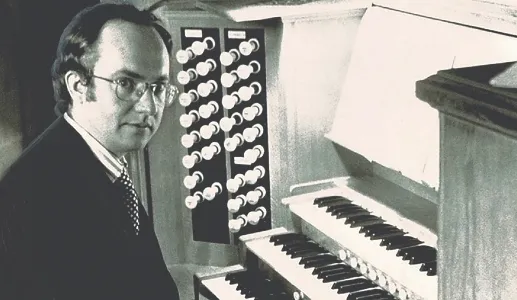
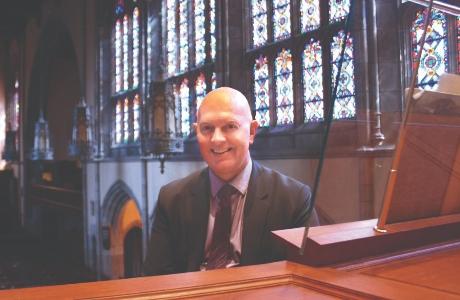
I am absolutely delighted that Jeffrey Brillhart, recently retired from Bryn Mawr Presbyterian Church, Bryn Mawr, Pennsylvania, after a long and distinguished tenure as director of music and fine arts, agreed to take part in this series of articles featuring interviews with American improvisers. Thankfully, Jeff continues to teach improvisation at the Curtis Institute of Music and the Yale Institute of Sacred Music. His legacy as a pedagogue in organ improvisation is staggering, and his record speaks for itself when considering the number of his students who have won major improvisation competition prizes in recent years.
Those who have not studied directly with Jeff would be well-served by exploring his improvisation method books (A World of Possibilities: Master Lessons in Organ Improvisation and Breaking Free: Finding a Personal Language for Organ Improvisation through 20th-century French Improvisation Techniques, published by Wayne Leupold, theleupoldfoundation.org). They are an invaluable exploration of the French manner of improvisation, a treasure trove of the techniques of that venerable tradition. We turn now to a discussion with Jeff, after which I will offer further reflections.
Discussion
When did you begin improvising, or perhaps playing by ear? Was it before formal studies or did it
begin later?
I began playing by ear at around the age of three. I’m told that, while watching my favorite television show, Captain Kangaroo, I would run over to the piano and plunk out the melodies I liked. I grew up in a house that had a lot of live music. While nobody was trained, my grandmother, grandfather, and father all played by ear. It was always popular music, you know, Frank Sinatra hits, Great American Songbook, etc.
My father owned a roller-skating rink with a Hammond organ set up in the center of the rink on a platform. From the age of five, I would skate out and play my “set,” of course, always by ear. (My signature song was “Around the World!”) Was this improvising? I suppose, though, I think it was mostly about developing my ears.
Do you agree or disagree that those who begin by playing by ear often gravitate more naturally to improvisation?
I believe there’s a correlation. For one thing, you are training your ears to be sensitive to sound. For another, you are developing confidence in playing without a score in front of you.
As a child, to the extent that you improvised, did you understand the theory behind what you were doing, or did that understanding catch up later?
Honestly, I had no idea what I was doing. I started studying the piano at age four. It was strictly repertoire, however. The word “improvisation” never entered into my lessons. That said, I often would “add” to whatever I was studying, which drove my teacher nuts! I would fill in harmonies and extend phrases to “make them sound better.” It wasn’t until my undergraduate studies at Drake University when the word “improvisation” appeared.
Who were your principal teachers and influences in improvisation? How did you learn from them? I seem to recall you saying that your world as an improviser was completely transformed when you studied with Philippe Lefebvre; how so?
As an undergraduate, my teacher, Carl Staplin, guided me for one year on the Dupré method [Cours Complet d’Improvisation à l’Orgue, published by Alphonse Leduc in 1924]. To be honest, I didn’t find the Dupré method very stimulating or helpful. While I did learn how to harmonize scales and generate an eight-bar phrase, I can’t say that it unleashed anything creative in me. What was far more impactful were the demands of my first church job as an eighteen-year-old undergraduate student. The church, Saint John’s Lutheran in Des Moines, Iowa, had a Sunday morning broadcast. There was a phone next to the senior pastor’s chair that connected to a phone on the organ console. He would often phone me during the service to say things like, “We’re running short! Add an interlude before the last verse of the hymn.” Sometimes that call would come during the hymn! Incredibly, when I accepted the job, I was not forewarned that this might happen! That literal baptism by fire taught me a great deal about being calm under fire and musical spontaneity.
Were there other turning points, watershed moments, in your journey to being the improviser you are today?
At age fourteen, I heard Pierre Cochereau improvise at Notre Dame Cathedral. While I had no idea who he was at the time, the sonorities he created and the rhythmic drive in his improvisations were mind-boggling. I remember thinking, “This is it. . . . This is what I have to do with my life!” It wasn’t until I entered college that I heard anyone else improvise. Thankfully, Carl Staplin was passionate about improvisation. Thanks to him we were fortunate to have gotten to study with André Marchal, Marie-Claire Alain, Gerre Hancock, and others. Though we studied repertoire with those guest artists, each improvised in their recitals, which further excited my own musical imagination.
When did you first improvise in a concert setting? Presumably it came after improvising in church?
Yes, after my experiences at Saint John’s Lutheran Church I became much more confident as a liturgical improviser. I did not improvise in a concert setting until after I started my tenure at Bryn Mawr Presbyterian Church. While I enjoyed those early concert experiences, I grew increasingly frustrated by my own limitations, particularly in regard to harmony. I would listen to recordings of Cochereau, Langlais, and Guillou and wish that I could create those sounds.
You are the foremost practitioner, to my knowledge, among American organists, of the twentieth- and twenty-first-century French tradition. Did you gravitate naturally to this particular musical language before embarking in specialized study of it?
For me, everything leads back to that Mass with Cochereau on the organ bench. Over the course of my studies, it was French repertoire that I most loved. As a student I devoured the music of César Franck, Louis Vierne, Jean Langlais, Marcel Dupré, Charles Marie Widor, and Olivier Messiaen. When I invited Olivier Latry to perform at Bryn Mawr Presbyterian Church in 1987 and heard him improvise, I knew I was hooked. He improvised a dazzling set of variations on Herzliebster Jesu. We stayed in touch, and in 1993 I was granted my first sabbatical from my church. I wrote to Olivier to ask about coming to Paris to study improvisation and the music of Vierne. He said, “Come,” and that was that. Hearing Olivier, Philippe Lefebvre, and Jean-Pierre Leguay improvise virtually every Saturday and Sunday at Notre Dame for six months was mind-boggling. During that sabbatical I spent a week in Toulouse studying with Philippe. Thanks to Philippe’s brilliant teaching and encouragement, that week became a watershed moment for me. Finally, things started to make sense!
To your mind, is there a distinctly American way of improvising at the organ?
To be honest, I don’t believe there is a distinctly American approach toward improvisation. That may be due to the reality that we American organists study the repertoire of many traditions. We play the best works of the United States, Canada, Great Britain, France, Italy, Spain, Germany, etc. That is not necessarily the case for organists in those countries. (I don’t recall ever hearing a French organist play Sowerby, for example!)
How do you regard the intersection of the two disciplines of composition and improvisation?
The similarities are immense. For me, the most successful improvisations are similar to the most successful compositions. That is to say, there is a clear structure, a consistent harmonic language, good voice leading, and a distinct trajectory. Obviously, with improvisation there is no correcting a mistake, no “living with the notes” until they are right. Some improvisers feel that improvisation is “composing in front of an audience.” While I think that is a worthy goal, that’s a lot of pressure on the improviser! Then there’s the view of Arnold Schönberg, who felt adamantly that composition has higher artistic life and improvisation has lower artistic life. At the end of the day, I believe that improvisations are for the moment, not for safekeeping. Because of that, I am not a fan of notating improvisations. In fact, while we know that Dupré improvised a Passion Symphony and a Stations of the Cross, when you examine the harmonic language and gestures of those compositions and then listen to Dupré’s improvisations, it is clear to me that his improvised versions of those two works could not have been as interesting as the composed versions.
I’d love to hear more from you about teaching. The results of your teaching speak for themselves, with the many successes and prizes your students have had and won. What is the most rewarding aspect of teaching for you?
I absolutely love to see a young improviser discover their inner musical voice. I love working with students who are curious, who are willing to move out of their comfort zone, and who develop an obsession with becoming better improvisers. My goal is to take students where they are and, in the most encouraging way possible, help unleash all that is within.
The most challenging?
For me, the student who doesn’t practice is the most aggravating, especially when that student exhibits some natural talent for improvisation. Occasionally I encounter a student who is content to simply coast by on what they already know. Sadly, with that attitude they will never improve. They are often resistant to feedback and closed to other ways of thinking.
Back to the issue of practicing improvisation: the first time I attended the Haarlem Organ Academy I went to the registration desk to sign up for practice time. The registrar looked at what I had signed up to study (Alain and improvisation) and said, “Oh, you’re studying improvisation, you won’t need any practice time.” I was appalled. Great improvisation will never happen without practice.
Do you believe each organist has the capacity to develop a distinct musical language?
Yes, but I believe that, like composition, it is extremely difficult to be wholly original. It takes years to develop a personal language. At the early stages of study, it can be helpful to try and imitate a composer, improvising a kind of “pastiche,” you might say. I will sometimes have a student take a simple work and use it as a jumping off point. For example, works like Jean Langlais’ Nazard or Jean Alain’s Choral Dorien or Felix Mendelssohn’s “Andante tranquillo” from Sonata III are excellent pieces to use as pastiche. But the student must have some curiosity and the drive to find their voice. Without that, there is no distinct language.
Composers of our time seek to carve out their own individual voices. Should improvisers do so as well?
That would be ideal. For sure, the improvisations of Tournemire, Cochereau, Escaich, and Messiaen are immediately identifiable. And it’s certainly interesting that they were composers as well! I believe that the discipline of composition can contribute to the improviser being unique and not simply be a copy of another improviser.
There is a recording of Chick Corea playing Mozart piano concerti and improvising his own cadenza in each. If my memory serves, each cadenza becomes more “Corea-like” the longer it progresses. I must say, in some way, I find this more interesting than attempts to precisely mimic one specific composer. Do you agree or disagree? (I will not be offended by any answer!)
That is a fabulous recording with Bobby McFerrin conducting. I absolutely adore how Corea starts out sounding like Mozart and quickly moves into his own jazz idiom. But it’s done so organically that I don’t find it disturbing in the least. On the contrary, knowing what we do about Mozart’s precocious nature, I suspect he would approve!
This is surely gross overgeneralization, but I would regard one distinction between the German and French schools as the former prioritizing historical styles of improvisation (especially Baroque), and the latter much less so. Do you think that is the case? Is there value in both approaches?
Oh, that is a big question! While I think there is some truth to that, there are several German improvisers who do a wonderful job improvising with a French harmonic language (Otto Krämer and Ansgar Wallenhorst, for example). And similarly, several French improvisers can improvise convincing German-style fugues (Olivier Latry, Thierry Escaich, Philippe Lefebvre, and Vincent Dubois, for example). As a discipline, a student should absolutely explore historical styles. But at the end of the day, my hope is that those studies would lead to something wholly original and unique to the student. After all, don’t great composers build on the greatest of the past? I’m much more interested in exploring unusual sonorities and textures on the organ than trying to recreate something from the eighteenth century (though I greatly admire those improvisers who prefer that world and who can improvise convincingly in that style).
I would say that two reasons that, at least to some extent, improvisers should practice imitating historical composers is pedagogical in the first sense and practical in the second (an interlude following a Tudor verse anthem, for instance, until the offertory is concluded). Are there others?
Well, I think this comes back to composition studies. We should focus on species counterpoint as young college students. We should explore the techniques of many composers in order to understand their thought processes. In liturgical improvisation, it would be rather bizarre to launch into a Messiaen mode of limited transposition-inspired improvisation after a Tudor verse anthem, so yes, one should know how to convincingly improvise in as many styles as possible.
Conclusion
Virtually everything Jeff says above resonates with my own experience and conclusions. I began this series wondering if interviewees and I could stumble on a relatively straightforward definition of what American organ improvisation is. Life is rarely that simple, of course, this being no exception. Several interviewees thus far have used the term “melting pot,” and I think there is a great deal of truth to that. I think Jeff puts it as insightfully as possible, noting that Americans study organ literature of so many periods and traditions, and that diversity inevitably bleeds over into ways of improvising at the organ.
Jeff’s childhood experience reaffirms what so many others have shared, that beginning to play by ear first as a child often proceeds naturally to being more comfortable playing “off the page.” (I have revealed before that I began to play by ear but then had the most marvelous formal teachers who did not discourage my early attempts at improvising—my piano teacher let me “improvise” in one of her studio recitals—but also insisted that I learn to play precisely what was on the page of notated music. No fudging was allowed when it came to that!) This should absolutely not be a detriment to budding improvisers who did not play by ear first anymore than not being a native French speaker, for instance, should be an impediment to learning it later in life.
Jeff also references studying species counterpoint: I agree wholeheartedly that this is of fundamental importance. I would add to that the importance of keyboard harmony. I consistently find that these skills are the most lacking in students who come to me seeking to become better improvisers. I regard them as the grammar of Western music; one can only get so far in becoming a fluent improviser without fully mastering that basic grammar. I use a number of ways to help students with this, including working on figured bass, another being the aforementioned Dupré improvisation method (in two volumes). I do not disagree at all with Jeff that this method will not lead one to heights of great inspiration; I regard it as useful up to a point. That point is shoring up keyboard harmony and counterpoint, in addition to an exploration of musical form (I use other methods on form as well: Dupré has his own ways of defining various forms, and a more comprehensive study is helpful).
Marcel Dupré left us with so much glorious music, Jeff having named two of the greatest works. Yet I must agree with his conclusion that their published state is likely far more exciting than the original improvisations must have been. I have immense respect for Dupré’s mastery of form and counterpoint, yet I must say that his recorded improvisations often seem a bit lacking in the electricity and interest found in so many of his published works.
Jeff also described how being thrown in the deep end at the Lutheran church he served built confidence. I had a similar experience in my early twenties when I first was appointed director of music at the Church of Saint Mary the Virgin, Times Square, New York City. That liturgy required quite long interludes and other extemporizations to cover ceremonial action, and I was forced to really take seriously what I was doing. (However, no one called me on the telephone in the loft—I love that!—I had the boring by comparison requirement to look in the mirror to see what was happening behind me, nearly a city block away, at the high altar.)
I am gratified to see the importance of practice mentioned. It is indeed absurd to think that one cannot practice improvisation. I stress this again and again to students: there is no magic trick to suddenly becoming a confident and skilled improviser. One absolutely must practice. My own experience has been that over the years as I became more secure as an improviser, my need to practice a particular improvisation in advance decreased greatly; now I very rarely do that, but I do try to carve out time occasionally to practice certain techniques or forms. But in the beginning, especially, students absolutely should rehearse specific improvisations, even making notes for themselves such as an outline. Over time, it becomes possible to truly improvise in real time (and even the rehearsed improvisations likely will not be exactly the same each time). To reiterate: one must practice and prepare. There is no shame in this; in fact, I regard it as the only way to build necessary skills.
I especially appreciated Jeff’s remarks on helping students build a distinctive musical language. There is no question that each person’s language will be an amalgamation of innumerable influences; that is inevitable and is to be cherished. Yet students can, in time, develop a personal language that is unique, in a sense, to themselves. It may not be “new” to Western music, but that need not be the goal. A discussion of musical language leads into the matter of seeking to improvise in strict historical styles or to emulate a specific piece of music by a specific composer. That latter approach is my own favored one: the first two pieces I often give students to imitate as closely as possible are “Ich ruf’ zu dir” from the Orgelbüchlein and the second of Brahms’s two chorale preludes on “O Welt, ich muß dich lassen.” Like Jeff, I greatly admire the skill and craft of those who virtually perfectly emulate, for instance, late-seventeenth and early- to mid-eighteenth-century counterpoint. Yet in the end, and this is entirely subjective, it is, for me, not the most compelling approach to improvising. I agree with the assessment of that Corea/McFerrin recording: highly recommended listening! (Though I do think it is important, for example, to be able to credibly keep a Tudor musical vocabulary, or at least a late-sixteenth/early-seventeenth century one, for an interlude following that proverbial verse anthem.)
I reiterate my gratitude to Jeffrey Brillhart for taking the time to encapsulate for readers of The Diapason so much of the wisdom he imparts regularly to students. I hope you have been fed by it as much as I have.