John Roberts (1829–1877): Builder of the First Carnegie Pipe Organ
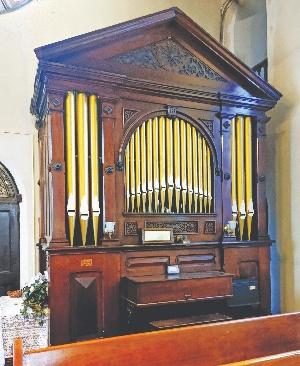
On Sunday, November 3, 1974, Robert Sutherland Lord, associate professor and organist at the University of Pittsburgh, presented an organ recital at the New Jerusalem Christian Church (Swedenborgian) at Sandusky and Parkhurst streets on Pittsburgh’s North Side. The special service was a celebration of the centennial of the church’s pipe organ, the first in philanthropist Andrew Carnegie’s long legacy of donating funds for church organs. Originally the First New Jerusalem Society of Pittsburgh, the congregation had built a new church at Isabella and Sandusky streets in what was then Allegheny City in 1873. The following year, Carnegie, who attended the church as a child with his father and attributed his love of music to its influence, anonymously donated $2,000 to purchase a pipe organ. The Society commissioned a small two-manual, mechanical-action organ from John Roberts of Frankford, Philadelphia, Pennsylvania, which is confirmed on this still-extant instrument’s nameplate. In 1906 the organ was moved to the New Jerusalem Society’s new building at Sandusky and Pearl (later Parkhurst) streets, about a mile further inland from the frequently flooding Allegheny River.1
Robert Lord was impressed by the “wonderful, old instrument,” particularly its durability, “warm” sound, and intriguing connection to Andrew Carnegie. He also became interested in the career of the virtually unknown John Roberts and began scouring “street directories, old newspapers, and dusty journals” to discover the elusive organ builder’s role in nineteenth-century American organ building. In 1979 the Organ Historical Society’s journal The Tracker published Lord’s biographical article, “John Roberts: Philadelphia and Cambridgeport Organ Builder (1850–1877).” At that time—and presently—only two complete Roberts organs are known to remain in existence. One is the Pittsburgh Carnegie organ, preserved at the Swedenborgian church in Urbana, Ohio, since 1986. The other, which Roberts built in Frankford in 1853, is in the sanctuary of Trinity United Church in Seabrook, New Hampshire.2
Based on his research, Lord provided a brief biography of Roberts and details on some of the organs he was known to have constructed, noting that a few of them had been built for New Jerusalem societies. In addition to the Pittsburgh organ, Roberts made organs for Swedenborgian churches in Brookline, Massachusetts (High and Irving streets, 1861), Chicago (Adams Street near State Street, 1863), and Philadelphia (Broad and Brandywine streets, circa 1866).3
In considering these organs, Robert Lord noted that he had tried unsuccessfully to determine if John Roberts was personally connected to a Swedenborgian society in Frankford, Philadelphia, or Boston. Lord’s speculation merged with research Gail Rodgers McCormick had been conducting for decades on the New Jerusalem Society of Frankford (f. 1823), where John Roberts and his family were members for three generations. Lord was able to construct a good overview of Roberts’s biography through the records available to him in the late 1970s, but the increased availability of original primary sources and digitized versions has made it possible to enhance the organbuilder’s story. His lifelong association with Swedenborgian societies is a significant part of his personal narrative.4
Digitized church registers for the New Jerusalem Temple, Bolton Street, Salford (now Greater Manchester), Lancashire, England, show that John Roberts was born November 12, 1829, and baptized on December 13. Nonconformist sects—Protestant dissenters from the Church of England—were gaining ground in Britain’s industrializing urban centers, promoting social reform and education among the working classes. Two months before John’s birth, the Manchester Courier reported the rise of “Dissenters in Salford,” including three hundred members of the New Jerusalem church, about a third of the membership in the two popular Wesleyan Methodist chapels. John’s father Edward, a native of Wales working as a plasterer, painter, and glazier, had been baptized at the temple at the age of eighteen. As was required by English law, Edward married Sarah Ellis in the Anglican church of Saint John’s Deansgate on February 15, 1829. John Roberts and his three younger siblings were baptized at the New Jerusalem Temple between 1829 and 1835.5
Like many Nonconformist churches, the New Jerusalem Society on Bolton Street conducted both a Sunday school and a day school. Edward Roberts served for many years as a teacher in the Sunday school. In 1840 James Boys, superintendent of the day school, was sent to Pilkington Township, Prestwich parish, about five miles north of Salford, to minister to the small society on Stand Lane and start a day school. James Boys may have requested Edward’s help with the new school. The Roberts family, now numbering seven, was living on Stand Lane near the Boys family when the English census was taken in the spring of 1841.6
Soon after John’s twelfth birthday in November 1841, they returned to Manchester, where Roberts later recalled that he served a “seven years apprenticeship to one of the best [organ] builders in England.” He did not name the company, but the family’s addresses in 1840s Manchester city directories would have been within a mile radius of the few “Organ Builders” identified in those directories.7 His apprenticeship may have been with the firm of Samuel Renn at 43 Dickinson Street. Samuel Renn built many organs for churches in Manchester, Salford, and surrounding parishes between 1823 and his death in 1845. In 1839 Renn built an organ for the Bolton Street New Jerusalem Temple, the Robertses’ home church. Renn’s work may have inspired ten-year-old John Roberts to consider organbuilding as a trade. In 1843 Renn constructed an organ for the Peter Street New Jerusalem Chapel in Manchester, which was situated about halfway between the Roberts home on Quay Street and the Renn workshop. Roberts may have apprenticed for that project. After Renn’s death, his widow Sarah continued to lead the business until about 1847, when James Kirtland and Frederick Jardine purchased it. Kirtland & Jardine’s descendant firm Jardine Church Organs remains in business in Manchester.8
By the late 1840s, Manchester’s working-class population was exploding, exacerbating the social issues engendered by poverty and overcrowding. During the Great Famine, Manchester was a popular destination for Irish immigrants looking for work in the textile trades. The Roberts family chose to improve their own lot through emigration. On Wednesday, August 30, 1848, Edward, Sarah, and their six surviving children, including nineteen-year-old “engineer” John, embarked on the packet ship Yorktown in Liverpool. A month later, on Wednesday, September 28, 1848, they disembarked at the port of New York with four hundred fellow passengers.9
The family immediately made their way to Philadelphia, perhaps through connections with Swedenborgians in the city or because of opportunities in the organ trade for John. The Reverend James Seddon, pastor of the New Jerusalem Society of Frankford, was a native of Prestwich parish and had visited his former home in the summer and fall of 1840. On March 21, 1849, twenty-year-old entrepreneur John Roberts, “Organ Builder,” took out an ad in the Philadelphia Public Ledger, promoting his “services to the Musical Public, in Repairing and Tuning organs in a superior manner.” He noted working with prominent Philadelphia organbuilder Henry Knauff “for a few months past,” perhaps on Knauff’s organ for Saint Paul’s German Lutheran Church at Brown and Saint John’s streets in Northern Liberties, consolidated into the city of Philadelphia in 1854. Roberts was ready to accept work requests at his new residence on Fair Hill Row, at or near his family’s home at Sixth Street and Germantown Road. In the 1850 United States census, Edward, a “grainer” and painter, and Sarah Roberts were enumerated in the Northern Liberties with their six youngest children, including one-year-old Louisa, born in Philadelphia. John likely was boarding in various places related to his organbuilding projects and was not captured in the census.10
Within a few years, John Roberts began to establish his organbuilding workshop in Frankford, which was an independent borough in Philadelphia County at the time. On July 23, 1853, he promoted his new enterprise in The Frankford Herald, requesting that the “Musical community” submit requests for his services at the Main Street (now Frankford Avenue) dry goods store of Charles C. Oram, a fellow member of the New Jerusalem Society of Frankford. One of John Roberts’s earliest organs was built in this year and installed in the Smithtown Methodist Church, now Trinity United Church, in Seabrook, New Hampshire, where it remains today. On April 1, 1854, John’s father Edward purchased property at the corner of Main and Orthodox streets, next door to the colonial-era Jolly Post Inn. The family home and a “shop,” surely the organ workshop of John Roberts, are shown on the property on an 1861 map of Frankford.11
On March 20, 1855, John Roberts and Susan Faunce, daughter of Frankford hotelier Daniel Faunce, were married by the Reverend Isaac C. Worrell at the New Jerusalem church at Hedge and Bowser streets in Frankford. Three months later, they were enumerated in the Massachusetts State Census in the second ward of the city of Cambridge. John’s reasons for moving his family to Cambridge are unknown. They may have left because of the late 1854 schism in the New Jerusalem Society of Frankford, which splintered friends and families. Possibly, the 1853 Roberts organ for the Seabrook, New Hampshire, church attracted New Englanders to his work. Robert Lord speculated that Roberts may have been attracted to the work of “prominent East Cambridge organ builders, George and William Stevens.” The schism and Roberts’s departure may have been in reaction to the Act of Consolidation of February 2, 1854, in which all of the independent boroughs and towns in Philadelphia County were absorbed into the city.12 In the 1855 state census of the city of Cambridge, John Roberts was living on Jennings Street in the Harvard Square neighborhood, about two miles west of George Stevens’s workshop in East Cambridge. George Stevens served as Cambridge mayor from April 1851 to April 1853. John and Sarah Roberts may have attended the small Swedenborgian gatherings led by Harvard Professor of Law Theophilus Parsons while in Cambridge, but their daughter Clara Novella (born 1856) and son Edward Alfred Bernard Roberts (born 1858) were baptized by the Reverend James Seddon at the New Jerusalem Church in Frankford. On December 27, 1858, Reverend Seddon performed the funeral service for John Roberts’s father Edward, who died from injuries suffered in a tragic fall from a thirty-foot scaffold at a work site in Frankford.13
By 1859 John Roberts appears to have established his own shop on Main Street in the old Cambridgeport neighborhood, where he and his family were enumerated in the 1860 census. In 1861 he constructed an organ for the Brookline New Jerusalem Society, about three miles south of Cambridge on the outskirts of Boston, which dedicated its new stone “Gothic style” church on February 22, 1862. Composer George J. Webb, a professor in the Boston Academy of Music and organist and member of the Boston Society of the New Jerusalem, reportedly praised the Roberts organ as “a very superior instrument.” In his 1979 essay on Roberts, Robert Lord identified the Brookline organ as the “only known example of a Roberts organ from his Cambridgeport period.”14
In early 1863 Roberts returned to his Main Street shop in Frankford. Over the next several months, he built an organ for the New Jerusalem Society of Chicago, whose new church building on Adams Street near Michigan Avenue was nearing completion. On September 24 the Philadelphia Inquirer published Roberts’s invitation “To Church Committees and Organists” to come to his shop to examine the new organ. Visitors were encouraged to travel to Frankford on one of the convenient “Fifth street cars,” as they would “pass the manufactory every 20 minutes during the day and evening.” The Chicago society’s new church was dedicated on Sunday, November 16, 1862, and Roberts’s $2,000, two-manual organ with “28 stops” and “a 16-feet [sic] pedal, of Bach’s range” was installed soon after. The organ was placed in a special recess on one side of the chancel, “faced by an ornamental screen, consisting of a combination of columns, and quatre-foils, the whole surmounted by an o-g arch terminating in a carved finial.” Composer George F. Root, best known for his popular Civil War anthem “Battle Cry of Freedom,” was serving as the Chicago society’s music director and organist at the time.15
Roberts used the positive testimonials of Webb, Root, and other prominent organists to promote his business, which was thriving despite the war. On April 8, 1865, the day before Lee’s surrender at Appomattox Court House, the Church of the Covenant on Filbert Street above Seventeenth Street announced the “opening festival” concert for John Roberts’s “Great Organ,” described as “one of the largest and most powerful” in Philadelphia. The celebration was originally scheduled for Easter Monday, April 17, but the tragedy of Lincoln’s assassination altered those plans. Yet, the Roberts organ would have added to the grand solemnity of the funeral service held at Covenant, and at most of the city’s churches, at noon on April 19, “being the time of the obsequies in Washington of [the] late lamented president.”16
On November 2, 1865, Roberts’s new organ for Spring Garden Street Methodist Church opened “with appropriate exercises.” The Inquirer provided details on the organ’s specifications and praised the quality of its sound: “In tone it is clear, sweet, and powerful, and it is unsurpassed for completeness and finish.” Recent successes prompted Roberts to expand his organbuilding business. On December 14, 1865, he purchased property at the corner of Penn and Orthodox streets in Frankford, three blocks from his former shop on Frankford Avenue, to build a residence and enlarged “Manufactory.”17 On Thursday, February 1, 1866, his new organ for Union Methodist Episcopal Church at Fourth and Arch streets opened with a “grand concert.” In early May the choir committee of Saint Michael’s Episcopal Church in Trenton, New Jersey, contracted for an organ at a cost of $2,250. By the early summer of 1866, “the ladies” of Walnut Street Presbyterian Church in West Philadelphia had raised the $3,000 they needed to purchase a new organ, and John Roberts eventually received that contract. On December 31, 1866, he purchased additional property at Penn and Orthodox streets. His daughter Bertha was born a month later.18
John Roberts appears to have established a solid reputation and possible working connection with respected organbuilders as well as churches rather quickly. The major organists of mid-nineteenth-century Philadelphia often played dedications or demonstrations of his organs, including David D. Wood, renowned blind organist and composer of Saint Stephen’s Episcopal Church, 1864–1910 (his death), and Michael H. Cross, organist at the Cathedral of Saints Peter and Paul, 1864–1877. Although publication of “testimonials” was a common publicity practice at the time, it does indicate that Roberts built organs of high quality, deserving of the rhetorical praise they often received. On March 17, 1869, the Inquirer published the following testimonials to John Roberts:
THOSE interested in the Progress of Philadelphia city, will be pleased with the testimonials just awarded to Mr. John Roberts, organ builder, of Frankford, Philadelphia:
SALEM. Mass., March 11, 1869. –Mr. John Roberts, Organ –Dear Sir: –The Committee of the First Baptist Society, in this place, take pleasure in expressing their entire satisfaction with the faithful and skillful manner in which you have relocated, remodeled, enlarged and improved their organ. The successful accomplishment of all that you undertook to perform is conceded by all, including the original builder of the organ, Mr. Thomas Appleton, of Boston, Mass., and the same is hereby cheerfully acknowledged by the committee.
JAMES UPTON,
Chairman of Music Committee.
Salem, Mass., March 10, 1869.–I do hereby certify to the full and entire ability of Mr. John Roberts, now of Frankford, Philadelphia, in the capacity of either organ builder, repairer, tuner or voicer of church organs.
Signed by THOMAS APPLETON, The Father Organ Builder of Boston, Mass. Facilities for the building of first-class organs, in every department, unsurpassed. Orders respectfully solicited.
We have been able thus far to identify twenty-three organs built by John Roberts, twenty of which have supporting evidence and are documented in the Organ Historical Society Pipe Organ Database (pipeorgandatabase.org). Only two instruments are extant, and an additional one, Grace United Methodist Church, Wilmington, Delaware, having been significantly altered several times since its installation, retains its original Roberts façade and possibly a pedal rank. We are fortunate that several stoplists were published, allowing a better understanding of Roberts’s tonal ideas and building style. From the available evidence, it seems Roberts was a typical builder of his time, implementing a conservative tonal scheme with some progressive elements. Rather than harkening back to the gentle, quieter organs of the second quarter of the century, he appears to have embraced sweetness of tone in some stops while employing powerfully voiced stops as well, seeming to have one foot firmly in “tradition” and one in “progressive” ideas.
Additionally, Roberts appears to have made variations to his stoplists according to the type of installation. He adopts relatively early a generally full chorus on the Great division, including mixtures on larger organs. He was not a builder of “fearsome foursome” organs of 8′ and 4′ pitches. Smaller organs frequently had choruses of stops up to 2′ pitch while some larger organs contained multiple mixtures.
Mechanically, John Roberts was apparently advanced to some degree. For the 1874 organ he built for Gethsemane Baptist Church in Philadelphia, the Philadelphia Inquirer on November 21, 1874, reported some insightful detail about the mechanical action:
The new organ built for this church has two full banks of manual keys, extending in compass from CC to A in alto, and one bank of pedal keys, extending from CCC to D. The number of sounding stops are 24, with 1304 speaking pipes attached thereto. The number of mechanical stops are 4, making in all 28 actual draw stops.
The manuals and pedals are placed in a separate case, distinct from the organ case, some four feet in front of the latter. The organist, thus seated, has his eye upon every member of the choir, and vice versa. Some portions of the movements of this instrument extend a distance of twenty-six feet, while the slowest movements are no less than ten feet. The bulk of these movements approximate more to the higher than the lesser figures; though such is the condition of these movements, the pressure required to push down the keys is on the average less than that required on best make of pianos, which is directly performed with the keys, and this has been accomplished without the aid of pneumatics in any form. The organ is a remarkably sweet-toned instrument, and the concert was in every respect a success.19
John Roberts cases varied with church architecture, although they seemed to follow general stylistic patterns: a basic three-tier center display of speaking or non-speaking pipes banked on either side by narrower displays, succeeding an earlier English pattern, often with a triangular pediment atop a simple case front design with well-executed decorative elements or carving; a more elaborate (when the architecture or project budget allowed), often Gothic case front with an attached keydesk; and at least in one instance we know that he built identical paired cases separated by some distance with a detached keydesk. In Wilmington, Delaware, the original 1868 Gothic case front is still extant. In 1916 the C. S. Haskell firm of Philadelphia enlarged the Roberts organ and added a second case front (no chamber or speaking pipes) matching the original. Both case fronts are still extant, now housing a Casavant organ with some original pipework. Also in 1868 Roberts built a pair of case fronts in the Gothic style for the First Baptist Church of Dayton, Ohio, both containing an instrument behind them, one of few documented detached consoles. From the newspaper description the façade design is very similar to the Wilmington organ.20
The organ for Grace Methodist Episcopal Church, now Grace United Methodist Church, in Wilmington, Delaware, was an ambitious project in 1868 worth examining. Considering the economics of post-Civil War America, such a large instrument (forty-one ranks) was surely something of a statement of success for both the church and the organbuilder.21 The stoplist reflects some progressive ideas, reflecting potentially some New England influences. Notable are the presence of mixture stops in the Great, Swell, and Pedal divisions, as well as a “new” stop, the Cor Anglaise [sic]. The Pedal division is a full thirty notes, rather than Roberts’s “usual” twenty or twenty-five notes.
GREAT (Manual II)
16′ Bourdon 56 pipes
8′ Open Diapason 56 pipes
8′ Viola 56 pipes
8′ Stopped Diapason bass 12 pipes
8′ Stopped Diapason treble 44 pipes
8′ & 4′ Flute Harmonique [sic] 44 pipes
4′ Principal 56 pipes
3′ Twelfth 56 pipes
2′ Fifteenth 56 pipes
1-1⁄3′ Full Mixture IV 224 pipes
8′ Trumpet 56 pipes
4′ Clarion 56 pipes
Great Organ to Swell Organ [Swell to Great]
SWELL (Manual III, enclosed)
16′ Bourdon 56 pipes
8′ Open Diapason 56 pipes
8′ Violin Gamba 44 pipes
8′ Vox Celestus 44 pipes
8′ Stopped Diapason bass 12 pipes
8′ Stopped Diapason treble 44 pipes
4′ Principal 56 pipes
4′ Clarabella Flute 44 pipes
3′ Twelfth 56 pipes
2′ Fifteenth 56 pipes
1-1⁄2′ [sic] Clear Mixture III 168 pipes
8′ Cor Anglaise [sic] 56 pipes
8′ Bassoon & Oboe 56 pipes
CHOIR (Manual I)
8′ Keraulophon 56 pipes
8′ Dulciana 44 pipes
8′ Stopped Diapason bass 12 pipes
8′ Stopped Diapason treble 44 pipes
4′ Gemshorn 56 pipes
4′ Clear Flute 44 pipes
2′ Fifteenth 56 pipes
8′ Clarionett 44 pipes
Choir Organ to Swell Organ [Swell to Choir]
PEDAL
16′ Open Diapason 30 pipes
16′ Dulciana 30 pipes
8′ Violin Principal 30 pipes
8′ Flute Bass 30 pipes
6′ & 4′ Rausch Fife [sic] 60 pipes
Pedal Organ to Great Organ [Great to Pedal]
Pedal Organ to Swell Organ [Swell to Pedal]
Pedal Organ to Choir Organ [Choir to Pedal]
Pedal Check
Bellows Signal
This organ survived until 1916 when C. S. Haskell rebuilt it, reused the older case, duplicated a façade on the right side of the chancel, enlarged the organ, added Solo and Echo divisions with Chimes, and a detached console at a cost of $12,500. Casavant Frères, Limitée, installed its Opus 2696 of 1962 behind the Roberts façade and retained the Haskell Echo division.
Extraordinarily, one of the two complete extant organs by John Roberts appears to be his oldest, built in 1853, now in Trinity United Church in Seabrook, New Hampshire. There are unanswered questions as to the organ’s history as well as the intrusion of several alterations since its original manufacture. Previous theories have attempted to attribute the organ to Henry Berger, claiming that Roberts was working for Berger at the time. We have uncovered no evidence to suggest John Roberts ever lived in Baltimore or worked with Henry Berger. This hypothetical connection may arise from a lengthy debate in 1852 concerning Henry Erben and Henry Berger in the Baltimore Sun, in which the author, J. Horner, states that Roberts’s statement, “the mystery revealed,” is as “clear as mud.” The article continues the entertaining argument about materials, attributing to John Roberts:
He then tells us that Henry Erben’s organs contain no more mahogany and walnut than is useful in Organ building. We know that it is sufficient if we use as much as is required. He says that “the man of the 19th century is impelled by different motives to what our fore fathers were. They used to make every thing of oak, and by so doing exhibited the greatest folly, for the oak corroded the pipes, and caused them to Fail; and for fear the public should not swallow ‘the elephant,’ he adds, ‘as any chemist knows.’ . . .
J. Roberts, in speaking of the number of pipes in the Philadelphia Organ [by Berger], states the number at 1,600, while Mr. Berger makes the number 1,944. What is the difference, and what, is the real number? He says that it is plain I don’t know what the Organ contains.
The Seabrook organ does, however, suggest a potential connection to Knauff since the stoplist comprises some older German elements.
MANUAL
8′ Open Diapason (TF)
8′ Stop’d Diapason Treble (TF)
8′ Stop’d Diapason Baſs
8′ Claribella [sic] (MC)
4′ Principal Treble (MC)
4′ Principal Baſs
4′ Flute Treble (MC)
4′ Flute Baſs
2′ Fifteenth Treble (MC)
2′ Fifteenth Baſs
Silena (perhaps a dummy stopknob for visual balance at the keydesk)
PEDAL
Copula
Pedal Movements
Withdraws 4′ Principal Treble and Baſs and 2′ Fifteenth Treble and Baſs
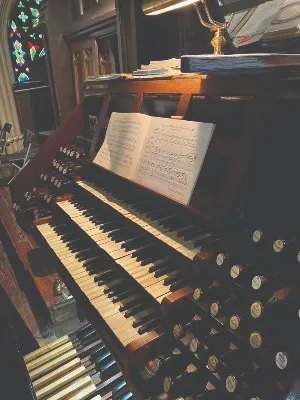
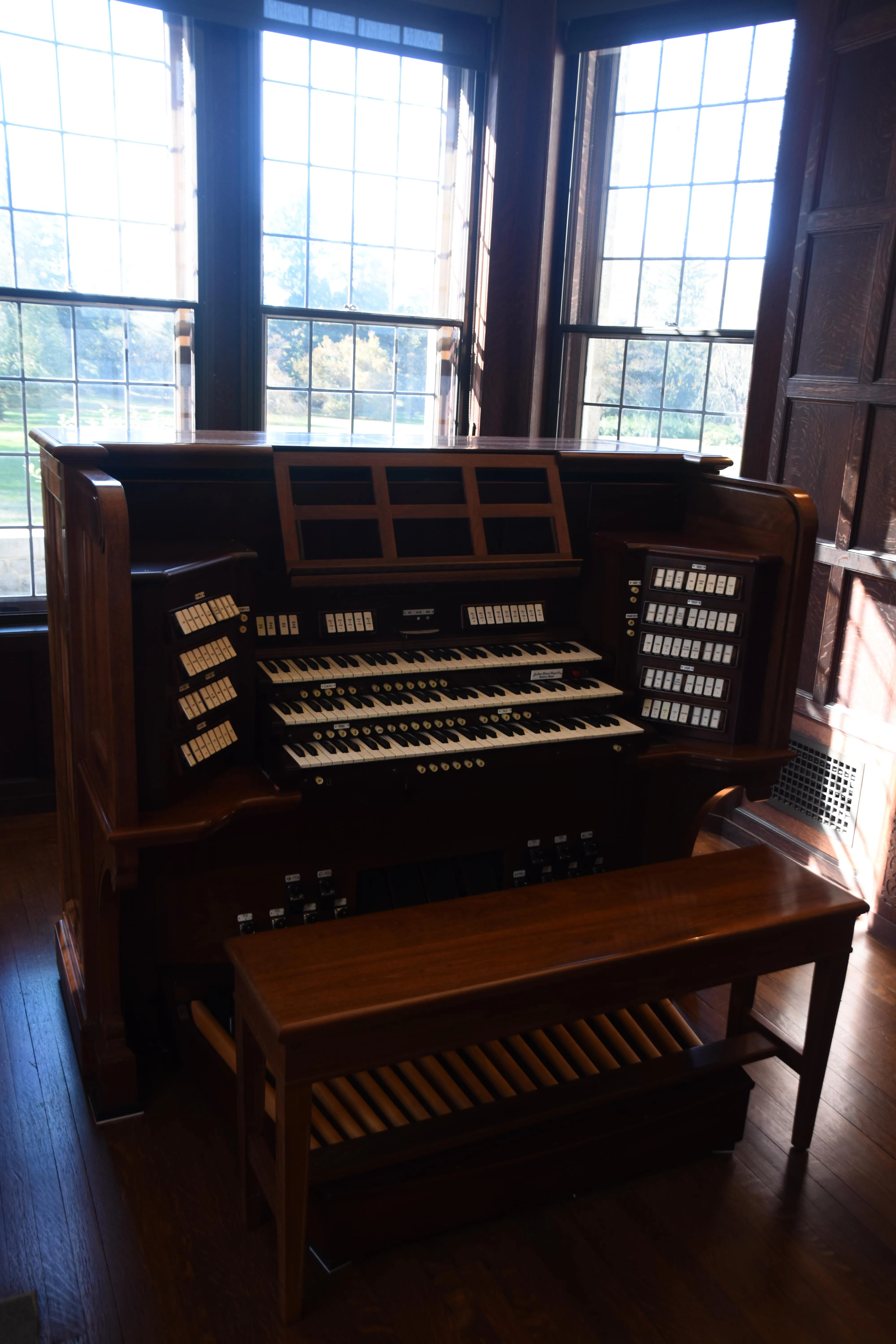
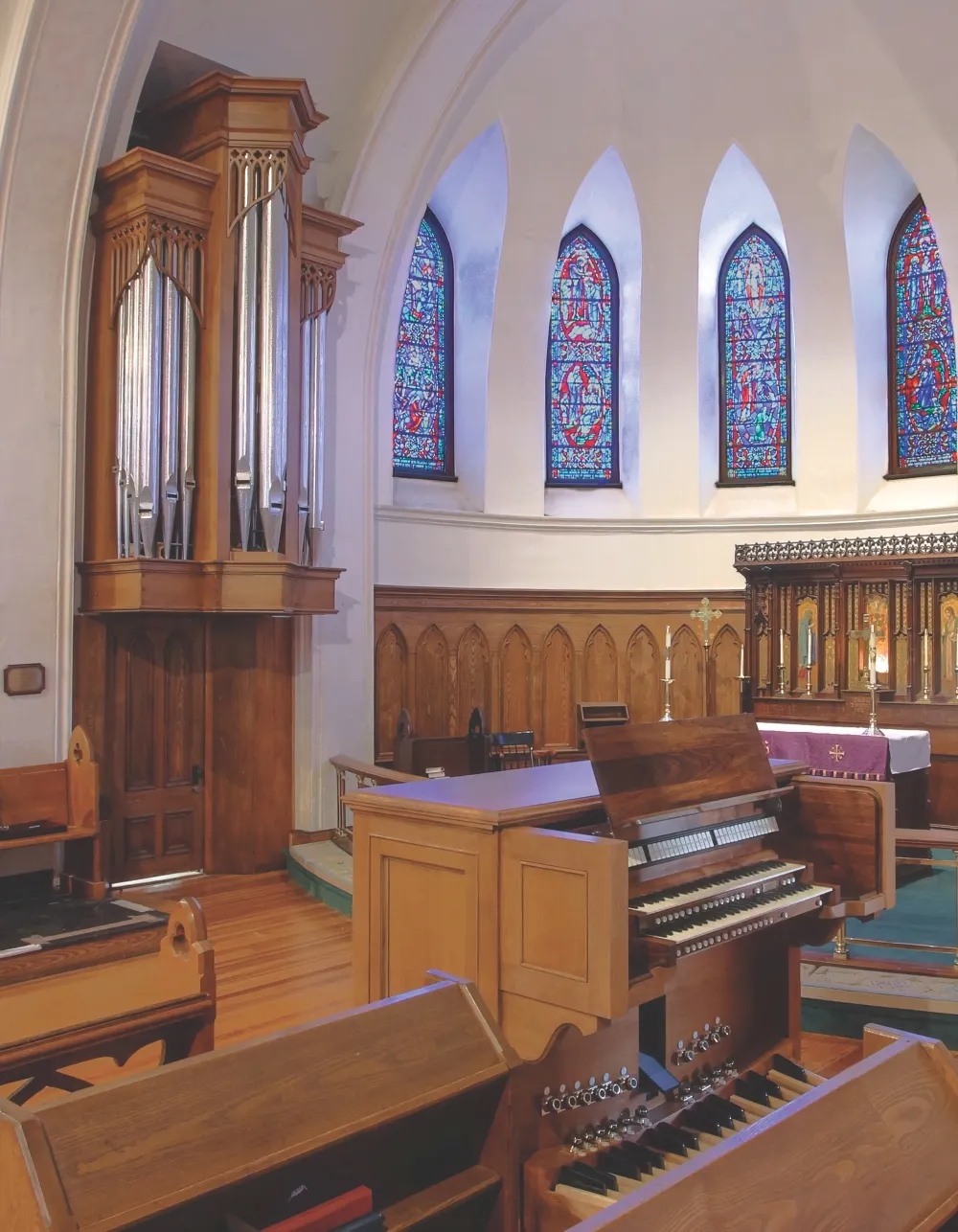
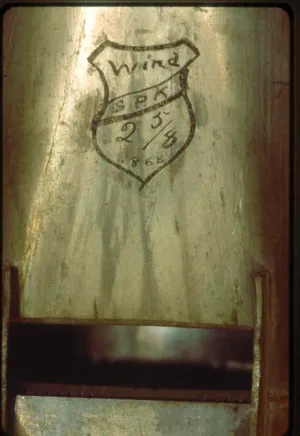
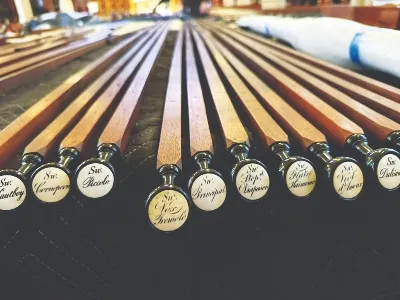
The other extant organ was built in 1874 for the New Jerusalem Swedenborgian Church in Pittsburgh, referenced earlier as the “first Carnegie organ,” and was moved to the Swedenborgian Church of Urbana, Ohio, in 1986 by Harry J. Ebert, subsequently restored to playing condition circa 2004 by Dana Hull (1927–2024), of Ann Arbor, Michigan, who also served as consultant on the restoration of the S. S. Hamill organ located in the front corner of the church. Photos of the Roberts keydesk indicate that it is virtually unaltered, the only obvious change being newer drawknobs for couplers, the Pedal Subbass stop, and the Tremolo and Bellows Signal drawknobs. It retains the original twenty-note pedalboard, footrests, foot trundles, and expression shoe. The escutcheon of the original water motor valve handle is also present, although the handle and coupling are not extant. Tuning slides were added to the metal pipework at some point in its history. The wooden pipes are clearly original, with apparently hand-shaped stopper handles. The tops of some zinc pipes show some past slitting and trimming, suggesting that the pitch may have been raised at some point in the organ’s history. While modern flexible paper tubing replaces the original zinc, the swell box, case, and façade are original. The façade pipes have been painted with a solid bronze metallic coating; historic photos suggest they were always finished thus, as no earlier stenciling is visible. For unknown reasons the original nameplate was removed and a photocopy framed.22
An entertaining aside about this organ is recounted in an article for the 140th anniversary of the Pittsburgh Society by Henrietta Zehner.
Two of Andrew Carnegie’s Scottish aunts had been among the founders of the church in 1841. Andrew Carnegie attended the Sunday school as a boy, was a choir boy and librarian as he grew older, and also served as a trustee. When the original church building was built in 1874 he donated $2,000.00 for the purchase of a pipe organ. At this time he remarked, “I can vouch for what the organ will say, but I cannot vouch for what the minister will say.” This was the first of several thousand organs donated to churches by Mr. Carnegie. The organ came from Philadelphia and when installed at the opposite end of the sanctuary from the pulpit in an elevated organ loft required some change in the roof. This prompted a joke around town to the effect that “Carnegie’s organ blew the roof off the church and then put it back on.”23
The stoplist of the organ is rather traditional and typical of its original manufacture date:
GREAT (Manual I)
8′ Open Diapason 58 pipes
8′ Dulciana 46 pipes
8′ Stopped Diapason Bass 12 pipes
8′ Melodia 46 pipes
4′ Principal 58 pipes
4′ Flute Harmonique 58 pipes
2′ Fifteenth 58 pipes
Swell to Great
SWELL (Manual II, enclosed)
16′ [?] Bourdon 58 pipes
8′ Violin Diapason 46 pipes
8′ Salicional 46 pipes
8′ Stopped Diapason Bass 12 pipes
8′ Stopped Diapason Treble 46 pipes
8′ Spitzflute 58 pipes
8′ Celeste 46 pipes
Tremolo
PEDAL
16′ Subbass 25 pipes
Great to Pedal
Swell to Pedal
Bellows Signal
Two combination trundles, unmarked.
Pitches not marked on stop knobs, those given are according to knob order and standard use. Couplers and Pedal stops unoriginal engraving and knobs: appear to be reed organ style black knobs with sans serif block type.
Robert Lord states, “The last decade of the life of John Roberts was probably the most active, and his early death at forty-eight [sic] may have occurred at the high point of his career.”24 The article “City Intelligence: Religious Matters,” Philadelphia Inquirer, March 26, 1870, includes several organs that were not mentioned in the Lord essay:
Cohocksink Presbyterian Church—Articles noting church construction, 1866–1867; “The new organ was built by Mr. John Roberts, of Frankford, and is a superior instrument.”25 First identified notice of an organ concert, December 1868.
First Baptist Church, Dayton, Ohio—split case with detached keydesk/console and cost $6,500. Identified from an announcement in the Inquirer, October 26, 1868.
Falls of the Schuylkill Baptist Church—we have been unable to find any other confirmation of this organ. There is a history of the congregation at the Historical Society of Pennsylvania: Jubilee Book of the Baptist Church of Christ at Falls of Schuylkill, Philadelphia, Pennsylvania (1890).
Church of [the] New Jerusalem, Broad and Brandywine—thus far unable to find additional confirmation, but Roberts and other Frankford New Jerusalem Society members were involved with members of this church.
“La Crosse”—No references identified other than this article. They may have been New Jerusalem societies, but not possible to confirm at the time of writing.
John Roberts’s business thrived at Penn and Orthodox for about a decade before tragedy struck. About 8:30 p.m. on Sunday evening, September 26, 1875, Roberts and his nineteen-year-old daughter Clara were traveling from Philadelphia to Frankford on a crowded Fifth and Sixth Street rail car. At the same time, a “Sunday excursion train” from Jersey City was returning to Philadelphia on the Pennsylvania Railroad’s connecting railway. The trains collided head-on at the intersection of the two rail lines above Harrowgate Lane in the Twenty-fifth Ward. According to the Philadelphia Inquirer, the streetcar was “cut in twain diagonally and completely wrecked.” A Philadelphia Times reporter interviewed some of the victims, including John Roberts, who had a broken thigh. Roberts recalled the moment he knew the collision was imminent, when he realized that he, Clara, and their fellow passengers were hurtling “into the very jaws of death.” He recalled exclaiming, “For God’s sake, stop the car! Stop the car! Oh, Clara, we’re gone!” Roberts and the other victims and their families brought multiple lawsuits against the Fifth and Sixth Street Passenger Railway Company, which was ultimately liable for about $200,000 in damages—more than $5,250,000 in present currency.26
The financial settlement could not ameliorate the physical and emotional damage that John and Clara Roberts experienced on that fateful evening. The Inquirer reported that Clara’s face was “disfigured for life” and John suffered spinal injuries that eventually manifested as spinal meningitis. No evidence has been found of new organs that Roberts created after the accident, although he did rebuild the organ at Grace Episcopal Church at Twelfth Street above Arch Street, Philadelphia, in the spring of 1876. In addition, changing tastes in organs would have affected his business. Organ tuning and repair, even used organ sales, likely became a larger part of the services he provided. In March 1877 he advertised the sale of the former organ of Saint Luke’s Protestant Episcopal Church in Germantown.27
On August 12, 1877, John Roberts, age forty-seven, died of complications from the spinal meningitis precipitated by the injuries he suffered in the Harrowgate accident. His son Edward attempted to maintain the organ business for a few years. In May 1879 the “Roberts & Co.” organ factory at Orthodox and Penn streets suffered a fire that resulted in a $2,000 loss in building and stock assets, equivalent to about $64,300 in present currency. The consequences of that loss were reflected in the census taken a year later, in early June 1880. The census taker recorded that Edward had been unemployed for seven months of the previous year, making his description of Edward’s occupation, “works at organ making,” unintentionally poignant. By 1885 he appears to have taken up his grandfather Edward’s trade as a painter. In late December that year his mother Susan sold their home and organ workshop at Penn and Orthodox. Susan died of chronic bronchitis and asthma in 1893, at the age of fifty-seven. Clara, who had been so severely injured during the Harrowgate crash, lived with various family members for the rest of her life, sometimes working as a dressmaker or private nurse. She died of pneumonia at the height of the influenza epidemic in October 1918. John and Susan Roberts, their three children, and John’s parents Edward and Sarah Roberts are all buried in Frankford’s historic Cedar Hill Cemetery, which was established in 1849, just a year after the Robertses arrived in Philadelphia.28
In 1879 an inventory of home and shop contents carried out in conjunction with executing his will of 1877 presents a snapshot of John Roberts’s financial condition at his death. The contents of his shop amounted to $5,375 (while not relatively substantial, it is not insignificant!), and home contents valued at $1,300–$3,300. (There is an old taped patch over two items, obscuring their exact value, but each appears to have four digits.) One of the appraisers, Samuel P. Faunce, was the younger brother of Susan Faunce Roberts. From 1879 until 1882, the city directories list her son Edward Roberts as an “organ maker” at 4709 Penn [Penn & Orthodox], where she is listed as well.
In his 1979 essay, Robert Lord admitted that John Roberts was “probably not one of the foremost builders of his time,” but acknowledged that he “certainly contributed to the growing organ industry during the third quarter of the nineteenth century.” His family also contributed to the growth of their industrializing Philadelphia neighborhood of Frankford and to the diversity of its religious traditions as members of the Swedenborgian church. Many of the Robertses’ fellow congregants in the New Jerusalem Society of Frankford also hailed from Greater Manchester, bringing with them the textile skills that would help make Frankford a powerhouse in that industry. But John Roberts brought the skills that supported the society’s long tradition of using instrumental and choral music in worship. That tradition continued through his familial and spiritual descendants long after his instruments disappeared. Roberts would be pleased that his famous “Carnegie” organ, which inspired the first look into his life and career nearly fifty years ago, is still preserved within the Swedenborgian community.
Notes
1. Robert Sutherland Lord, “First Carnegie Pipe Organ,” The Bicentennial Tracker, In Commemoration of the Bicentennial of the United States of America 1776–1976 and the Twentieth Anniversary of the Organ Historical Society, Inc. 1956–1976 (Organ Historical Society), pages 138–40; “Carnegie Organ 100 Years Old,” Pittsburgh Press, November 2, 1974, page 4; “Report of the Pennsylvania Association,” Journal of the Fifty-Fifth Annual Session of the General Convention (1875), pages 109–110; Andrew Carnegie, Autobiography of Andrew Carnegie (Houghton Mifflin Co., 1920), pages 51–52; “Religious and Charitable” (new church at Pearl and Sandusky, Allegheny City), Pittsburgh Press, February 2, 1907, page 2. Pearl Street was renamed Parkhurst Street in 1909; “Making a Joke of Street Names,” Pittsburgh Post-Gazette, July 28, 1909, page 2. Lord’s 1976 article was updated and reprinted; see “The First Carnegie Organ,” in Organ Atlas, Organ Historical Society (OHS Press, 2010), pages 62–67.
2. Robert Sutherland Lord, “John Roberts: Philadelphia and Cambridgeport Organ Builder (1850–1877),” The Tracker 23, no. 3 (Spring 1979), pages 3–7 (quotes, 3); “Organ Update,” The Tracker 31, no. 1 (1987), page 18 (transfer of Pittsburgh organ to Urbana).
3. Lord, “John Roberts,” pages 3–4; “Dedication of a New House of Worship in Brookline,” New Jerusalem Magazine 34 (March 1862), page 378; “City Intelligence: Religious Matters,” Philadelphia Inquirer, March 26, 1870, page 2 (only identified reference to the First Philadelphia Society organ); “The New Jerusalem Church Organ,” Chicago Tribune, November 14, 1863, page 4.
4. Original records related to the New Jerusalem Society of Frankford are available at the Historical Society of Pennsylvania, Historical Society of Frankford, Academy Archives (Bryn Athyn, Pennsylvania), and Center for Swedenborgian Studies (Berkeley, California). Many church publications and secular newspapers are now readily accessible in digital format.
5. New Jerusalem Temple (Salford) baptisms, 1811–1837, and burials, 1813–1837, are indexed on the Lancashire OnLine Parish Clerks website, lan-opc.org.uk. The original document showing the Roberts/Ellis marriage at Saint John’s, Deansgate, is available online through the FamilySearch.org database England, Manchester, Parish Registers, 1603–1954. Both churches have been demolished. “Dissenters in Salford,” Manchester Courier, September 5, 1829.
6. “Obituary” for Edward Roberts, Intellectual Repository and New Jerusalem Magazine 6 (July 1859), page 334; 1851 UK census, Prestwich cum Oldham, Lancashire, ED 3, folio 45, page 16, line 6, GSU roll 306932.
7. Pigot & Slater’s General and Classified Directory of Manchester and Salford (1841), 88, page 213; Edward T. Freedley, Philadelphia and its Manufactures; A Hand-book of the Great Manufactories and Representative Mercantile Houses of Philadelphia, in 1867 (E. Young & Co., 1867), pages 549–550, 553 (quote about Roberts apprenticeship); “Organ Builders;” “Painters, Plasterers, & Gilders” (Edward Roberts, 12 Quay St, Deansgate), in Slater’s Classified Directories of the Following Important English Towns (Manchester, 1847), pages 48–49. In 1847 Sarah Renn is listed as the owner of the Dickinson Street workshop.
8. For Samuel Renn, see Michael Sayer, “James Davis and the Lancashire Organ Builders,” Musical Times 111, no. 1528 (1970), pages 645–649. The church of Saint Paul’s, Halliwell, Bolton, Greater Manchester, maintains an unrestored organ with Sarah Renn’s plate, dated 1848, which likely was built in partnership with Kirtland & Jardine; see British Institute of Organ Studies’ (bios.org.uk) National Pipe Organ database, npor.org.uk/survey/N10666. A brief history of Kirtland & Jardine is given on the Jardine Church Organs website: organbuilders.co.uk/history.
9. Ship Yorktown, Liverpool to New York (manifest signed September 28, 1848); Passenger List 1113, pages 2–3; NARA microfilm M237, roll 75; “Arrived Yesterday,” Evening Post (New York, New York), September 28, 1848, page 3.
10. “John Roberts, Organ Builder,” Public Ledger, March 21, 1849, page 2; “The Organ of St. Paul’s Lutheran Church,” Public Ledger, December 21, 1848, page 3; McElroy’s Philadelphia Directory for 1849 (Philadelphia: Biddle, 1848), page 317 (Edward Roberts, painter; John Roberts does not appear in the directory); 1850 U.S. census: Edward Roberts, head, family #1269, Northern Liberties, Ward 7, Philadelphia, PA; NARA microfilm M432, roll 811, page 523B.
11. “J. Roberts, Organ Builder,” Frankford Herald, July 23, 1853 (The county and city were consolidated by law, February 2, 1854.); Lord, “John Roberts: Philadelphia and Cambridgeport Organ Builder (1850–1877),” page 4. The Seabrook organ plate reads, “John Roberts, Frankford near Philadelphia, 1853.” For the Roberts home and “shop,” see D. J. Lake and S. N. Beers, Map of the Vicinity of Philadelphia from Actual Surveys, Plate 3-A (Philadelphia: J. E. Gillette & Co., 1861).
12. “The Consolidation Act of 1854 extended Philadelphia’s territory from the two-square-mile ‘city proper’ founded by William Penn to nearly 130 square miles, making the municipal borders coterminous with Philadelphia County and turning the metropolis into the largest in extent in the nation, a position it held until Chicago leapt ahead in 1889.” “Consolidation Act of 1854,” The Encyclopedia of Greater Philadelphia, Andrew Heath, website accessed April 29, 2025.
13. Lord, “John Roberts,” page 3; Massachusetts State Census: John Roberts, family #1011, 2nd Ward, Cambridge; George Stevens, family #888, 3rd Ward, Cambridge; John Ford, Cambridge Directory and Almanac for 1856 (Cambridge, Chronicle Office, 1856): John Roberts (h Jennings St, 157); George Stevens (h 51 Thorndike St, 165). Stevens’s home was near his shop at Fifth and Otis streets in East Cambridge. Roberts’s baptisms and deaths recorded in the original register books held by the Historical Society of Frankford. Edward Roberts’s obit, Intellectual Repository . . . (July 1859), page 334.
14. In the Cambridge directories for 1859 (page 142), 1860 (page 168), and 1861 (page 140), John Roberts was listed as having a shop on Main Street. In 1860–1861 his residence was given as Front Street Court in the Cambridgeport neighborhood (Cambridgeport was consolidated into the city of Cambridge in 1846); 1860 U.S. census: John Roberts, family #3028, 4th Ward, Cambridge City (Cambridgeport post office), NARA microfilm M653, roll 508, page 390; “Dedication of a New House of Worship in Brookline, Mass.,” New Jerusalem Magazine 34, no. 9 (March 1862), page 378; Lord, “John Roberts,” page 4. Lord states that the nameplate for the lost Brookline organ read, “John Roberts, Cambridgeport, Mass., Hoc Fecit A.D. 1861.” The former Brookline New Jerusalem Church, 58 Irving Street, is now the home of the “Boston Latvians.”
15. Freedley, Philadelphia and its Manufactures (1867), page 553. The Philadelphia city directory in 1864 (page 628) and 1865 (page 586) give this address as “208 Frankford av.” His widowed mother and siblings still lived in the family home on Orthodox above Frankford. “To Church Committees and Organists,” Philadelphia Inquirer, Philadelphia, Pennsylvania, September 24, 1863, page 3; “Chicago Society of the New Jerusalem: Dedication of the New Temple,” Chicago Tribune, November 17, 1862, page 4 (the recess was described, but the organ had not yet been installed); Rudolph Williams, The New Church and Chicago: A History (Chicago: W. B. Conkey Co., 1906), pages 147, 174. (The Chicago church and organ were destroyed in the great fire of October 8–10, 1871.) The Chicago organ may have had an ornamental screen like the one on the Brookline organ pictured in Lord, “John Roberts,” page 4. That organ is also pictured in David H. Fox, “Some Observations on ‘Pipeless’ Pipe Organs,” The Tracker 33, no. 1 (1989), page 20.
16. “Opening of the Great Organ in the Church of the Covenant,” Philadelphia Inquirer, April 8, 1865, page 5. On April 15 the church announced the postponement of the concert to April 18, because of the “illumination” scheduled for Easter Monday, but Lincoln’s death canceled that event; “Festival Postponed,” April 15, 1865, page 5. The organ may have first been heard at the funeral service, noted in the Inquirer, April 19, 1865, page 4.
17. G. M. Hopkins, C. E.–Publisher. City Atlas of Philadelphia, 23rd Ward, 1876, Plate A [Property Atlases/Maps]. Retrieved from libwww.freelibrary.org/digital/item/46145.
18. “Opening of the New Organ” (Spring Garden), and “New Organ,” Philadelphia Inquirer, November 2 (page 5) and 4 (page 2), 1865; Deed, Giles L. Shallcross to John Roberts, Philadelphia Deed Book JTO 40, pages 511–513; “Grand Organ Concert” (Union Methodist), Philadelphia Inquirer, February 1, 1866, page 3; Hamilton Schuyler, A History of St. Michael’s Church Trenton, from the Year of Our Lord 1703 to 1926 (Princeton, New Jersey: Princeton University Press, 1926), page 230 (During renovations at Saint Michael’s in 1871, the organ was “thoroughly rebuilt;” page 236); “Presbyterian Church Fair” (Walnut Street), Philadelphia Inquirer, June 19, 1866, page 3. The article “City Intelligence: Religious Matters,” Philadelphia Inquirer, March 26, 1870, confirms that Roberts built organs for West Walnut Street Presbyterian Church and for an unidentified church in Trenton. The December 1866 purchase is recorded in Deed, George W. Buzby to John Roberts, Philadelphia Deed Book JTO 9, pages 92–94.
19. “Grand Organ Concert,” Philadelphia Inquirer, November 21, 1874, page 2.
20. “A Magnificent Organ.–An organ of novel construction has been completed by Mr. John Roberts, of Frankford, for the First Baptist Church of Dayton, Ohio, and costing $6500, and which in its first exhibition and trial has given great satisfaction. It is constructed in two separate and distinct cases, separated by a distance of 22 feet opening, to admit light from an immense window in the west end of the gallery of the church in which the instrument is to be placed. Between the two organs, at a distance of about 11 feet from each, and all the necessary appliances of key and pedal rounds, stops, composition and swell pedal, in neat walnut case, at which the organist is seated, and enabled to play upon either or both the organs at the one time.” Philadelphia Inquirer, October 26, 1868, page 2.
21. “One of the prominent features of the interior is THE ORGAN. This splendid instrument stands in an arch recess on the south side of the chancel. Its front extends some distance beyond the recess. It is 28 feet high, 10 feet 4 inches deep, and 16 feet wide. Its case is 30 feet high, 121⁄2 feet wide, and composed of dark walnut and bay wood, handsomely carved and ornamented. There are in it of various kinds of lumber some 15,000 feet, and of material 2 tons. It was built by John Roberts of Frankford, Philadelphia. It contains four separate and independent organs, three of which are played by the hands and one by the feet. The pedal organ is unusually complete and forms a desirable appendage to any organ of merit.” Delaware Tribune and Delaware State Journal, January 30, 1868, page 4.
22. Robbin Ferriman of the Urbana church communicated in an email on June 20, 2025: “The story about the name plates is that they were removed because people were stealing them and trying to pass off other organs as these, when they weren’t. I think it sounds fishy, but what do I know?”
23. 140th Anniversary of the Pittsburgh Society, “This Has Been a Living Church Since 1841,” Henrietta Zehner, The Messenger, September 1981, page 12.
24. Lord, op. cit., page 6.
25. “A New Organ,” Philadelphia Inquirer, May 6, 1868, page 3.
26. “The Railroad Catastrophe,” Philadelphia Inquirer, September 28, 1875, page 3; “The Harrowgate Slaughter,” Times (Philadelphia), September 28, 1875, page 1; “$200,000 in Damages,” Philadelphia Inquirer, October 4, 1875, page 2.
27. “$200,000 in Damages,” Philadelphia Inquirer, October 4, 1875, page 2; “Obituary—John Roberts,” Philadelphia Inquirer, August 15, 1877, page 5; “Mr. John Roberts” (sale of Saint Luke’s organ), Philadelphia Inquirer, March 17, 1877, page 3 (also notes his recent return “from Europe”). A brief history of the organs at Saint Luke’s Germantown is available at the church’s website, see
stlukesgermantown.com/theorgan.
28. “Miscellaneous,” Philadelphia, May 10, 1879, page 3 (fire); 1880 U.S. census, Philadelphia, PA, ED 473, NARA microfilm T9, roll 1182, page 181d; Deed, Susan B. Roberts [John Roberts’s executrix] to Harriet J. Lewis, recorded December 28, 1885, in Philadelphia Deed Book GGP 109, pages 36–39. Edward A. B. Roberts is listed in Philadelphia city directories as an organ maker at 4709 Penn from 1881 until 1883. He is likely the painter Edward Roberts identified in Mechanicsville in the far northeastern corner of the 23rd Ward in 1885. He appears variably as Edward and Edward A. B. Roberts in city directories and the census, identifying himself as a house painter and decorator in the 1910 and 1920 U.S. censuses. He died March 20, 1922, at age 63. Edward A. B. Roberts is noted in Eugene M. McCracken, “Pennsylvania, The Keystone State,” The Tracker 4, no. 2 (January 1960), page 4.