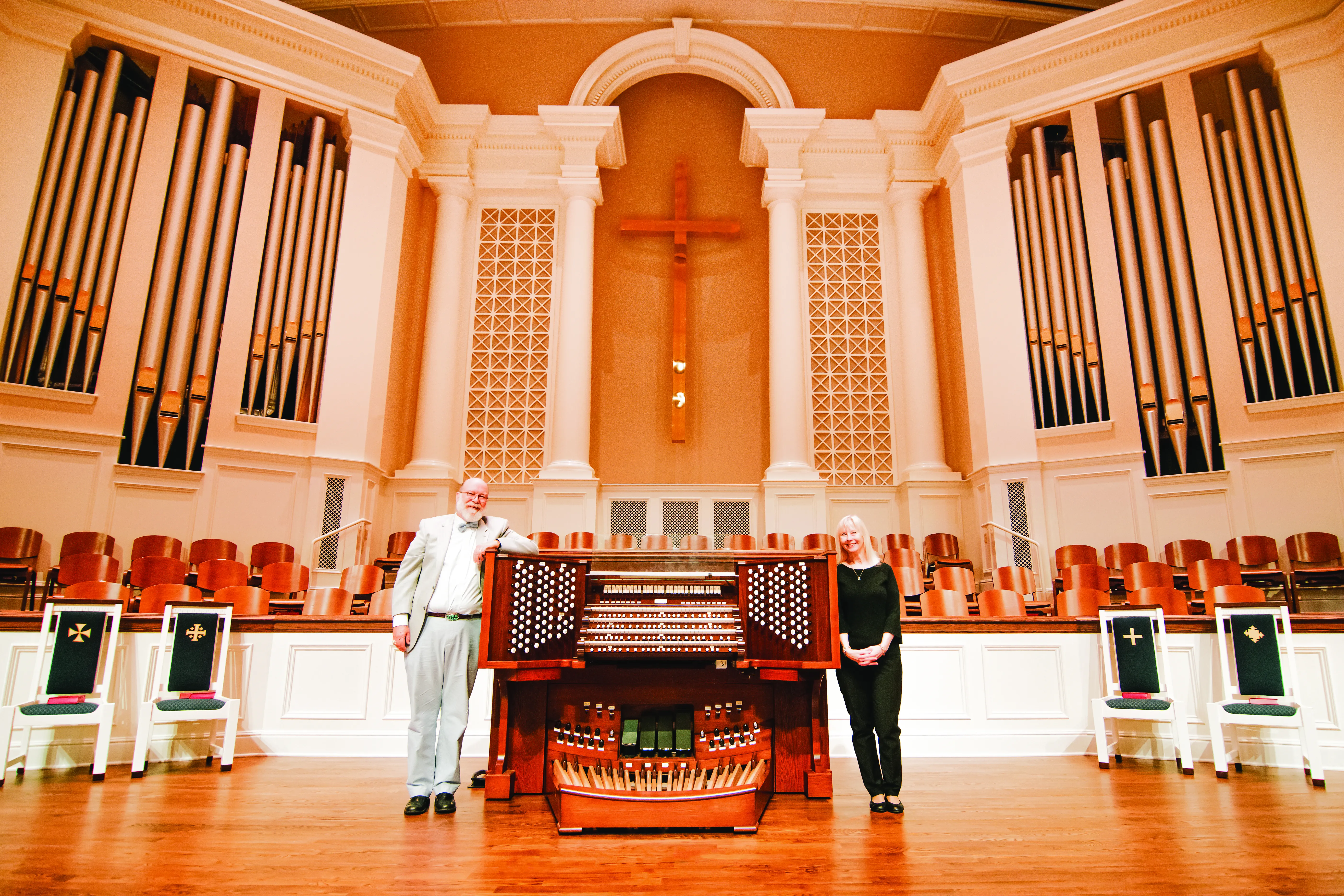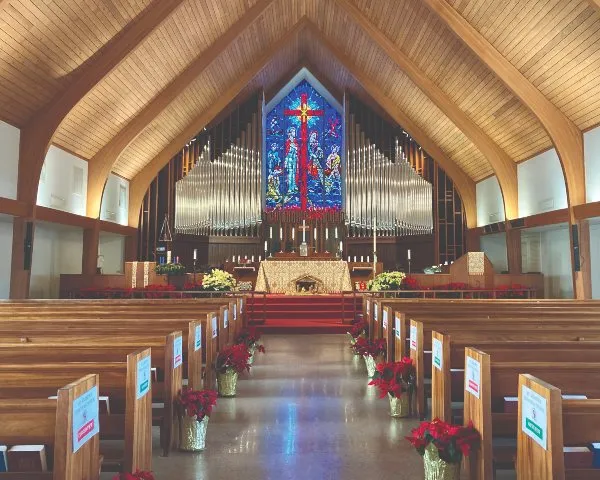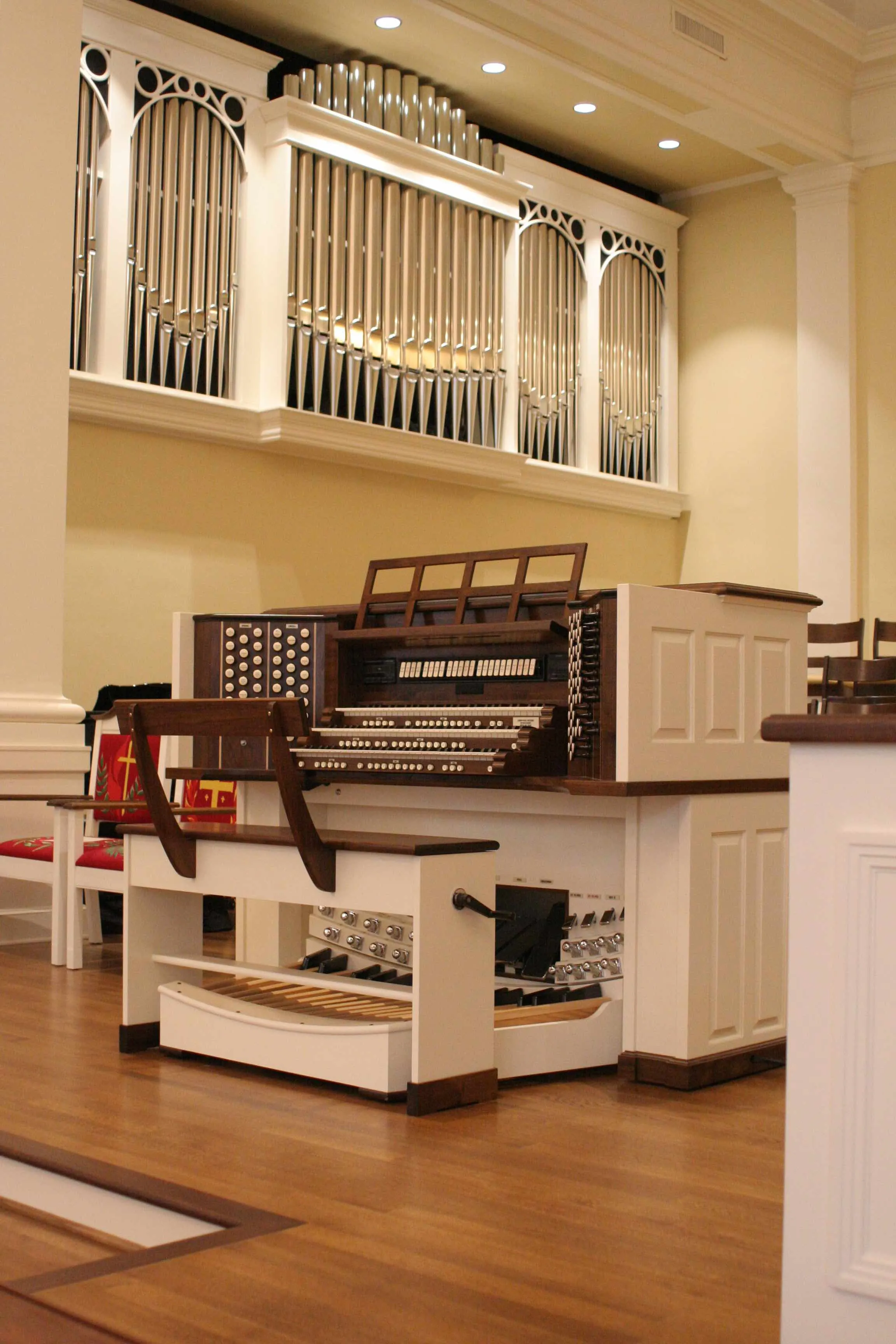
Cover feature: Holtkamp Organ Company, Christ UMC, Charleston, WV
Holtkamp Organ Company, Cleveland, Ohio; Christ Church United Methodist, Charleston, West Virginia
From the organist
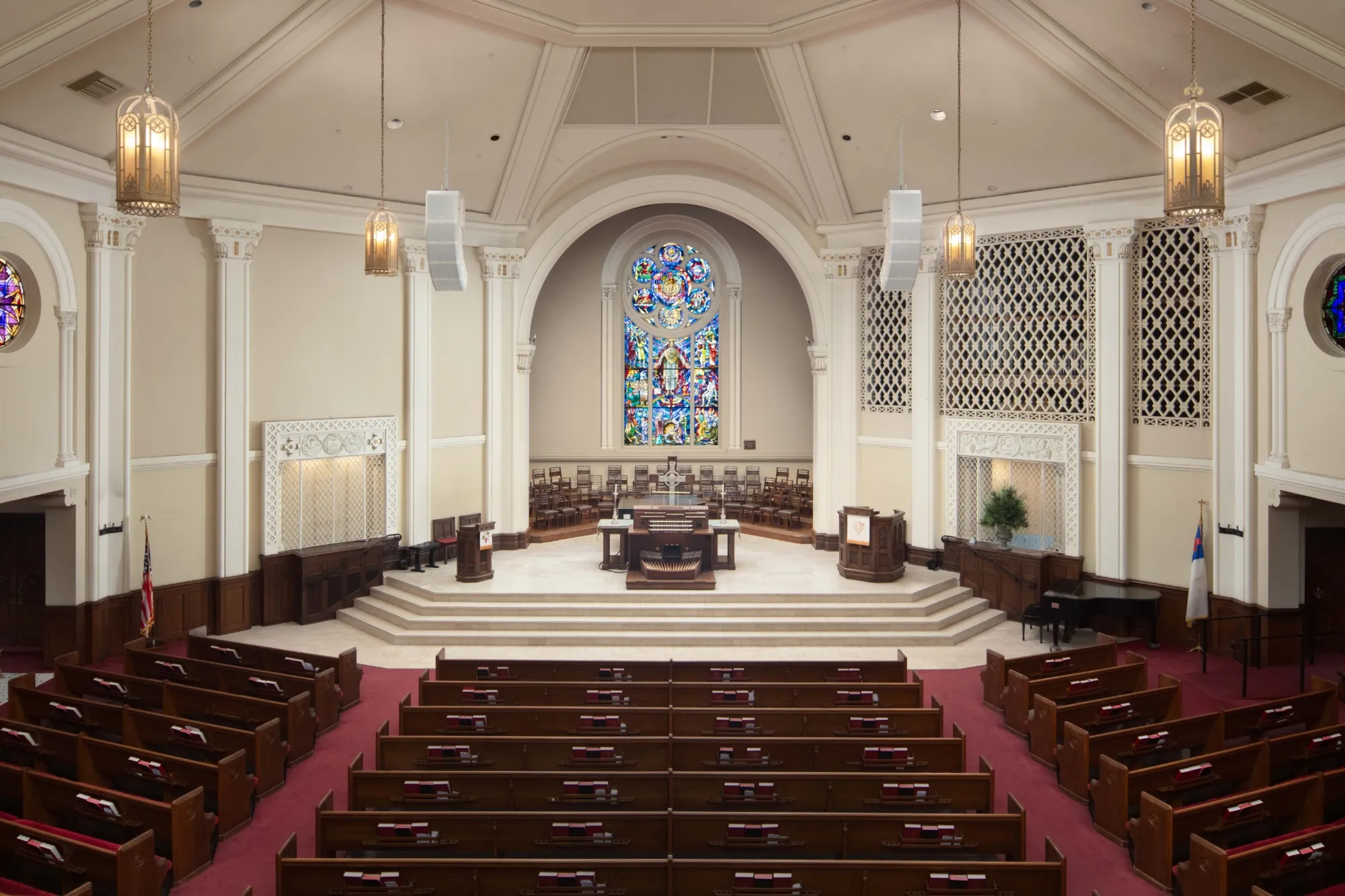
At the beginning of the twentieth century, the city of Charleston, West Viriginia, was on an upward trajectory in growth thanks to a booming industry in natural resources such as coal, salt, natural gas, and timber. In 1880 the population was 4,192, but by the 1930s the population ballooned to over 60,000. The downtown skyline was growing, with several new church towers, including the bell tower and sanctuary of the State Street Methodist Episcopal Church. There was a religious trend in America to return to the European standards of worship espoused by American banker and musician Lowell Mason that included the use of pipe organs and church choirs. In 1903 the congregation of the State Street Methodist Episcopal Church voted to purchase and install their first pipe organ and hire their first choir director. The State Street organ would be the second pipe organ in Charleston, West Virginia, with the first organ being purchased by the Episcopal church a few years earlier.
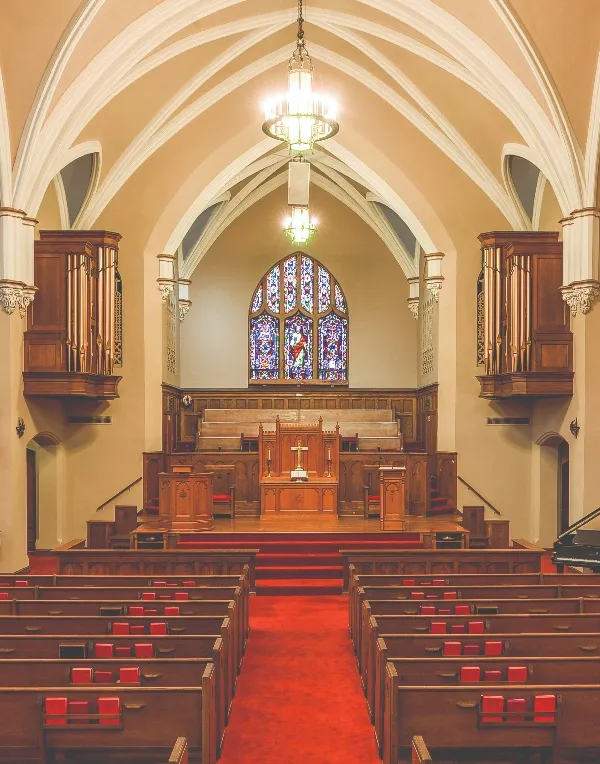
On May 22, 1903, a contract was signed with M. P. Möller to build a modest 14-rank pipe organ for the State Street Methodist Episcopal Church sanctuary, Opus 477. After the church met the necessary requirements, philanthropist Andrew Carnegie agreed to donate fifty percent of the cost of the organ, about $600. The congregation raised the remainder of the needed funds, which included monies to pay for the addition of an alcove to the front of the sanctuary that would house the new pipe organ. The original sales contract specified that the two-manual and pedal console and organ case were made of quarter-sawn oak stained a dark walnut color. The façade pipes were gilded gold with a fleur-de-lis pattern. The organ arrived by riverboat and was transported to the church by horse-drawn carriage. The dedication recital, given by Edward Mason from Ohio Wesleyan University, was held on February 12, 1904, over one hundred years after the church was founded. More than three hundred people were in attendance.
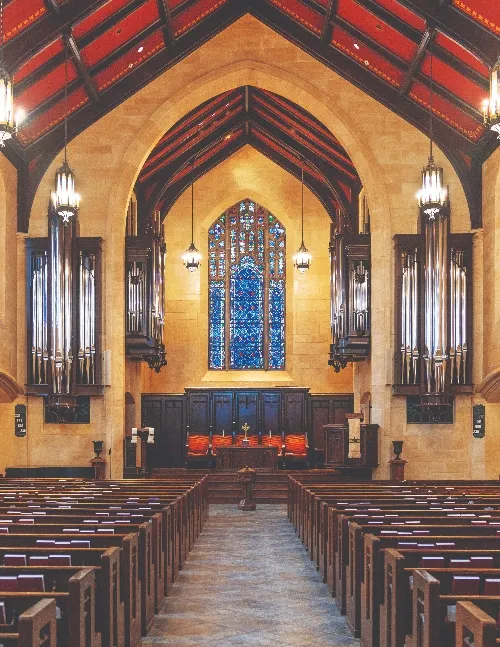
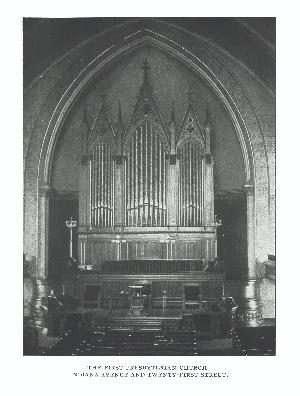
In 1908, because of the growth of the city of Charleston and the congregation, the decision was made to build a larger church in an area of town that was quickly being developed. The State Street Methodist Episcopal Church was sold to the local Jewish community. While the new Gothic structure was being built by John Fulton of Uniontown, Pennsylvania, the congregation met at the local YMCA where they used the auditorium for worship. The Möller organ was moved from the State Street Church to the stage at the YMCA. At this point the name of the State Street congregation was changed to First Methodist Episcopal Church. In 1911 the congregation moved into their new English Gothic church building.
Since the new sanctuary had a larger pipe organ, the 1903 Möller organ was sold to Simpson African Methodist Episcopal congregation where it was installed in their new sanctuary in 1914. The Möller organ served the Simpson AME Church until 1965 when it was electrified, renovated, and enlarged by the Charleston Organ Company, owned and operated by Allen Harrah (who went on later in his career to lead the Rodgers Organ Company).
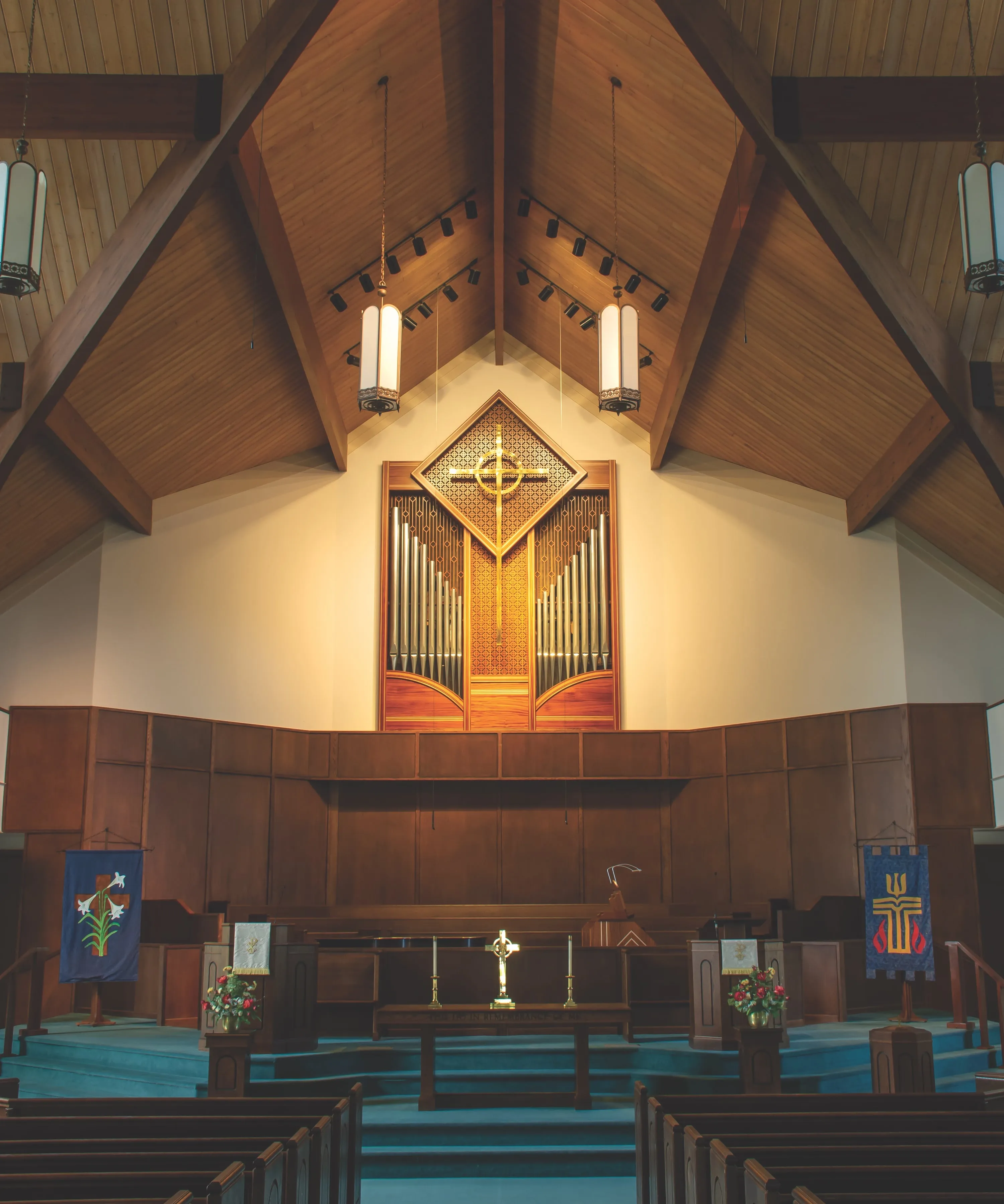
On July 19, 1969, the 1911 sanctuary of the First Methodist Episcopal Church, now known as Christ Church United Methodist, was destroyed in a fire. Four years later the church was rebuilt by the renowned church architect Edward Sovik of Northfield, Minnesota. The new church was completed in 1973, and in 1974 a contract was signed with the Holtkamp Organ Company to build a new tracker pipe organ consisting of three manuals and forty ranks. At this point in time, the membership of Christ Church surpassed 2,000.
In 1992 I was hired as the full-time director of music/organist, making me the fourth person to hold the position since 1933. Thanks to Christ Church historian Ann Emich, I became fascinated with the church’s history, which included the history and location of the 1903 Möller organ, Opus 477.
In 2005 I had a random conversation with the Reverend Dr. Ernest Watkins, minister of what is now known as Simpson United Methodist Church. During the conversation, I told Dr. Watkins about the history of the Möller organ that was housed in the Simpson sanctuary. Dr. Watkins said that the organ was in disrepair, and the church trustees were trying to decide whether to fix the instrument (at the cost of over $50,000) or sell it. Without having any financial backing, I stepped out in faith and said if the Simpson UMC trustees decided to sell the Möller organ, Christ Church would buy it. After being assessed by Chris Nagorka of Kanawha Organ Works, the Simpson UMC trustees voted to sell the instrument. I was able to secure the funding needed to purchase the organ thanks to a descendant of one of the original 1903 donors. In the summer of 2005 Christ Church took possession of the organ once again. Chris Nagorka and I discovered that twelve of the original fourteen ranks of pipes from 1903 survived the 1965 rebuild. These twelve ranks of pipes were removed from Simpson UMC and were stored at Christ Church while plans for a new Antiphonal organ were being developed.
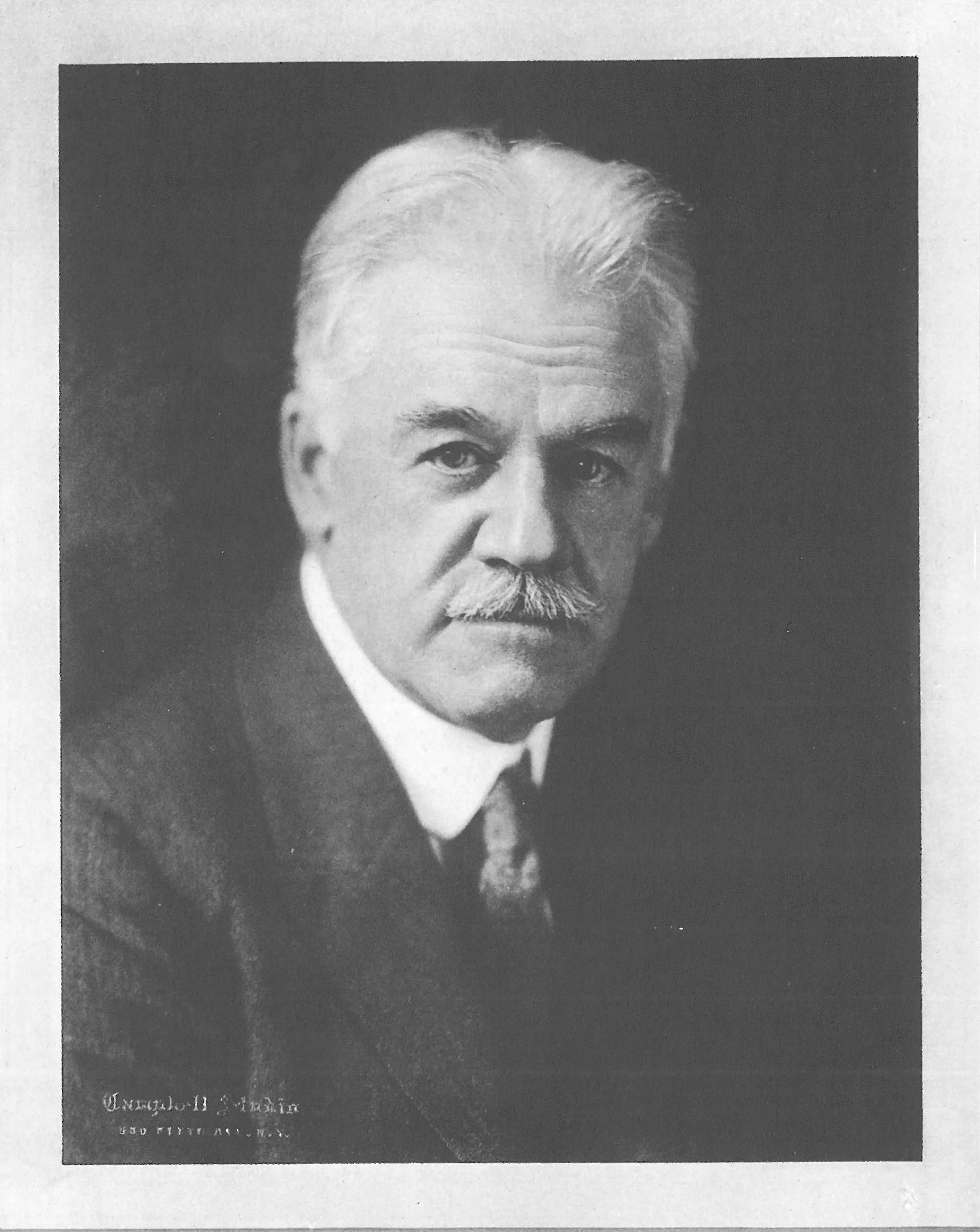
From the very beginning of this project, I knew I wanted the Holtkamp Organ Company to design and build our Antiphonal organ. The 1975 Holtkamp at Christ Church was designed by Walter Holtkamp, Jr. Chris Holtkamp, Walter’s son, is now president of the company. This continuity of organ history and design was extremely important to me and to the congregation.
In 2005 Chris Holtkamp made a trip to Charleston to inspect the twelve ranks of Möller organ pipes from 1903. He found them to be in excellent shape and thought they would work well in a new antiphonal instrument. By 2007 we had a design concept for an antiphonal organ of thirteen ranks that could be used independently or in conjunction with the 1975 Holtkamp tracker. The task now was how to make these two organs, from completely different eras, work together.
For over twenty years, the pipes from the 1903 Möller organ remained in storage at Christ Church. A trust fund for the project was established, and over the years a significant amount of donations was collected, both from individual gifts and from two estates. In 2024 a series of unexpected events led to a donor stepping forward offering to fund the balance needed to complete the project. After the cost of construction was finalized by Chris Holtkamp, a construction contract was signed on July 15, 2024. During the course of the following year, the design of the Antiphonal organ was finalized. On Monday, June 2, 2025, the console of the 1975 Holtkamp tracker organ was removed and taken to Cleveland to be rebuilt. For the next six months, the 1975 organ was silent. Finally, in November of 2025, fifteen months after signing the construction contract, the Antiphonal organ was complete and ready for installation. On Saturday, November 22, 2025, after twenty years of dreaming and planning, the new Antiphonal organ finally arrived at Christ Church.
Overseeing the organ’s installation during the busy season of Advent was not on my list of things to do, but that is how the schedule worked. Even though Christ Church’s sanctuary, called a Centrum, looked like a construction zone during the Advent season, there was something very special about watching the installation take place during a time when the congregation was anticipating the birth of Christ. Each week anticipation was building as the construction piles got smaller and the Antiphonal organ began to take shape.
Thanks to the incredible Holtkamp team, both the 1975 tracker organ and the Antiphonal organ were playable by Christmas Eve, but we did not tell the congregation. I used the piano to play the prelude on Christmas Eve, but after the greeting at the opening of the worship service, the lighting in the room was dimmed. The spotlights on the new Antiphonal organ came on, and for the first time, the congregation heard the organ our church ancestors purchased over one hundred twenty years ago. The Antiphonal organ was played in dialogue with the 1975 organ during the introduction to “Hark! The Herald Angels Sing!” At one point during the introduction, the instrument swelled to full organ, the congregation stood, and everyone joined in singing the opening carol. It was a very powerful and emotional moment for me and the congregation as we joined with our church ancestors in singing about the birth of Jesus. The anticipation was over, and it was an experience I will never forget.
Earlier, I mentioned the name of Christ Church historian, Ann Emich. Her knowledge of the history of Christ Church and its historical connection to Charleston led me on a path of discovery I was not anticipating. When looking over the files for the purchase of the 1903 Möller organ, I kept coming across the surname Wills. I knew this name because my grandmother’s maiden name was Wills. It is an old family name that has its origins in Virginia. After digging a little deeper, I discovered that a woman by the name of Nina Franklin Carey Blundon married a man named Woodson T. Wills, a great, great uncle I didn’t know anything about. Both Nina and Woodson, who had two children, were involved in the life of this congregation, and both were involved in the purchase and dedication of the 1903 Möller organ. Nina and Woodson, along with their youngest son, Bernard, were members of the State Street Church choir. The discovery of my ancestors’ involvement in this organ project only enhanced my desire to see the project through to its completion.
My goal as the minister of worship arts/organist was to help design and create an instrument that would move the congregation to another level of worship through music. Chris Holtkamp did a fantastic job balancing the Romantic-style pipework from 1903 with the organ reform design of the 1975 tracker organ. The Antiphonal organ contains sounds and colors the 1975 organ lacks, so when they are played together, the sound is sonorous and envelopes the congregation but does not overpower. Thanks to the wonderful acoustics of Ed Sovik’s Centrum, the instrument is so well balanced it is hard to tell exactly where the organ sound is coming from. Many people in the congregation have changed where they sit so they can hear and feel the breadth of the organ’s sound. This organ project has far exceeded all my expectations. Every time the Antiphonal organ is played, I hear the voices of our ancestors joining with the voices of today—“And from morn to set of sun, through the church, the song goes on.”
—Rev. David F. Donathan, Deacon
Minister of Worship Arts/Organist
From the builder
My association with Christ Church United Methodist began in the summer of 1972. I was home from college on vacation, so naturally, I was pressed into service whenever something came up with which I could be useful. That summer the shop was in the midst of the installation of the new 31-stop tracker organ for Christ Church United Methodist. On this occasion I was tasked with driving a load of organ components from Cleveland to Charleston in a U-Haul rental truck. The drive itself was not particularly challenging. But solo navigating downtown Charleston in a very large and unfamiliar vehicle with no GPS, well, that was something else. None the less, I arrived at my destination without incident.
I was first contacted by David Donathan in 2005. In the two years that followed we had intensive discussion during which time my education regarding his potential project began. We entered into a design retainer agreement in early 2007. The first job was to create a tonal design of the Antiphonal organ. The intention from the outset was to create an Antiphonal organ that was equally balanced with the 32-stop Centrum organ (a 16′ Subbass was added in 2019), but in a style true to the original Möller organ from 1903. The pipes that we would use were safely packed in boxes on the top shelf of a storage area at the church. While we had stop names, we had no information regarding scaling, materials, cut-up, or any other pertinent details of pipe construction. While the original organ was fourteen stops, only twelve stops had made it into storage at CCUM. Those that went missing, the Great 8′ Diapason and the Swell 8′ Aeoline, were apparently removed in 1965 when the organ was electrified. Using the twelve stops at our disposal, we designed a thirteen-stop organ of two manuals and pedal, with the sole addition being the 16′/8′ Bassoon/Oboe.
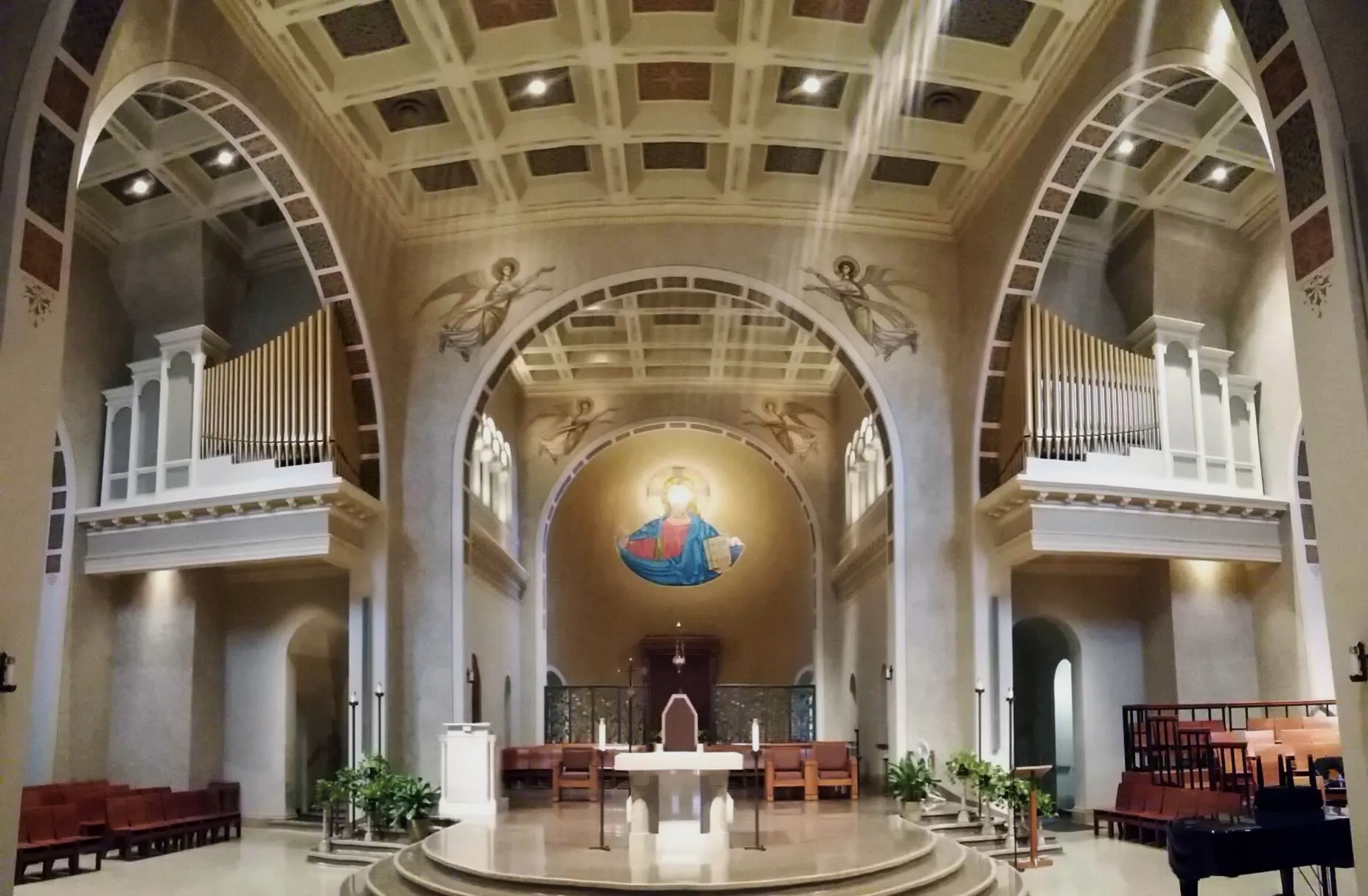
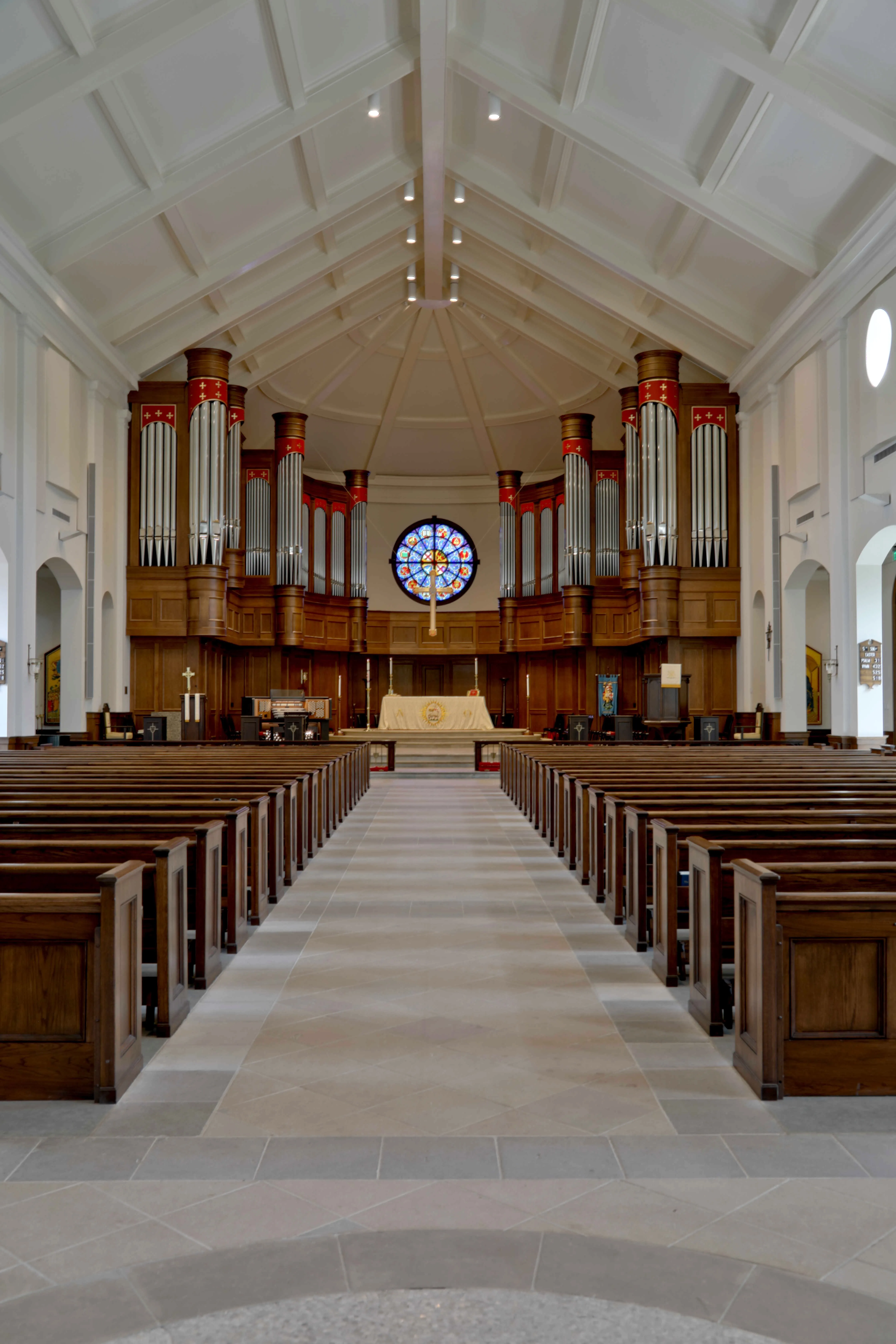
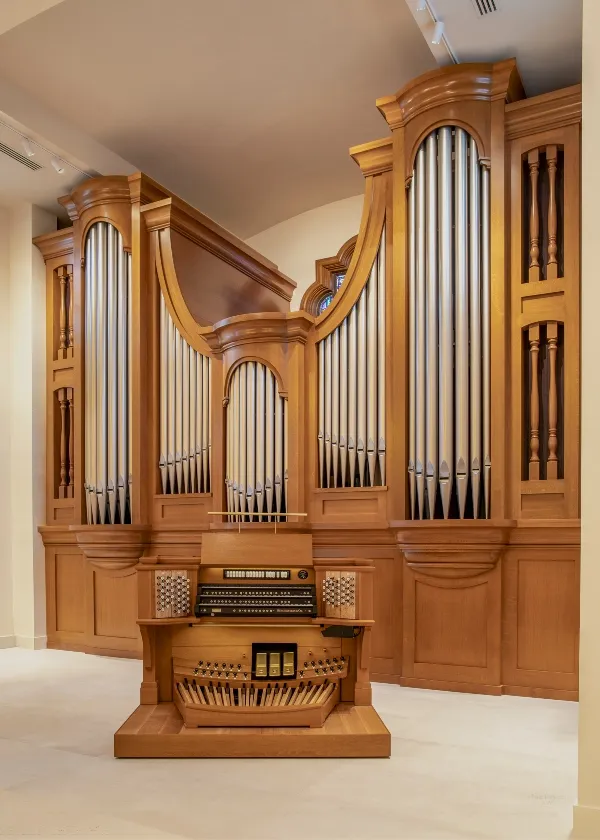
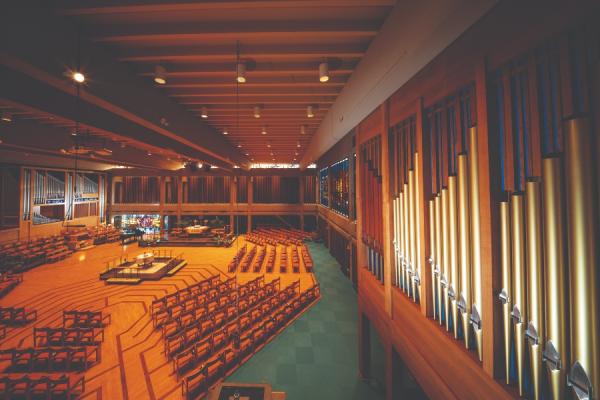
Following this came visual design. Oh, the visual design. The Centrum was designed by Edward Sovik, church architect of renown. The design style is known as “brutalist.” I personally find this epithet often misleading, especially when applied to the Centrum. The space is bright and open with creative detailing in the structure. The colors are warm and complementary. Of particular interest to me were the side aisles of the room. The repetitive robust concrete pillars topped by concrete segmental arches gives the space a feeling of movement and intimacy, almost buoyancy. Because of this buoyancy, I did not want to design a heavy structure in a corner. Instead, we decided on an elevated case using structure echoing the concrete pillars and arches which surround the Centrum. At this point in time my children were between six and nine years old. This was close enough to their toddler years to remind me how active they could be while at church. From the outset it was planned to have a portion of the area beneath the chests, what we call the under-space, intended as a play area for young children, with shelves for toys at the very back. In the final design, the under-space to the far right is used for the blower (wonderfully silent in its exposed position) and the relay for the Antiphonal organ, and the under-space on the left is for play. As the design progressed, we chose a color reminiscent of the stained oak on the Centrum walls for the casework, and a complementary stained mahogany for the wood façade pipes. We chose a medium blue for the sound-transparent screens behind pipe shades, reflecting the brilliant blue of the Creation Window to the left of the Antiphonal organ. For the 8′ Diapason façade pipes we chose a color of gold that is not too dark and not too light, with enough visual presence, sheen, and warmth to be at home.
The windchests are slider with electric key action and electric solenoid stop action for the main chests, and electro-pneumatic action for the unit chests. We also use electro-pneumatic chests for the 8′ Diapason façade pipes. The chests are positioned with the Great/Pedal in the left half of the casework and the Swell on the right half of the casework. Each division is split into treble and bass chests, with the treble chests below for tuning stability.
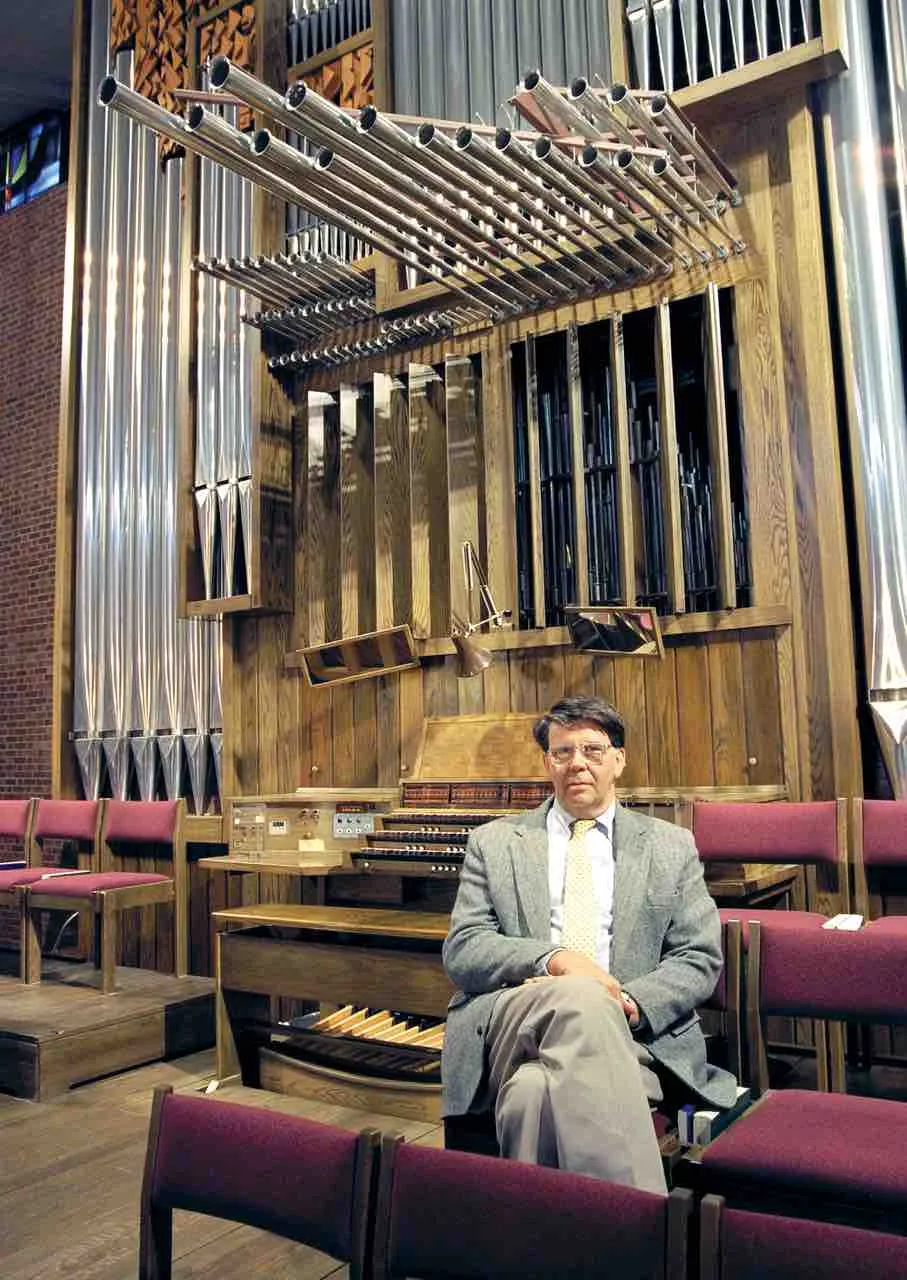
The Centrum organ has mechanical key action. The new Antiphonal organ uses electric slider and electro-pneumatic actions, and is eighty feet away in the opposite corner of the Centrum. Somehow the Antiphonal needed a mechanism for actuating its pallets and valves that was placed in the tracker action or console of the Centrum organ. The hope was that this mechanism would be placed in the keys themselves so that the firing of the pallets and valves of the Antiphonal was timed with the pluck point on the keys and pedals in the Holtkamp tracker. The solution that we chose is an optical switching system. It has two primary components. First is an optical sensor that is like an infrared light beam used in security systems, but much, much smaller. This optical sensor is placed below each key on the key bed of each manual. Second is the shutter. The shutter is L-shaped metal, secured to the bottom of each key, and its position relative to the optical sensor is adjustable. When the key is pressed, the shutter breaks the light beam in the optical switch, and the note plays.
The project began in earnest in July 2024. One of the important early jobs was to retrieve the pipes from storage at CCUM. At this point we did not know exactly what we were dealing with in terms of pipe scales and details of construction. With them unpacked and organized in trays we took measurements of all details. As it turns out, with the exception of the 16′ Bourdon, all scales in the organ were, relatively speaking, on the small side. I attempted imagining what the organ would have sounded like at State Street Methodist Episcopal Church in 1903. Based on photos, it was placed behind a fairly tight façade. I imagined that the acoustical space into which they spoke was at least medium-large. Combining these factors with the generally small scale of the existing pipes, it seemed clear that the organ in its original setting must have been fairly mild. If we retained the existing scales of the Möller pipes it would have been impossible for the Antiphonal organ to be an equal partner with the Centrum organ. When placed on moderate wind pressure they produced sounds true to their names. It was clear that in order to produce sound levels compatible with the Centrum organ, they could not be just pushed by opening toes or placing them on higher wind pressures, as that would result in timbre that was forced and unsteady. All pipes would need to have their scales increased to achieve the winning combination of timbre and loudness. This was done carefully so that the pipes added to each stop would be compatible with the original.
The Antiphonal organ was completed prior to Christmas 2025. If you have a chance to visit, see, and hear, you will find that the Möller is indeed true to its original self. The Centrum and Antiphonal organs balance each other wonderfully. The tonal styles of each instrument, although very different, are complimentary in ways that I did not imagine when we began in earnest in 2024. My most sincere thanks go out to David Donathan, the organ committee, and the congregation of Christ Church United Methodist for making the project possible.
In the world of pipe organ building we are eternally preoccupied with geometric shapes, both in the planning and building of our work. Lines, angles, arcs, circles, ellipses, planes, reveals, moldings. And parallel lines. Are they really parallel or just a bit off? This project is defined by a circle. Not in its visual design, scaling, or voicing, but in terms of its story. What started in 1903 for State Street United Methodist Church in Charleston, West Virginia, has traveled through three buildings and two congregations, and has come full circle to its current home, with the congregation that purchased the organ in 1903, in the Centrum of Christ Church United Methodist. Poetry in motion.
—F. Christian Holtkamp
President, Artistic and Tonal Director
Builder’s website: www.holtkamporgan.com
Church website: www.ccumwv.org
Photo credit: Perry Bennet, unless otherwise indicated
Centrum Organ
GREAT
16′ Pommer 61 pipes
8′ Principal 61 pipes
8′ Gedackt 61 pipes
4′ Octave 61 pipes
4′ Spitzflute 61 pipes
2′ Superoctave 61 pipes
1-1⁄3′ Mixture IV 244 pipes
8′ Trumpet 61 pipes
8′ Festival Trumpet (prepared)
SWELL (enclosed)
8′ Bourdon 61 pipes
8′ Gamba 61 pipes
8′ Voix Celeste 61 pipes
4′ Nachthorn 61 pipes
2′ Principal 61 pipes
1-1⁄3′ Larigot 61 pipes
16′ Dulzian 61 pipes
8′ Oboe/Fagott 61 pipes
4′ Rohrschalmey 61 pipes
Tremolo
POSITIVE
8′ Copula 61 pipes
4′ Prestant 61 pipes
4′ Rohrflute 61 pipes
2′ Waldflute 61 pipes
Cornet II 122 pipes
1⁄2′ Scharf III 183 pipes
8′ Cromorne 61 pipes
Tremolo
8′ Festival Trumpet (prepared)
PEDAL
32′ Resultant
16′ Principal 32 pipes
16′ Subbass 32 pipes
16′ Pommer (Great)
8′ Octave 32 pipes
8′ Flauto 32 pipes
4′ Choralbass 32 pipes
2-2⁄3′ Rauschbass IV 128 pipes
16′ Posaune 32 pipes
8′ Trumpet 32 pipes
8′ Festival Trumpet (prepared)
Antiphonal Organ
GREAT
8′ Diapason 61 pipes
8′ Melodia 61 pipes
8′ Doppelflute 61 pipes
4′ Principal 61 pipes
4′ Flute d’Amour 61 pipes
2′ Superoctave 61 pipes
Chimes (prepared)
SWELL (enclosed)
8′ Stopped Diapason 61 pipes
8′ Gamba 61 pipes
8′ Voix Celeste (TC) 49 pipes
4′ Flauto Traverso 61 pipes
2′ Flautina 61 pipes
16′ Bassoon/Oboe (ext) 12 pipes
8′ Bassoon/Oboe 61 pipes
Antiphonal Swell 4
Tremolo
PEDAL
16′ Bourdon 32 pipes
8′ Flute (ext) 12 pipes
16′ Bassoon/Oboe (Swell)
Couplers
Great to Pedal 8, reversible by piston and toe stud
Swell to Pedal 8, reversible by piston and toe stud
Positive to Pedal 8, reversible by toe stud
Swell to Great 8
Positive to Great 8
Swell to Positive 8
Antiphonal Pedal to Pedal 8
Antiphonal Great to Pedal 8
Antiphonal Swell to Pedal 8
Antiphonal Great to Great 8
Antiphonal Swell to Great 8
Antiphonal Swell to Swell 8
Antiphonal Great to Positive 8
Antiphonal Swell to Positive 8
Combinations
Generals 1-2-3-4-5-6-7-8 piston and toe stud
Pedal 1-2-3-4-5 toe stud
Great 1-2-3-4-5 piston
Swell 1-2-3-4-5 piston
Positive 1-2-3-4 piston
Antiphonal Generals 1-2-3-4-5-6 piston
Set piston
General Cancel piston
Full Organ Reversible piston and toe stud
Next piston and toe stud
Previous piston and toe stud
Zimbelstern toe stud
32′ Resultant Reversible toe stud
Console Details
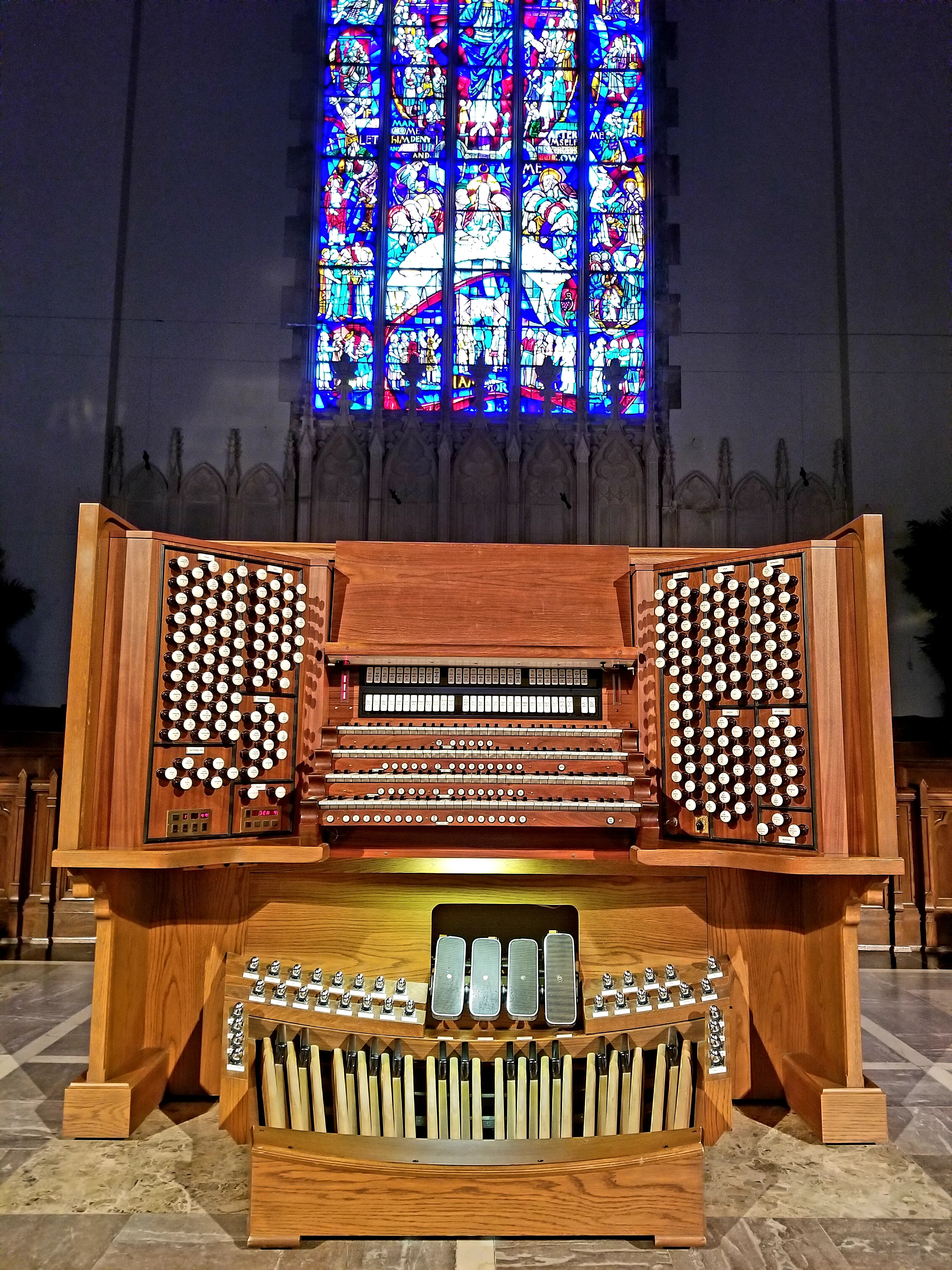
Existing Holtkamp signature stop tab console
Manual natural keys – plum wood
Manual sharp keys – palisander
Pedal natural keys – maple
Pedal sharp keys – black plastic
Centrum stop tabs – oiled American cherry
Antiphonal stop tabs – bleached American cherry
Organ bench with adjusting crank mechanism
Centrum Swell expression pedal
Antiphonal Swell expression pedal
Crescendo pedal
Full Organ indicator light
Summary
Centrum Organ
32 stops, 41 ranks, 2,182 pipes
Antiphonal Organ
13 stops, 13 ranks, 776 pipes