In the Wind: Life Work
Life work
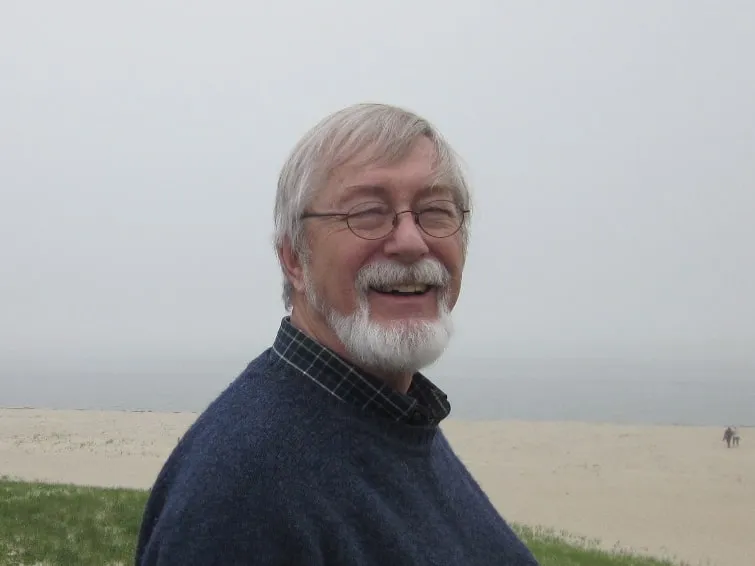
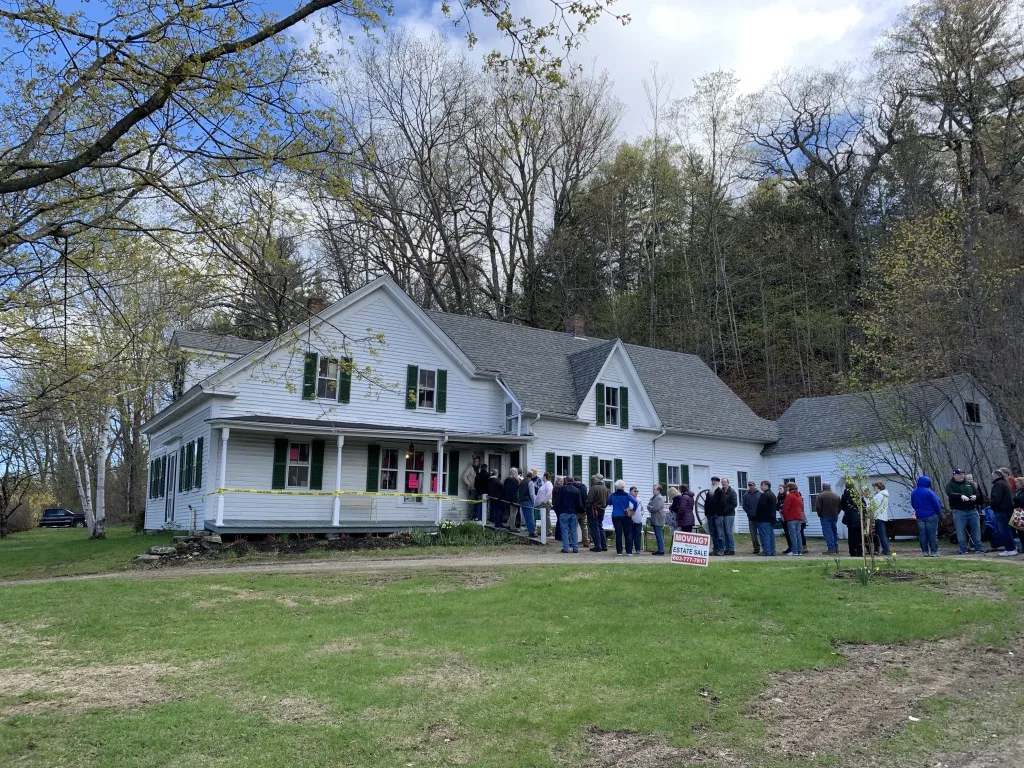
Donald Hall (1928–2018) was a poet who lived most of his life on what had been his grandfather’s farm in Wilmot, New Hampshire. He held degrees in literature from Harvard and Oxford, and early in his career he taught literature at the University of Michigan for several years during which time his first marriage failed. As he described it in his book, Life Work (Beacon Press, 1993), after divorcing his first wife, he spent two unhappy and unproductive years resenting how the demands of teaching were keeping him from the joy of writing. In 1972 Hall married his student, the poet Jane Kenyon, and gave up university life, forsaking salary and benefits to return to the farm in Wilmot where he and Kenyon spent the rest of their lives writing and living a simple rural life.
Donald Hall wrote more than fifty books including poetry, memoir, sports, and children’s books. He wrote book reviews, lucrative work for a freelance writer, and he was a devoted writer of thousands of letters. He served as Poet Laureate of New Hampshire and later the United States, and won countless awards, honors, and fellowships.
Something you can’t possibly do
Life Work has been an inspiration for me since I first read it a few years after it was published. The first chapter begins:
I’ve never worked a day in my life. With the trivial exceptions of some teenage summers, I’ve never worked with my hands or shoulders or legs. I never stood on the line in Flint among the clangor and stench of embryonic Buicks for ten hours of small operations repeated on a large machine.
He reveled in the process of writing, moving words around within sentences until they pleased him, writing hundreds of drafts of each poem to get them just right. In 1997 Hall and Kenyon spent seven weeks traveling around China and Japan for the USIS (former agency called the United States Information Service). Hall wrote that before that trip it had been more than eleven years since he missed more than one or two days of writing. “For seven weeks of travel I wrote nothing except one hundred and four postcards, a literary form I have never mastered.” Just before returning to the United States, they visited the Hokkaido Historical Museum in Sapporo, Japan, where the museum’s director asked Hall to edit a two-sentence photo caption he had written. Hall wrote, “I was in heaven,” as he tweaked and tinkered with his host’s writing.
In Life Work Donald Hall wrote about the prolific British sculptor Henry Moore who was in his eighties when Hall visited to interview him. Moore had several studios on his property so he could move back and forth between projects during the day, and he always had a sketch pad with him so he could doodle with shapes, perhaps the same way Hall moved words around. In response to Hall’s question, Moore replied, “The secret of life is to have a task, something you devote your entire life to, something you bring everything to, every minute of the day for your whole life. And the most important thing is—it must be something you cannot possibly do!”
High in the air or crawling on your belly
In fact, he could do it, but I love the romantic idea of doing work that sustains, nurtures, and enriches you. I know many organ builders who feel just that way. Developing a project is a stimulating exercise. Diving into the work of building one, making cutting lists from drawings and firing up the machines in the wood shop is a delight. Completing a new instrument, renovation, or restoration is a thrill. Hearing a new organ leading a singing congregation for the first time brings tears to my eyes, but the reality of that romance is that it isn’t magic, it doesn’t just happen. It takes thought and planning, physical work, repetitive work, and sometimes work that is arduous or even scary. There is a special awareness of mortality when you are on top of a scaffold, wrestling a heavy tower crown into place, or crawling on your belly in the company of rats, dragging a cable through a dirt crawl space from console to organ chamber (that was in the 1970s on East 55th Street in Cleveland, Ohio).
The workshop of the Noack Organ Company in Georgetown, Massachusetts, has a terrific testimony to a life’s work on display. When you enter the building through the Main Street door, you are greeted by a gallery of photos that includes all the Noack organs. Fritz Noack was responsible for 158 of them. When I visit the shop and see all those photos, I am reminded of the man whose dedication, wit, wisdom, and productivity was behind that staggering output. The photos are displayed roughly in chronological order, and it is fascinating to trace the development of an artist from the simple Bauhaus-like designs of the 1960s to opulent classic organ cases festooned with moldings, round and pointed towers, carvings, and gold leaf. Didier Grassin joined the company in 2011 and became president when Fritz retired in 2015. The Noack website shows Opus 171 to be completed in 2026.
Fifty-eight perspectives
Last June, during the same trip that took me to Holland, feeding this column for four recent issues of The Diapason, Wendy and I spent five days in Barcelona, eating in magical restaurants and exploring Spain’s lusty, robust red wine. We visited museums and architectural masterpieces. Architect Antoni Gaudi’s (1852–1926) whimsical houses and especially his towering, eloquent Basílica de la Sagrada Família (Basilica of the Holy Family), which is nearing completion after almost 150 years of construction, were highlights of our trip.
Pablo Picasso (1881–1973) was born in Malaga, Spain, and his family moved to Barcelona when he was fourteen. We spent a morning in the Museo Picasso in Barcelona, which is devoted exclusively to his art. We listened to an audio guide on our mobile phones as we moved through the galleries and quickly understood how fast Picasso worked. In a career that spanned seventy-eight years, he is supposed to have produced close to 13,500 paintings. When we include sculptures, prints, drawings, his total output is estimated at well over 50,000 works of art. There are 28,470 days in seventy-eight years—he produced an average of about two works every day. He must have had a manic need to be producing art, expressing himself every minute. Picasso had four children, I doubt that he spent much time with them.
The museum includes a group of fifty-eight paintings completed over a four-month period, studies and interpretations of Diego Velázquez’s Baroque painting, Las Meninas (The Maids of Honor). They were painted between August 17 and December 31, 1957, and range in size from 76.5 inches by 102.5 inches (more than six by eight feet) to 5.5 inches by 6.9 inches. Picasso donated the group to the museum because he considered them as a series that should be exhibited together. We saw other paintings completed in the same period, so we know that Las Meninas was not the only thing he was working on, but as the audio guide pointed out, Picasso was in a frenzy to unpack all the mysteries of Velázquez’s complex and many-layered painting. I wondered how many assistants he kept busy procuring, producing, blending, and delivering the paint and preparing the canvases—he must have used dozens of gallons of complex oil pigments during those busy three months.
When Picasso died, his estate included over 46,000 unsold art works. He was many times more prolific than most artists, a notable exception being the Public Television art teacher Bob Ross of the “happy little clouds.”
Millions of notes
Georg Philipp Telemann (1681–1757) produced over 3,000 compositions, and Johann Sebastian Bach (1685–1750) wrote just under 1,300. Franz Schubert (1797–1828) composed over 1,500 pieces including 600 songs, even though his life was half as long as either Telemann or Bach. In addition to composing, these men had busy lives as teachers and church musicians.
Telemann moved to Hamburg in 1721 to accept the position of Kantor of the Johanneum Lateinschule and as director of music for five of Hamburg’s largest churches. I imagine him racing back and forth across town between classrooms and choir lofts, squeezing in time for composing whenever he could, as driven and frenetic as Picasso. He even managed to find time to fulfill a commission from a patron whose cat had killed his canary. A friend and fellow student at Oberlin included Telemann’s Kanarienkantata on his senior recital. I played harpsichord continuo in a small ensemble while he wailed, “O wey, o wey, mein Kanarien ist tot.”
Telemann applied for and was offered the job of Thomaskantor in Leipzig in 1722 but turned it down because he thought the salary was too low. After another applicant declined, Johann Sebastian Bach famously won the job as third choice and had a legendary twenty-eight-year career there, composing hundreds of cantatas, Masses, and passions, among countless other works. In addition to all that composing, he, like Telemann, was teaching, rehearsing, and performing his music endlessly.
Bach had twenty children, ten of whom survived into adulthood. Bach’s biographer Peter Williams wrote that Bach was “a solicitous father” who cared deeply about his children’s education, most of whom grew up to be successful musicians.
Franz Schubert was sickly as a child and gravely ill with syphilis in his later days. He died impoverished as he had never been able to hold a steady job as a teacher or conductor. He wrote letters to his brother describing in detail his ghastly illness and continued to write music until his death at the age of thirty-one. I am about to turn seventy, and I chuckle when I think of my thirty-one-year-old self. How could someone so young achieve the depth and passion of Schubert’s symphonies, chamber music, and song cycles like Die Schöne Müllerin and Winterreise. How could he have understood the human condition so deeply?
Lifers
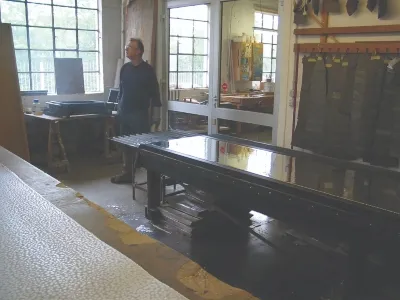
Last weekend, I was among some 850 people who attended an open house at the workshop of C. B. Fisk, Inc., in Gloucester, Massachusetts. The event showcased the company’s Opus 166, a three-manual, fifty-four-stop organ built for Church of the Little Flower in Coral Gables, Florida, and much of the organ was set up and playable. The crowd included twenty-eight people from the church who flew to Logan Airport and traveled to Gloucester by bus. It was a joy to see such wide interest in the workshop, the organ, and what’s involved in building such a thing.
I have been in and out of organbuilding workshops across the United States and Europe since I was about thirteen years old, and I have always felt that the existence of such places in this age of electronic distractions and short attention spans is magical. Many of the people present last Saturday learned about the event from local newspapers (it was featured on the front page of the Gloucester Daily Times), had never experienced a pipe organ up close, and certainly had never thought about what is involved in building such a thing. Fisk personnel gave hourly tours of the shop, explaining how metal is cast, cut, and soldered to make pipes, how windchests work, how the organ is laid out, and what it is like to play. Concert organist and associate professor of organ at the Eastman School of Music Nathan Laube was present, presiding at the organ’s detached console and graciously encouraging the crowd’s interest, especially that of several young people who seemed deeply interested in learning to play.
C. B. Fisk, Inc., was founded in 1961 by Charles Brenton Fisk (1925–1983). Charlie originally intended a career in nuclear physics and started studying at Harvard University. During World War II he worked under Robert Oppenheimer at Los Alamos, but as he continued his education after the war, his interests swerved to building pipe organs. He was one of the first Americans to build significant mechanical-action organs in the twentieth century, including the first modern four-manual tracker organ in the United States built for Harvard University in 1967. Charlie’s career was shorter than Fritz’s, but still he brought the company through Opus 97.
Charlie was involved in the planning of the firm’s Opus 98, a thirty-stop, two-manual organ for the First Presbyterian Church of Evansville, Indiana. He first visited the church in 1980, but the contract was signed in 1984, four months after Charlie’s death, a remarkable expression of the church’s trust in the Fisk team. Sixty-eight organs later, the firm is flourishing with a large staff and a beautifully equipped workshop.
There are seven Fisk “lifers” who worked personally with Charlie and are still around forty-three years after his death. Steve Kowalyshyn works in the shop part time; Steve Dieck, previous president of the firm, is still chairman of the board and lives in Japan. Linda Cook and David Pike retired from full-time work last year to winter in Costa Rica and plan to work in the shop part time in summers. Brian Pike still works full time. Bob Cornell retired last year, but still comes in to help with IT problems, and Charles Nazarian is responsible for the visual design of Fisk organs. Charlie Fisk’s memory is present in that workshop, influencing the ethic of the place and the quality of the instruments.
Devotion
Michelangelo (1475–1564) was still chipping away at Carrara marble six days before his death at the age of eighty-eight, and the Rondanini Pietà was left unfinished. During his extraordinarily long career, Michelangelo produced about two hundred sculptures and paintings, but the numbering is a little misleading if the ceiling of the Sistine Chapel counts as one. Michaelangelo’s David is seventeen feet tall and weighs eight and a half tons; that was not produced in a day. It is mind-boggling to imagine the weight of the original stone before everything except David was removed—it must have been close to twenty tons. It is even harder to imagine how the stone was moved from a steep hillside in Carrara, site of the famous quarry, some eighty miles to Florence where Michelangelo worked.
Wendy and I spent a week in Tuscany a couple years ago where we saw Michelangelo’s David and magically found twenty minutes alone early one morning with his Pietà in the Museo dell’Opera del Duòmo adjacent to the famous cathedral (duomo) in Florence. We also visited the quarry at Carrara to see first-hand what the terrain is like. We saw massive modern machinery used to cut and move stone, and great spaces filled with loaded trucks, the weight and dimensions of each stone marked clearly on the side. We did not see a stone the size of a house on a wooden sledge drawn by a huge procession of oxen and men, and we did not see such an exultation trying to cross a river or go up a hill. They must have really wanted to move those stones to take on such an endeavor.
We stopped our car in an open space paved with chips of marble, and I pocketed a couple apricot-sized pieces that now sit on my desk. They are little keepsakes that remind me of that trip (and the marvelous Sangiovese wines), but more, they remind me of the procession of great artists whose lifelong devotion to their passions have bequeathed us the heritage of architecture, visual arts, and music that are such an important core to our beings.