The Use of Heels in Pedaling Johann Sebastian Bach’s Organ Works
Since the beginning of the Organ Reform Movement in the immediate post-World War II period, flat seventeenth- and eighteenth-century-style North and Central German pedalboards have been gradually reintroduced to organ construction, causing a radical change in the pedaling and interpretation of the organ works of Johann Sebastian Bach (1685–1750). Bach’s organs have pedalboards with fewer keys, typically from C1 to C3 or D3, and are considerably wider and shorter than modern American Guild of Organist or Wesley-Willis style pedalboards, with a compass of C1 to G3.
Starting in the 1950s, organists also began a widespread examination of period sources, causing many to rethink the way they approached their pedal technique as it applies to the performance of Central and North German Baroque music. This examination brought a much-needed rethinking of how Baroque articulation is applied to Bach’s organ music, concerning both hands and feet. However, over time, organists became increasingly dogmatic in their approach to pedaling the works of Bach, insisting that only toes be utilized to create historically informed interpretations. A notable example of bias against the use of heels in pre-Romantic era music can be found in the popular Organ Technique: Modern and Early by George Ritchie and George Stauffer, where heels are not offered at all as an option in Baroque music in either their exercises or musical examples.1 Instead, both only include all-toe style pedaling.
Recent scholarship is beginning to take a more nuanced approach by applying what we know about Bach’s pedal technique from his organs, what his students and contemporaries wrote about pedal technique, and the shoes of his era. In his 2012 book, Bach’s Feet, David Yearsley addresses the use of heels directly in the introduction:
The most often posed of these questions asks whether Bach used his heels, or just his toes. My answer is that he did use his heels though not nearly as often as in modern pedal technique. There are many documented examples of the use of the heel in the eighteenth century in the Bach circle, especially in passages either directly transcribed from instrumental music or composed in imitation of it. Given this evidence, it would be hard to maintain that Bach involved his heels only in
exceptional cases. . . .2
I agree with Yearsley and further argue that the almost complete prohibition of the use of heels in the organ music by Bach contradicts both historical evidence and ergonomic necessity to create musical effects and facilitate greater ease of performance. To support and apply these outlined period principles, I will examine two instruments closely associated with Bach, deconstruct two treatises, inspect shoes from the Baroque era, and last, look at two musical examples from Bach’s middle and late periods of composition that indicate places that benefit from the use of heels through musical clues.
Bach’s instruments give us a first-hand look into how he would have performed and how his playing changed during his lifetime, as well as how the design of Central German organs evolved throughout his career. Sandra Soderlund remarks on Bach’s instrument in Arnstadt, built by Wender in 1703, that given the height and short length of the keys, Bach must have used almost exclusively toes during this period.3 His compositions in Arnstadt point us to this conclusion, with a notable example being the pedal solos in his Praeludium et Fuga in C Minor, BWV 549, which can be executed exclusively with all toes. The compositions of his contemporaries and teachers Dieterich Buxtehude (c. 1637–1707) and Georg Böhm (1661–1733) also bring us to the conclusion that all-toe pedaling was the norm at the end of the seventeenth century and into the beginning of the eighteenth century.4
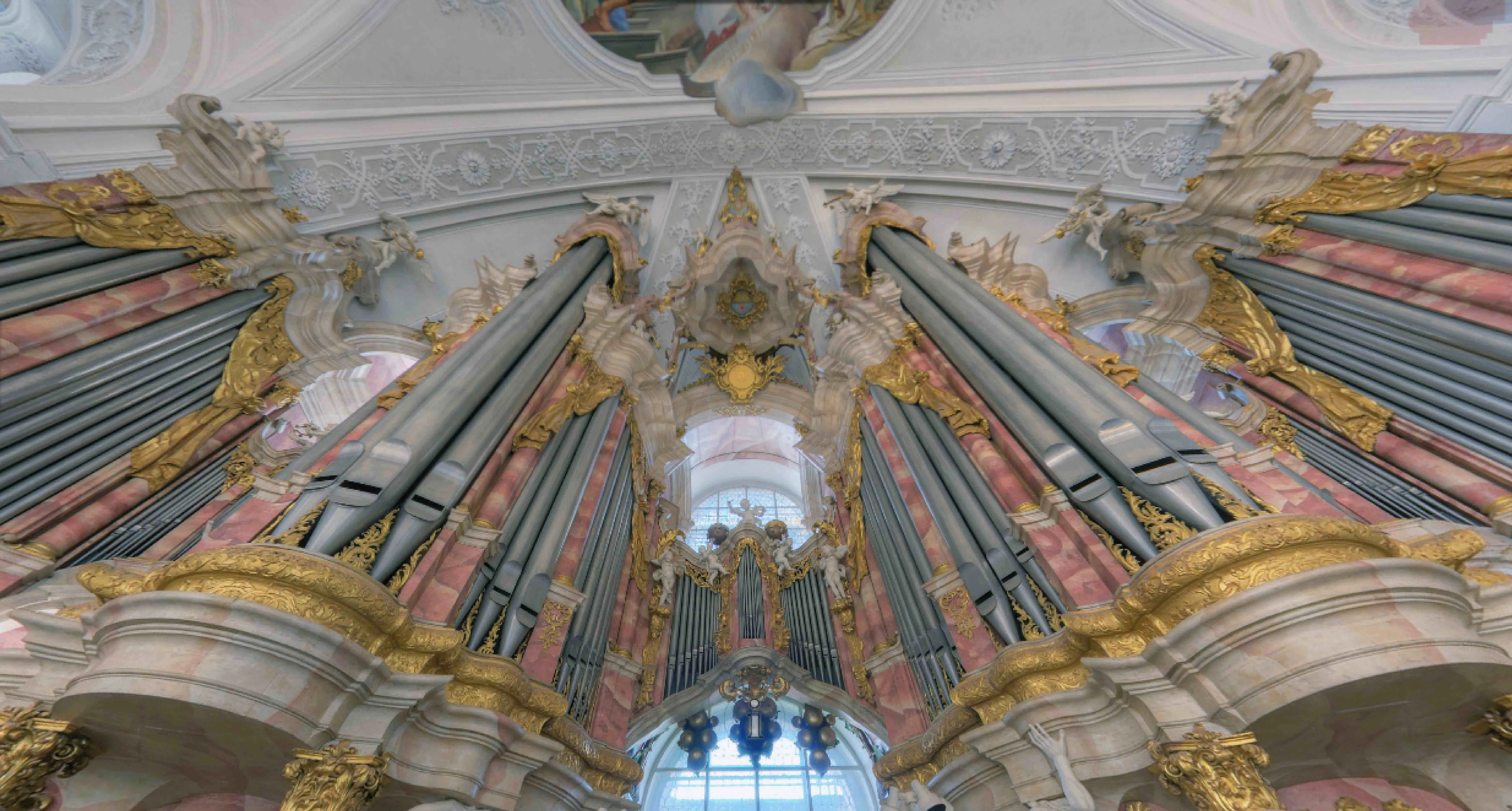
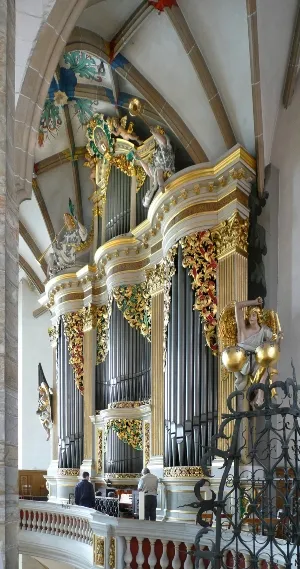
Toward the end of his life, Bach and Gottfried Silbermann conducted the final inspection of the 1746 Hildebrandt organ at Saint Wenzel Church in Naumburg.5 This instrument shows the extent of the development of Central German tonal design and pedalboard construction. While the compass remains the same, the length of the keys allows for comfortable use of heels and toes, reflecting the increased contrapuntal demands called for by Bach and his contemporaries.
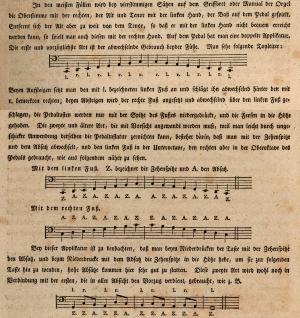
There are two period treatises that include suggestions for the use of heels while pedaling that have a direct connection to J. S. Bach. The first was written by Johann Christian Kittel (1732–1809), one of Bach’s last known pupils, studying with him in 1748. Kittel’s work, Vierstimmige Choräle mit Vorspielen (Four-voiced Chorales with Preludes) contains the most important direct knowledge we have regarding Bach’s pedaling during his later years.6 In Kittel’s preface, he includes several examples of scales and exercises for pedals with indications for both alternate toe style pedaling, as well as heel-toe style pedaling (Figure 1).7
The first example is a C-major scale using the alternate toe method of pedaling (left, right, left, right, etc.). However, Kittel provides a second, “older” way to pedal, giving us the same scale in both feet. By naming the heel-toe method of playing as the “older way,” Kittel indicates to us that at the time of publication (1803), the use of heels belonged to the previous Baroque era.9 In Figure 1, heels are noted with an “A” for Absätze (heels, in German), and toes are notated with a “Z” for Zehe (toes, in German). In his final example, Kittel provides a short excerpt of a typical period bass line that uses both heels and toes. In his explanation right before the excerpt, he recommends the use of shoes with high heels to better facilitate heel-toe pedaling and goes so far as to state that the ideal method of pedaling is one where the player uses a mix of alternate toes and heel-toe pedaling. This leads me to believe that he is chronicling the techniques of his late master, J. S. Bach, to pass on his knowledge to a new generation.
The second treatise in the Bach circle concerning pedaling was written by Johann Samuel Petri (1738–1808), who was a student of Wilhelm Friedemann Bach (1710–1784) from 1762 until 1763.10 Wilhelm Friedemann was the most proficient organist of all of Bach’s surviving sons and was the impetus behind J. S. Bach’s six trio sonatas for organ. Friedemann began his organ studies with his father in Weimar and continued them for nine years in Leipzig before taking his first position in Dresden. Petri’s Anleitung zur Practischen Musik (Introduction to Practical Music, 1767/1782) is the closest pedagogical publication for the organ chronologically to the life of J. S. Bach that has a credible connection to him.11 In his treatise, Petri includes various examples of scalar exercises for the pedals, some of which practice all-toe pedaling, and others that include heel-toe pedaling (Figures 2 and 3).12 In this treatise, Petri uses a numbered system to notate his pedaling with “1” corresponding to the right toe, “2” to the left toe, “3” to the right heel, and “4” to the left heel.
The virtuosity required to perform these exercises and the large-scale inclusion of heels as part of one’s pedal technique is striking. Considering that Petri published this treatise only a few years after studying with Wilhelm Friedemann Bach, we can infer that some, if not most of these techniques were inherited from Petri’s time working with Bach’s son. Furthermore, we can surmise that Wilhelm Friedemann learned these techniques from his late father, meaning that J. S. Bach must have incorporated some use of heels in his pedal playing from at least his time in Weimar onward.
The typical shoe in eighteenth-century Central Germany supports the use of heels while playing the pedals. It was made of leather with a 2-1⁄2-inch heel that would have been malleable enough for effective pedal playing and general comfort.15 An example of this type of shoe that was typically worn by the middle and upper classes, complete with a silver buckle, is described in the documents for J. S. Bach’s estate after his death.16 Its construction was not too dissimilar to modern organ shoes, both in materials and shape. Since Bach’s shoes would have had a heel large enough for heel-toe pedaling, it is a reasonable possibility, given the historical evidence previously mentioned, that in certain cases, Bach himself must have employed the technique.
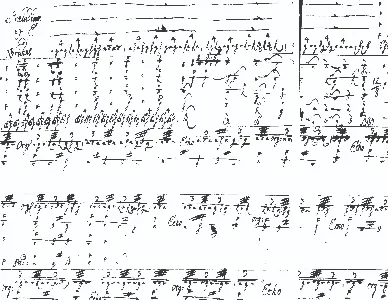
Bach’s organ works contain for us the greatest evidence that heels are at times necessary for the effective performance of his compositions. This is especially true when he includes the use of slurs in his pedal lines. The use of slurs in Praeludium et Fuga in B Minor, BWV 544, composed during his Leipzig period,17 is an example of heels being needed to create the desired musical effect. In BWV 544, we find slurs in measures 7 and 9 in the pedal, connecting the two sets of thirty-second notes (Figure 4, page 14).18
We see this figuration return in measure 33 with no slur. However, given the idea of normalizing the pedal articulation and the placement of the figuration in the pedalboard, the use of heels on the thirty-second notes is the most advisable choice (Figure 5).20 In measure 64, we see this same figuration in inversion, potentially indicating another possible place for the use of heels (Figure 6).22
The Neue Bach Ausgabe also includes slurs for the grace notes in measures 8 and 10.24 This is curious, as they are not included in the manuscript. However, slurring these grace notes does punctuate the appoggiatura,25 making the dissonance of the grace note more accented than the resolution of the dotted quarter. In the end, it is the performer’s choice as to what they wish to emphasize. However, if one wishes to highlight the appoggiaturas, use of the heels should be encouraged.
Toccata in C Major, BWV 564, was composed before Bach’s time in Leipzig,26 possibly in Weimar (given its Italian, ritornello-form influence), and includes slurs, running sixteenth-note triplets, and thirty-second notes in the pedal solo (Figure 7) in measures 13–32.27 Given the wide extremities in the pedalboard and speed at which the toccata is executed, David Yearsley infers that the use of heels is recommended for this excerpt, with a secondary option being generous use of foot crossing with all toes.28 Like Kittel, I believe that a combination of the two provides the best result, both in this work and other middle to late period Bach works. By being too rigid in one’s approach and not including heels in this display of pedal virtuosity, one could leave themselves open to a higher chance of inaccuracy and subsequently provide a diminished musical product by not being able to keep the figurations flowing forward.
The use of heels in J. S. Bach’s organ works has needlessly been a contentious issue among organists for the past seventy years. While not advocating for a wholesale reintroduction of Romantic era heel-toe pedaling as we saw before the Organ Reform Movement, I believe it is wise to consider the organs Bach played, his students’ and contemporaries’ remarks, the design of eighteenth-century shoes, and music itself before making blanket statements that heels are ill advised in historically informed interpretations of Bach’s music. In the future, I hope that organists look at the resources and consider a less dogmatic approach that may be closer to a realistic historical interpretation as to how Bach pedaled his works.
Notes
1. George Ritchie and George Stauffer, Organ Technique: Modern and Early (Prentice Hall, 1992), Part II.
2. David Yearsley, Bach’s Feet: The Organ Pedals in European Culture (Cambridge University Press, 2012), pages 16–17.
3. Sandra Soderlund, How Did They Play? How Did They Teach? A History of Keyboard Technique (Hinshaw Music, 2006), pages 146–147.
4. David Yearsley, “In Buxtehude’s Footsteps,” Early Music 35, number 3 (August 2007), pages 339–353.
5. Christoph Wolff and Markus Zepf, The Organs of J. S. Bach: A Handbook (University of Illinois Press, 2012), pages 74–77.
6. Johann Christian Kittel, Vierstimmige Choräle mit Vorspielen (Johann Friedrich Hammerich, 1803), pages 3–4.
7. Ibid.
8. Ibid.
9. Ibid.
10. Soderlund, pages 506–508.
11. Ibid.
12. Johann Samuel Petri, Anleitung zur practischen Musik vor neuenangehende Sänger und Instrumentspieler (Johann Christoff Wirthgen, 1767), pages 115–122.
13. Ibid.
14. Ibid., pages 123–126.
15. Yearsley, Bach’s Feet: The Organ Pedals in European Culture, pages 247–256.
16. Ibid., pages 252, 255.
17. Peter Williams, The Organ Music of J. S. Bach (Cambridge University Press, 2003), pages 96–99.
18. Johann Sebastian Bach, Praeludium in Organo pleno, pedale, score, circa 1727/1731, private collection, page 1.
19. Ibid.
20. Ibid., page 2.
21. Ibid.
22. Ibid., page 4.
23. Ibid.
24. Johann Sebastian Bach, Orgelwerke, volume 5 (Bärenreiter-Verlag, 1972), page 198.
25. Williams, pages 96–99.
26. Ibid., pages 150–153.
27. Johann Sebastian Bach, Toccata C. Pedaliter di Giov. Sebast: Bach, score, 1725, Staatsarchiv Leipzig, pages 1–2.
28. Yearsley, Bach’s Feet: The Organ Pedals in European Culture, pages 134–136.
29. Bach, Toccata C. Pedaliter di Giov. Sebast: Bach, pages 1–2.
Bibliography
Bach, Johann Sebastian. Orgelwerke, volume 5. Kassel, Germany: Bärenreiter-Verlag, 1972.
Bach, Johann Sebastian. Praeludium in Organo pleno, pedale. Manuscript score, circa 1727/1731. Private collection.
Bach, Johann Sebastian. Toccata C. Pedaliter di Giov. Sebast: Bach. Manuscript score, 1725. Staatsarchiv Leipzig.
Barnes, William H. The Contemporary American Organ. Glen Rock, New Jersey: J. Fischer & Bro., 1964.
Kittel, Johann Christian. Vierstimmige Choräle mit Vorspielen. Altona, Hamburg: Johann Friedrich Hammerich, 1803.
Laukvik, Jon. Historical Performance Practice in Organ Playing: An Introduction Based on Selected Organ Works of the 16th–18th centuries. Translated by Brigitte and Michael Harris. Stuttgart: Carus, 1996.
Petri, Johann Samuel. Anleitung zur practischen Musik vor neuenangehende Sänger und Instrumentspieler. Lauban: Johann Christoff Wirthgen, 1767.
Ritchie, George, and George Stauffer. Organ Technique: Modern and Early. Englewood Cliffs, New Jersey: Prentice Hall, 1992.
Soderlund, Sandra. How Did They Play? How Did They Teach? A History of Keyboard Technique. Chapel Hill, North Carolina: Hinshaw Music, 2006.
Williams, Peter. The Organ Music of J. S. Bach. Second edition. Cambridge: Cambridge University Press, 2003.
Wolff, Christoph, and Markus Zepf. The Organs of J. S. Bach. A Handbook. Translated by Lynn Edwards Butler. Urbana, Illinois: University of Illinois Press, 2012.
Yearsley, David. Bach’s Feet: The Organ Pedals in European Culture. Cambridge: Cambridge University Press, 2012.
Yearsley, David. “In Buxtehude’s Footsteps.” Early Music 35, number 3 (August 2007): pages 339–353.