On Teaching: The Harpsichord, an Introduction, Part 4
The harpsichord: an introduction, part 4
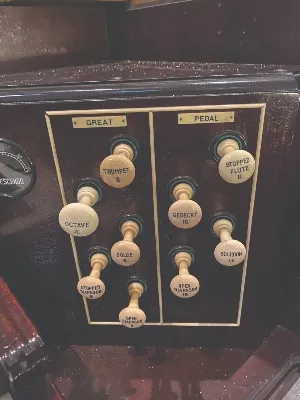
I begin by writing about the relationship between sets of strings on a harpsichord and the number of stops. There is often a one-to-one correspondence between the two: each stop available on a harpsichord is one set of strings being plucked at a particular place along the length of those strings, producing a particular sort of sound. This is analogous to the pipes of an organ stop. Understanding the relationships between sets of strings and stops or different sounds is crucial for playing and can avoid confusion, especially in getting to know a new instrument.
It is logistically difficult for there to be more than two sets of 8′ strings on a harpsichord. It can be done, but it involves drilling holes through the bridges and other labor-intensive techniques, and it is extremely rare for any builder to consider it worthwhile. So the two-8′-stop design described last month, with the two sets of strings in pairs on either side of the gap where the jacks sit, is standard. Since a set of jacks cannot occupy the same space as another, they inevitably pluck their respective strings at different points, producing different timbres. However, it is entirely possible in theory to have more than one set of jacks plucking the same set of strings in different places, making different sounds. This is rare but not unheard of. On inspecting a harpsichord that is new to you, if you believe that you see three sets of jacks addressing two sets of 8′ strings, you will certainly observe that two of them are plucking the same strings as each other in different places. Because they are plucking in different places, they make different sounds, even on the same strings: they constitute two different stops. You might encounter a harpsichord with only one set of 8′ strings, but with two sets of jacks playing those strings. That constitutes two different sounding. The timbre is not intrinsic to the string, but is a result of several factors of which the placement of the plucking along the length of the string is the most important.
However, two stops set up on the same strings at different points cannot play at the same time. So to a large extent the reason for having two sets of 8′ strings, each with its own set of jacks, is to permit the two 8′ stops to be used either separately or together. Those two stops can create three sounds—each of them alone, and the two of them together, assuming that the mechanism is set up to allow that.
Keyboards
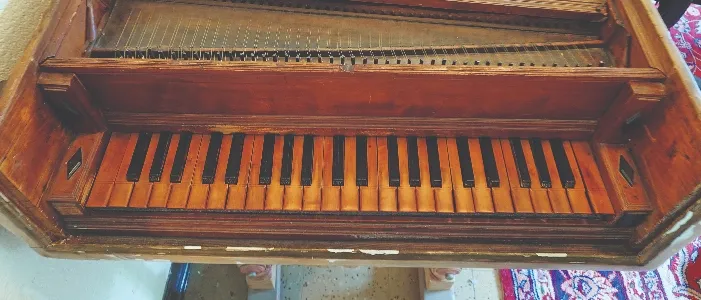
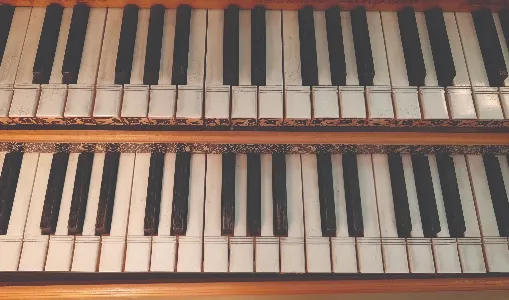
There are many one-manual harpsichords; they are somewhat more common than doubles. (Three-manual harpsichords are exceptionally rare. I have seen only one and heard of one other.) The number of manuals is a separate matter from the number of stops or the nature of those stops. No matter how many sets of strings there are, how many sets of jacks, which jacks pluck which strings, it can all be built to play from one keyboard, or to be split among two. When a single-manual harpsichord has a relatively large number of stops—2 x 8′ + 4′, or very rarely a 16′ or 2′ as well—those stops can be played separately or combined to produce as many different sounds as if they were part of a two-manual instrument.
However, one cannot change sounds as quickly on a single as on a double, and you cannot use two sounds at the same time, one in each hand. So it is not right to say, “I want/need a double-manual harpsichord because I want/need more colors and different sounds.” But it can be right to say, “I want/need a double because I want/need to change sounds by changing manuals or to play different parts of the texture of a piece on different sounds at the same time.” Perhaps only 5% of the canon actually requires two manuals; Bach’s Goldberg Variations and some of the eighteenth-century French repertoire are notable examples. The pieces or movements that require two manuals are ones in which lines cross, so that having each hand on a different keyboard with a different sound is necessary. The artistic intent of these pieces usually involves something interesting about the interaction of the two different sounds, beyond just the logistics of accounting for all notes. A double can also be useful for continuo playing if, for example, you want to make the bass line in the left hand stronger than the added notes and chords in the right hand.
In addition to sets of strings and jacks, there are certain accessories that are found on some harpsichords that are, in effect, additional stops. They create different stops by altering something within existing stops. The most common of these by far is a device that pushes soft pads (usually of either leather or felt) up against all strings of one set. This makes the sound more mellow, “plucky,” and inclined to die away quickly. The correct name for this device is “buff stop,” where “buff,” essentially the same word as “beef,” refers to the leather of the pads. But it is now more commonly called the “lute stop.” This acknowledges that the sound of a set of strings with pads of this sort applied is somewhat reminiscent of the sound of a lute, though not so much so that one would be mistaken for the other. The buff stop was very likely invented in the first place to try to evoke the sound of a lute. A buff stop can be found on either of the two choirs of 8′ strings, if the instrument has two 8′ choirs, but not on both. (Fitting buff pads to the ends of both sets of strings would be extremely tricky, if not impossible.) The artistic effect of a buff stop is a rather different thing depending on whether the underlying 8′ sound is flutier or reedier. But in either case, it is a sound that listeners often react to as being entrancingly beautiful, though it is also somewhat polarizing: some people just do not like it!
If a harpsichord has two 8′ stops, they are different in timbre. This is scientifically necessary, but the question of how they relate to each other in volume is more open. Within certain limits, the straightforward decibel volume of harpsichord notes is determined by how long, wide, thick, stiff, or flexible the plectra are. The process of shaping plectra to be the length, width, and so on that will make the sound come out in the desired manner is called “voicing.” I will return to discussing voicing later. For the present purposes, the point is that when there are two 8′ stops on a harpsichord, they may have been voiced to relate to each other in volume in any number of different ways. The process of discovering how they relate to each other is one of playing and listening. It is usual for the stop that plucks closer to the player and thus closer to the ends of the strings to be at least a little bit quieter than the stop that plucks farther from the player, closer to the middle of the strings. Since the former is also the more nasal or reedy-sounding in timbre, it often comes about that with that stop being quieter, the two stops balance each other well. The reediness compensates to the listener’s ears for the slightly lower volume. But all of this sounds a bit different from one harpsichord to another, and all needs to be explored by listening. The relative voicing of two 8′ stops also goes a long way toward determining the timbre of the 2 x 8′ sound when the two are drawn together.
On two-manual harpsichords with two 8′ stops, the stop closer to the ends of the strings (“quintadena”) is always played natively from the upper manual. The stops that are farther from the ends of the strings (“gedeckt”) are played from the lower keyboard.
Couplers
Most two-manual harpsichords have couplers. A coupler on a harpsichord is essentially the same that it is on an organ: a device or system for making one keyboard play from another. This is a concept that is simpler in its execution on the harpsichord than on the organ. Every harpsichord coupler is mechanical, and for reasons of weight and leverage, every harpsichord coupler involves playing the upper manual from the lower, not the reverse. There are no couplers that are not at the unison. When a coupler is drawn, the possible alternation of sounds between the keyboards is between all the drawn stops found on the lower keyboard and a smaller subset of the drawn stops found on the upper keyboard. Under these circumstances, the lower keyboard is always the louder of the two, though not necessarily by much.
Harpsichord couplers are engaged and disengaged by moving one or the other of the keyboards in and out. The internal mechanism is somewhat different in couplers that work by moving the upper keyboard and ones that work by moving the lower. In systems in which the upper keyboard is moved in and out, the upper keys actually move or play when the coupler is engaged and the lower manual is played. In systems in which it is the lower keyboard that moves in and out, when the coupler is engaged the lower manual plays the upper-manual stops without moving the upper keys. The system in which it is the upper keyboard that moves in and out is more common. As with so much else, this can be figured out empirically with any harpsichord that you encounter. To start with, very likely whichever keyboard moves in and out will have some sort of knobs or other handholds at each end.
Whenever one plays on two stops at once, whether through coupling or through having drawn two or more stops on a given keyboard, one may notice that on each key, the stops that are playing do not all pluck their strings at exactly the same time. If one presses a key down very slowly one can hear the stops playing one after another rather than simultaneously. This is as it should be: if two quills pluck at exactly the same time, the resistance of the key is so great that it is close to unplayable. But the two or three stops should pluck closely enough behind one another that in normal playing they seem to be sounding at the same time. If a (two or more stop) note is much stiffer or harder to play than the notes around it, it may be that the two or more stops have been inadvertently adjusted to play at exactly the same time. You can test for this by pressing the key down very slowly, maybe even supporting it from beneath to exaggerate the slow motion. If this way one cannot separate the plucks, then some technical work is required. On the other hand, sometimes with two or more stops engaged, one will notice in ordinary playing that on a particular note the different stops fire off separately: that they can be heard as different notes. This also requires the services of a harpsichord technician.
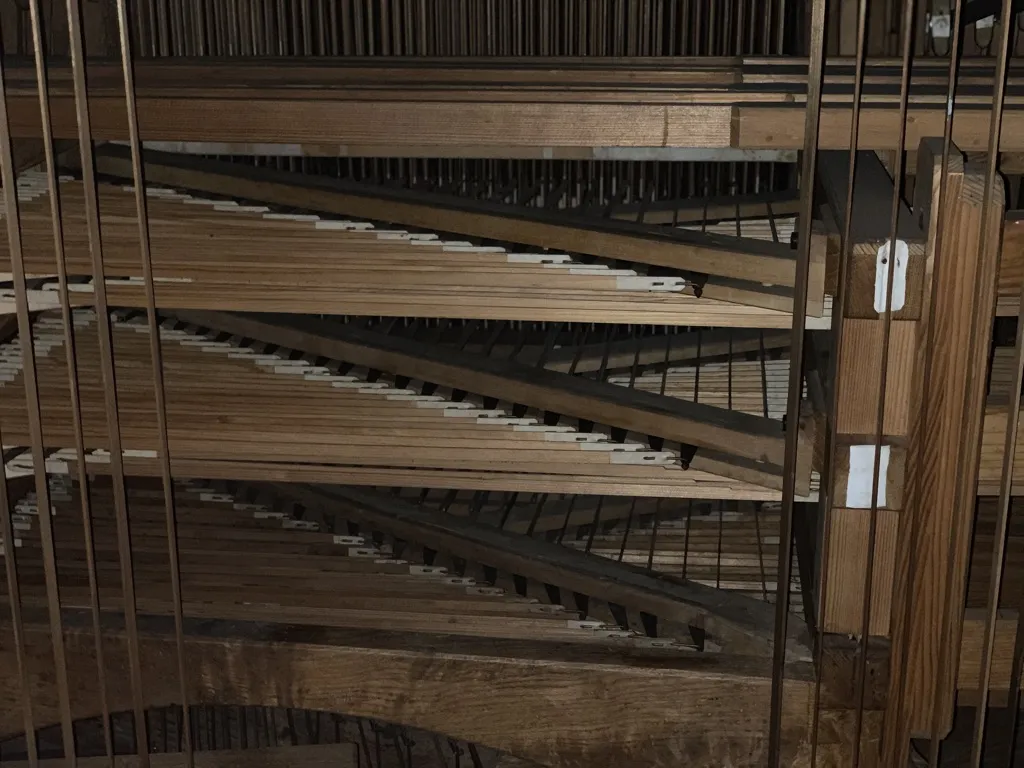
On any instrument with stops, there must be some way of engaging and disengaging those stops. There are a wide variety of those with the organ—systems that are radically different from one another. The way the stop action works inside a harpsichord is always the same. (As I described it in an earlier column: “The nature of the stop mechanism in harpsichords is this: each whole row of jacks can be moved very slightly from side to side, so that the plectra either are or are not under the strings.”) So there has to be something that the player can do to move those rows of jacks mounted in their registers. This can be simply that the registers project out the side of the case and can be pushed and pulled. Or it can be that there are levers attached to the registers that project through the case somewhere—almost always in the front, right above the keyboards. These levers are usually not labeled. One must figure out which lever puts which stop on and off, and indeed which position of each lever is on, and which is off. The good news is that there cannot be more than a few stop controls on any one harpsichord, so figuring this out is not a major chore.
On some double-manual harpsichords, the upper manual has only one available sound, the 8′ stop closest to the player. This is actually quite common. In this situation, there may not be a control for that stop that is operable by the player. After all, it is unlikely that we would need to use that upper manual as a silent keyboard. (There is always a mechanism inside the instrument for setting exactly where that upper manual register is positioned. This can be adjusted, but that is a matter of instrument building or technical work, not playing.) If there is a buff stop, there will be some sort of control to turn it on or off.
There are some harpsichords, almost exclusively from the early twentieth century through about the 1960s, that have pedals to change the stops. This was never a regular feature of harpsichords in the historical harpsichord era. It was developed as a regular practice in the early days of the twentieth-century harpsichord revival because certain aspects of the musical aesthetic of that time led to a bias in favor of changing stops often while playing. If you do encounter an instrument with this sort of design, the function of each pedal can be discovered by trial and error.
To be continued