"Seeing" Olivier Messiaen's Music
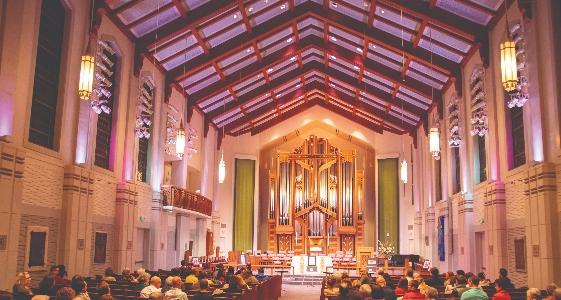
Olivier Messiaen (1908–1992), a musical synesthete, recorded observations of his experiences in so much detail that one would assume the role of synesthesia carried great influence in Messiaen’s compositional language. To provide my audience a glimpse of his synesthetic world and yet another entry into his harmony, I performed Messiaen’s La Nativité du Seigneur (1935) at Christ Church Cathedral (Episcopal), Cincinnati, Ohio, on January 28, 2023, with programmed lighting in the space. The lighting changed in real time according to my analysis of what colors Messiaen associated with La Nativité. Additionally, I worked with an artist to realize these color collections into iconography reflecting the subject matter of each movement. This article outlines the importance of Messiaen’s synesthesia, how I formulated my analysis, and examples of the lighting and artistic representations.
Messiaen’s seventh volume of Traité de rythme, de couleur, et d’ornithologie (1949–1992) emphasizes the importance of his condition, as it contains detailed delineation of all the specific color combinations in tandem with their respective modes and transpositions. Notable elements of Messiaen’s condition include that the colors associated with his harmonies remained unchanged throughout his life,1 the condition shaped his musical output both consciously and subconsciously,2 and color remained the primary aspect on how he perceived and assessed music.3 Messiaen became more and more vocal about his condition and its effect on his music throughout his life.
Although his earlier musical works do not discuss color and his Technique de mon langage musical (1944) only mentions color briefly as a side note,4 his later works become more expressly specific about the colors that shaped or inspired Messiaen’s output. Couleurs de la Cité Céleste (1963) contains a note from Messiaen stating the influence of his coloristic visions on the work.5 Other compositions continued to present composer notes and prefaces6 on color influence until finally culminating in his seventh volume of Traité de rythme, de couleur, et d’ornithologie, which, according to Yvonne Loriod, could have been written as early as 1970–1975.7 In this final volume, not as yet translated from French, Messiaen provided painstaking detail to the colors he associated with sound collections. Not only does each mode have a color collection associated with the pitch collection, but each unique transposition has unique color collections as well, sometimes masking the dominant color of the mode.8 I share much of Håkon Austbø’s opinion in the introduction of his article, “Visualizing Visions,” that despite the subjectivity of Messiaen’s condition or experience, due to the nature of the detail he left us, we could explore these colors for more insight on the inspiration for Messiaen’s creative output.
Joseph Edward Harris, in his doctoral thesis, explored the concept of musique colorée and what constitutes it.9 Harris theorized that pieces before the 1950s do not have the same coloristic influences as pieces written after. However, the preface of La Nativité (1935) is Messiaen’s first time outlining and acknowledging the organization of his modes of limited transposition. Since this became the basis of color in his later treatise, one cannot claim his experience had zero effect on his compositions before the 1950s. In Jon Gillock’s compilation and translation of Messiaen’s CD cover notes, we find more valuable references from the composer serving as a demonstration of the importance of color even during the beginning of his second compositional period. In describing “Les mages,” movement eight from La Nativité, Messiaen wrote, “Observe the iridescence of the ‘harmony on the dominant’: one passes from green and gold to a velvety blue, from deep violets alternately with orange.”10 Thirty years later, these very color combinations are described in the chords used, as outlined in his Traité.11 The following analysis of La Nativité focuses primarily on the basic modal collections or chords on the dominant in each piece. In the case where Messiaen left his modal language entirely, whatever factors of the music lend themselves to conditions of musique colorée, as outlined in Harris’s thesis,12 determine the focus on analyzing those aspects.
Most of the analysis in La Nativité could be conducted by modal analysis. I primarily chose this method due to the importance of La Nativité being the first work Messiaen published with explicit descriptions of his modes. Messiaen predominantly uses modes 2 and 3 in his work. However, modes 4 and 6 make appearances as well.13 Additional techniques include analyzing instances of the “chord on the dominant.”
The movements fitting neatly within the modal harmony are “La vierge et l’enfant,” “Les bergers,” “Les enfants de Dieu,” and “Desseins éternels.” “La vierge et l’enfant” begins with an A section in mode 21.14 The harmony in the manuals shifts through various transpositions of mode 2 toward the end of the A section. The entire B section does not deviate from mode 61. When the piece returns to A′, the harmony also returns to mode 2. This analysis is confirmed by Messiaen stating in his preface that the first piece uses modes 2 and 6. “Les bergers,” “Les enfants de Dieu,” and “Desseins éternels” followed a similar analytical procedure and were relatively simple to delineate.
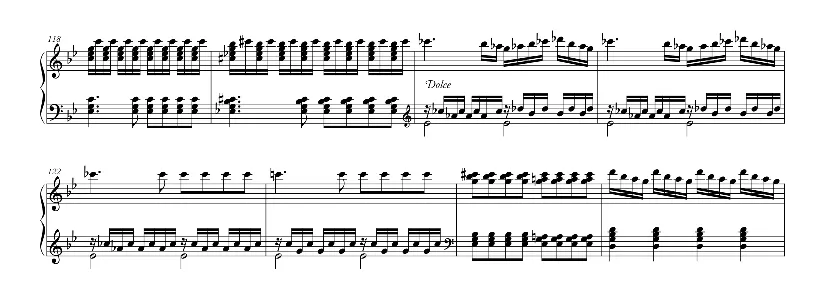
“Les anges,” with the quick rhythm of its notes, limits the music from the parameters of musique colorée. I decided to loosely analyze the modal collection that had anomalies that made musical sense. For example, in Figure 1, notice how the opening phrase could be analyzed as mode 31 with the D-flat an anomaly in measure 4, the low F-natural. However, analyzing the passage as mode 32 causes the high B-flat to be an anomaly, as well as the low G-flat in measure 4. I chose mode 32 since the B-flat holds a musical quality of an “escape tone,” and the G-flat acts as a chromatic voice leading to the F in measure 4. Using these decisions, I worked through the movement to find most of the piece is in various transpositions of mode 3, with an occasional glimpse of mode 2. This movement shows Messiaen’s flexibility within his modal language and depicts the transient nature of the celestial beings.
However, he does not refer to this piece at all in his preface as it pertains to his modes. He also mentions how the high register of sounds washes colors out. One can deduce that “Les anges” is less about the color and more about the rhythmic texture and effect of light, reminiscent of angels.
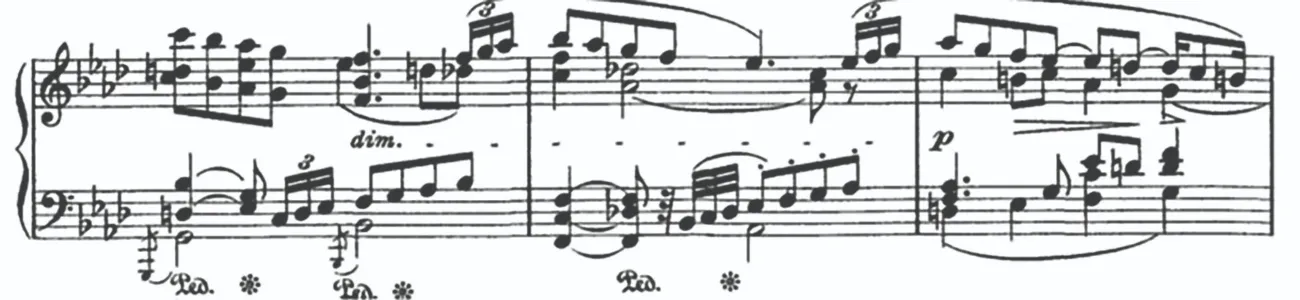
In “Les mages,” we observe a different texture of a sustained chord in the left hand with punctuating chords in the right hand to accompany a melismatic line in the pedal. The most fascinating example one finds here is the use of the chord on the dominant as Messiaen describes in his cover notes of a CD recording of La Nativité.15 He also refers to the technique in his preface and states that it is used in the eighth piece, “Les mages.” By the time Messiaen described this chord in Traité he called the chord “transposed inversions on the same base note.”16 Using this and the fact that the left-hand chord harmony follows the parameters of musique colorée, the analysis of this piece is centered according to the harmony on the dominant as it is demonstrated in the left hand, and presents the color shifts in accordance with the inversions. During the course of the movement the left hand cycles through eighteen different spellings and inversions of the chord on the dominant, each one with its unique color description as found in his treatise. In Figure 2, the first chord presented in Messiaen’s treatise is the one found in “Les mages” as described from the CD notes: shifting through gold, green, and blue.17 This movement presents the most color shifts, which presumably is the closest rendition to Messiaen’s experience.
“Dieu parmi nous” contains all the textures as found in the previous movements. Most of the work, being quite fast in tempo, required a similar analysis to “Les anges.” However, the thematic material fits the modal harmonic molds. The opening descending theme is in mode 41, and the pedal descent is in mode 21. The theme on the gambe and celeste follows the specific parameters of musique colorée and is in mode 21. When the first theme returns, it is in mode 31. This analysis is confirmed by Messiaen’s own example of analysis of the opening page of this movement as seen in Figure 3.
The remaining movements were analyzed in a similar fashion as described in the previous examples. Occasionally a simple diatonic chord would be used; in these cases I would refer to a table as presented by Austbø in his article where he deduced colors associated with certain chords as determined by crossover in the modal collections.18 This technique was used in “Jésus accepte la souffrance” and in “Le verbe.”
I used two avenues of presentation: a visual light display and a collaborative project with an artist. At the first display, for the premiere of the project at Christ Church Cathedral, I performed the entire La Nativité, using the nave’s lighting system. I programmed the lighting for each movement to demonstrate the colors as described in Messiaen’s treatise and had an assistant cycle through my colors as I performed the work. In Figure 4, the lighting portrays the general colors of mode 21 as described by Messiaen: “Blue violet rocks, spotted with gray cubes, cobalt blue, dark Prussian blue, with reflections of purplish violet, gold, ruby red, and mauve, black, and white stars. Dominant color: Blue violet.”19 The goal of this lighting presentation was to show the visual shifts of Messiaen’s harmony with general colors and accent colors. In cases where the modal collections were less defined and the register of the music was high, the colors in the nave would be more washed out and bright (Figure 5).
The second avenue of presentation involved a collaboration with an artist, Olivia Wiering. We met on a weekly basis, discussing the theological significance of each portrait, how the music and modes interacted to demonstrate the subject, and the degree of freedom she could use to paint each portrait.
Olivia began by creating samples of each mode pattern as Messiaen described. In Figure 6, one sees all three transpositions of mode 2: mode 21, described earlier; mode 22, “Spirals of gold, silver, on vertical bands of brown and ruby red. Dominant color: gold and brown”; mode 23, “light green and prairie green foliage with spots of blue, silver, and reddish orange. Dominant color: green.”20
Olivia then designed a sketch of each movement and incorporated these modal patterns into her image. “La vierge et l’enfant,” as described before, used all transpositions of mode 2. In Figure 7, one can see Olivia’s portrait for the movement, where she incorporates mode 2 visually. The halo and writing with gold branches surrounding Mary is the depiction of mode 61, “Large gold letters on a gray background, with spots of orange, and green branches with gold reflections.”21 When working with the movements, such as “Les anges,” Olivia took more freedom with the design, with the modal structure less defined. Notice in Figure 8 how Olivia takes the representations of mode 3, but bends the structure to demonstrate the movement of “Les anges.” In “Les mages,” I provided Olivia a table of all eighteen chord combinations as described by Messiaen that I analyzed, and she incorporated them into a colorful landscape of the Magis’ journey, as seen in Figure 9.
Using this additional lens of Messiaen’s synesthesia to further explore La Nativité provided my audiences many different avenues to not only visually experience his harmony, but also consider the theological significance of his work. As demonstrated with the analysis and the assumption that we will never truly know what Messiaen saw, the goal of this project was not to literally translate his music into visuals, but to simply provide an avenue for the average listener to enter into Messiaen’s harmonic world. At the concert in January 2023, many of the audience members had never heard his work before, but found the experience to be meaningful with all the layers provided to help engage their senses in Messiaen’s work. Ultimately, this is the goal of the performer, to best provide a bridge from their role as an interpreter and demonstrate why they are passionate about the music they play. To see more examples of Olivia’s work or my visual analysis in video format, please visit our websites: oliviaroseillustrations.com and stellaoneillmusic.com.
Notes
1. Jonathan W. Bernard, “Messiaen’s Synaesthesia: the Correspondence between Color and Sound Structure in His Music” (Music Perception 4, no. 1, October 1, 1986), https://doi.org/10.2307/40285351, page 43.
2. Claude Samuel, Olivier Messiaen, and Felix Aprahamian, Conversations with Olivier Messiaen (Stainer & Bell, 1976), https://books.google.com/books?id=ITwIAQAAMAAJ, page 17.
3. Olivier Messiaen and Claude Samuel, Music and Color: Conversations with Claude Samuel (Portland, Oregon: Amadeus Press, 1994), http://catalog.hathitrust.org/api/volumes/oclc/28507464.html, page 63.
4. “passing reference to ‘the gentle cascade of blue-orange chords’,” Bernard, “Messiaen’s Synaesthesia,” page 41.
5. Håkon Austbø, “Visualizing Visions: the Significance of Messiaen’s. . .,” Music + Practice 2 (2015), https://www.musicandpractice.org/volume-2/visualizing-visions-the-significance-of-messiaens-colours/.
6. Ibid.
7. Ibid.
8. Bernard, “Messiaen’s Synaesthesia,” page 46.
9. Joseph Edward Harris, “Musique Colorée: Synesthetic Correspondence in the Works of Olivier Messiaen.” Ph.D., The University of Iowa. Accessed March 4, 2022. https://www.proquest.com/docview/305168146/abstract/7C91F4DFBA484512PQ/1.
10. Jon Gillock, “Messiaen’s Organ Works: the Composer’s Aesthetic and Analytical Notes,” Music/The AGO-RCCO Magazine XII, number 12 (December 1978).
11. Olivier Messiaen, Traité de rythme, de couleur, et d’ornithologie (Paris: Alphonse Leduc, 1949–1992), page 146.
12. Texture is in block-chord form, chords are classifiable, tempo is slow; durations are not short, music is not mimetic, music is in middle register, voice leading is smooth, meter is irregular, durations are additive, and music was composed after the early 1950s.
13. Messiaen refers to a fourth mode in his preface and provides two versions. Later in his treatise, he labels the first version as mode 6 and the second as mode 4. I refer to these pitch collections as he labels them in his treatise.
14. The superscript refers to the transposition of the mode.
15. Gillock.
16. Messiaen, Traité de rythme, de couleur, et d’ornithologie, page 142.
17. Gillock.
18. Austbø.
19. Messiaen, Traité de rythme, de couleur, et d’ornithologie, page 118.
20. Messiaen, Traité de rythme, de couleur, et d’ornithologie, pages 118–119.
21. Messiaen, Traité de rythme, de couleur, et d’ornithologie, page 132.
22. Messiaen, Traité de rythme, de couleur, et d’ornithologie, page 122.
23. Messiaen, La Nativité du Seigneur, volume 3, page 1.
24. Messiaen, Traité de rythme, de couleur, et d’ornithologie, page 142.
25. Messiaen, La Nativité du Seigneur, volume 3, page 7.
26. Messiaen, Traité de rythme, de couleur, et d’ornithologie, page 244.
27. Permission granted for publication from Anatole Wiering for photographs.
28. Permission granted for publication from Olivia Wiering for all art examples.
Bibliography
Austbø, Håkon. “Visualizing Visions: The Significance of Messiaen’s. . .,” Music + Practice 2 (2015). https://www.musicandpractice.org/volume-2/visualizing-visions-the-significance-of-messiaens-colours/.
Bernard, Jonathan W. “Messiaen’s Synaesthesia: The Correspondence between Color and Sound Structure in His Music.” Music Perception 4, number 1 (October 1, 1986): pages 41–68. https://doi.org/10.2307/40285351.
Bronson, Christine Elizabeth. “Making Meaning with Synesthesia: Perception, Aspiration, and Olivier Messiaen’s Reality.” M.M., The Florida State University. Accessed March 4, 2022. https://www.proquest.com/docview/1411374735/abstract/77DD1A71DFA4E59PQ/1.
Galeyev, B. M. “The Nature and Functions of Synesthesia in Music.” Leonardo 40, number 3 (June 2007): pages 285–88. https://doi.org/10.1162/leon.2007.40.3.285.
Harris, Joseph Edward. “Musique Colorée: Synesthetic Correspondence in the Works of Olivier Messiaen.” Ph.D., The University of Iowa. Accessed March 4, 2022. https://www.proquest.com/docview/305168146/abstract/7C91F4DFBA484512PQ/1.
Gillock, Jon. trans. “Messiaen’s Organ Works; The Composer’s Aesthetic and Analytical Notes.” Music/The AGO-RCCO Magazine, December 1978, pages 42–54.
Johnson, Robert Sherlaw. Messiaen. Berkeley: University of California, 1975.
Landale, Susan. “Olivier Messiaen Musical Language Musical Image.” Music/The AGO-RCCO Magazine, December 1978, pages 36–39.
Messiaen, Olivier. La Nativité du Seigneur. 4 vols. Paris, Alphonse Leduc: Alphonse Leduc Éditions Musicales, 1936.
———. Traité de rythme, de couleur, et d’ornithologie (1949–1992). Vol. VII. A. Leduc, 2002.
Messiaen, Olivier, and Claude Samuel. Music and Color: Conversations with Claude Samuel. Portland, Oregon: Amadeus Press, 1994. http://catalog.hathitrust.org/api/volumes/oclc/28507464.html.
Samuel, Claude, Olivier Messiaen, and Felix Aprahamian. Conversations with Olivier Messiaen. Stainer & Bell, 1976. https://books.google.com/books?id=ITwIAQAAMAAJ.
Schloesser, Stephen. Visions of Amen: The Early Life and Music of Olivier Messiaen. 2014.