The Oldest Organ in Christendom Plays Again After 800 Years of Silence
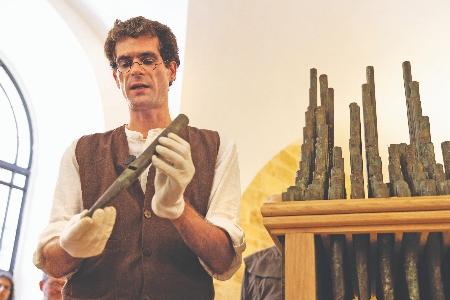
On September 9, for the first time in modern history, the pipes of a Medieval organ have been heard again, just as they sounded a thousand years ago. And it was with the eleventh-century liturgical chant, Benedicamus Domino Flos filius, performed by David Catalunya on the original bronze pipes of the Organ of Bethlehem.
The major achievement has been made possible thanks to an international research project led by musicologist Dr. David Catalunya, whose passion for historical instruments brought him to Jerusalem in search of a liturgical treasure buried by the Crusaders in the twelfth century. This project is promoted by the Complutense Institute of Musical Sciences (ICCMU) in collaboration with the Terra Sancta Museum and the Custody of the Holy Land (Franciscans of the Holy Land). The Organ of Bethlehem project was officially presented to the international press at the Convent of Saint Saviour in Jerusalem, headquarters of the Custody of the Holy Land, with the participation of the research team and representatives of the collaborating institutions.
A “Musical Pompeii” beneath the Church of the Nativity in Bethlehem
During the press conference, Father Eugenio Alliata, Franciscan archaeologist from the Studium Biblicum Franciscanum (SBF), recounted the context surrounding the discovery of this object. He explained that the existence of a hidden treasure in Bethlehem had been preserved in the collective memory of the Franciscans for centuries. The treasure was finally discovered, almost by chance, during the establishment of the Franciscan hospice for pilgrims called “Casa Nova” in 1906 in an area that was once the cemetery of Catholic Christians.
Excavations conducted by archaeologists from the Studium Biblicum Franciscanum uncovered 222 bronze pipes, a carillon of thirteen bells, and other liturgical objects hidden by the Crusaders before their departure from the Holy Land. In order to preserve it, the organ was displayed at the Franciscan Archaeological Museum of the Convent of the Flagellation. But for over a century, this discovery went virtually unnoticed in academic circles.
A Spanish researcher from the Complutense leading an international mission
During his time as a researcher at the University of Oxford, David Catalunya came across a mention of the organ in the Basilica of the Nativity in Bethlehem. This was the starting point of an adventure that has now become an international project with a scientific headquarters in Madrid and a working field in Jerusalem and Bethlehem. The project is coordinated by the Complutense Institute of Musical Sciences (ICCMU), the leading music research center in Spain, whose director, Dr. Álvaro Torrente, traveled to Jerusalem for the event.
During the press conference Dr. Catalunya provided information on the value of the object, the scientific research team composed of four members, including Winold van der Putten, organbuilder, and Koos van de Linde, organ expert, and the reconstruction project. The pipes were analyzed using advanced technologies. These analyses helped understand the materials used as well as the manufacturing process. The research has revealed that some of these original pipes, made more than a thousand years ago, still function, fully preserving their original sound, representing an unprecedented musicological discovery.
As a world premiere, Dr. Catalunya played music on some of the original pipes, producing the same sounds that once accompanied Crusader liturgies at the Nativity Church in Bethlehem. “This organ was buried with the hope that one day it would play again,” explains Catalunya. “Today this forgotten voice can be heard again, not just as an object of study, but as a living experience that connects art, history, and emotion. Like a musical Pompeii, it is a unique window into the past, a living relic.”
Álvaro Torrente stated, “The Organ of Bethlehem is not only a treasure of the past that we can now contemplate and hear. It is also a unique source of knowledge about European music, engineering, and organology, capable of radically transforming our vision of medieval culture. It is like finding a living dinosaur: something that once seemed impossible and that suddenly becomes real before our eyes and ears.”
The Bethlehem Organ project was one of the selected initiatives in the recent twelfth edition of the 2025 Leonardo Grants in the humanities category, awarded by the BBVA Foundation. The recognition highlights its interdisciplinary nature and pioneering contribution to historical musicology, sound archaeology, and the dissemination of European heritage.
The organ will be on display at the Terra Sancta Museum Art & History
The signing of a collaboration agreement in April between the Complutense University, the Custody of the Holy Land, and the Terra Sancta Museum ensures access to the collections and logistical support for the next five years. Beyond the technical aspects, the project aims to restore the spiritual, historical, and artistic value of this unique object. Father Stéphane Milovitch, chairman of the board of directors of the Terra Sancta Museum, explained,
The results of this research project are already greatly enriching the current scenography of the future Music cloister, which will display the Treasure of Bethlehem, and we hope that tomorrow they will enrich the experience of future museum visitors allowing the deployment of a whole series of cultural outreach activities.
The Musical Cloister will be one of the twenty exhibition rooms in the future Terra Sancta Museum Art & History, its construction is currently being supported by the Belgian government, the Belgian Consulate, and the cooperation agency ENABEL.
§
Dr. David Catalunya is a researcher at the Complutense Institute of Musical Sciences (ICCMU), where he works on the RESOUND project, funded by the European Research Council. He was previously a researcher at the University of Oxford (2019–2023) and the University of Würzburg (2011–2019). His work delves into Medieval music, intellectual culture, organology, and the history of technology. For decades, Catalunya has developed his academic career alongside artistic activity as a keyboard performer and director of the vocal ensemble Canto Coronato.
§
The Franciscan friars have been present in the Holy Land for over 800 years. As the only Latin Christian presence tolerated by the Muslim authorities at the departure of the Crusaders, the Catholic Church asked them to guard the Holy Places. Since 1342 they have been carrying out this mission, and today they are responsible for fifty shrines, twenty parishes, sixteen schools, more than 500 social housing units for disadvantaged Christian families, and employ more than 1,200 people in the Holy Land.
There are 300 Franciscan brothers spread across eight countries. The Terra Sancta Museum is one of their cultural projects. It is the first major international museum of Christian art to be established in the heart of Jerusalem. Made up of two museums—an archaeological museum and a historical museum still under construction—it aims to serve as a cultural bridge between different faiths and peoples while reaffirming the universal and Christian character of the Holy City. The museum project is being led on site by Franciscan friar Stéphane Milovitch. The president of the scientific committee of the Terra Sancta Museum is Béatrix Saule, honorary director of the Palace of Versailles, France.
§
The Complutense Institute of Musical Sciences (ICCMU) is an international reference center for the research and recovery of historical Spanish music. Affiliated with the Complutense University of Madrid, its work is carried out by the institute’s own multidisciplinary team and a broad network of over 1,000 specialists—including musicologists, musicians, historians, philologists, and cultural managers—from both national and international institutions such as the University of Cambridge, Université Paris-Sorbonne, University of California Los Angeles (UCLA), Università degli Studi di Bologna, and the University of Melbourne, among others. The Institute is directed by Álvaro Torrente Sánchez-Guisande.
For information: bethlehemorgan.org.
See also “Organs, Organbuilders, and Organists in the Holy Land,” by Gunther Martin Göttsche, translation from German by Valerie E. Hess, February 2021, pages 12–17.