Harpsichord Notes: Two Bach recordings
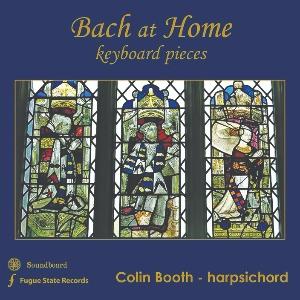
Bach at Home: Keyboard Pieces
Bach at Home: Keyboard Pieces, by Colin Booth, harpsichordist. Soundboard/Fugue State Records, $16.98. Available from ravencd.com and colinbooth.co.uk.
Colin Booth’s newest recording of works by Johann Sebastian Bach focuses on keyboard music that was likely meant for domestic purposes. Many of the works are described by Booth as “odd” or “unfairly neglected,” given that none of the selections was published within one of Bach’s more lofty collections such as the Well-Tempered Clavier or the Clavierübung, although this certainly does not discount their value. Behind many of these works, Booth sees the influence of the organ, and he remarks about this along with many other salient points in his liner notes. Booth’s performances and interpretations give life to this music, and his liner notes provide insight into his creative approach.
The liner notes discuss at length Bach’s limited time for composing, the numerous instruments he had available to play, and the fact that the organ seems to permeate a large amount of his keyboard music in one way or another. About the influence of the organ, Booth cites the numerous pedal points, especially the lengthy ones, which would require restriking on a harpsichord. He suggests that due to the public facing nature of the organ along with the requirement of someone to work the bellows, it is likely that Bach spent a fair amount of time playing a pedal harpsichord at home. In his recording, Booth stresses performance practice elements that he feels are not given full focus in contemporary harpsichord playing. He argues that tempo should be focused on the meter signature, even if that produces a more “leisurely” tempo than normally heard. He also stresses the importance of beat hierarchy and inégalité, which he believes penetrated more than just the works in French forms or styles. These notes illuminate Booth’s musical decisions.
Seven of the works on this disc are titled “prelude”—some are attached to another piece on the disc, while several others are teaching pieces that Bach used with his pupils. Booth programmed the preludes as connecting matter among some of the larger works on the record. One such work, Prelude, Fugue, and Allegro in E-flat Major, BWV 998, is performed with the lautenwerk in mind, with lengthened bass notes and prevalent use of the lute stop. Another larger work, Suite in A Minor, BWV 818a, was revised by Bach and includes five short movements. Booth identifies this as being related to the French Suites in feeling and size; the five unique movements of this piece include a bold prelude played with great drama, a menuet filled with rhythmic invention, and an exciting giga. After Concerto in G Minor, BWV 985, based on a violin concerto by Telemann, Booth includes a curious work, Fantasia on a Rondo Theme, BWV 918, which seems to be a clever two-part invention with a unique formal design. Various fugues such as Fugue in D Minor, BWV 948, and Fugue on a Theme by Erselius, BWV 955, are beautifully performed, but Prelude in B Minor, BWV 923, and Fugue in B Minor, BWV 951, based on a theme of Albinoni, are two of the most fascinating pieces on this disc. The prelude is filled with blocked chords meant to be arpeggiated similarly to Chromatic Fantasy and Fugue, which Booth does artfully here, along with a lengthy and satisfying rendition of the fugue that follows.
For those familiar with Booth’s other recordings, this harpsichord may seem familiar. The instrument was used in Booth’s recordings of Bach’s Well-Tempered Clavier. It is modeled after a French instrument from 1661 but has German qualities and is strung in brass. Booth remarks about the great clarity of the sound and its value for contrapuntal music such as this; he is correct that this instrument sounds wonderful and is well-balanced across all the registers, thus giving great clarity to the counterpoint.
Booth’s notes and recording provides a fascinating perspective into the homelife of Bach, with a view of the ways in which he may have conceived pieces designed for a “domestic” audience, and how he may have used the harpsichord in ways that recall the organ. Each of the works is performed with great care, attention to detail, and faithfulness to the spirit of the music. This is certainly another worthy CD to add to your collection among many by Colin Booth.
Bach: Les Variations Goldberg
Bach: Les Variations Goldberg, Jean-Luc Ho, harpsichordist. L’Encelade, ECL2201E, ˇ22, 2 CDs. Available from encelade.net.
CD 1: Aria; Variatio 1. à 1 Clav.; Variatio 2. à 1 Clav.; Variatio 3. Canone all’ Unisuono à 1 Clav.; Variatio 4. à 1 Clav; Variatio 5. à 1 ô vero 2 Clav.; Variatio 6. Canone alla Seconda à 1 Clav.; Variatio 7. à 1. ô vero 2 Clav. (al tempo di Giga); Variatio 8. à 2 Clav; Variatio 9. Canone alla Terza. à 1 Clav.; Variatio 10. Fugetta. à 1 Clav.; Variatio 11. à 2 Clav.; Variatio 12. Canone alla Quarta.; Variatio 13. à 2 Clav.; Variatio 14. à 2 Clav.; Variatio 15. andante. Canone alla Quinta. à 1 Clav.
CD 2: Variatio 16. à 1 Clav. Ouverture; Variatio 17. à 2 Clav.; Variatio 18. Canone alla Sexta. à 1 Clav; Variatio 19. à 1 Clav.; Variatio 20. à 2 Clav.; Variatio 21. Canone alla Settima.; Variatio 22. à 1 Clav. alla breve; Variatio 23. à 2 Clav.; Variatio 24. Canone alla Ottava à 1 Clav.; Variatio 25. à 2 Clav.; Variatio 26. à 2 Clav.; Variatio 27. Canone alla Nona. à 2 Clav.; Variatio 28. à 2 Clav.; Variatio 29. à 1 o vero 2 Clav.; Variatio 30. à 1 Clav. Quodlibet.; Aria da Capo è Fine.
In a time with so many wonderful recordings of a work as important as Bach’s Goldberg Variations, why record them again? This is surely what every artist from our time questions as they desire the opportunity to put their stamp on this masterpiece (and many others). Jean-Luc Ho’s recording provides another window into this glorious piece fit with bold choices of tempi and affect, a beautifully resonant and powerful instrument, and—most importantly—a spirit of intentionality behind every interpretive choice. Serving as “professor of tunings, settings, and temperaments” at the Paris Conservatoire, Ho is an award-winning harpsichordist with much artistry to share.
From the start of the recording, one feels drawn into an experience that feels like a live performance. One can hear Ho set the registration before many movements, and the timing between tracks is carefully set to create a sense of groupings of variations to pace the listener. The opening Aria swings forward with the natural feel of a dance and the promise of tempi chosen based on historical awareness rather than the need to stand out among the large number of recordings of this work. Throughout the variations, one hears Ho’s ideas about gesture and how these influence his sense of rhythm and character; Variation 13 is a clear example of the ways in which Ho imagines freedom within a central pulse, while the first trip to the minor mode—Variation 15—is full of intense pathos in a way that breathes fresh drama.
Ho is intentional from the outset about the way in which he adds ornaments to sometimes very thick textures, often letting the music speak for itself. In places that are begging for imagination, he richly embellishes, as heard in Variation 4 and Variation 22. One senses that his approach is not to overwhelm the music with new ideas, but to add in ways that serve the music. Technically, Ho demonstrates a solid control of the instrument with mastery of the many dazzling feats heard throughout such as in Variation 26 and others for two keyboards.
In addition to the wonderful playing, Ho wrote an inspired essay (translated from French by Nick Halliwell) detailing his relationship to this music and the heaviness of the responsibility entrusted to anyone who plays it. Here, he describes in detail his thoughts about the ten canons heard throughout and questions how a fourteen-year-old keyboardist named Goldberg could have possibly handled such a lofty work. Photos by Ken Yoshida and digital design by Fokko B add artistic touches.
The recording, utilizing a French double harpsichord “in the Goujon style” made by Émile Jobin in 1983, was completed in January 2022. Ho describes the process of searching for a harpsichord worthy of this music and settling on this one, which he obtained from noted harpsichordist Blandine Verlet. The instrument is capable of much including intense emotional power such as that in Variation 25 and light frivolity heard just two variations prior. For those who are interested in this work, this recording features yet another fine performance of this important masterpiece.