Harpsichord Notes: Bach and the Lautenwerk
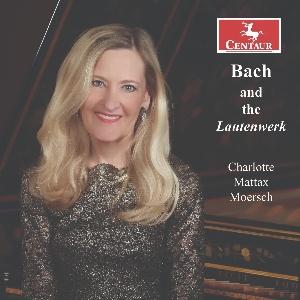
Bach and the Lautenwerk, Charlotte Mattax Moersch. Centaur, CRC4127, 2025. Available from amazon.com and other resources in CD and other digital formats.
Sonata in D Minor, after Violin Sonata in G Minor, BWV 1001: Adagio, Fuga allegro, Siciliana, Presto; Sonata in G Major, after Violin Sonata in C Major, BWV 1005: Adagio, Fuga, Largo, Allegro assai; Sonata in D Minor, BWV 964, after Violin Sonata in A Minor, BWV 1003: Adagio, Fuga, Andante, Allegro; Lute Suite No. 1 in E Minor, BWV 996: Praeludio: Passagio-Presto, Allemande, Courante, Sarabande, Bourrée, Gigue, Johann Sebastian Bach.
The lautenwerk gently arrests the listener as few instruments can. At first glance, it looks like any other single- or double-manual harpsichord, but the familiar timbre of the harpsichord is replaced by the mellower yet equally resonant and warmly rich tone of plucked gut strings. Jakob Adlung described it in the eighteenth century as “the most beautiful of all keyboard instruments after the organ. . . because it imitates the lute, not only in tone quality, but also in compass and delicacy.” Johann Sebastian Bach himself acquired one around 1740, and he likely owned two at the time of his death. No original lautenwerk has survived from the eighteenth century, but enough evidence of designs has survived to inform builders such as Anden Houben and Willard Martin in their craftsmanship.
Charlotte Mattax Moersch’s recent album Bach and the Lautenwerk, released by Centaur Records, explores the singular relationship between the great German composer and this unusual yet captivating instrument. Moersch programs the Violin Sonata in G Minor, BWV 1001, and the Violin Sonata in C Major, BWV 1005 (both transcribed for harpsichord by Gustav Leonhardt, in D minor and G major), the Violin Sonata in A Minor, BWV 1003, transcribed by Bach as BWV 964 in D minor, as well as one of the only compositions for lautenwerk in existence, Suite in E Minor, BWV 996. Moersch’s approach to the lautenwerk warmly invites the listener into total immersion in this unique instrumental sound. Her sense of rhetoric, pacing, breath, and flow serve these masterworks of repertoire well, as does her choice of a magnificent lautenwerk specimen. The particularly elegant instrument in this recording was built by Anden Houben in 1997.
The complexity of Bach’s fugal writing becomes a canvas for Moersch’s beautifully etched and graceful rhetoric. This feature comes across most vividly in fugue subjects, especially BWV 1001’s fugue. The structure of the fugue movements is crystal clear, and each new idea is treated with a deep expression that brings out its own unique figural and rhetorical qualities. The largest fugue movement of the album, BWV 1005ii, is successfully held together through a masterful handling of narrative. This same treatment of rhetoric in the larger, perhaps more wandering movements comes across most satisfyingly in BWV 1005i as well. A linear flow with sensitive timing easily bypasses the danger of richer registers becoming unwieldy and muddy with this instrument’s greater sustaining power.
In fugal movements and beyond, Moersch shows every twist and turn of moving lines (BWV 1001i), highlights dissonant moments (BWV 1003iii), and draws out the character and expression in each line (BWV 1003iv) without ever becoming pedantic in her delivery. Her greatest interpretive feature in fast movements is her ability to combine energy with elegance (BWV 1005iv). Simultaneously, she conveys a lyricism in the singing movements of BWV 1005iii and BWV 1003iii that contrast tenderly with the sculpted fugues and zestier fast movements. Her tasteful register changes on this two-manual instrument (BWV 1005ii, BWV 1001iii) accentuate the underlying masterful handling of the polyphonic writing and give the listener the impression of a collective ensemble at work (BWV 1003ii). As if this stunning performance were not enough, the listener gets to enjoy a warmer resonance that might not be found on a typical harpsichord album. The resonance and ringing quality of this lautenwerk might be best captured on high-quality speakers, especially in movements such as BWV 1005i, BWV 1003iii, and BWV 1003iv, which contain very rich writing.
The crown jewel of this album is the Suite in E Minor, BWV 996, the only work on this album composed specifically for the lautenwerk. Because of this blend of creation and medium, the work perfectly captures the acoustic potential of the lautenwerk. Moersch’s performance demonstrates masterful rhythmic vitality and articulation of gestures. The musical intent of “Praeludio” is crystal clear, both in “Passagio” and the fugal “Presto,” and the subsequent dance movements’ distinct characters are beautifully communicated. “Allemande” is stately, and even though it may meander, it is deeply elegant.
Performances on the lautenwerk run the contrasting dangers of excessive speed or dense polyphony such that material becomes garbled, and lethargic tempi such that the musical line is lost. With this suite in particular, Moersch strikes the perfect balance between vigorous dance and haunting expressivity, and “Courante” best exemplifies this blend in the suite. The majesty of “Sarabande” is combined with some whimsy, a creative touch in a movement with a restricted range of notes. “Bourrée,” a movement most frequently borrowed by keyboardists, is treated with both vigor and more whimsy, as well as an interesting choice of timbre. The grandiosity of “Gigue” is met with an attention to detail that captivates the listener unlike in any other robust dance on this album. Moersch continues to etch every musical gesture while sweeping the listener off their feet. The final bars are a fitting conclusion to the earthiness and elegance of this suite.
Historical keyboardists frequently face the multi-dimensional challenge of performing specific music by specific composers on one specific instrument. Much to the delight of the listener, Moersch easily exceeds all expectations. A finer combination of repertoire and instrument one would be hard pressed to find.