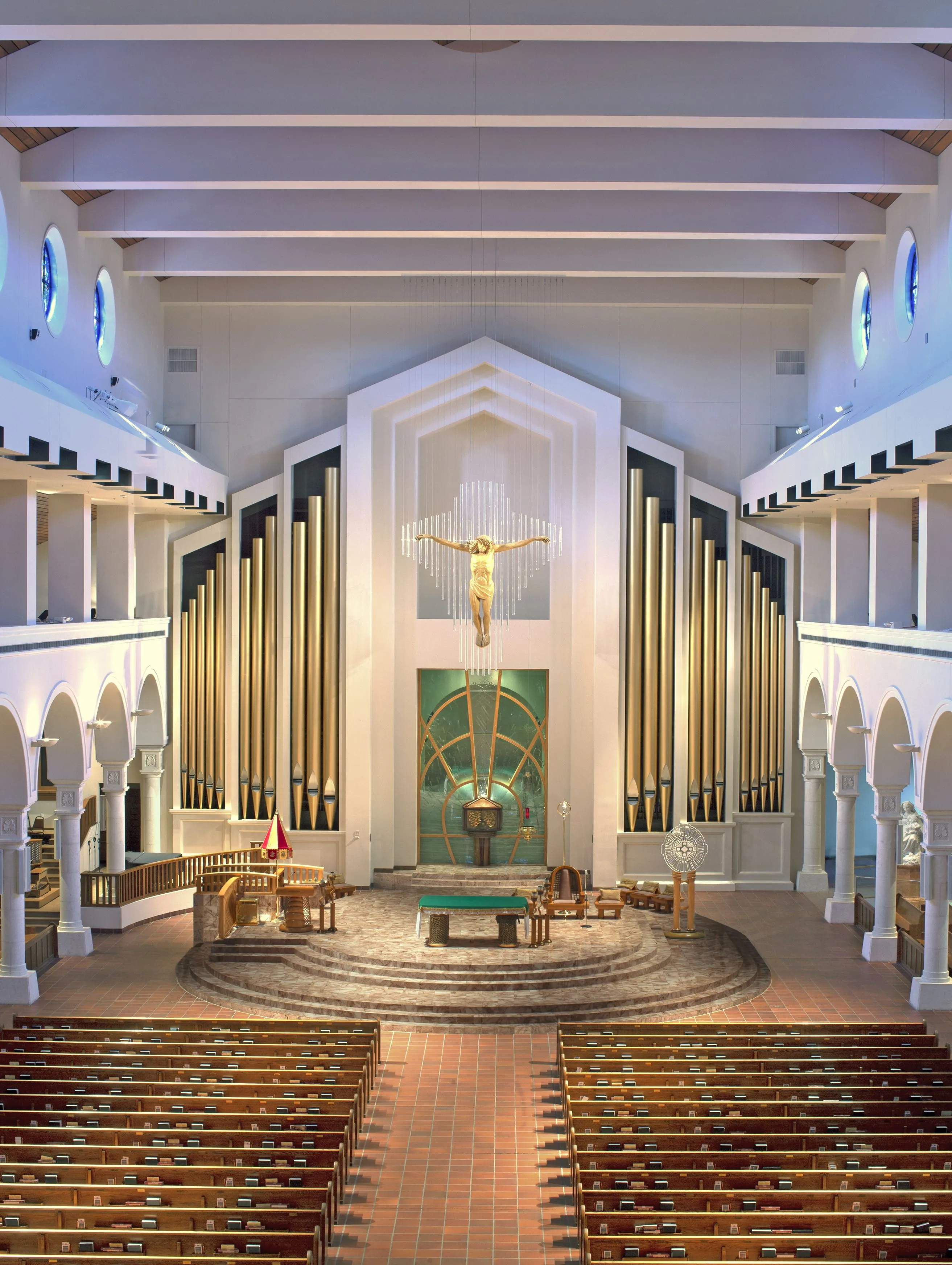
Cover feature: Schoenstein & Co. Opus 185
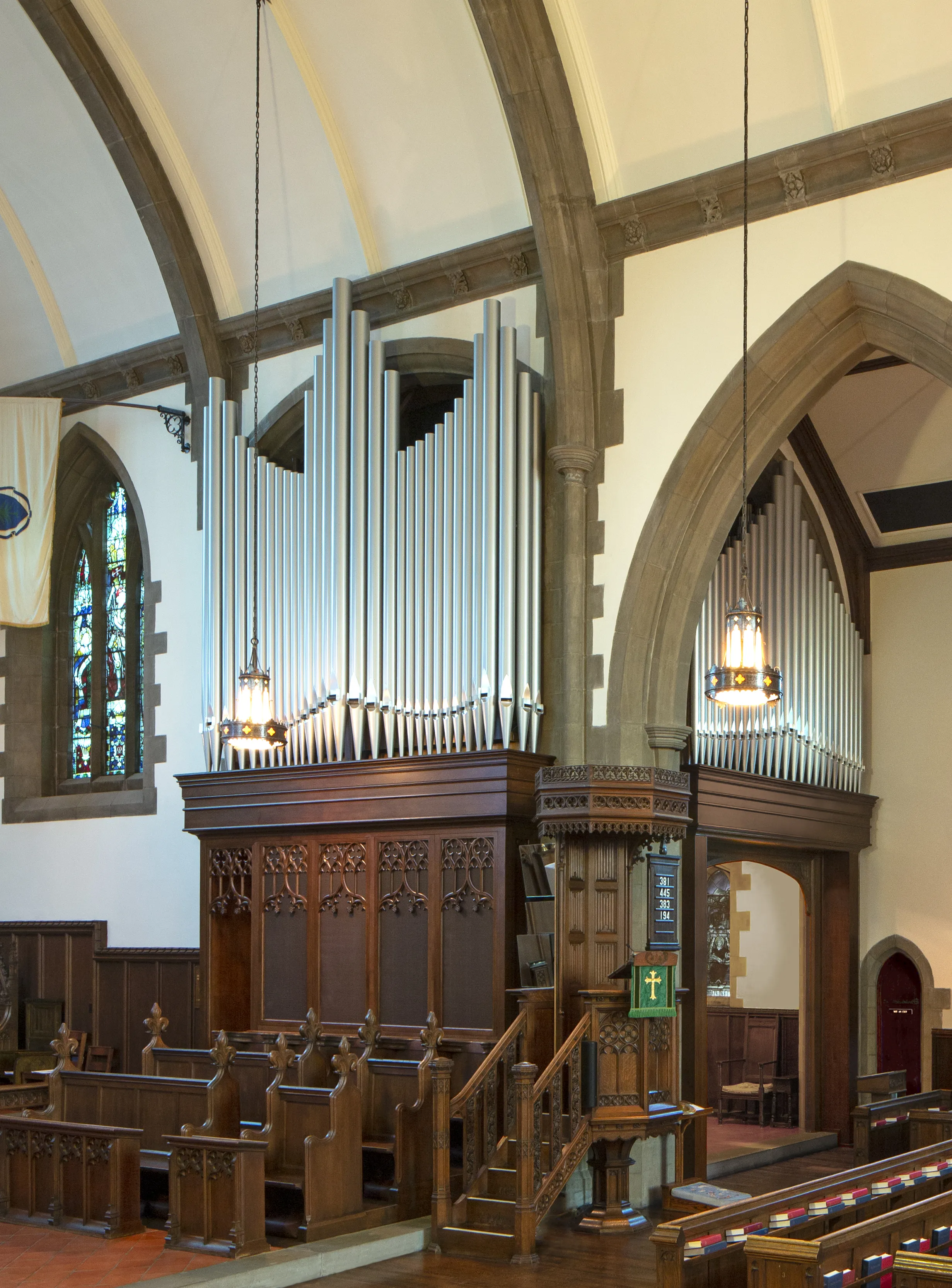
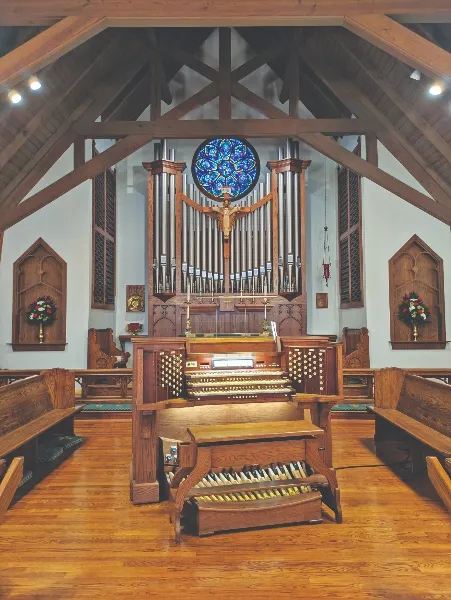
Schoenstein & Co., Benicia, California; Church of the Good Shepherd, Corpus Christi, Texas
The Accompanist-Orchestrator: Getting the Best out of Stanford and Korngold
When listening to one of the old Hollywood soundtracks, our ears instantly recognize hallmarks of the era. There are the singing melodies, the rich orchestrations, and the ingenious musical devices. (To say nothing of the fantastic playing.) We remember the great film songwriters and composers, and our modern minds often forget the many talented orchestrators responsible for two of the three hallmarks listed above.
Consider now the talented choir accompanist. Seated at the organ bench, this person fulfills all the duties of the Hollywood orchestrator, with the added responsibility of playing the performance! The pianist accompanies sensitively, the conductor makes an orchestra do the same; only the organist is responsible for sensitive playing and orchestration. Charles Villiers Stanford writes the core material, and the choir leads in the foreground, while the uniqueness of each organ forces the accompanist into their role as accompanist-orchestrator, responsible for realizing the full musical potential of Mr. Stanford’s work.
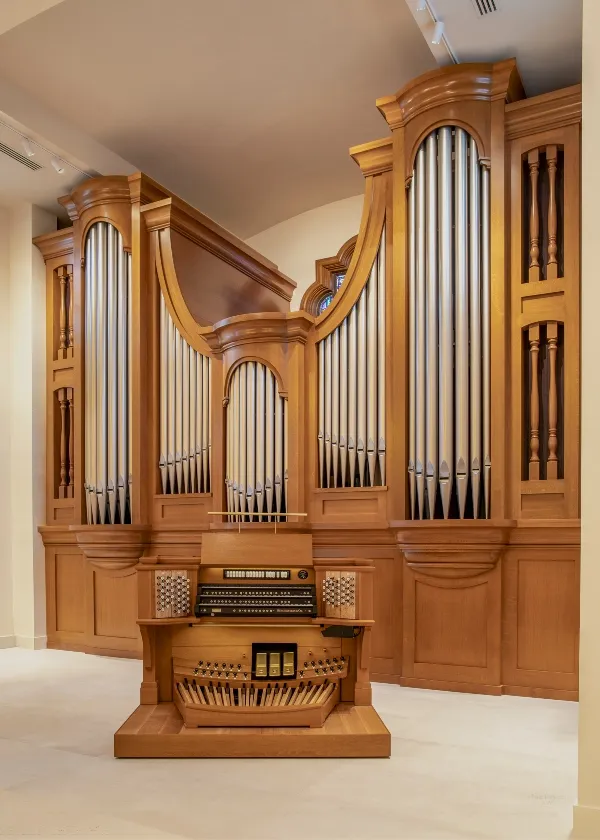
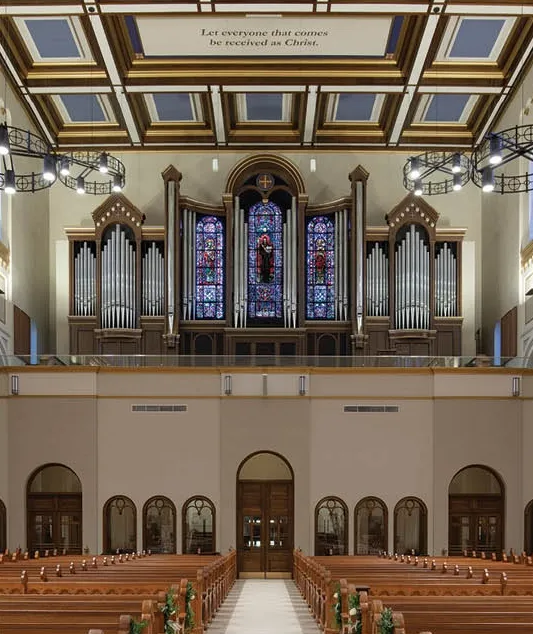
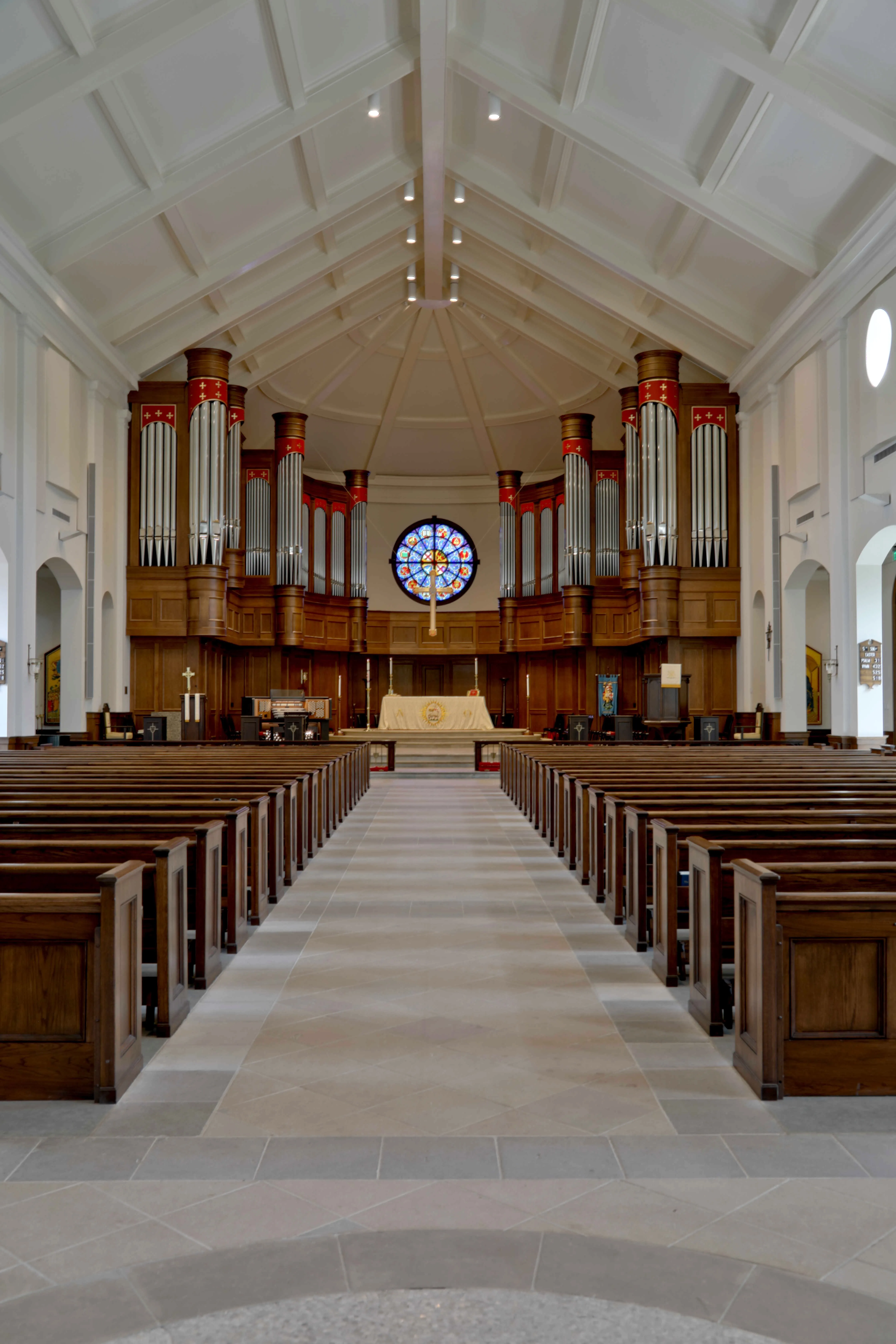
Our organ for Church of the Good Shepherd in Corpus Christi, Texas, was designed to give the accompanist-orchestrator the musical resources to fulfill this role with as much skill as the best Hollywood orchestrators. It presents an opportunity to examine aspects of the relationship between composer, accompanist-orchestrator, and orchestra (organ).
The composer
Hollywood composers bear a striking resemblance to church music composers. They both write music for practical use, sometimes for only one performance; their music is part of a larger art-piece (the movie or church service); they work with many stakeholders, including those who may have no interest in their craft (producers or clergy).
Some Hollywood composers were famous for beautiful melodies and nothing else, giving little more than a melody and sketch to the orchestrator. Others specified every detail of the orchestration. An experienced accompanist can think of examples from each category found in church music.
Although spectacular music has been written by both kinds of composers, the Hollywood orchestrators generally found the former, less micro-managing composers more creatively stimulating. The same can be said for the accompanist-orchestrator; and where there is more space for personal expression, there is more opportunity to match the composer’s material to the organ.
The accompanist-orchestrator
The master orchestrators of Hollywood made even the simplest song a masterpiece. More than assigning parts to players, their job was to realize the potential of the composer’s material. Orchestrators and accompanist-orchestrators are at their best when they are musical chameleons. Much like good improvisation, good orchestration and accompaniment sounds inevitable. Rather than draw attention to itself, it draws attention to the best parts of the composer’s piece, making improvements to any lackluster material in the composer’s voice.
In capable hands, everything from registration—musically timed changes, making certain lines solos—to added material—descants, additional counterpoint, subtle harmonic changes—is at the discretion of the accompanist-orchestrator. Sometimes “playing the ink” on one beautiful registration is all that’s needed. Good taste is central to success, and the mark of success is simple: only the performers know what the accompanist-orchestrator is doing, while the listener, none the wiser, enjoys a fantastic performance of the composer’s piece.
The orchestra
Great orchestrators could work with nearly any orchestra, from awe-inspiring to frustrating. The same is true for great accompanist-orchestrators, craftspeople who never blame their tools. In order to realize the talents of the accompanist-orchestrator, however, the organ needs to sound as beautiful and function as musically as the best Hollywood orchestras. Each player (stop) must have a pleasing sound on their own and blend into a unified yet colorful ensemble tone. Ensembles must be highly expressive, capable of dynamic changes fast and slow. The string section (diapasons) must be perfectly balanced.
Roster size and personnel budget
When designing an organ for the accompanist-orchestrator, tough choices must be made to fit within space and budget. Orchestrators encountered the same challenges and, like a creative organbuilder, found compelling solutions. Asking simple questions like, “what’s more useful, an Oboe or a Glockenspiel (Larigot)?,” can reveal the best path forward. Other learnings from the orchestrators can be found in their scores: the most important instruments have the largest usable playing compass, one beautiful violin is worth ten “color instruments,” effects are always subservient to a simple, never-tiring sound.
An orchestra of soloists
The Berlin Philharmonic is famous for its string section of soloists who play together with perfect ensemble skills. This should be the goal for all diapasons on the accompanist-orchestrator’s organ. For Church of the Good Shepherd, we employed our usual diapason scaling methods to ensure color variety across the whole organ. Cohesion between diapasons comes from thoughtful scale variation, careful voicing, slotting, and—new with this organ—a languid counter-bevel.
Full-compass beauty
Organbuilders are always battling height constraints, and flue pipes are often mitered or Haskelled to compensate. The latter method, better for strength and overall space, often leads to weak, unfocused basses. No Hollywood orchestra would settle for mediocre cellos and basses, so we set out to find a way to improve Haskell bass tone. Our head voicer, Timothy Fink, found the answer in studying the master of Haskelling, Estey. Following Estey’s lead, we fitted all Haskelled pipes with a bucket languid. The result is fantastic: the change to Haskelled basses is imperceptible, with plenty of rosin and singing tone all the way to low C.
Employing bucket languids is one of many tools we used to make sure every stop’s compass is musically relevant. This allows the accompanist-orchestrator to employ any stop they choose for the material at hand, offering unending possibilities for color and variety that sound musically convincing to someone who has never heard the organ.
Unenclosed = unemployed
There are many musical instruments that, although beautiful unto themselves, cannot meet the demands of the accompanist-orchestrator, their choir, and repertoire. With the exception of the diapason chorus and a few unenclosed color flues (all of which serve the accompanist-orchestrator, too), an organ for the accompanist-orchestrator requires enclosed, useful stops.
Our double-enclosed Swell reeds can be used to anchor full organ or accompany a small (human) choir. Director of Music Ministries Dr. Mi Ou Lee demonstrated their flexibility by using the 32′ Contra Posaune in perfect balance as part of the string celeste ensemble. In the Choir, the 16′ English Horn—a stop usually only useful for solos in one part of its compass—is voiced with a rich, full bass. Much like an orchestral bassoon section, it can be used in myriad ways for single lines and harmony.
Overlapping dynamic range
Soloists and accompanying ensembles within the orchestra need to balance with the singers across the dynamic range of the voice. No Hollywood orchestra would hire a player who can only accompany at their softest dynamic level. A diapason mezzo-piano should equal a singer’s mezzo-piano such that they can take advantage of their full dynamic range while singing together.
The Choir division in Corpus Christi deserves special mention here. It is designed to follow exactly the dynamic contours of a (human) choir. The dulcianas sing with a pure “ah” vowel and blend seamlessly with singers. All color stops can be used with even the most sensitive singers, from the barely audible (box closed) Flute Celeste to the cornet and Tromba. This division, more than any other, offers inspiration to the accompanist-orchestrator and begs for creativity in every accompaniment.
Beyond movie music
When a concert-goer attends a Philadelphia Orchestra program of Mozart, they do not hear Mozart’s orchestra. Instead, they hear a compelling performance in the ensemble’s own musical voice. All musicians—from the most versatile to the specialist—have a voice, and the same is true for organs.
Organs serve in many roles, and even the most devoted church musician will admit there is more to life than choral accompanying. Expression and musicianship will always carry the day, and any organ that meets the demands of a talented accompanist-orchestrator will perform all music with ease. Building one organ to sound perfect in every context is impossible. Building one organ to sound musical in every context is the key.
This principle was demonstrated masterfully by consultant Ken Cowan, taking the organ through choral accompaniments, hymns, and repertoire from Rachel Laurin to Bach. Cowan’s work with us produced an organ of many colors and capabilities, and Mi Ou Lee is already using the instrument to its potential each week. It was our pleasure to work with Cowan, Lee, and all the people of Church of the Good Shepherd, including Father Milton Black, rector; and Shane Smith, facilities director.
—Bryan Dunnewald, President and Tonal Director, Schoenstein & Co.
Builder’s website: schoenstein.com
Church’s website: cotgs.org
Photo credit: Louis Patterson
GREAT (Manual II)
16′ Contrabass 61 pipes
8′ First Open Diapason 61 pipes
8′ Second Open Diapason 12 pipes (ext 16′)
8′ Harmonic Flute 61 pipes
8′ Bourdon 61 pipes
8′ Flauto Continuo (Antiphonal)
4′ Principal 61 pipes
4′ Octave (ext 16′) 12 pipes
4′ Spire Flute 61 pipes
4′ Flute (Antiphonal)
2′ Fifteenth 61 pipes
2′ Mixture III–IV 187 pipes
8′ Tromba (Choir)
8′ Solo Tuba (Antiphonal)
SWELL (Manual III, enclosed)
16′ Bourdon (ext 8′) 12 pipes
8′ Open Diapason 61 pipes
8′ Stopped Diapason 61 pipes
8′ Gamba 61 pipes
8′ Gamba Celeste 61 pipes
4′ Gemshorn 61 pipes
4′ Harmonic Flute 61 pipes
2′ Flageolet 61 pipes
8′ Oboe Horn 61 pipes
Tremulant
Stops under double expression
16′ Posaune 61 pipes
8′ Trumpet 61 pipes
8′ Posaune (ext 16′) 12 pipes
8′ Vox Humana 61 pipes
4′ Clarion 61 pipes
2′ Mixture III–V 236 pipes
Swell 16′
Swell Unison Off
Swell 4′
8′ Solo Tuba (Antiphonal)
CHOIR (Manual I, enclosed)
16′ Dulciana 61 pipes
8′ Dulciana (ext 16′) 12 pipes
8′ Chimney Flute 61 pipes
8′ Flauto Dolce (Ch. Fl. bass) 49 pipes 8′ Flute Celeste (TC) 49 pipes
8′ Erzähler (Antiphonal)
8′ Erzähler Celeste (Antiphonal)
4′ Dulcet (ext 16′) 12 pipes
4’ Silver Flute 61 pipes
2 2⁄3′ Nazard 61 pipes
2′ Piccolo 61 pipes
1 3⁄5′ Tierce (TC) 42 pipes
16′ Bass Horn (ext 8′) 12 pipes
8′ Tromba 61 pipes
8′ English Horn 61 pipes
8′ Clarinet 61 pipes
Tremulant
Choir 16′
Choir Unison Off
Choir 4′
8′ Solo Tuba (Antiphonal)
ANTIPHONAL (Floating, enclosed)
16′ Bass Flute (ext 8′) 12 pipes
8′ Echo Diapason 61 pipes
8′ Erzähler 61 pipes
8′ Erzähler Celeste (TC) 49 pipes
8′ Flauto Continuo 61 pipes
4′ Erzähler (ext 8′) 12 pipes
4′ Flute (ext 8′) 12 pipes
16′ Flügel Horn (ext 8′) 12 pipes
8′ Flügel Horn 61 pipes
8′ Solo Tuba 61 pipes
PEDAL
32′ Resultant
16′ Diapason (wood–Austin)* 32 pipes
16′ Contrabass (Great)
16′ Dulciana (Choir)
16′ Bourdon (Swell)
16′ Bass Flute (Antiphonal)
8′ Octave (ext 16′ Diap) 12 pipes 8′ Bass (Great)
8′ Flute (Great 8′ Harmonic Flute)
8′ Dulciana (Choir)
8′ Stopped Diapason (Swell)
4′ Choral Bass (ext 16′ Diap) 12 pipes 4′ Flute (Great 8′ Harmonic Flute)
32′ Contra Posaune (ext Sw) 12 pipes
16′ Trombone (ext Ch 8′) 12 pipes
16′ Posaune (Swell)
16′ Bass Horn (Choir)
16′ Flügel Horn (Antiphonal)
8′ Solo Tuba (Antiphonal)
8′ Posaune (Swell)
4′ Clarinet (Choir)
*retained from previous organ
COUPLERS
Great to Pedal 8
Great to Pedal 4
Swell to Pedal
Swell to Pedal 4
Choir to Pedal
Choir to Pedal 4
Swell to Great 16
Swell to Great
Swell to Great 4
Choir to Great 16
Choir to Great
Choir to Great 4
Swell to Choir 16
Swell to Choir
Swell to Choir 4
Choir to Swell
Antiphonal on Great
Antiphonal on Great 4
Antiphonal on Swell
Antiphonal on Choir
Antiphonal on Pedal
Manual I/II Reverse
All Swells to Swell
Cymbelstern
CONSOLE
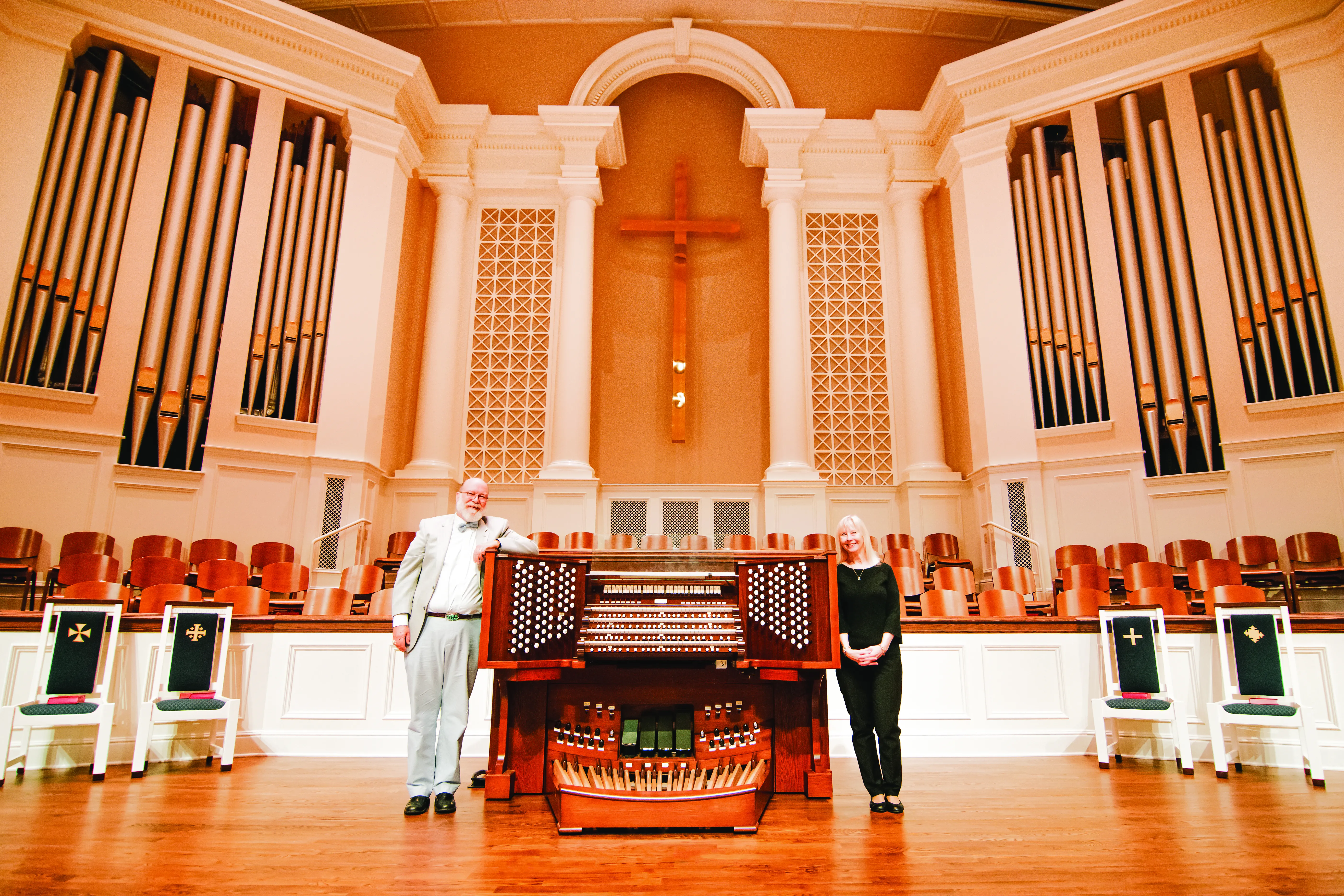
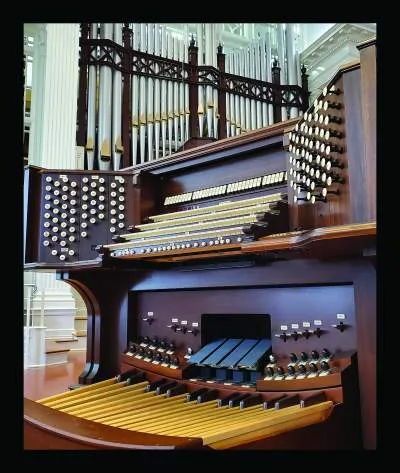
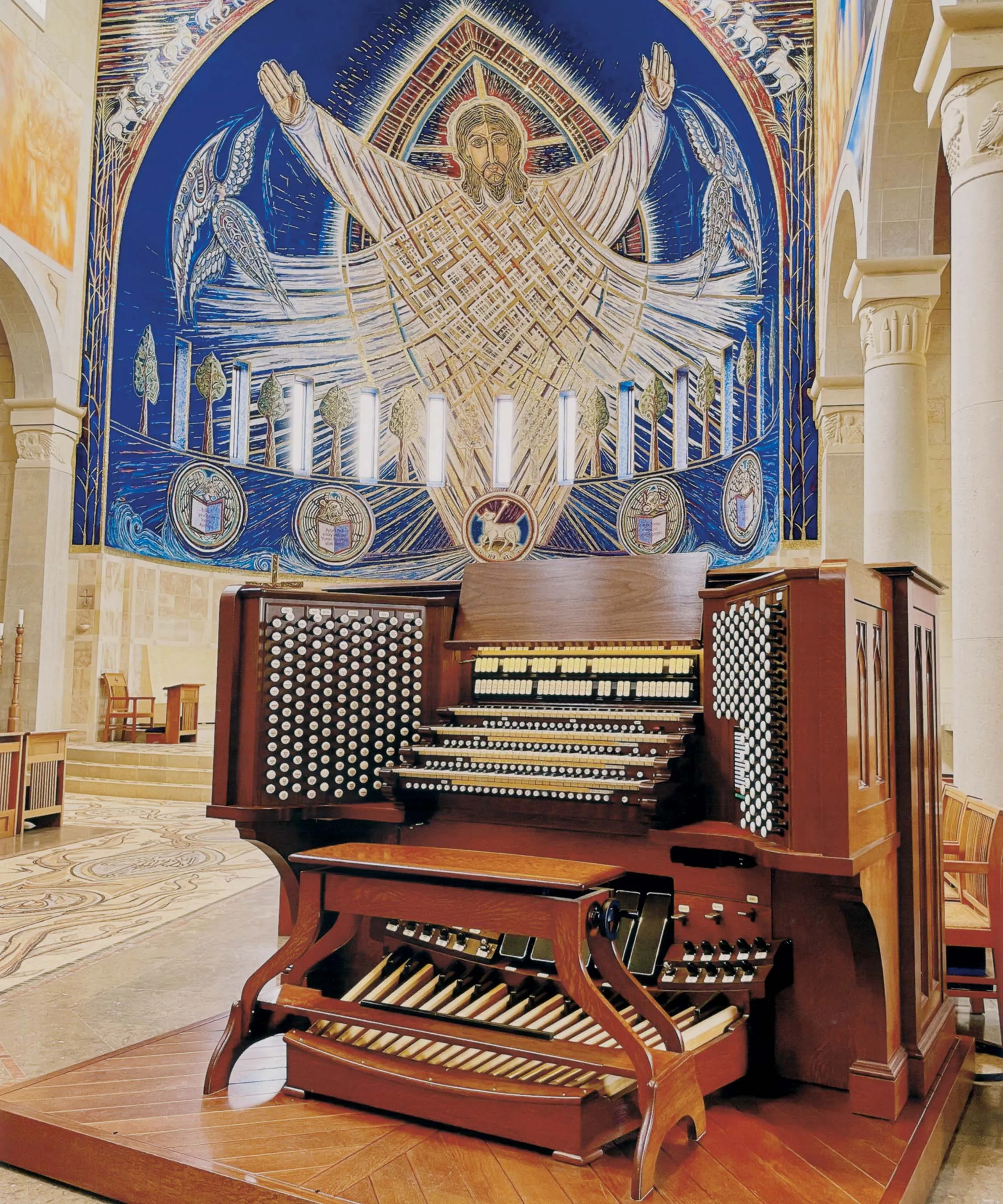
• Three manual and pedal American-style open drawknob console with adjustable bench and music rack all of hardwood designed and finished to complement the church furnishings.
• Bone and ebony covered keys with articulated touch.
• Polished ebony drawknobs on brass shanks.
• Solid state, capture combination action:
5,000 memories – assignable, lockable with back-up and level indicator
14 General pistons and toe studs (10 left, 4 right)
8 Great pistons
8 Swell pistons
8 Choir pistons
4 Antiphonal pistons
3 Pedal toe studs
1 Set piston
1 General cancel piston
2 Level setting pistons
Programmable piston range for each memory folder.
• Great to Pedal reversible piston and toe lever.
Swell to Pedal reversible piston and toe lever.
Choir to Pedal reversible piston.
• Full Organ reversible piston and toe lever with multiple memories and indicator.
• Four balanced expression pedals of brass – Choir, Swell, Inner Swell, and Crescendo.
• Piston sequencer (European system) with piston number indicator, (+) toe stud, 5 (+) pistons, (-) toe lever and (-) piston.
• Antiphonal expression selector.
• Record/playback system.
• Pedal light and coupler rail light.