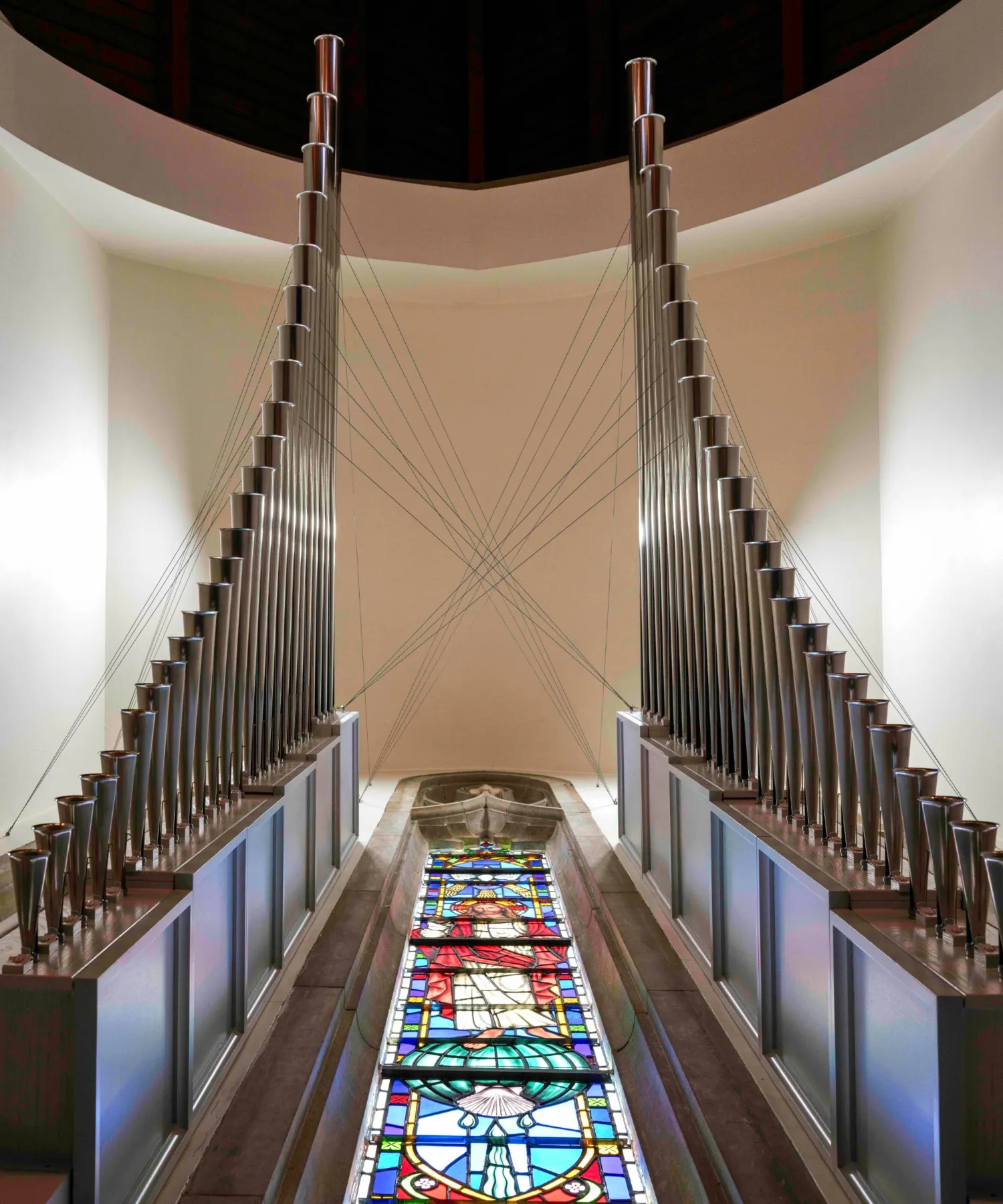
Cover feature: Rieger at Musiikkitalo, Helsinki
Rieger-Orgelbau GmbH, Schwarzach, Austria; Musiikkitalo, Helsinki, Finland
Making the impossible possible—the new concert hall organ at Musiikkitalo Helsinki
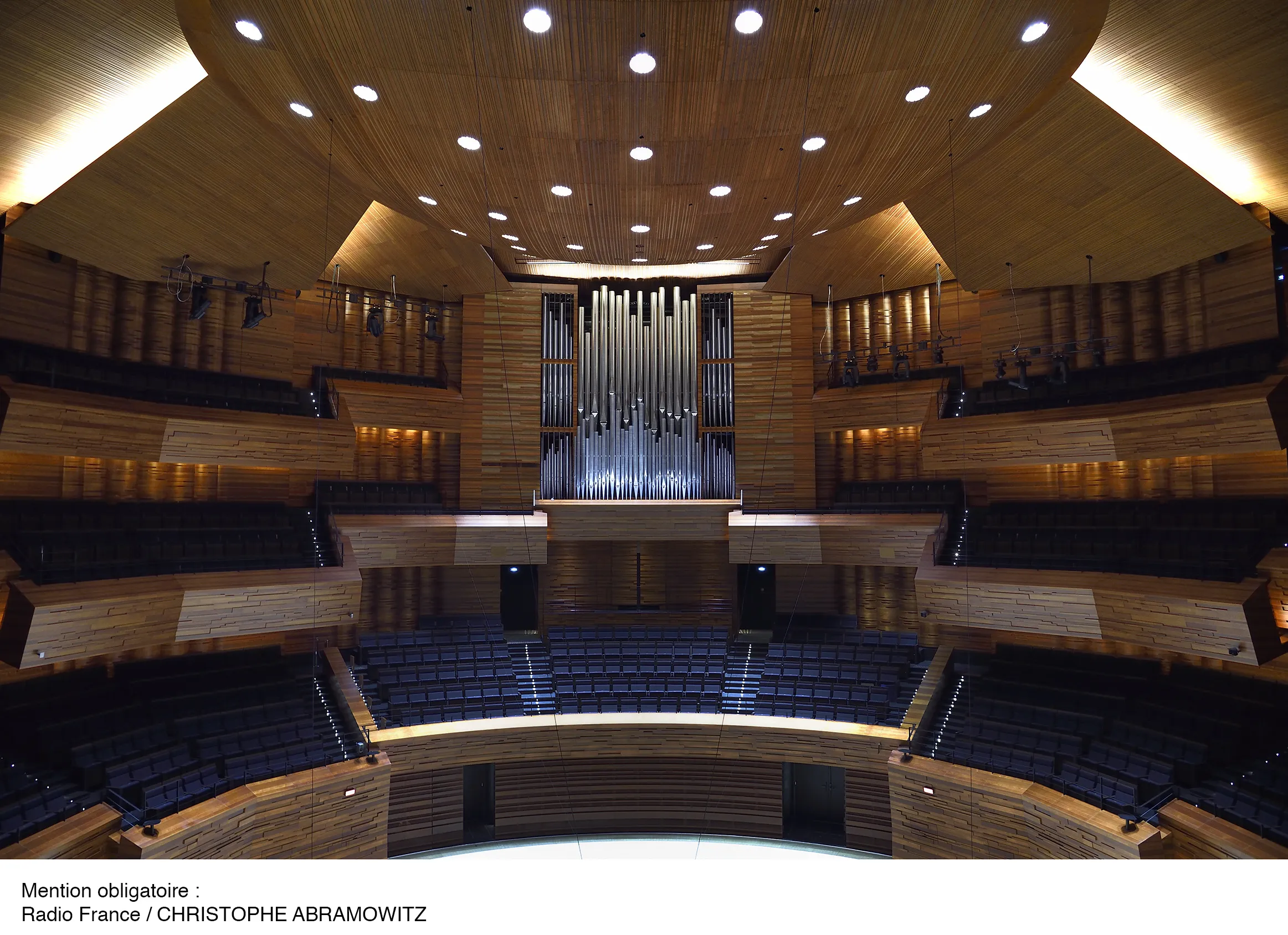
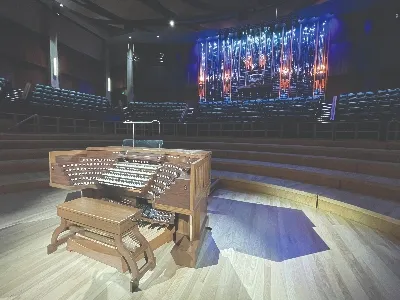
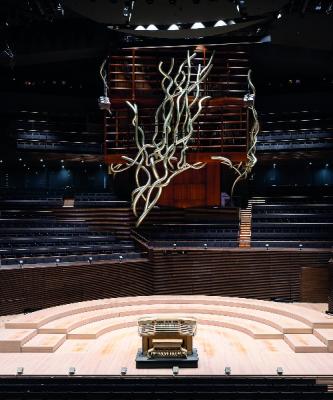
Sometimes, as an organ builder, one is blessed with courageous clients. Courageous in terms of the technical execution of an organ and also its design. Because then you can ask questions together such as, “Do organ pipes really have to stand side by side in rows on the front of an organ? Or, could the façade pipes be detached from the case, float freely and interlock with each other?” Two years ago, these ideas became reality in the Helsinki Concert Hall. The façade was designed by Harald Schwarz together with Wendelin Eberle. One of these sculptural pipes serves as a wind channel, while all the others are real sounding pipes of the Violonbass 16′ register.
The organ construction
However, the characteristic feature of this organ is not only its façade design, but above all its musical and technical versatility. In terms of style, the organ commission responsible for the specification placed great emphasis on creating an instrument that was as musically versatile as possible, which on the one hand did not fall into the trap of copying a particular style, but on the other hand did not become too arbitrary in terms of style. The organ in Musiikkitalo has 124 stops, distributed across an Orchestral division (Manual I, enclosed), the Great division (Manual II), Positiv (Manual III), the enclosed Récit (Manual IV), in addition to several floating divisions. This makes the instrument the largest concert hall organ in Europe.
The instrument, which is more than nineteen meters high, has been divided into different levels. At the bottom, in its own case, is the enclosed Orchestral section, which includes a complete string family and the Orchestral Pedal. Due to its position directly next to the stage and its specification, this Orchestral section is ideal for playing with ensembles and can be complemented by attractive colors such as Physharmonika, Celesta, or Glockenspiel from the floating divisions.
All other divisions are located behind a large general swell, a device that is ideal for concert hall organs. A conventional organ that is too loud when played with an orchestra, for example, can only be adjusted dynamically by reducing and changing the registration—but this means sacrificing the ideal tonal color. With a general swell, on the other hand, the ideal registration can be maintained and reduced or adjusted as a whole.
The Positiv and the Great on the second level form the tonal heart of the organ and are largely oriented towards the German Romantic sound, while the Récit is dominated by French symphonic Romanticism. Finally, the Pedal is located on level three. The organ gains additional power from the floating Solo and chamade reeds.
The organ is supplied with wind by six blowers located above and below the organ.
The two consoles
The organ can be played via a mechanical console (on the right-hand side of the organ case) or via a mobile, electric console on the stage. This mobile console has three options for tone generation in that the playing action can be set to “on/off” mode, “proportional action,” or “tracker” mode. “On/off” is the classic electric action. In the proportional playing system, the key travel is measured a thousand times per second and transfers the finger movement to the opening of the pallet in an 4 CMYK_edit absolutely identical manner. In tracker mode, the mechanical opening behavior of the pallet is imitated in such a way that the opening is initially proportional but then simply opens (similar to a falling pallet after the pressure point in a mechanical action). Organists can select and switch between different modes at the console to find the one that best suits the organ piece they are playing. The Rieger combination system (Rieger electronic assistant or REA), developed in-house, also makes it possible to set combinations not only by number, as is usual, but also by the titles of the compositions (title mode), from which a concert list can then be compiled (concert mode). In addition, REA can be used to record the organist’s playing, save it in a list, and then play it back.
The electric console can also be adjusted ergonomically to suit the individual player (by changing the distance between the pedalboard and the manual keyboards, pedal lateral position, pedal insertion).
The stop action
The stop action also works proportionally. There is no pure “on/off”; as with a mechanical stop action, the slider can be drawn and positioned absolutely steplessly. In addition, any slider position can be saved in its individual setting, which is particularly convenient for performing new music.
The assignment of the organ sections to the keyboards is predetermined on the mechanical console (Orchestral, Great, Positiv, Récit), whereas on the electric console, the assignment of divisions to the manuals is freely selectable (“floating”).
Contemporary music and microtonality
In addition to the excellent reproduction of music from historical organ eras, contemporary music can be performed in an exemplary and inspiring manner at the Musiikkitalo. A number of other technical details that characterize this organ are also helpful in this regard.
The implementation of microtonality deserves special mention: the upper manual of the mechanical console has a quarter-tone keyboard with additional upper keys, the intervals of which are calculated precisely to quarter tones. The “glissando,” with 31 intermediate steps per octave, aims for a similar aesthetic, microtonal orientation.
Special musical effects, especially in contemporary music, can be achieved by individually adjusting the wind pressure in the Positiv and Orchestral divisions. In these divisions, the wind pressure can be reduced continuously to zero, independently of each other, allowing the resulting different timbres to be played off against each other in an appealing way. In addition, the blower can be switched off separately (when the stops are drawn).
Another innovative feature is the “Sostenuto,” which allows a chord to be held without continuing to press the keys until the next one is struck. The “Sostenuto Plus” ensures that sound fields can also overlap. The pedal divide, which allows the pedal keyboard to have different registrations on the left half than on the right—the organist determines the split point him/herself—is particularly inspiring for improvising.
Broad acceptance of the organ
In order to give these special features artistic recognition, several composition commissions and composition competitions were launched immediately after the organ’s inauguration on New Year’s Day 2024, both for solo organ and for organ and orchestra. Interest remains unabated; the organ inspires not only composers, ensembles, and soloists with its diversity, but also attracts “normal audiences,” as tours of the organ and concerts are usually sold out, thanks in part to the association founded specifically for the purpose of organizing concerts at the Musiikkitalo.
The construction of this new organ was largely initiated and made possible by the contemporary Finnish composer, Kaija Saariaho, who sadly did not live to see its completion.
The organ façade mentioned at the beginning has now become an attraction in Helsinki, significantly shaping the profile of the Musiikkitalo concert hall. Interestingly, its image is now even available as a souvenir pin in the concert hall shop.
In our Austrian homeland, there is a beautiful motto to which we feel committed and which applies in a special way to the realization of this organ: “We honor the old and welcome the new, while remaining true to ourselves.”
—Reiner Schuhenn
Rieger Orgelbau GmbH
https://musiikkitalo.fi/en/about-musiikkitalo/organ
Photos by Sakari Röyskö (Musiikkitalo)
ORCHESTRAL (Manual I, enclosed)
16′ Salicional 61 pipes
16′ Bourdon 61 pipes
8′ Geigenprincipal 61 pipes
8′ Salicional 61 pipes
8′ Unda maris (TC) 49 pipes
8′ Wienerflöte 61 pipes
8′ Dolce 61 pipes
8′ Dolce céleste (TC) 49 pipes
8′ Gedeckt 61 pipes
4′ Octave 61 pipes
4′ Viola 61 pipes
4′ Flûte 61 pipes
2′ Violon 61 pipes
2′ Mixtur III–IV 232 pipes
2 2⁄3′ Harmonia aeth. II–V 269 pipes
16′ Basson 61 pipes
8′ Cor anglais 61 pipes
8′ Clarinette 61 pipes
8′ Horn 61 pipes
Tremulant
1,514 pipes
GREAT (Manual II)
16′ Principal 61 pipes
16′ Bourdon 61 pipes
8′ Principal 61 pipes
8′ Rohrflöte 61 pipes
8′ Flûte Major 61 pipes
5 1⁄3′ Großquinte 61 pipes
4′ Octave 61 pipes
4′ Gemshorn 61 pipes
3 1⁄5′ Großterz 61 pipes
2 2⁄3′ Quinte 61 pipes
2 2⁄7′ Septième 61 pipes
2′ Octave 61 pipes
2 2⁄3′ Fourniture III 183 pipes
1 1⁄3′ Plein Jeu IV–V 269 pipes
1 1⁄3′ Cymbale tierce III 183 pipes
8′ Cornet V 305 pipes
16′ Posaune 61 pipes
8′ Trompete 61 pipes
4′ Klarine 61 pipes
1,855 pipes
POSITIV (Manual III)
16′ Quintadena 61 pipes
8′ Principal 61 pipes
8′ Bourdon 61 pipes
8′ Salicional 61 pipes
8′ Quintadena 61 pipes
4′ Principal 61 pipes
4′ Flûte 61 pipes
2 2⁄3′ Nazard 61 pipes
2′ Quarte de Nazard 61 pipes
1 3⁄5′ Tierce 61 pipes
1 1⁄3′ Larigot 61 pipes
1 1⁄7′ Septième 61 pipes
1′ Sifflöte 61 pipes
8⁄9′ None 61 pipes
2′ Mixtur IV 244 pipes
16′ Dulcian 61 pipes
8′ Trompette 61 pipes
8′ Cromorne 61 pipes
8′ Regal 61 pipes
Tremulant
1,342 pipes
RÉCIT (Manual IV, enclosed)
16′ Bourdon 61 pipes
8′ Diapason 61 pipes
8′ Flûte harm. 61 pipes
8′ Bourdon 61 pipes
8′ Viole de gambe 61 pipes
8′ Voix céleste (TC) 49 pipes
4′ Flûte traversière 61 pipes
4′ Viole 61 pipes
2 2⁄3′ Nazard harm. 61 pipes
2′ Octavin 61 pipes
1 3⁄5′ Tierce harm. 61 pipes
1 1⁄3′ Plein Jeu IV 244 pipes
16′ Bombarde 61 pipes
8′ Trompette harm. 61 pipes
8′ Hautbois 61 pipes
8′ Voix humaine 61 pipes
4′ Clairon harm. 61 pipes
Trémolo
1,208 pipes
CHAMADE (floating)
16′ Chamade 61 pipes
8′ Chamade 61 pipes
4′ Chamade 61 pipes
183 pipes
SOLO (floating)
8′ Principal 61 pipes
8′ Flûte harm. 61 pipes
8′ Violoncelle 61 pipes
8′ Voix céleste (TC) 49 pipes
4′ Principal 61 pipes
4′ Flûte 61 pipes
2′ Plein Jeu IV 244 pipes
8′ French Horn 61 pipes
8′ Clarinette 61 pipes
8′ Tuba 61 pipes
4′ Tuba 61 pipes
8′ Chimes
842 pipes
SOLO MICROTONAL (floating)
8′ Violoncelle 61 pipes
4′ Principal 61 pipes
4′ Glissando 61 pipes
8′ Clarinette 61 pipes
244 pipes
PHYSHARMONIKA (floating)
16′ Physharmonika 61 pipes
8′ Physharmonika 61 pipes
8′ Celesta
122 pipes
ORCHESTRAL PEDAL (enclosed)
32′ Akustikbass
16′ Salicional
16′ Bourdon
8′ Salicional
8′ Gedecktbass
16′ Basson
8′ Basson
PEDAL
32′ Principalbass (ext) 12 pipes
32′ Untersatz (ext) 12 pipes
16′ Principal 32 pipes
16′ Offenbass 32 pipes
16′ Violonbass 32 pipes
16′ Subbass 32 pipes
10 2⁄3′ Quintbass 32 pipes
8′ Oktavbass 32 pipes
8′ Gemshorn 32 pipes
8′ Bourdon 32 pipes
6 2⁄3′ Großterz 32 pipes
5 1⁄3′ Großquinte 32 pipes
4 4⁄7′ Großseptime 32 pipes
4′ Choralflöte 32 pipes
4′ Rauschquinte IV 128 pipes
32′ Kontrabombarde (ext) 12 pipes
32′ Kontrafagott (ext) 12 pipes
16′ Bombarde 32 pipes
16′ Fagott 32 pipes
8′ Trompete 32 pipes
4′ Clairon 32 pipes
688 pipes
124 stops, 7,998 pipes
Couplers – mechanical
I/II, III/II, IV/II, IV/III
I/P, II/P, III/P, IV/P
Couplers – electric
II/I, III/I, IV/I
I/II, III/II, IV/II, IV/III
16′ & 4′ on all divisions
8′ off on all divisions (electric console only)
Pizzicato on all divisions
3 free programmable couplers
melody coupler
Rieger Combination System
20 Users with 1000 Combinations each with 3 Inserts each
Archive for 250 Tracks, 250 Combinations each
4 Crescendi - adjustable
Sequencer
Copy function
Repeat function
2 Consoles
Main (mechanical key action)
Mobile (electrical)
Tuning System
Replay System
Sostenuto
Sostenuto +
MIDI
Extras
Proportional stop action system
Proportional key action system from mobile console in 3 selectable modes: on/off, proprotional, tracker.
Divided Pedal from mobile console
Flexible wind system for Orchestral and Positiv division (5–160mm)
Divided Windpressure Récit
Blower “on/off”
Swell shutters (Récit) also selectable in “French mode”
Swell Pedal – couplers
Page turning
MIDI