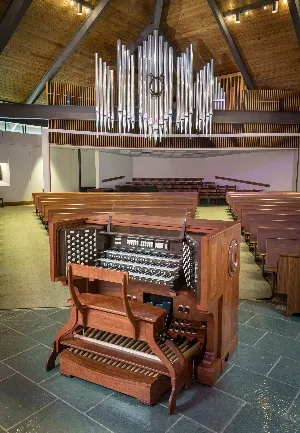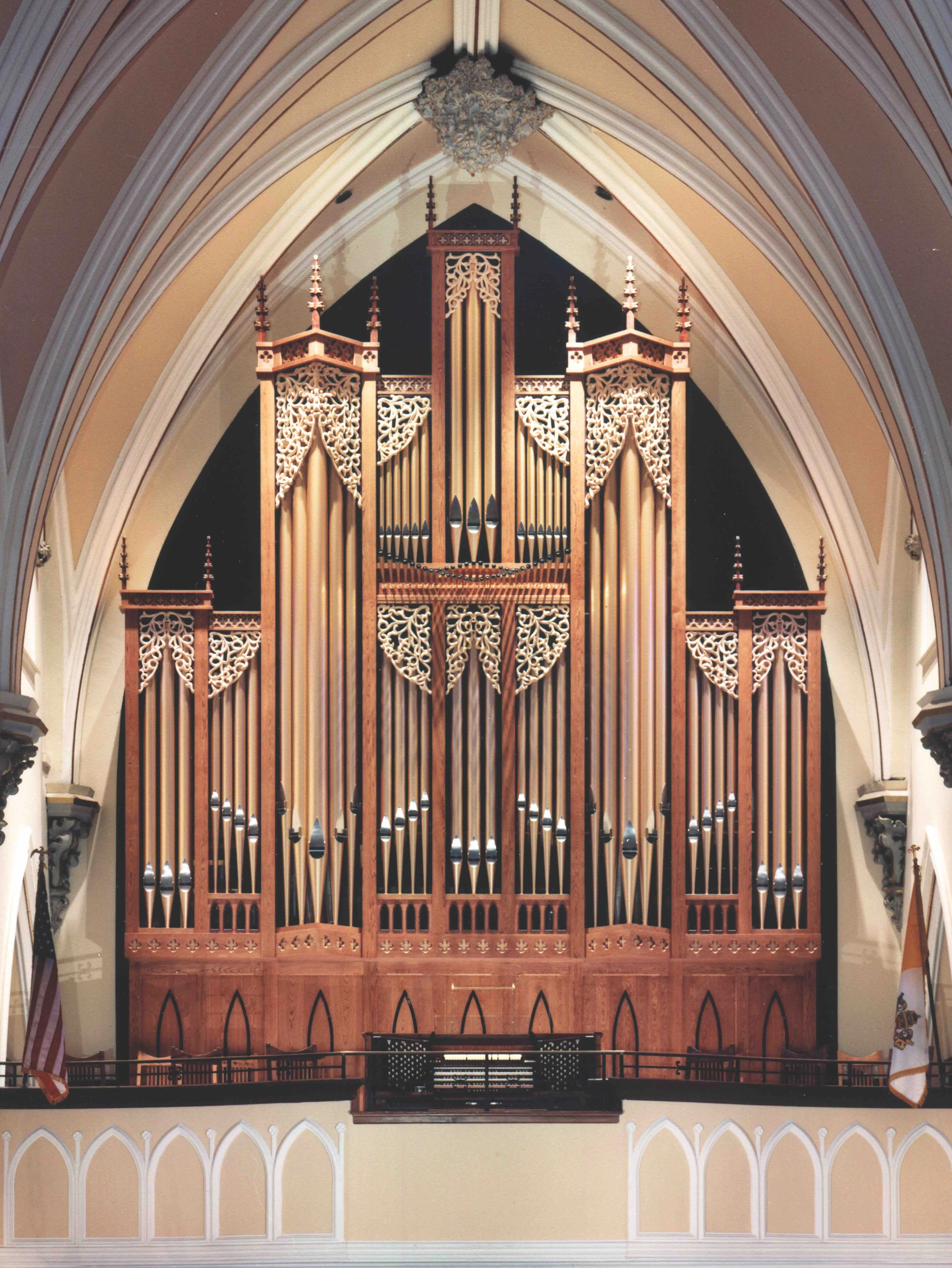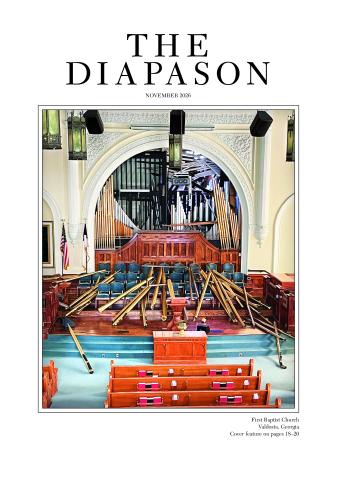
Cover Feature: Kegg Pipe Organ Builders, St. Andrew's, Houston
Kegg Pipe Organ Builders, Hartville, Ohio; Saint Andrew’s Episcopal Church, Houston, Texas
From the builder
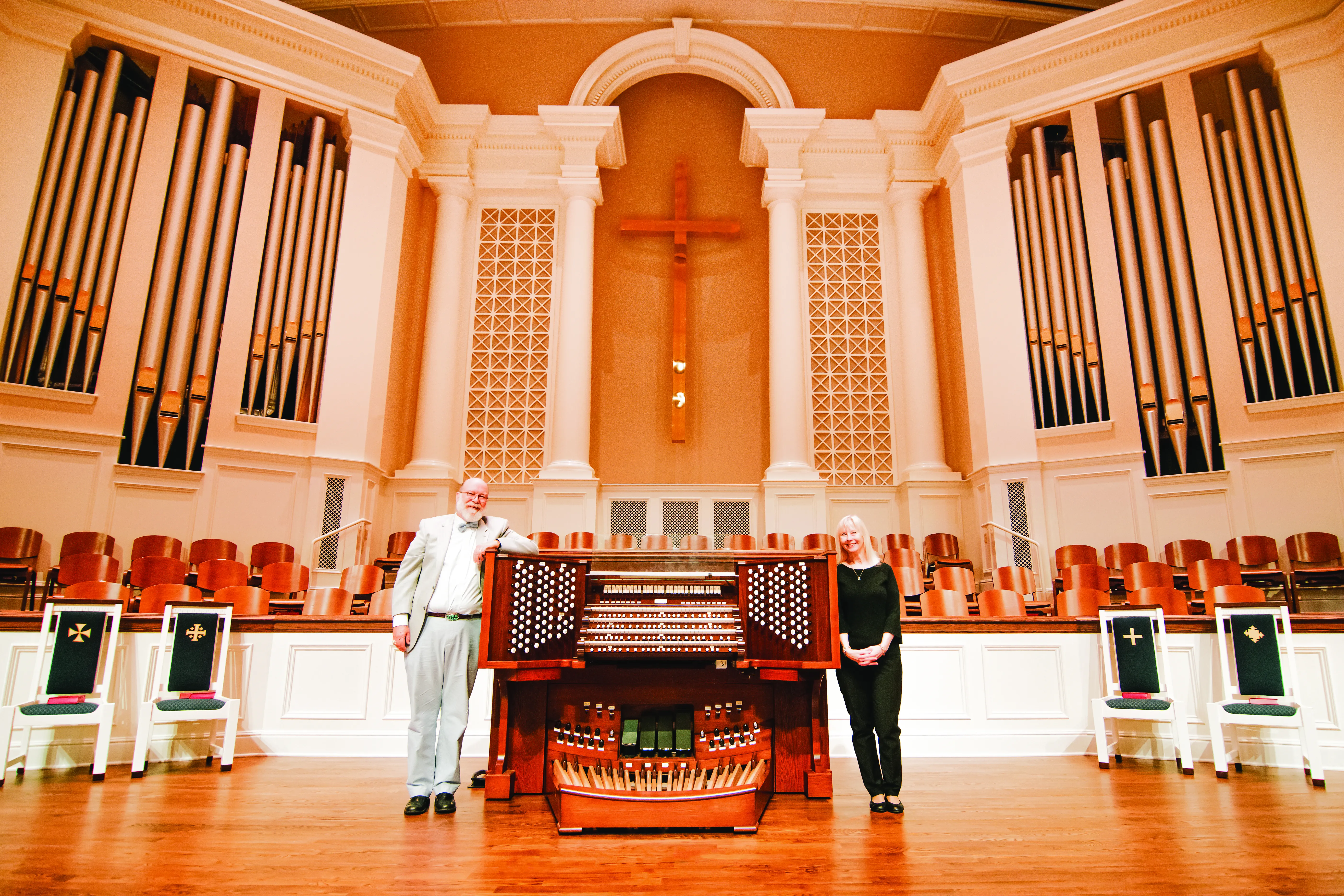
A knowledgeable and fortunate pipe organ builder grows and evolves throughout their career. I have consistently aimed to design organs that will perform all music with passion, particularly excelling in American church music by accompanying timeless choral and liturgical pieces while further graciously leading hymns. When I established my company in the 1980s, I believed that the organ style most suited to this objective would be warmer and more romantic than what was typically prevalent at that time. I further developed concepts to best cater to my clients regarding stoplists and the type of action that would fulfill my aim. I endeavored to create musical organs that were engaging to play and listen to, utilizing the most suitable technology available, whether it be modern or historical. Our new organ at Saint Andrew’s Episcopal Church exemplifies the evolution of the Kegg style and incorporates all elements I consider essential in a modest instrument for a complex and varied music program.
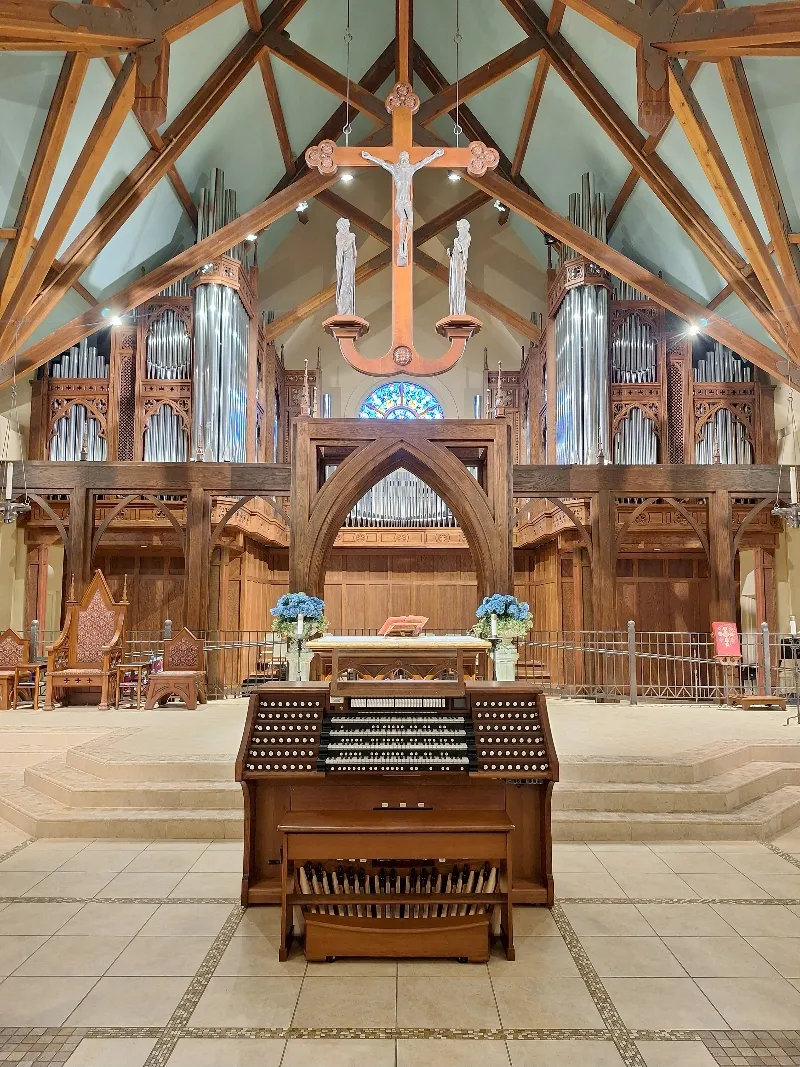
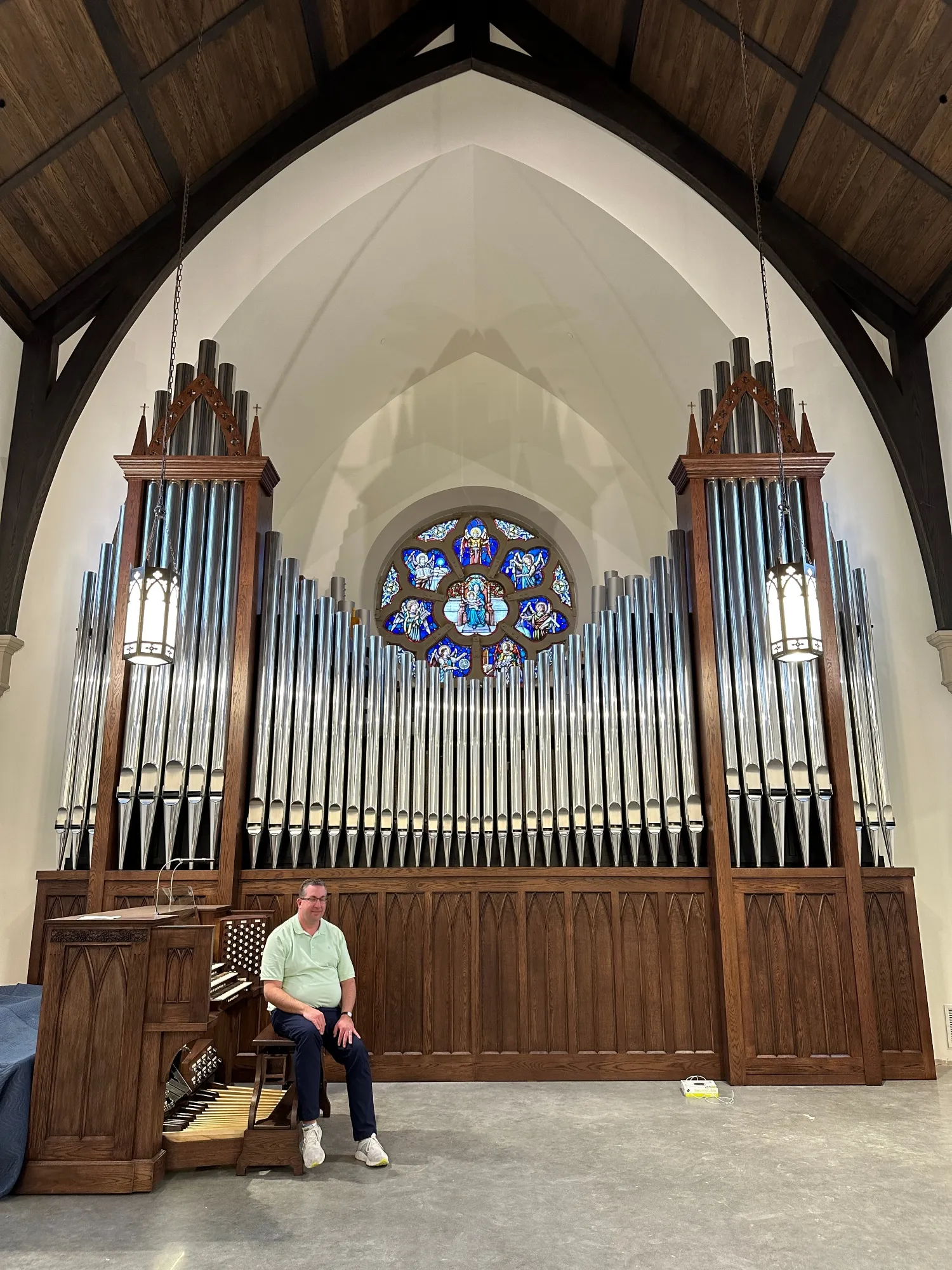
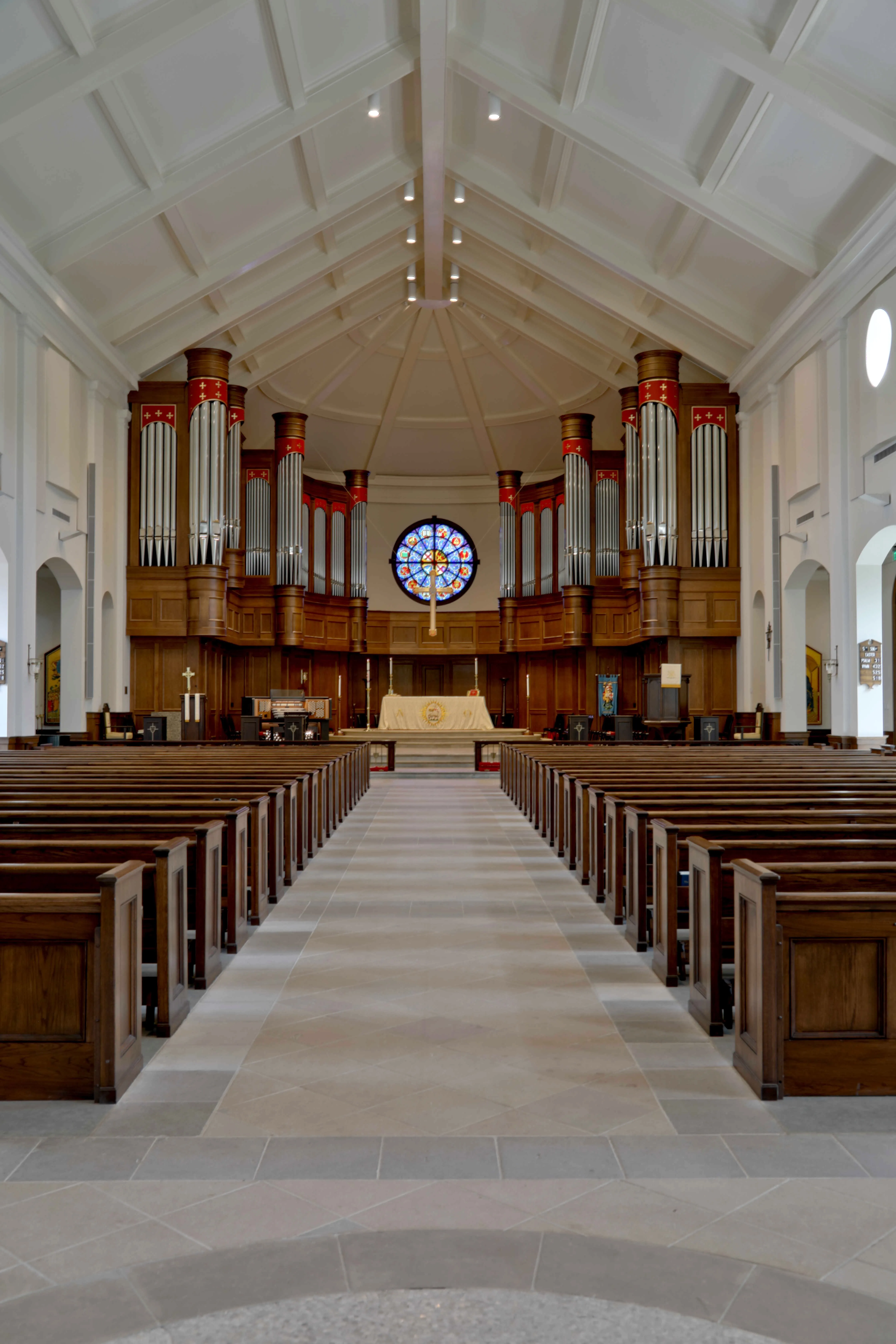
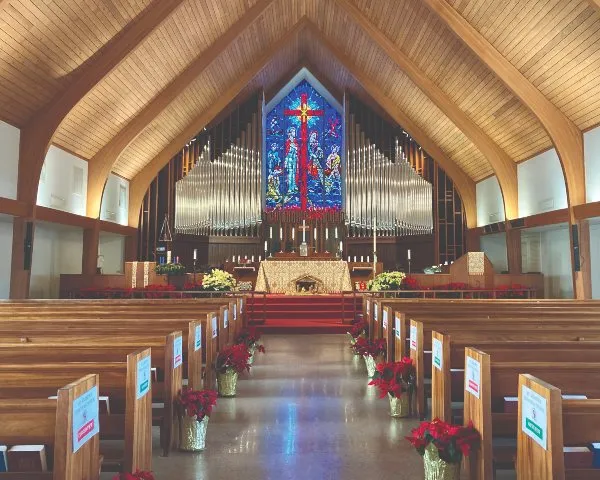
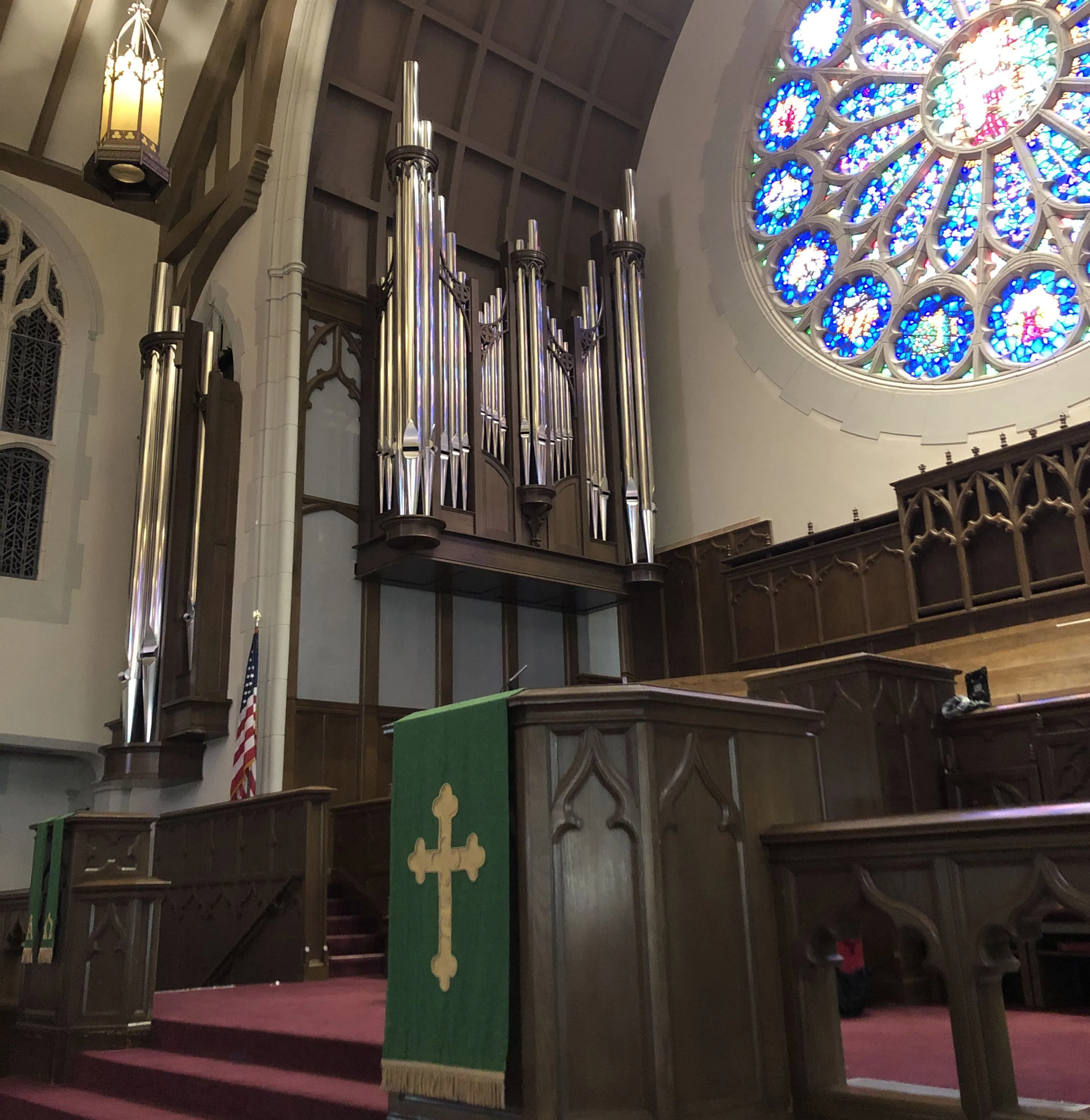
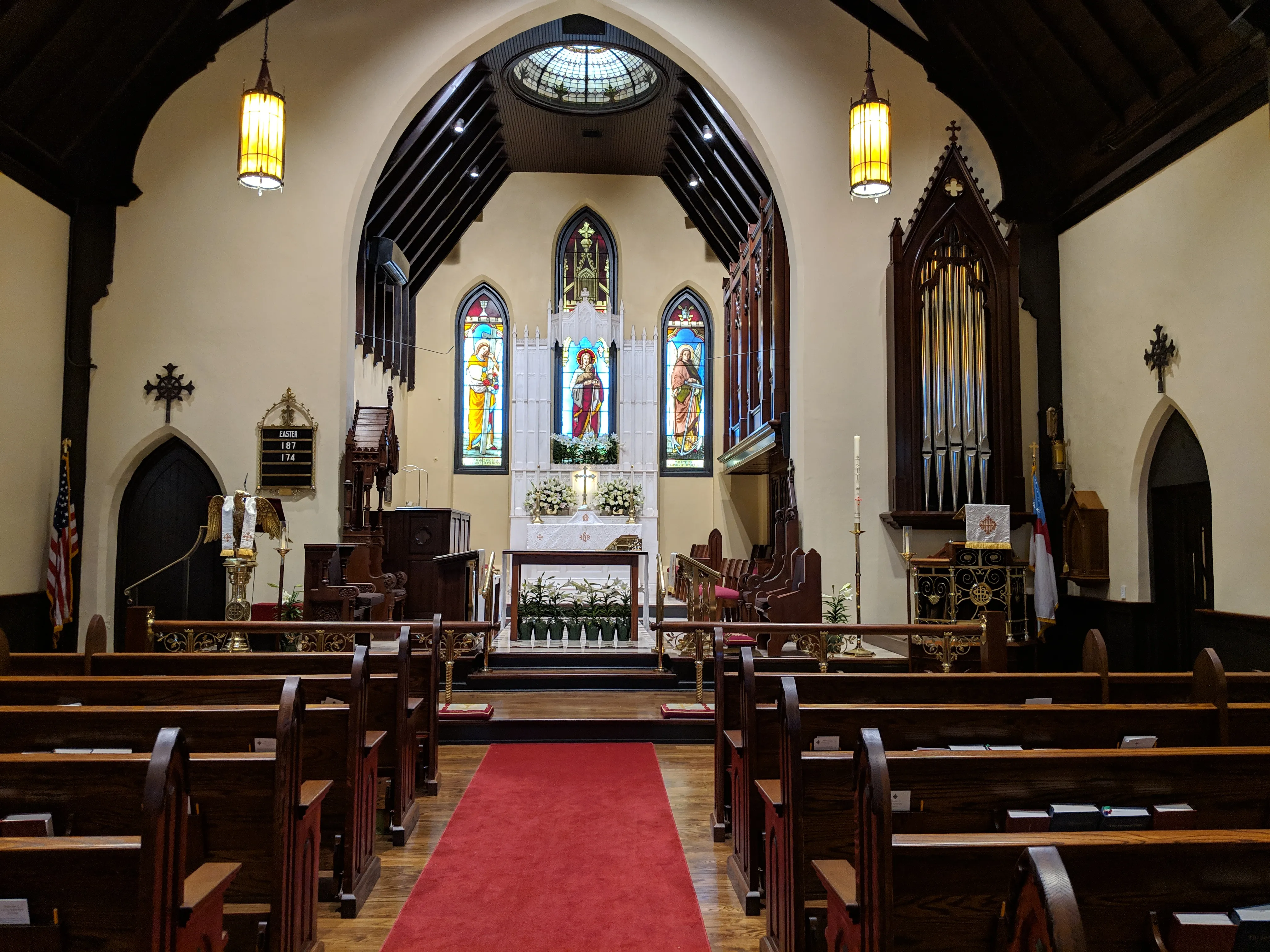
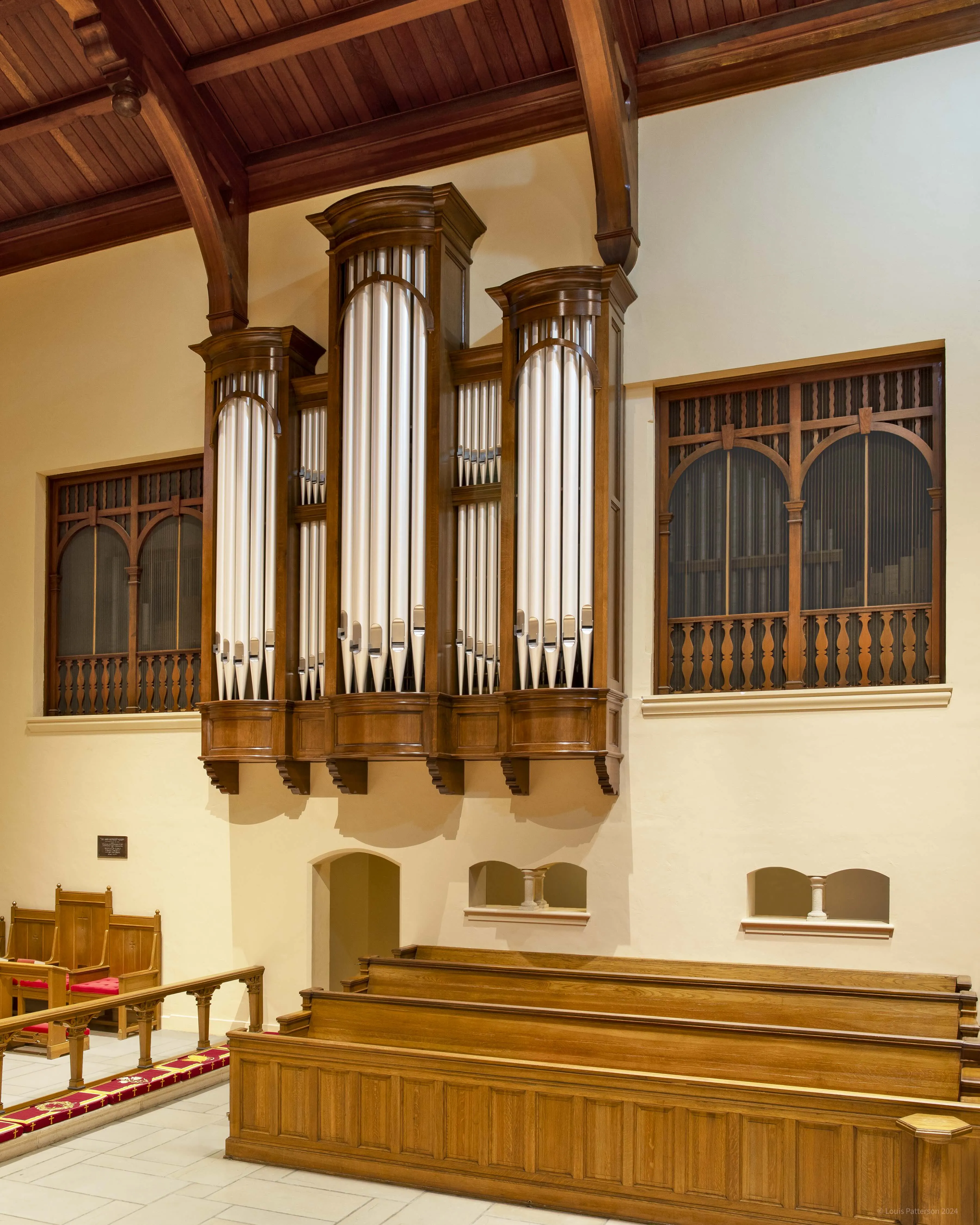
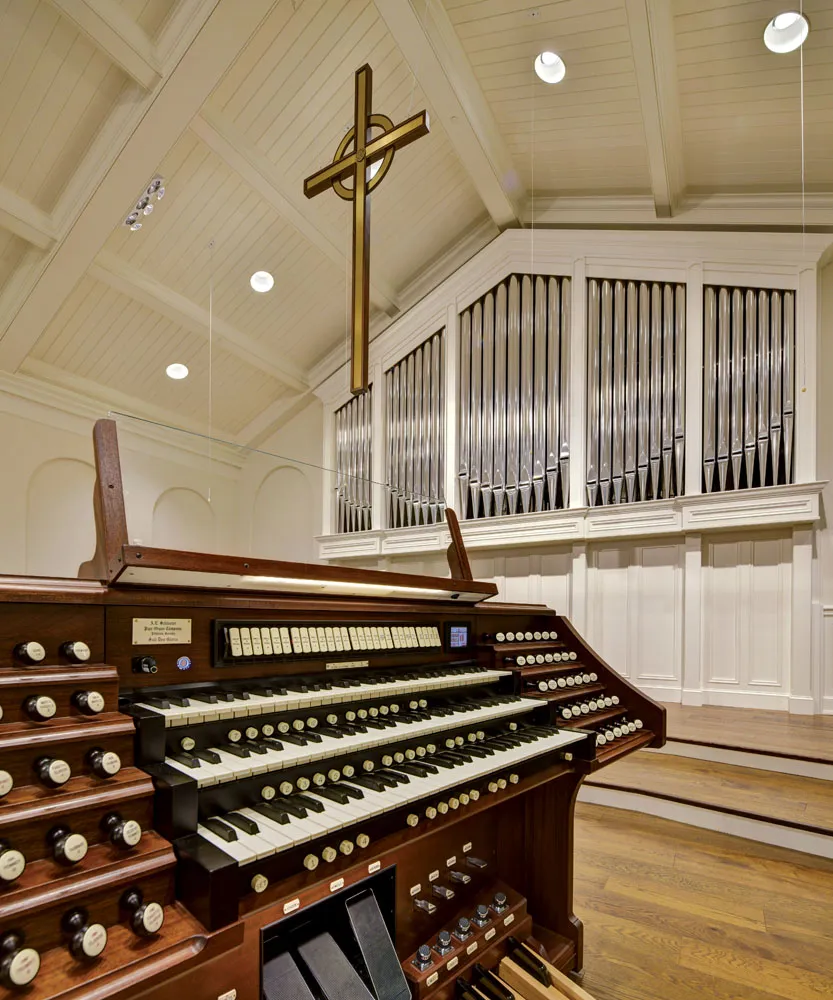
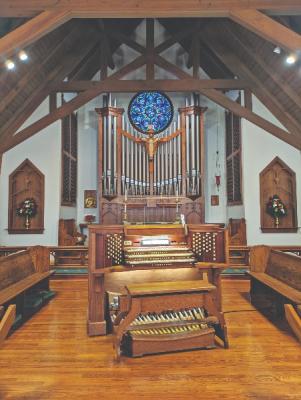
When we initially started our discussions with the parish, the intention was to position the organ beside the chancel. I came to the realization that the organ the committee envisioned would not be suitable for that location. Furthermore, I thought it was unfortunate that the beautiful rose window above the altar was nearly obscured by the roof trusses. There were minor indications of organ chambers at the sides of the altar that were being utilized as closets. Considering all these factors, we formulated a proposal to expand the side chambers to a functional size, lower the rose window, and move the altar in order to accommodate a new organ case. I presented this idea with some apprehension, as one might expect. Such proposals can lead to removal from the premises. However, after considering the exquisite window and how essential elements of the altar were reimagined in the new organ case, the committee recognized that this was a favorable direction, and we continued to pursue this course. The central case incorporates a tabernacle and shelves for candles, elements found in the former altar. This new case also features the Christus Rex from the previous altar as its focal point. The revisions appear as if they always belonged in that space.
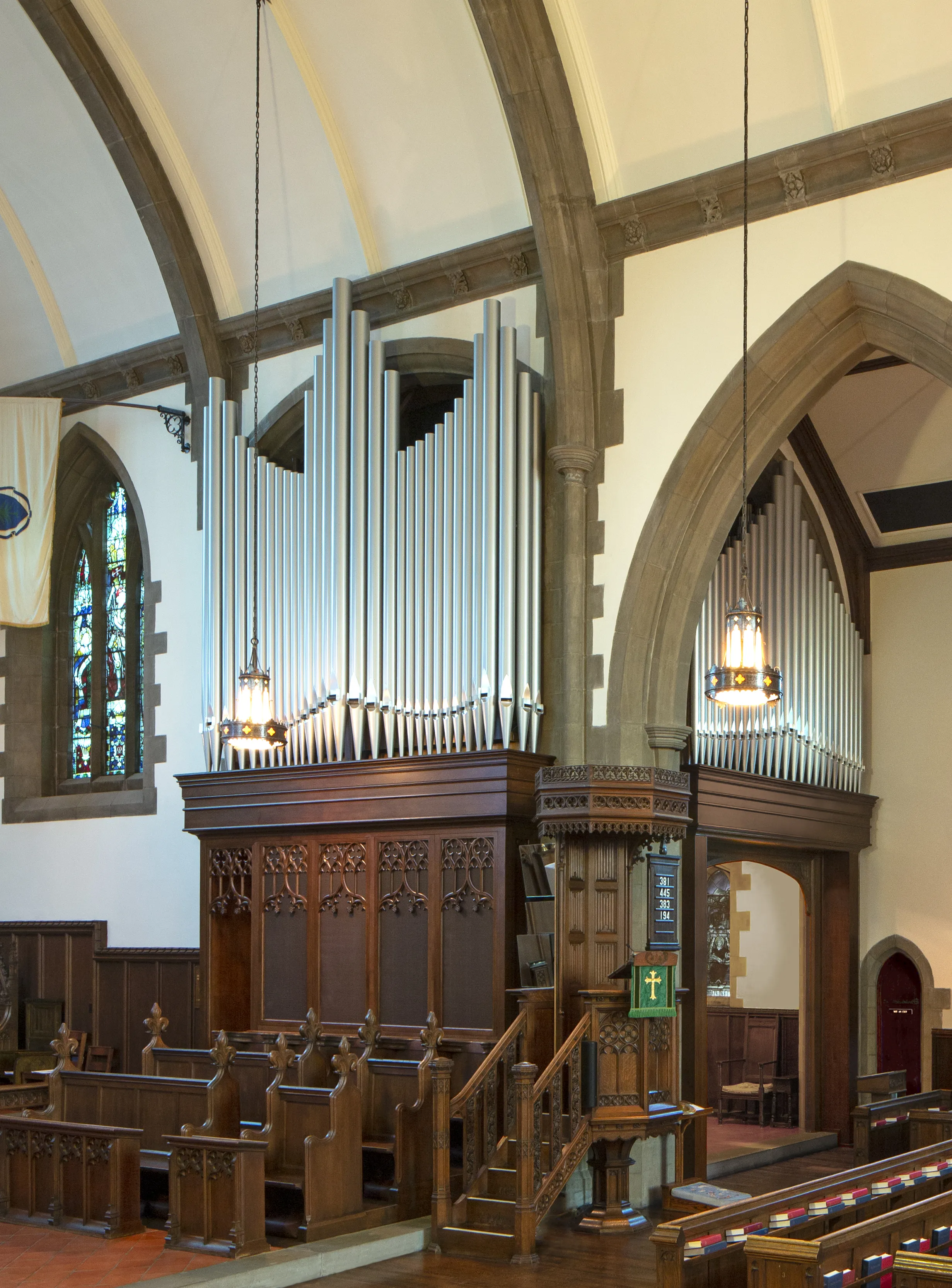
The organ musically encompasses all the essential components required for the American Episcopal choral tradition, appropriately scaled to the size of the building, while also delivering the necessary choruses and structure to render most organ literature in an engaging manner. Several aspects are particularly noteworthy. The 16′ Tuba draws inspiration from an Ernest M. Skinner model, characterized by its richness, power, and smoothness, serving as a mezzo-piano solo voice as it is placed behind the Choir shades. The Flute Celeste elevates the listener’s experience akin to aural incense. The Solo Diapason mimics the effect of a First Open Diapason by incorporating three principal stops, all at 8′ pitch. The stops employed for this purpose are the Great Principal, Octave, and Pedal Principal, creating a truly enchanting atmosphere in this context.
We aspire that this organ will benefit this joyful congregation for many generations ahead. I express my gratitude to Music Director John Kirk, whose friendship and enthusiasm have been apparent in all our discussions from the outset.
—Charles Kegg
Kegg Pipe Organ Builders
Spencer Bean
Philip Brown
Michael Carden
Justin Dana
Joyce Harper
Bruce Schutrum
Philip Laakso
Paul Watkins
From the director of music
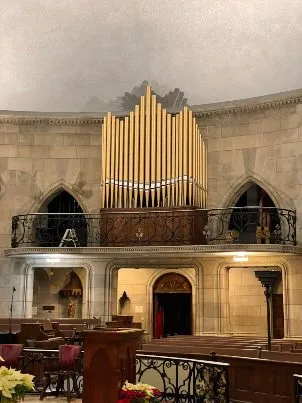
Saint Andrew’s Episcopal Church, established in 1911, is situated in the historic tree-lined area of The Heights in Houston. Upon my arrival a decade ago, I was pleased to discover a welcoming congregation that appreciates high-quality liturgy (without being overly particular) and enthusiastically sung hymns, service music, and psalms. The parish had been saving for a pipe organ for many years, and in the 1990s they installed a 1909 Pilcher organ, enhanced with several ranks of vintage pipework. Due to limitations in space, the 13-rank instrument was completely enclosed and situated in the gallery above the narthex, yet the choir and console were positioned in the chancel. Despite having good pipework and excellent voicing, the distance between the choir, organist, and the instrument posed a continuous challenge in balancing the organ with the choir and congregation.
After the instrument incurred significant and expensive maintenance projects in 2019, we began to investigate the option of either rebuilding or replacing the instrument and moving it to the chancel, where it could more effectively support the liturgy. When the parish opted to initiate a capital campaign in 2022 entitled “Our Vision, Our Hope, Our Legacy,” the organ project emerged as a capstone of that initiative.
My initial discussions revolved around acquiring a mechanical-action instrument for Saint Andrew’s. I “matured” by hand-registering Episcopal liturgy on a stunning 24-rank tracker within a spacious acoustic environment and dedicated my graduate studies to playing on remarkable mechanical-action instruments. Consequently, I was entirely convinced of the advantages of mechanical action (and continue to be, in numerous respects) when I started engaging with builders.
Considering the spatial and financial constraints of Saint Andrew’s, I quickly understood that mechanical action would result in a restricted specification and suboptimal positioning in a dry acoustic environment. Most importantly, I aspired for Saint Andrew’s to possess an instrument that would enhance its liturgies, which led me to engage with a broader array of builders. Following the receipt of outstanding proposals from three top-tier builders, the organ committee and I reached a unanimous decision to choose Kegg Pipe Organ Builders.
I had the opportunity to experience several Kegg instruments, ranging from twelve ranks in a dry environment to 76 ranks in a highly resonant space, and each organ exhibited meticulous and exquisite voicing, liturgy-focused stoplists, and thoughtful borrowing techniques. The organ committee was similarly impressed with his instrument at the Church of the Little Flower in Saint Louis, although I did advise them to attempt to overlook the opulent acoustics found there. Additionally, Kegg’s approach to the severely constrained area at Saint Andrew’s offered a design that made it appear as though the 1946 structure had been specifically designed with an organ in consideration.
Our newly acquired organ features a range of foundational tones and is capable of supporting congregational singing across various dynamics, while effectively accompanying the choir, from the voice of an individual child to the collective sound of the choirs. It boasts a diverse assortment of reeds that enhance the color of the organ’s ensembles, can deliver a powerful solo line, or render a soft melody.
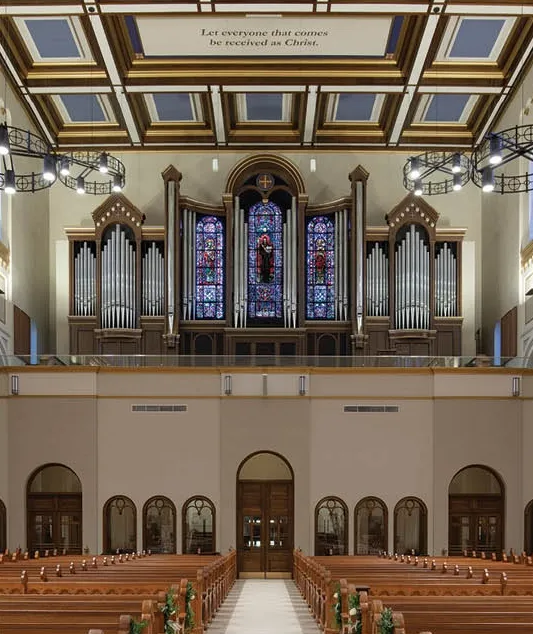
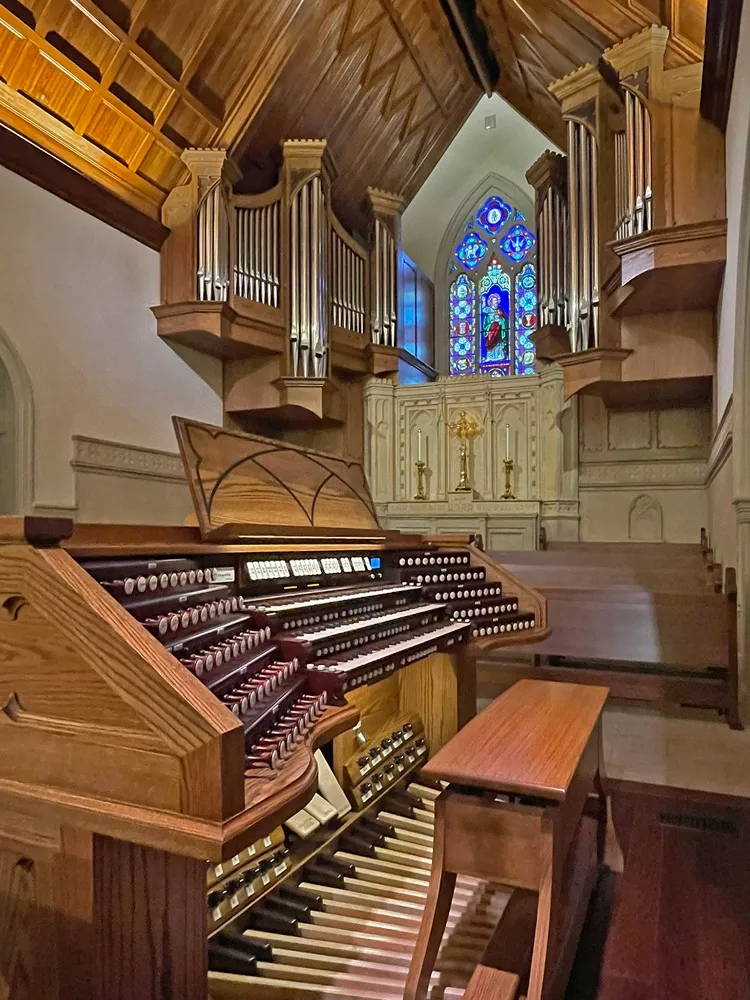
I take great pride in the fact that this organ project has enabled Saint Andrew’s to reclaim a triptych of stained-glass windows that honor the twelve apostles, which had been hidden by the former instrument. Additionally, the magnificent rose window situated above the altar was relocated to a more prominent position above the unenclosed Great façade.
The enclosed Antiphonal division is situated within a newly constructed chamber adjacent to the narthex stained-glass triptych and is designed to enhance the sound projection of the chancel instrument into the space. In addition to an 8′ Diapason, it incorporates pipework from the earlier Pilcher instrument. This organ project was fully financed by the parishioners of Saint Andrew’s; however, two families graciously contributed extra funds for the Antiphonal division, Zimbelstern, and the custom-designed tracery on the organ console, which is consistent with elements found throughout the church.
Without the foresight, effort, and commitment of our rector, the organ committee, and the whole parish, this project would not have come to fruition. Thanks to the parish’s vision and Charles Kegg’s creativity, insight, and expertise, Saint Andrew’s will persist as an inviting parish that aims to express praise and gratitude to God through art and music.
—John Kirk, Director of Music and Organist
Builder’s website: www.keggorgan.com
Church website: saecheights.org
Cover photo by G. Lyon Photography, Inc. All other photos by Charles Kegg
GREAT (manual II)
16′ Geigen Diapason (ext Ch)
8′ Solo Diapason III (collective)
8′ Principal
8′ Concert Flute (Ch)
4′ Octave
4′ Rohrflute (Ch)
2′ Fifteenth
IV Mixture (draws 2′)
8′ Tuba (Ch)
8′ Trumpet (Sw)
8′ Clarinet (Ch)
Zimbelstern
Chimes (console preparation only)
Great 16
Great Unison Off
Great 4
SWELL (manual III, enclosed)
16′ Gedeckt
8′ Geigen Diapason (Ch)
8′ Rohrflute (ext Gedeckt)
8′ Salicional
8′ Voix Celeste GG
4′ Principal
4′ Spitzflute
2 2⁄3′ Nazard TC
2′ Octave (ext Principal)
2′ Flute (ext Spitzflute)
1 3⁄5′ Tierce TC
IV Mixture
16′ Trumpet
8′ Trumpet (ext Trumpet)
8′ Oboe *
4′ Clarion (ext Trumpet)
Tremulant
Swell 16
Swell Unison Off
Swell 4
CHOIR (manual I, enclosed)
8′ Geigen Diapason
8′ Concert Flute
8′ Flauto Dolce
8′ Flute Celeste TC
4′ Rohrflute
2′ Flute (ext Rohrflute)
V Cornet (Sw)
8′ Clarinet
Tremulant
8′ Tuba (high pressure)
Choir 16
Choir Unison Off
Choir 4
ANTIPHONAL
8′ Open Diapason
8′ Gedeckt *
4′ Octave *
4′ Flute *
Tremulant
Antiphonal on Great
Antiphonal on Choir
* pipes retained from previous instrument
PEDAL
32′ Resultant
16′ Subbass
16′ Geigen Diapason (ext Ch)
16′ Gedeckt (Sw)
16′ Antiphonal Bourdon (ext Gedeckt)
8′ Principal
8′ Bass Flute (ext Subbass)
8′ Gedeckt (Sw)
4′ Octave (ext Principal)
4′ Flute (Ch Concert Flute)
32′ Harmonics
16′ Tuba (ext Ch)
16′ Trumpet (Sw)
8′ Trumpet (Sw)
4′ Clarinet (Ch)
Couplers
Great to Pedal 8, 4
Swell to Pedal 8, 4
Choir to Pedal 8, 4
Swell to Great 16, 8, 4
Choir to Great 16, 8, 4
Swell to Choir 16, 8, 4
Great/Choir Transfer
Crescendo ON
Virtuoso control system
14 General pistons
8 pistons per division
40 memories per user
Unlimited users
6 reversibles
High resolution record/play
Piston sequencer
Full Organ
Range
Clear
Undo
Swell expression pedal
Choir expression pedal
Antiphonal expression pedal / 2 memory adjustable Crescendo pedal
Bone/rosewood key tops
Tracker touch manuals
Wood stop knobs
Concave and radiating pedal clavier
Adjustable bench
Transposer
Pencil drawer
Cup holder
32 ranks, 28 stops, 1,952 pipes