Cover Feature: Fisk Opus 75, University of North Carolina School of the Arts
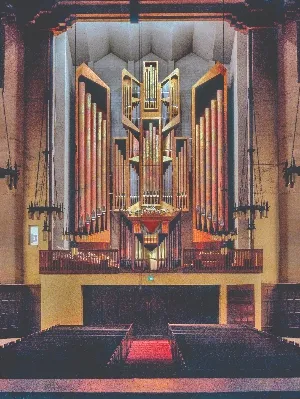
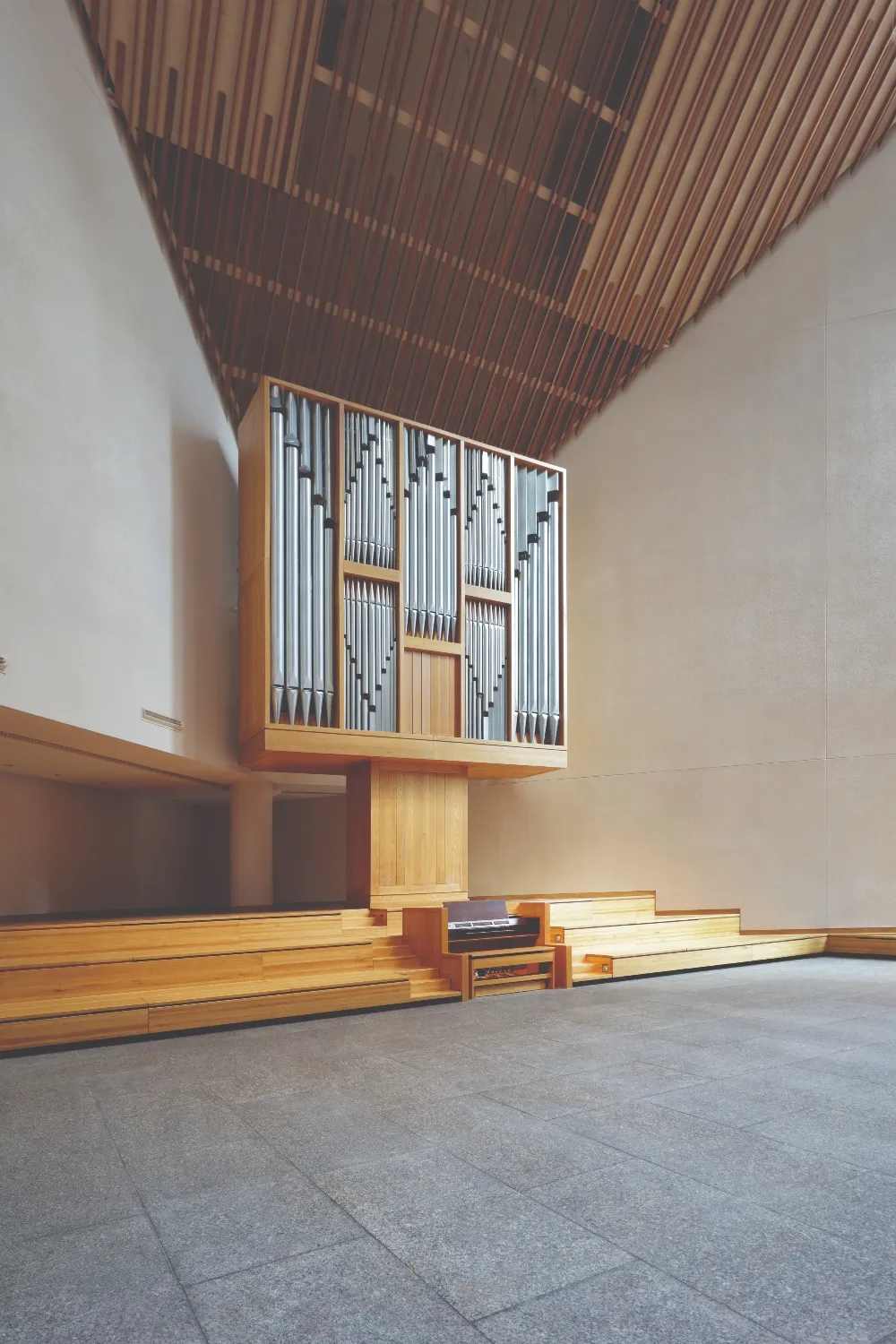
C. B. Fisk Opus 75; University of North Carolina School of the Arts, Winston-Salem, North Carolina
A little history
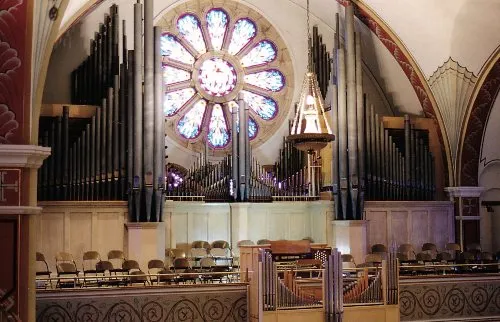
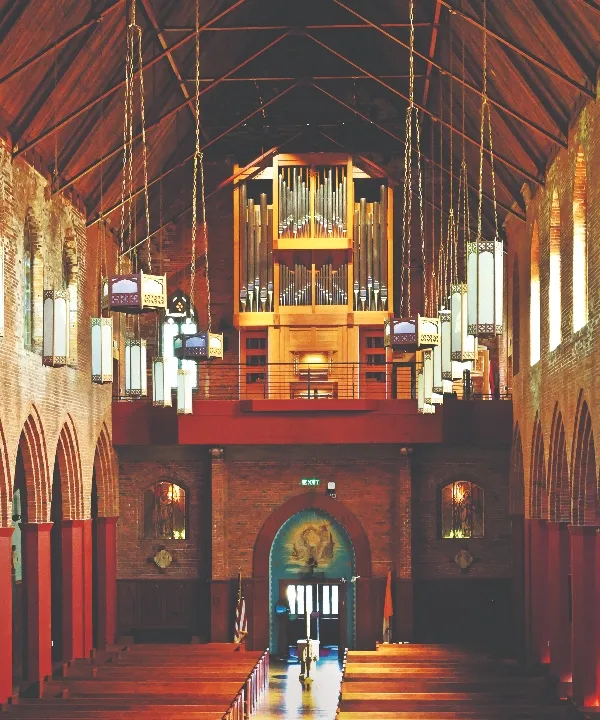
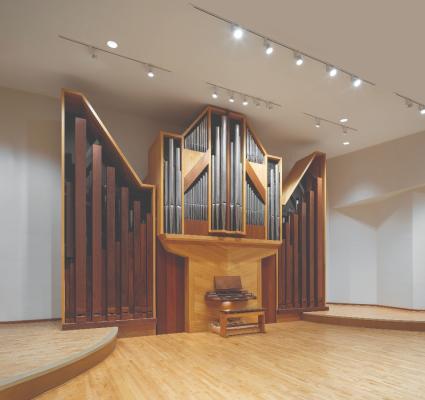
C. B. Fisk Opus 75 was originally built in 1976, concurrent with the extensive renovation of Crawford Hall at what was then the North Carolina School of the Arts. Letters and notes in our “completed work” files and architectural drawings in the shop archives show that thoughtful consideration of many aspects of the hall had taken place, especially regarding acoustics, the shape of the stage, and the type of seating.
Originally, a two-manual specification was approved, but in February of 1976 the contract was enlarged and a third manual added. These were the days of rather high inflation in the United States, and in March the NCSA Foundation made payment in full in order to avoid the typical inflationary increases specified in the contract.
Once contracted, there were a few changes. The Great 4′ flute was removed from the specification, and a 4′ principal was added to the Choir. Charles Fisk’s notes show that there were extensive discussions about the type of pedalboard, the spacing of the keyboards and pedalboards in relation to each other, and the tremulant. Other letters show the desire, on the part of School of the Arts organist John Mueller, for a Voix humaine. In May 1976 this was to be a “prepared-for” stop—room being reserved on the Great chest, but the pipes and racking not being made until some later point after the organ was installed. However, the stop was made and paid for separately before the installation.
On November 9–12 of the same year (1976), Thomas S. Kenan III, a very prominent North Carolina philanthropist—the donor of Opus 75—visited the Fisk shop to see the completed model and various parts of the organ under construction. Charles Fisk then went to Durham, North Carolina, on the weekend of December 12 to speak at “Fenner’s symposium” for the dedication of the Flentrop organ at Duke University.
Opus 75 was installed in May of the following year (1977) and finish-voiced that summer. Installation crew was Dave Waddell, Steve Dieck, David Pike, Jill Faulds, and Steve Bartlett. They stayed in the dormitories, and in researching for this article, I found the postcards that each of them sent home to the shop. On-site voicing was done by Charles Fisk and Barbara Owen with assistance from the youngsters of the time, Stephen Paul Kowalyshyn and David Pike, both of whom are still working at Fisk fifty years later! The new organ was announced on page 18 of the December 1977 issue of The Diapason:
Charles B. Fisk, Gloucester, Mass.; built for North Carolina School of the Arts, Winston-Salem, NC. 3 manual and pedal, 50 ranks; suspended mechanical key and stop action. In remodeled school auditorium, with case of red oak and oiled red Honduras mahogany; Swell placed behind Choir, with shades in slanted angles of upper case. Installation of trackers at 10 degree angle permits keyboards to be placed as far outward from case as possible. Manual compass 56 notes, pedal 30. Flexible winding system patterned after Gottfried Silbermann; large winker-type reservoir may be engaged for more immediate wind supply by drawing wind stabilizer stopknob. Dedication recital December 3 by John Mueller, organ teacher at the school, who worked with builder in drawing up design.
The dedication events took place over the weekend of December 2–4, with an organ and orchestra concert on Friday night, a solo recital by John Mueller on Saturday night, and another recital on Sunday night, shared by alumni Harry Huff and Jane Graham Ryan.
The Zeitgeist of the time
Aside from these basic facts, what was in the air in the organ world in the 1970s? One could observe that the connection between various academic institutions and the Fisk firm was strong, and there was serious academic interest in the acquisition of instruments built according to classical European principles. The Fisk shop—then and now—had a philosophy of exploration, of research into historical methods, and a desire to “translate” and recreate the sounds of old European instruments. Charles Fisk took two study trips to France and Germany during the 1970s, seeing many old organs, taking extensive notes, making sketches, measurements, and tracings. He was entranced and heavily influenced by what he observed, especially by the work of Gottfried Silbermann and Louis-Alexandre Clicquot. (Fisk, Travel Notes, pp. 3–12, 14–16, 17–27, 65–68.)
At the time that Opus 75 was built, the concept of instruments that could do one thing well was at the leading edge of organbuilding. Fenner Douglass and Charles Fisk were both striving to create organs that were works of art in their own right. They were not interested in anything pusillanimous or half-hearted. The goal was to build organs that had as much artistic and historic integrity as they could practically (and sometimes impractically) produce, and to create sounds that would make people sit up and pay attention. These were the days when classical case design, mechanical key and stop action, as well as flexible-wind, low-pressure, and a tree-like wind system were still relatively new concepts in American organbuilding.
But Fisk, though he was absolutely running along the path of research into classical organbuilding techniques and had a close personal friendship with Fenner Douglass, could never resist trying to make the organ capable of doing a little bit “more.” At the Greensboro College Organ and Church Music Conference in 1980, when he was asked for “Some final thoughts on copying old organs and eclecticism,” he said:
[To Fenner Douglass:] I think really, you and I . . . agree . . . you talk about organs which are not true (I mean, I’ve heard you for years) and the thing that worries you is organs (if I may be so bold) . . . which don’t cleave to any particular idea of what an organ is—that are just reaching out in all directions at once. And . . . when I say that people who build organs are laboring under illusions of what was really done in any . . . classical or romantic time in the way of good organ building, I think . . . those are saying the same thing.
I will probably never really give up the idea of trying to . . . add a little wing [to an organ] that will produce something else that I like; I am that American . . . we won’t do this to the Wellesley organ, but . . . I don’t think . . . I will ever get out of the habit of thinking, “My, wouldn’t it be nice if . . . ” I’d say, “Fenner won’t like this, but wouldn’t it . . . ” [Transcription of recorded conversation, quoted by Barbara Owen in Charles Brenton Fisk Organ Builder, vol. 2, pp. 160–161].
Barbara Owen summarized the apparent dichotomy thus:
Charles Fisk acknowledged what many could not accept in the 1950s—if an organ is to be really good, if it is to soar above mere functionalism and be a work of art, it simply cannot be all things to all people. But he also believed that if an organ was truly well-designed and beautifully voiced, if it brought music of any kind to a high level, then it would always be capable of more than it might appear to be able to do. (Owen, in Preface to CBF, vol. 2)
The way this author puts it: formulaic organbuilding produces mundane and unremarkable instruments. Excellence and intellectual honesty require not merely careful work, but also educated good taste, open-minded experimentation, and a bit of artistic risk.
Another major influence—still a major influence even today—was Charles Ferguson’s translation of Dom Bédos de Celles’ L’art du facteur l’orgues into English. The translation was published in 1979, but Ferguson and Fisk were in correspondence about this work at least as early as 1973. Fisk was one of the five to whom Ferguson sent his handwritten manuscript installments for technical advice on nomenclature, tools, measuring conventions, and compositional coherence. (The others were George Becker, Jr., M.D., Fenner Douglass, Charles Krigbaum [at Yale], and Bruce Spiegelberg, an expert on early tools.) We also know that Fisk discussed Dom Bédos with Frank Taylor (heir of Melville Smith’s teaching on French Classical repertoire, and who translated a section for the publication). (Photo in Cornell, Charles Fisk, Revolution or Evolution?????: Speculative Meanderings.) The Fisk shop reed maker at that time, Roland Dumas, also participated, translating the section on reeds and copying proportions from some of the plates onto a roll of adding-machine paper, from an original printing of the Dom Bédos at the Boston Public Library. (Phone interview with Robert Cornell)
The purpose of all the study and research was to reclaim some measure of historical authenticity in the construction of new organs. Fenner Douglass summed up the idea rather well in a letter to William Metcalf at the University of Vermont (home of Fisk Opus 68) in 1974:
The least satisfactory approach to successful or authentic registrations in organ music lies in the notion that musical effect emerges from simple lists of stops, applied to any instrument equipped with stops bearing those names. Equally fallacious is the notion that an all-purpose organ can be devised at all, suitable for the needs of the entire literature. Organ building of the seventies tends to rely increasingly upon inspiration derived from distinct historical traditions rather than a fusion of various stylistic patterns.
David Fuller (University of Buffalo, home of Fisk Opus 95) (in the January 1973 issue of The Diapason) put it another way:
Now it is time to begin sorting out the sub-species and give our organists and audiences the experience of old French and Italian music, as well as the different schools of German music, on the proper kinds of instruments. This means copying—an encouraging start on Classical French organs has already been made—and of course we already have two or three early English organs. If we are lucky, the future may see essays on big European romantic organs. . . . In any case, it is not a matter of satisfying curiosity, but of broadening our musical experience, of bringing whole segments of the literature for our instrument back to life.
We must start by going all the way. This means that some instruments need to be built in this country with all the limitations as well as all the positive qualities of specific types of historical organs.
The Fisk firm has indeed explored many historic styles over the intervening years. Examples are the North German Opus 72 at Wellesley College; extensive Silbermann explorations in Opus 87 at the University of Michigan; early Italian forays at Mount Holyoke College (Opus 84), the Episcopal Cathedral in Cincinnati (Opus 148), and Christ Church, Christiana Hundred (Opus 164), as well as numerous French Romantic instruments á la Cavaillé-Coll: Rice University (Opus 109), Oberlin College (Opus 116), Plymouth Congregational Church, Seattle (Opus 140), and Church of the Little Flower, Coral Gables, Florida (Opus 166), currently under construction, with three Barker machines inspired by those of the Eugène Puget organ at Notre-Dame de la Dalbade, Toulouse.
Specific historical precedents in Opus 75
After his visits to Europe in 1974 and 1977, Fisk set about using the acquired knowledge in as many ways as he could accomplish. From the Silbermanns at Rötha and Grosshartmannsdorf, he copied the wind system, the tremblant doux, and the position of the “Choir” division in relation to the Great, the way the key action goes through the Great to get to the Choir, and the angle and thickness of the flue pipe languids in various stops. He had read all of Charles Ferguson’s Dom Bédos translation, and started his own pipe shop in earnest in 1976; Opus 75 is the first to use hammered lead cast and hammered in the Fisk pipe shop for some of its ranks.
From the 1734 Louis-Alexandre Clicquot at Houdan, he copied the Voix humaine and very likely the mixture composition for the Choir (having a 5 1⁄3′ come in at G#2!). He definitely had the sound of Clicquot reeds in his mind for the Great and Pedal divisions, and in his voicing he was working to achieve those sounds, but, of course, in radically different acoustical situations. Influenced again by Fenner Douglass and by the 1898/9 Mutin-Cavaillé-Coll at Saint-Esprit, Paris (Fisk, Travel Journal, pp. 69–70), he made the Swell reeds capable of some French Romantic literature.
Goals of the present project
There were three overall desires for the project: ensuring continued mechanical fitness; expanding the tonal possibilities by replacing two ranks; improving the balance and blend of the Great chorus and selected other ranks.
This project was numbered “75I” (the major maintenance and additions) and “75J” (stopknob refurbishment)—there had already been projects 75A through 75H over the years since 1977. Maintenance is crucial to any instrument, especially one that is heavily used every day by generations of students, and this school has done a good job of caring for the instrument. Would that all organs were maintained as well as this!
In approaching work on an instrument that is, at least to some degree, recognized as historically significant, one should rather carefully consider what to do. Some of that caution is rightfully engendered by considering the builder’s original intent.
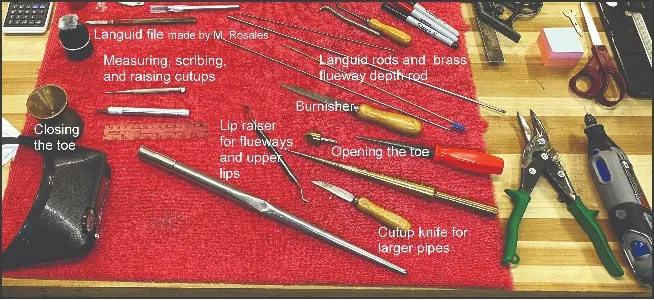
One of our oft-repeated sayings at Fisk is, “Why go half-way when you can go too far?” It has a logical corollary: “You never know that you have gone too far until you do,” sometimes phrased as, “You can’t find the middle until you know where the edges are.” The concept also applies in the microcosm of voicing. The type of sound that Charles Fisk was trying to achieve in the Opus 75 Great principal chorus was that of Gottfried Silbermann, and that meant that he wanted to cutup the pipes perhaps higher than some voicers would consider “safe.” He was not naïve, he knew that “just right” is just shy of “too far.” Those who knew him well testify that he was constantly pushing the limit of possibility in the quest for his concept of excellence. When the crew for this project had the façade pipes down, cutting them apart to lower their cutups, we found one that had clearly been cut up too high, and then had had a piece of metal soldered onto the upper lip, and the cutup process started again. We think that this was Charlie’s “mea culpa” and a clear indication that he was aware that he had gone just a bit too far. We didn’t see this until we had already made the decision to lower all the façade cutups, but after a wry laugh, we realized that it gave us the confidence to do this work without any reservation.
Details of the work—“What we did last summer”
• Releathered the manual and (two) pedal bellows of the organ. (Tricky removal, but thankfully we didn’t have to cut any structural supports.)
• Solidified and reduced noise in the mechanical stop action (involved removing pipework on the Great and Positiv, sometimes several times, to mitigate slider vibration issues).
• Made and installed new Swell shades and frames (in the upward-facing diagonal sections of the swell). Originally, there were only swell shutters on these side diagonals of the upper case, facing up to the ceiling. The old shades were of the very light “airplane wing” variety and did not hold the sound in—tight Swells were not considered terribly crucial in the 1970s. An older version of solid shades with interlocking edge profiles had already been added to the front of the Swell at some point in the past.
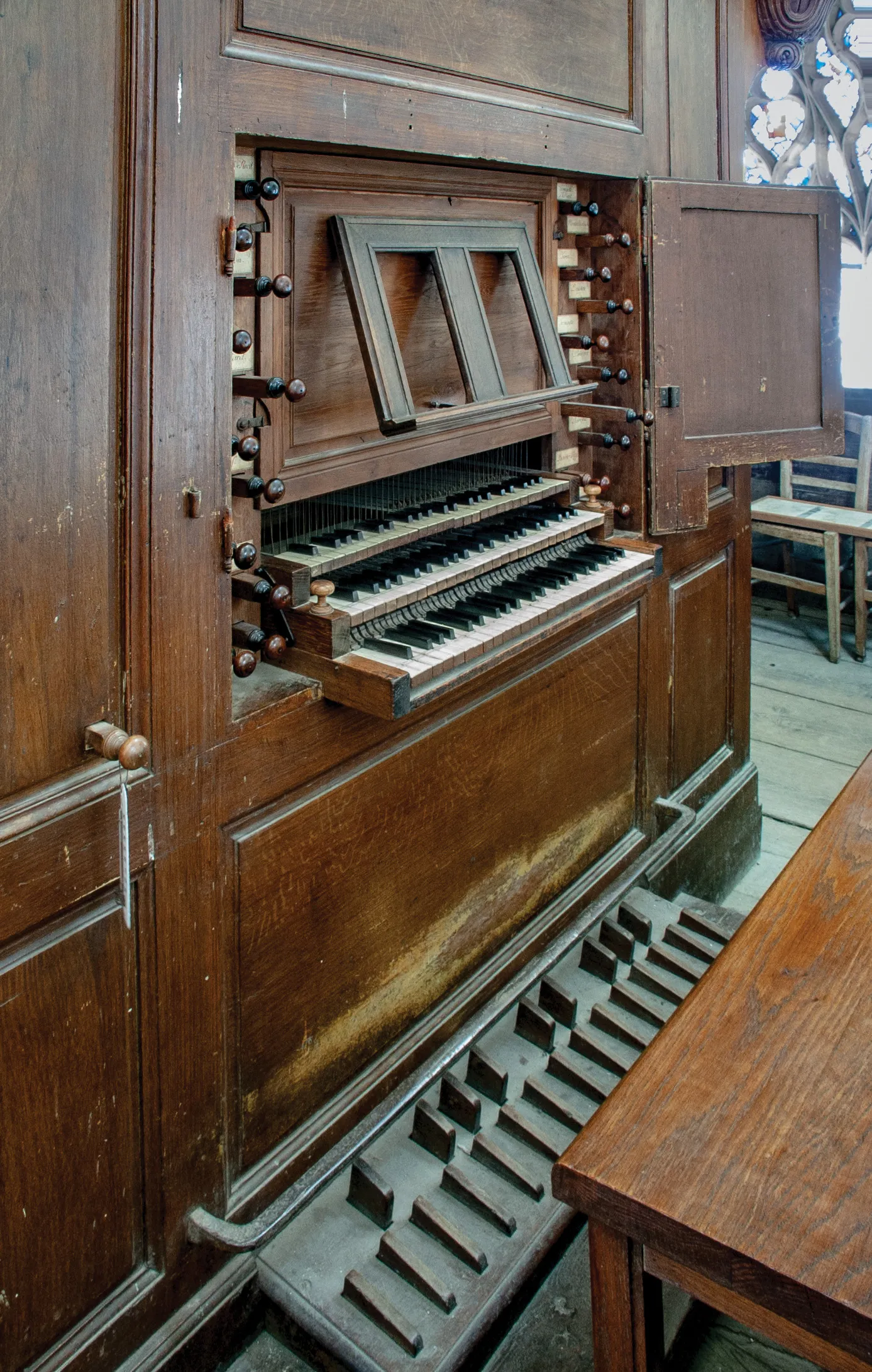
• Modified Pedal key action and installed new Fisk-style concave-parallel pedalboard (30-note, flat/parallel, but with the tops of the naturals and sharps concave, and the front of the sharps radiating).
• Installed and voiced a new full-length, conical Pedal Basson 16′ (a French stop) to replace the original cylindrical Bassoon 16′ (a Germanic stop).
• Installed and voiced a new Great Open Flute 4′ to replace the original Clarion 4′.
• Lowered cutups on the Great Prestant 8′ (façade pipes)
• Adjusted voicing of Great fluework as necessary on Great 8′, 4′, 2′, and Mixture.
• Regulated the existing reeds of the organ.
• Replaced tuning wires on the Swell Hautbois 8′. Adjusted voicing of notes 1–24. (Soldered up the large slots at the top of the bells, and put new, small slots at the very bottom of the bells. Also weighted the tongues in the bottom two octaves to soften and mellow.)
• Regulated the mechanical key action. (It has aluminum trackers, but does have adjustable Heuss nuts in necessary places.)
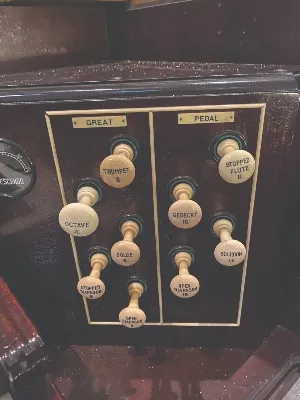
• Removed all stop knobs (a truly laborious process involving a lot of steam), had them re-engraved, refilled the engraving, reinstalled them.
• Cleaned and re-oiled the console.
• Through-tuned the organ. (With special thanks to the facilities personnel and the HVAC contractor at UNSCA who achieved much better temperature control this time, which allowed the best tuning this instrument has ever had.)
Musical priorities and perspectives change over the years. French Classical and German Baroque literature are very much still with us of course, but not quite so exclusively in the foreground. The rejuvenation was celebrated in October with a weekend of events commemorating the legacy of beloved organ teachers John and Margaret Mueller, including a masterclass with Jack Mitchener, a lecture by Russell Stinson, and a fabulous solo recital by Timothy Olsen, who heads the Organ Department at UNSCA, and was a most valuable collaborator on the project. Opus 75 was always a combination of French Classical reeds (in Great and Pedal), Silberman-inspired flue work, and Cavaillé-Coll reeds in the Swell. The two new stops are conducive to further forays into French Romantic literature, and all of the work should keep this instrument in great shape for the next several generations of students.
—Carl Klein, DMA
Director Special Projects & Maintenance, Reed Maker, Voicer
C. B. Fisk, Inc.
Bibliography
Cornell, Robert. Charles Fisk, Revolution or Evolution?????: Speculative Meanderings. Talk at Old West Church, Boston, May 11, 2002 [Photo of Charles Fisk and Frank Taylor studying Dom Bedos together]
Completed Work Files at the Fisk Shop:
Opus 75, Opus 75A (North Carolina School of the Arts)
Opus 68 (University of Vermont)
J28 (Smithsonian Institute Snetzler Restoration)
Douglass, Fenner, Owen Jander, and Barbara Owen. Charles Brenton Fisk Organ Builder, vol. 1. Easthampton, MA: Westfield Center for Early Keyboard Studies, 1986.
Douglass, Fenner. The Language of the Classical French Organ. New Haven: Yale University Press, 1969.
Douglass, Fenner. Cavaillé-Coll and the Musicians. Raleigh, NC: Sunbury Press, 1980.
Ferguson, Charles. Letters & Handwritten Manuscript copy of Dom Bedos, marginal annotations by Charles Fisk, 1973.
Ferguson, Charles, translator. The Organ-Builder, by Francois Bédos de Celles, O.S.B., Vols. 1 & 2. Raleigh, NC: Sunbury Press, 1977.
Fesperman, John. Two Essays on Organ Design. Raleigh, NC: Sunbury Press, 1975.
Fisk, Charles. Travel Data, 1974 and 1977.
Fisk, Charles and Fenner Douglass. Letters covering the period 1964 to 1978.
Fuller, David. “Historical Purism in Organ Design.” The Diapason, January 1973, p. 2.
Owen, Barbara. Charles Brenton Fisk Organ Builder, vol. 2. Easthampton, MA: Westfield Center for Early Keyboard Studies, 1986.
Pape, Uwe, ed. The Tracker Organ Revival in America. Berlin: Pape Verlag, 1977.
Riley, Willard. “Dom Bedos in English, a review.” The Diapason, February 1978, pp. 1, 10–12, 14–15.
Schweitzer, Albert. Deutsche und Französische Orgelbaukunst und Orgelkunst. Leipzig: Breitkopf & Härtel, 1906, 1927.
Taylor, Frank. “The New Fisk Organ at the University of Vermont—A Review,” The Diapason, July 1976, p. 1.
Builder’s website: cbfisk.com/
University website: www.uncsa.edu/music/organ/index.aspx
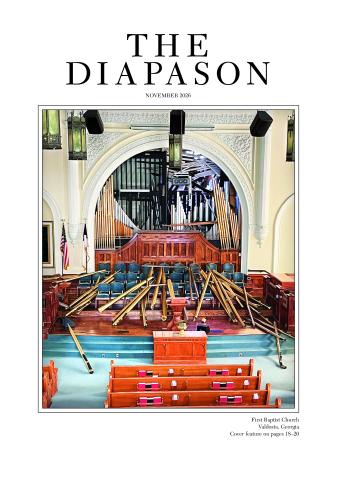
Cover photo: Tim Buchman
Timeline of the 1970s at the Fisk shop
1967: Memorial Church, Appleton Chapel, Harvard University, Cambridge, Massachusetts (Opus 46) (Dedication concert: Anton Heiller) “consciously eclectic” (Owen: CBF v. 2, p. 17) but NOT in the 1950s way
1969: Restoration of Snetzler chamber organ for the Smithsonian Institute (J28)
1970: John Fesperman: A Snetzler Chamber Organ of 1761 (Smithsonian Institute Press)
1970: Old West, Boston (Opus 55) (Dedication concert: Max Miller). Great Trumpet was first set of reeds made in the Fisk shop
1971: First Church of Christ (Center Church), New Haven, Connecticut (Opus 54). Hautboy according to Dom Bédos (Dedication concert: Charles Krigbaum)
1972: St. Paul’s, Willimantic, Connecticut (Opus 57) (Dedication concert: eventually George Becker). First opus to employ double draws; Trumpet and Cremona direct copies of François-Henri Clicquot at Poitiers
1973: Charles Ferguson and Fisk correspondence re: Dom Bédos translation
1973: David Fuller, “Historical Purism in Organ Design,” The Diapason, January 1973
1974: Charles Fisk takes study trip to Europe: April—on his own with help from Dirk Flentrop; May—with Harald Vogel. Visits (among others) the Silbermann organs at Grosshartmannsdorf and Rötha
1974: Ascension Memorial, Ipswich, Massachusetts (Opus 62) (Dedication concert: André Isoir). First use of hammered tin in the United States (F-H Clicquot trumpets)
1974: Frank Taylor records DuMage and D’Andrieu at Old West (Opus 55)
1975: John Fesperman, Two Essays on Organ Design (Smithsonian)
1975: Mireille Lagace records Buxtehude at Old West (Opus 55)
1975: Saint Michael’s, Marblehead, Massachusetts (Opus 69)
1976: Fisk pipe shop established; casting and hammering of lead begins
1976: University of Vermont (Opus 68) (Dedication concert: Fenner Douglas). Frank Taylor review in July 1976 issue of The Diapason
1976: First Presbyterian, Cazenovia, New York (Opus 70) (Dedication concert: Robert Noehren)
1977: Charles Fisk takes another study trip to Europe: with Frank Taylor and Owen Jander, guided by Klaas Bolt and Harald Vogel. Visits Houdan—Louis Alexandre Clicquot 1734 (CBF p. 65). Voix humaine copied for Opus 75
1977: First Congregational, Westfield, Massachusetts (Opus 71). Like Opus 75, heavily influenced by the Silbermann at Grosshartmannsdorf (Dedication concert: Joan Lippincott)
1977: Saint Peter’s & Saint Andrew’s, Providence, Rhode Island (Opus 74) (Dedication concert: George Kent, Frank Taylor)
1977: (University of) North Carolina School of the Arts (Opus 75) (Dedication concert: John Mueller)
1981: Wellesley College (Opus 72) (Dedication concert: Harald Vogel)
GREAT (manual I)
16′ Bourdon (W, HL) 56 pipes
8′ Prestant (SM) 56 pipes
8′ Spire Flute (HL) 56 pipes
4′ Open Flute [2025] 56 pipes
4′ Octave (HL) 56 pipes
2′ Superoctave (HL) 56 pipes
[Blockflöte (SM) 56 pipes
Cornet II (HL) 112 pipes
Mixture IV–VI (Tin) 254 pipes
8′ Trumpet (HL, HT, SM) 56 pipes
8′ Voix humaine (SM) 56 pipes
CHOIR (manual II)
8′ Gedackt (HL) 56 pipes
4′ Prestant (SM) 56 pipes
4′ Chimney Flute (HL) 56 pipes
2 2⁄3′ Nazard (SM) 56 pipes
[Sesquialtera III (SM) 112 pipes
2′ Doublet (Tin) 56 pipes
Sharp IV (Tin) 224 pipes
8′ Cromorne (HL) 56 pipes
SWELL (manual III, enclosed)
8′ Violin Diapason (HL) 56 pipes
8′ Stopt Diapason (HL) 56 pipes
4′ Spitzflute (SM) 56 pipes
2′ Fifteenth (Tin) 56 pipes
[Fourniture III (SM) 112 pipes
1 1⁄3′ Larigot (HL) 56 pipes
[Cornet III–IV (HL) 144 pipes
8′ Trumpet (SM) 56 pipes
8′ Hautbois (SM) 56 pipes
PEDAL
16′ Prestant (W) 30 pipes
8′ Octave (HL) 30 pipes
4′ Superoctave (HL) 30 pipes
[Mixture IV (HL) 90 pipes
16′ Basson [2025] 30 pipes
8′ Trumpet (HL) 30 pipes
4′ Shawm (HL) 30 pipes
Couplers
Swell to Great
Choir to Great
Swell to Choir
Great to Pedal
Choir to Pedal
Swell to Pedal
Accessories
Tremblant fort (affects whole organ)
Wind Stabilizer
[ indicates double-draw, some of which are either/or, some of which are additive
W = wood; HL = hammered lead; SM = spotted metal; HT = hammered tin
35 independent voices/2,460 pipes
Suspended mechanical action
Keyboards 56 notes/pedalboard 30 notes