
Home
  • Magazine
  • News
  • New Organs
  • Videos
  • Resource Directory
  • 2020 Resource Directory
  • Classifieds
  • Artists
  • Home
  • Events
  • 20 under 30
    • Nominate class of 2025
  • Subscribe
  • Advertise
  • About us
  • Contact us
Home
  • Magazine
  • News
  • New Organs
  • Videos
  • Resource Directory
  • Classifieds
  • Artists
  • Events
  • 20 under 30

March 2014

PDF URL
http://www.thediapason.com/sites/diapason/files/March14Full-issueSTD.pdf

Issue Content

New Organs

St. Jane Frances de Chantal Church, Bethesda, Maryland

Lively-Fulcher Organbuilders, Rocky Mount, Virginia

The Parish of St. Jane Frances de Chantal was founded in 1950 and is part of the Archdiocese of Washington. The original church building, which was designed by Philip Frohman (architect of Washington National Cathedral), underwent a major renovation and expansion project in 2001. The new sanctuary has a seating capacity for over 800 persons and features a wide nave with 65-foot ceilings. Parts of the Frohman building were preserved, including the former choir loft, which is now the liturgical south transept.
Read more
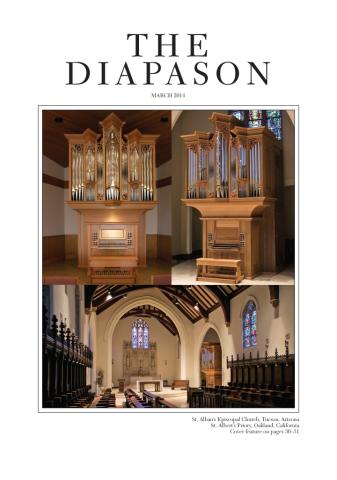
Cover feature

Paul Fritts & Company, 

Tacoma, Washington

Opus 35, St. Alban’s Episcopal Church, Tucson, Arizona

Opus 36, St. Albert’s Priory, Oakland, California

Two recent instruments by Paul Fritts & Company Organ Builders of Tacoma, Washington, while built from the same design, demonstrate how different spaces contribute greatly to unique outcomes.

Opus 35 was completed in 2012 for St. Alban’s Episcopal Church in Tucson, Arizona and Opus 36 was completed in 2013 for St. Albert’s Priory in Oakland, California. Both are modest 2-manual instruments of 22 stops. Both employ suspended mechanical key action and mechanical stop action.

Read more
M.P. Rathke restores 1897 Möller Opus 188

Zion’s Lutheran Church, East Germantown, Indiana

I first visited Zion’s Lutheran Church in 1986, near the beginning of my organbuilding apprenticeship. I recall surprise in discovering that the venerable M.P. Möller, with whose plentiful local electro-pneumatic installations I was familiar, had once built mechanical-action instruments. If Zion’s organ were representative, Möller’s tracker output had clearly been more than respectable. Apart from a stiff key action, the organ was a pleasure to play, and its 16 stops made a grand sound in this relatively small church.

Read more
Hellmuth Wolff: Mentor and Friend

A Remembrance

News of organbuilder Hellmuth Wolff’s passing on November 20, 2013, was not unexpected, but still came as a surprise and shock. He was 76 years old. Hellmuth had sent a message to let us know that he was afflicted with an asbestos-related lung condition. Twenty years ago, on one of his visits to Vancouver, I had noted that he was not much of a hiker. His respiratory difficulties had been evident for years, but it was a shock to hear that his condition was asbestos-related. Blower boxes?

Read more
The University of Michigan 53rd Conference on Organ Music

September 29–October 2, 2013

Marilyn Mason—legend in her own time, musician and teacher of international renown, torchbearer for composers, organ builders, and students, ground breaker, and pioneer—was honored in this year’s 53rd Conference on Organ Music. Mason has been consumed by a magnificent obsession, and has shared her mantra “eat, sleep, and practice” with hundreds of students at the University of Michigan.

Read more
In the wind...

Blest be the tie that binds

Our hearts in Christian love;

The fellowship of kindred minds

Is like to that above.


Read more
On Teaching

Organ Method XVIII

This month, I begin a section on putting hands and feet together. It is surprisingly straightforward. That is, if a student has become a comfortable player of pedal parts, is also comfortable playing music at a keyboard, and has not tried to put manual parts and pedal parts together prematurely (which can result in a loss of confidence and developing of bad habits), then the act of putting hands and feet together is quite natural. Learning to play manuals and pedals together in the first place requires a lot of work, and learning any given organ piece might require patient work at any stage of a player’s career. But it is possible for that effort to feel comfortable, and it should yield prompt and easily discernible results. I am trying to frame this for students in such a way that they can use this approach themselves without a teacher, but also so that a teacher can participate in the process, keep track of how it is going, and help it along. 

Before they reach this point, students should be quite accustomed to keeping track of such things as hand position, overall posture, foot angle, leg position, and everything to do with tension. Therefore they should also be able to keep track of those things in the slightly more complex circumstance of playing with both feet and all fingers. To aid the student’s understanding of the process and being able to monitor his or her own work, I include a lot of discussion (in general, but here in particular). Whether this discussion seems at all dense or overly complicated, and whether the ratio of discussion to exercises seems right, are two points about which I would find reader feedback especially useful. This month’s excerpt has, just by chance, no examples; next month’s continuation will discuss those that are referred to in the first sentence immediately below.

We now come to some exercises and discussion aimed at helping you to get comfortable putting your hands and feet together, that is, learning to play pieces for manuals and pedals. This is what is considered “typical” or “real” organ playing—though of course a healthy proportion of the organ repertoire is for manuals alone. It is what uniquely characterizes organ playing technically, and what defines the organ musically for many people.

Read more
Nunc Dimittis

Warren L. Berryman, age 91, died January 18, 2014, in Morrison, Colorado, where he had resided since 1991. Born February 24, 1922, in Omaha, Nebraska, Berryman was a graduate of the University of Nebraska at Omaha and the University of Minnesota; he received the Doctor of Sacred Music degree from Union Theological Seminary in New York City in 1958.

Read more
April 2026
View All Issues
Copyright ©2026 The Diapason. All rights reserved.