New Organs
Quimby Pipe Organs, Inc., Warrensburg, Missouri: James C. Coleberd residence, Hannibal, Missouri

Quimby Pipe Organs, Inc., Warrensburg, Missouri: James C. Coleberd residence, Hannibal, Missouri
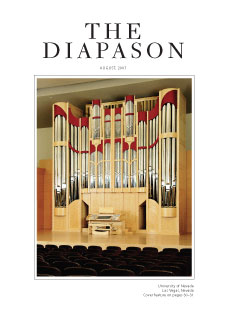
Rudolf von Beckerath Orgelbau, Hamburg, Germany: Maurine Jackson Smith Memorial Organ, University of Nevada, Las Vegas, Doc Rando Recital Hall
While the history of the organ in the territories of modern Latvia stretches back to the Middle Ages, Latvian organ music itself (as well as classical Latvian music in general) emerged only in the last quarter of the 19th century. This anomaly arose from the history of the country, which was almost always under foreign rule and, accordingly, influenced by different cultural traditions.
April 12–15, New College and All Souls College, Oxford University
Delegates from eight European countries and the United States attended a splendid conference on the organ in Tudor England, organized by Katharine Pardee. The centerpieces of the conference were the two reproduction organs built by Goetze and Gwynn, using as a basis the two soundboards of two organs found in Suffolk at Wetheringsett and Wingfield.
The Debussy of the organ, Maurice Duruflé, by the mid-20th century contributed to the musical world organ works that define Impressionistic virtuosity—and its most notable Gregorian-based Requiem, with an Impressionistic orchestral accompaniment.
How much are we missing when we indulge in expensive and noisy fun? And what are we teaching our children about priorities?
I spent a musically intense afternoon listening to the entire first book of J. S. Bach’s Das Wohltemperierte Clavier [The Well-Tempered Keyboard] played on the pedal harpsichord by Peter Watchorn.