New Organs
Levsen Organ Company, Buffalo, Iowa: First United Methodist Church, Peoria, Illinois

Levsen Organ Company, Buffalo, Iowa: First United Methodist Church, Peoria, Illinois
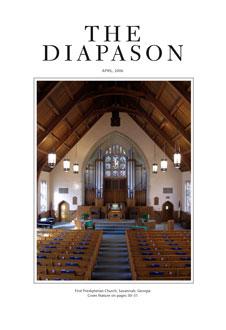
A. E. Schlueter Pipe Organ Company, Lithonia, Georgia: First Presbyterian Church, Savannah, Georgia
July 12–18, 2005
The fiftieth convention of the Organ Historical Society was itself an historical occasion and was held in an appropriately historical locale in Massachusetts, the “Old Colony,” part of which had been the center of the first permanent English settlement of colonists who came to New England in 1620.
This is the second in a series of “organ lessons” by Jan-Piet Knijff. The first, “Bruhns’s ‘Little’ E-minor,” appeared in the January 2006 issue of The Diapason, pp. 22–24. The second movement from Organ Sonata No. 2 is probably the most accessible organ piece of Paul Hindemith. Though not exactly easy, it is not terribly hard to learn and though mildly spiced with the usual Hindemithian dissonances, the piece sounds friendly enough to appeal to an “average” audience, either in church or in the concert hall.
I know I share with many organbuilders the sense that the organ is alive. Stand inside an organ chamber when the blower is off and all is silent—unliving. Turn on the blower. The reservoirs fill, the swell shutters give a little twitch, and the instrument seems to quiver expectantly, ready to sound.
We normally don’t notice air. We don’t bump into it when we walk. We don’t feel its resistance when we gesture with our hands. But we do notice it when it’s in motion—we call that wind.