In the Wind: How does it work?
How does it work?
My first car was a used 1969 Mercedes-Benz 230 that ran beautifully and was fun to drive. It had a straight six-cylinder engine with carburetor and ignition coil, and I knew exactly how everything worked. I did most of the maintenance myself including oil changes, brake pads, and a new exhaust system. It was a very simple car, and I took comfort from my familiarity with it. I could not have imagined heated mirrors, heated and ventilated seats, or hybrid power trains.
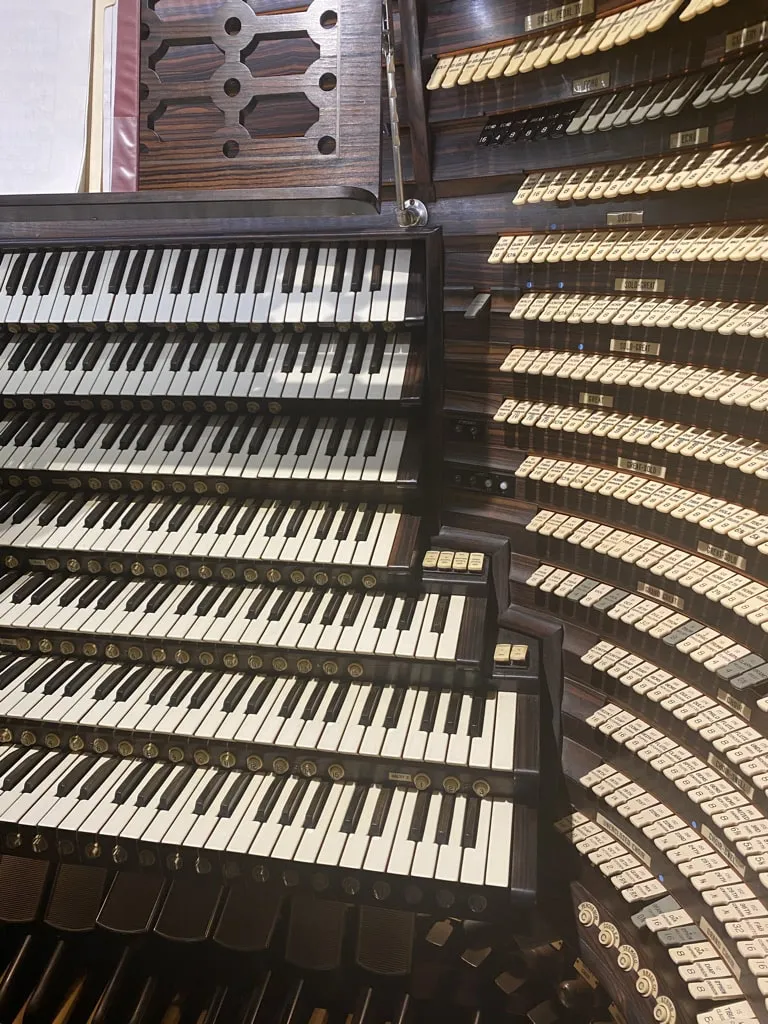
When I first encountered a remote combination action made by the Skinner Organ Company, it seemed mystical, but by watching it operate, I understood it pretty quickly. Its movements are exposed so when a certain stop will not set on a certain piston, you can zero in on the matrix and find just what’s wrong. In the mid-twentieth century, Casavant built powerful and accurate combination actions housed in their massive consoles. Although those consoles were packed full of machinery and you sometimes had to do some dismantling to get at a problem, you still could see the physical reason for a malfunction.
When I started the Bishop Organ Company in 1987, I became curator of the organs at Trinity Church and The First Church of Christ, Scientist (The Mother Church), both iconic churches in Boston. Ron Poll, brother of Robert Poll who was curator of the organ in the Mormon Tabernacle in Salt Lake City at the time, had been engaged to install the first solid-state combination and switching system at The Mother Church, and I was soon to learn that I would be doing the same at Trinity Church. I was following Jason McKown (1906–1989) in both jobs. Jason had started his career at the Skinner Organ Company, and in 1928 he worked personally with Mr. Skinner on the installation of the company’s Opus 692 at the West Medford Congregational Church in West Medford, Massachusetts.
Watching Ron Poll at work installing the SSL system at The Mother Church, Jason shook his head and said, “That’s for you young fellows.” He was over eighty and saw no need to educate himself. I have installed dozens of those systems over the years. They introduce wave after wave of new capabilities, but they sometimes have little bugs flitting about within that are difficult to track down.
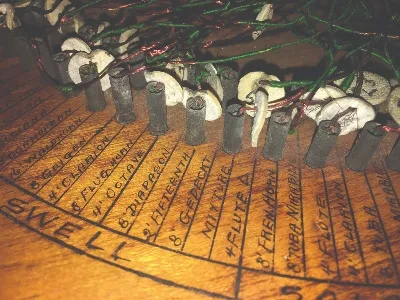
I first had organ lessons on a Holtkamp organ in Harvard Square, Cambridge, Massachusetts, that had a combination system with a setterboard behind the Swell box that comprised hundreds of toggle switches arranged in rows. The rows left-to-right were the pistons, the rows up-and-down were the stops. To set a stop on a certain piston, you simply turned on the appropriate switch. My teacher was the organist there. He used the little doughnut-shaped stickers for reinforcing the holes of notebook pages on the switches to mark his “house” piston settings. I was allowed to change pistons for my practicing and lessons if I returned the system to his house settings when I was finished. I could never have imagined multiple levels of memory, programmable crescendos, or heaven help us, MIDI playback systems. I was twelve years old at the time and couldn’t imagine much other than what I was seeing.
Hey, Google!
Wendy recently bought a new car, very snazzy and peppy, and it rides great on the highway. The larger than usual touchscreen that dominates the dashboard contains nearly all the controls, there are no buttons or switches. To change the speed of the fan, you go to the touch screen. To change the interior temperature, you go to the touchscreen, you have to take your eyes off the road frequently as you change settings while driving. To make things easier, there is a Google system embedded in the car. You can bypass the touchscreen by saying in a confident voice, “Hey, Google! Turn up the heat,” or “Hey, Google! Turn down the fan.” Our granddaughter loves it, calling out from the back seat, “Hey, Google! Are unicorns real?” She once asked enough questions in a short enough time that Google crashed and had to be rebooted.
Wendy had an experience with the car that seemed to foretell future trouble when she stopped for gas and could not get the little door over the gas cap open. We live in the age of reboot, so she started the engine and turned it off a few times, but nothing. She called the dealership. It was a Saturday, and the service department was not open, but a salesperson suggested a trick. Get out of the car, lock the doors, walk around the car with the keys in your hand like some sort of pagan ritual, unlock the doors, and voilà. He didn’t say if it mattered whether clockwise or counterclockwise. What if it had been a Sunday and the dealership was closed? Does the prompt and friendly AAA guy know that trick? The sound system sometimes freezes, but more fundamentally, Wendy reports that she must return to the dealership periodically to have the operating software reinstalled. What if it crashes when she is in the middle of nowhere?
A saga of six cars
When I started the Bishop Organ Company, I bought a full-sized van so I could cart around organ components like windchests and reservoirs. Counting that one, I have now had six big cars, the criterion being the ability to load eight-foot sheets of plywood, eight-foot pipe trays, or an eight-foot dinghy. I could also easily carry ten-foot organ pipes. Once when buying lumber, I carefully rested a twelve-foot board of rough-sawn pine on the dashboard and slid a second one on top of it, right through the windshield. The people at that lumberyard never forgot me.
Automotive technology has progressed along the way such as electronic ignition and fuel injection, but those advances have not changed the way the engine works. The spark plugs still fire to ignite the fuel in the cylinder whether there is an ignition coil or electronic ignition, and as the engine turns, it turns the transmission, and off you go.
Over nearly forty years, I drove those six cars each around 250,000 miles, roughly a million-and-a-half miles. Last summer as my second Chevrolet Suburban approached the 250,000 mark, several expensive repairs were looming, so I figured I would get through the winter and shop for a new car in the spring. Wendy’s experiences worried me. The Suburban was a 2017 model, old enough that all the controls were tactile knobs and switches. My muscle memory allowed me to change the speed of the fan or the temperature, or operate the speed control without looking, and I dreaded having to give that up, to say nothing of having an operating system that might crash or being outwitted trying to buy gas.
When I started shopping for the next car, I admitted to myself with Wendy’s encouragement that since I have retired from the heavy work of organ building, I no longer need a big vehicle. I wanted to keep three-row seating because it’s fun when we are with our grandchildren to be able to have them and their parents in the same car for an outing, so I singled out the most recommended of the larger three-row SUVs, and test drove the Jeep Grand Cherokee, the Hyundai Palisade, and the Toyota Grand Highlander. I planned to try similar models by Kia and Honda, but the Toyota won me over.
It has tactile controls for almost all the functions. Though I do not sit as high above the road as before, it feels substantial and stable. It is easy and comfortable to drive, but because it is a hybrid, when I look under the hood, I might as well be looking at a nuclear reactor. I recognize the gasoline engine, which is pushed toward one side, I see an electric motor, and I recognize reservoirs for brake and steering fluids, but there are a lot of components that I cannot identify. A diagram in the owner’s manual shows a second electric motor near the battery amidships. That motor and battery are integrated under the second row of seats. I wonder if I will ever see them.
In the Suburban, there was a switch that turned four-wheel-drive on and off. If I encountered slippery conditions, I put the transmission in neutral, flipped the switch, and knew exactly what to expect from the drive train. In the Toyota, there is an array of buttons near the shift lever on the center console for driving modes like snow and ice, mud, hills, “sporty,” and “normal” that allow the car to “decide” how to deal with the road situation. If one wheel slips, the brain sends power to a different wheel.
There are also internal computer controls to determine when I am driving with electric or gasoline power or some combination of the two. The gasoline engine runs quietly enough that I sometimes cannot tell which power I am using. Colorful animated displays on the dashboard imply what is going on, and I had questions about how those systems work. Sitting at the salesman’s desk, I asked a lot of questions that he could not answer. Wendy recognized my frustration, quietly dialed my son Michael’s phone, and handed her phone to me. Mike, who has much more current automotive knowledge than I, chuckled and told me that cars have been built with this technology for more than twenty years, and you just need to believe it. In other words, shut up and drive.
They’ve gone about as far as they can go.
In the Rogers and Hammerstein musical Oklahoma, Will Parker returns from a trip to Kansas City and regales the others singing, “Everything’s up to date in Kansas City, they’ve gone about as far as they can go. . . . They went and built a skyscraper seven stories high, that’s about as high as a building ought to go.” Just how far are they going to go with the integration of Artificial Intelligence (AI) in the operating systems of our cars or our pipe organs?
My 2017 Suburban had hints of AI. The driver’s seat buzzed when the car got too close to something else, especially another vehicle. It was amusing, a heavy vibration under my rear end like a duck quacking, clearly audible anywhere in the car. If the car wandered toward the lines at the edge of a roadway or lane, the steering wheel gave a little twitch, and if the car thought my eyes had been off the road for long enough, it gave a little warning. Those functions were driven by sensors that even knew enough to sign off when disabled. When driving in slush or snow, I’d see “Side Sensors Temporarily Unavailable” flash across the dashboard, as the muck on the road glopped onto the sensors. Wendy’s car and my new Toyota have lots of those functions, but neither is using AI to the extent necessary for self-driving cars. They are using reactive AI.
On January 26, 2026, Peter Lyon published an article in Forbes magazine with the title “The Dark Side of AI Can Take Over Your Car.” He starts by defining reactive AI, which “respond[s] to driver commands or sensor inputs like how adaptive cruise control reacts to traffic, lane-keeping assists respond to road markings, and voice assistants respond to spoken prompts. These systems are narrow, rule-based, and heavily constrained by software logic written in advance.”
Lyon goes on to say that the next advances will be predictive AI, in which the data collected by “cameras, radar, lidar, GPS, driver behavior patterns, and cloud-based learning” will equip vehicles to “predict traffic flow, weather risks, driver fatigue, or even emotional state.” The unanswered question is at what point does this challenge the traditional understanding of “human control and responsibility.” Tomorrow’s cars could detect driver impairment and refuse the commands of the driver. I can see the value of automotive technology that enhances highway safety or predicts vehicle maintenance issues, but I am not looking forward to driving a car that assesses my emotional state. What would be next, a car broadcasting information about a driver’s emotional state to the state police? I guess if a driver is impaired enough that their car chooses to turn them in, have they forfeited their right to privacy? Who would set that standard? The manufacturers? The police? The government?
At least one M. P. Möller organ that I maintained included some functions that kept organists from using inappropriate registrations, the machine informing the operator, maybe a precursor to automotive AI instructing the driver. An electro-mechanical switch was included that disabled the Great Mixture if the 8′ Principal was not drawn. Another switch disabled tremolos and Voix Celestes if mixtures were drawn. That is pretty good advice for a beginning organist, but what if a musician wanted to draw a mixture alone for a certain effect, and what if an organ tuner wanted to tune the Mixture to the 4′ Octave? I discovered that I had to open the console and disable that switch to tune the mixture, reactive AI from about 1961.
If our cars could judge our emotional state or whether we are impaired, how might this apply to our organ consoles? The Widor again? The last time your accuracy rate was 82.7%. Don’t play it faster than you can repeat the sixteenth-note chords in the left hand, Widor didn’t.
Well done, good and faithful servants.
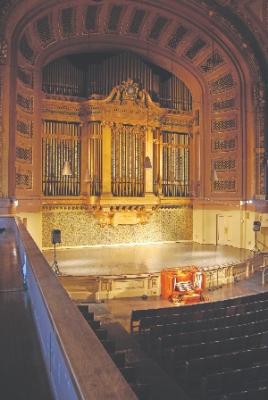
Martin Jean, the director of the Yale University Institute of Sacred Music, has just announced the retirement of Yale organ curators Nicholas Thompson-Allen and Joseph Dzeda, to become effective in 2028. Nick’s father Aubrey Thompson-Allen had been appointed curator at Yale in 1952. Joe and Nick both joined Aubrey’s company around 1970 and became co-curators when Aubrey retired in 1973. Joe and Nick have been strong advocates for all of Yale’s pipe organs for over fifty years, a terrific roster of instruments by Holtkamp, Beckerath, Taylor & Boody, Skinner, and the magnificent Newberry Organ, the huge orchestral instrument in Woolsey Hall. They have also taken care of the exceptional Aeolian-Skinner, affectionately known as “Sister Soosie,” at Trinity Church on the Green in New Haven, Connecticut, along with many other instruments in their area.
Joe and Nick’s work on all the organs they have cared for, repaired, relocated, or restored has been informed by their deep respect for the intentions of their original builders, especially the heritage of Ernest Skinner. Their workmanship, diligence, and philosophy are both impeccable and impressive.
Well-known university organs are typically the most heavily used anywhere as students prepare for required performances, and the Newberry organ is a leader in that class, putting huge demands on the skills and productivity of the curators. Remember that the marvelous Fisk organ at Old West Church in Boston had to be restored after only twenty-five years because of the constant use it received from Yuko Hayashi’s students at the New England Conservatory of Music. Not only are the blowers of the Newberry organ running long and late every day, but the students at Yale are sophisticated musicians who demand much of the organs as they prepare the most complex pieces in the repertory. Joe and Nick have approached their work with grace, dignity, and humor, serving as strong positive examples for generations of student organists, scores of whom have left Yale to embark on flourishing careers.
I have been fortunate to collaborate with them and to call them friends. I am grateful to them for their tireless work setting the highest example of skill and understanding as they preserve the organs under their care, and I wish them the happiest of well-earned retirements.