New Organs
Mid-Atlantic Organ Company, Charlotte, North Carolina:
Covenant Presbyterian Church, Charlotte, North Carolina

Mid-Atlantic Organ Company, Charlotte, North Carolina:
Covenant Presbyterian Church, Charlotte, North Carolina
Dobson Pipe Organ Builders, Lake City, Iowa, Op. 79, 2004
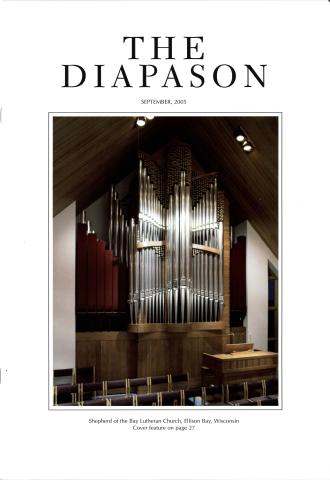
Shepherd of the Bay Lutheran Church, Ellison Bay, Wisconsin
Part two of two
The balance of this article will explore some of the methods used by Schoenstein in designing symphonic organs.
Part one of two
I submit that the time is past due to pick up the
traces where the great innovators of organbuilding left off and continue the
development of the organ’s expressive qualities.
.” In my nearly half-century of commissioning new music, much of the time I have been the recipient of extraordinary generosity: most of my composers have donated their music, while others have asked for only modest fees.
We are not a small sect of aficionados preserving antique organs to satisfy our own interests. Rather, we recognize the beauty and historicity of these instruments for their relevance to modern worship and modern music-making as well as for their antiquity.
May 23-30, 2005, New Brunswick, New Jersey
Although advertised as an eight-day event,
the third biennial symposium sponsored by the American Organ Archives of the
Organ Historical Society (this year with co-host, the Music Department of the
Mason Gross School of the Arts, Rutgers University), consisted of four days of
organ recitals, lectures, and panel discussions. The remainder of the eight
days gave participants a generous amount of time to visit the Archives in
Princeton, a short drive from New Brunswick.